Not only are prices rising, but the performance of entry-level mobile phones has also regressed in the past few years.
As is well known, the price hike of storage chips has exerted a significant negative impact on the current smartphone market.
Not long ago, we at 3eLife mentioned in the article "Can You Buy a Flagship Phone for Two to Three Thousand Yuan? Such a Good Deal Will No Longer Exist" that those pure performance-focused smartphones with top-tier specs and affordable prices in the past are destined to either lower their product positioning or cease further updates in the future.
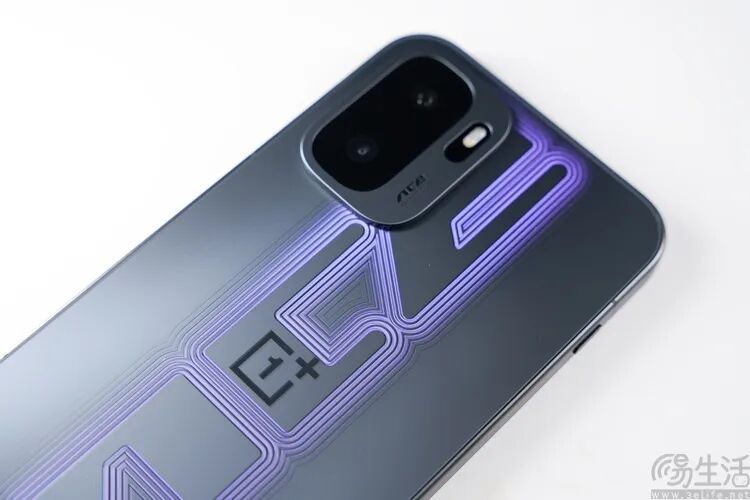
Although such models may be abandoned by manufacturers due to their "low profitability", they are still priced in the mid-to-high range of two to three thousand yuan. This price point means that these models are not even the most "affected" segment in this price surge.
It is the entry-level models that performance enthusiasts and mobile gamers pay little attention to that have become the biggest "victims" of this price surge.

In fact, this statement may not be entirely accurate, as these models may not even qualify as "victims". After all, even from the perspective of chips, they may have long been abandoned by the entire industry.
An Exposed New Chip with Some Unusual Characteristics
Recently, NotebookCheck revealed what it claims to be exclusive product documentation, exposing an unannounced Qualcomm Snapdragon mobile platform that has not yet been officially released.
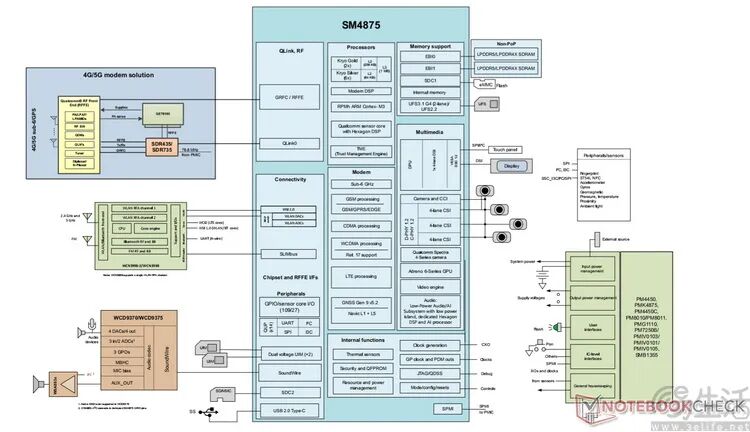
Relevant documentation shows that the platform's internal codename is "SM4875". Considering that the current Snapdragon 4 Gen5 has an internal codename of "SM4850", and the Snapdragon 4 Gen1 has an internal codename of SM4375, this new chip is likely the next-generation Snapdragon 4 Gen6.
So what improvements does this new Snapdragon 4-series product bring? Currently exposed information shows that it still adopts the same TSMC 4nm process as its predecessor and uses the same CPU architecture. Although the specific models of the GPU and ISP have not been revealed, their basic generation has not been upgraded either.
In fact, based on currently available information, the obvious upgrades of Snapdragon 4 Gen6 compared to previous generations are almost entirely concentrated on a faster 5G baseband and more advanced Wi-Fi and Bluetooth modules. No significant changes can be seen in the core performance aspects.
Some people might say that this is not surprising. After all, with such high storage costs now, entry-level platforms must prioritize cost savings first, and it is normal not to make major performance changes.
This Is Not the Case: The Performance of Entry-Level Phones Has Been "Locked" for Years
What would you think if we told you that the stagnation of entry-level platform performance is not a recent phenomenon of one or two years, but has lasted for at least four years or even longer?
Based on public information, we have compiled a comparison table of all Qualcomm models from the first-generation Snapdragon 4 to the latest exposed generation.
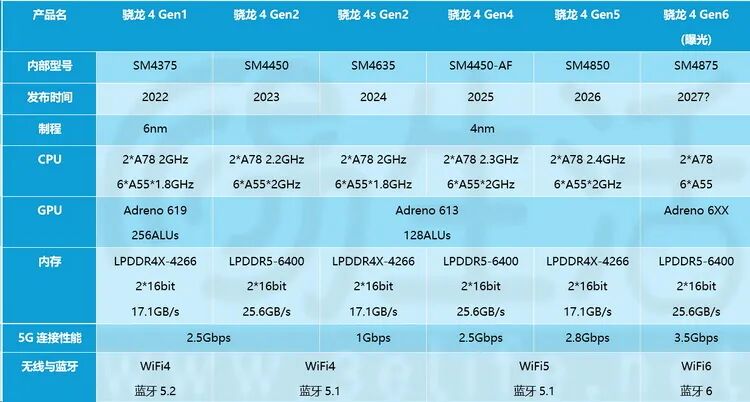
As we can see, since the first generation launched in 2022, the entire Snapdragon 4 series has not updated its CPU and GPU architectures. Its CPU performance has barely improved, and the GPU specifications have even decreased instead of increasing. Coupled with the fluctuating memory frequency, it presents a product planning approach that can be described as "giving up on progress".
However, this phenomenon is not unique to Qualcomm. We have also compiled information on MediaTek's products in the corresponding positioning, namely the MT6733/MT6735 family.
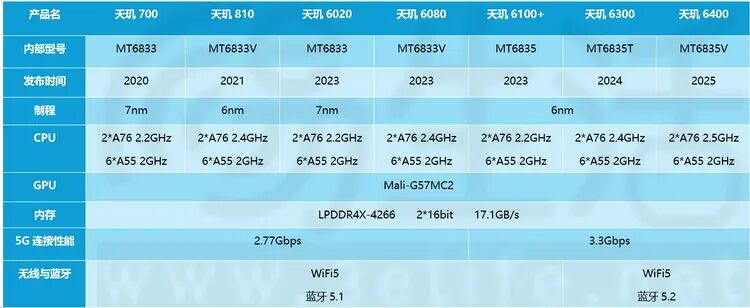
The results show that MediaTek's situation is even more severe than Qualcomm's. For example, Dimensity 6020/Dimensity 6080 are just renamed versions of Dimensity 700/Dimensity 810. The subsequent three generations from Dimensity 6100+ to Dimensity 6400 are only minor overclocks based on a single design. Moreover, MediaTek's entry-level platforms in the past six years have never upgraded their memory controllers, and have always used the same design as the 2020 Dimensity 700.
In fact, from 2020 to 2025, the multi-core CPU performance of MediaTek's flagship SoCs has increased by more than 160%. However, in the entry-level market, this figure is at most 5%. In other words, within the same time span, the technological progress speed of higher-priced flagship chips is more than 30 times that of entry-level products.
What Consequences Will This Bring? Fragmentation May Be the Least of the Problems
What kind of consequences will arise when more expensive products continue to advance rapidly while the cheapest entry-level products remain technologically stagnant?

First of all, from the perspective of entry-level smartphone users, even without this storage chip price hike, the objective cost-effectiveness of such models has actually been declining over the years. Since the performance requirements of software itself cannot stop increasing, when entry-level SoCs never improve, the "relative smoothness" that users can actually experience will inevitably become slower and slower.
Secondly, this stagnation of entry-level products will actually harm users of flagship products as well. The reason is simple: app developers cannot completely ignore the adaptation for entry-level models. But in this case, on the one hand, the huge performance gap between flagship and entry-level platforms will inevitably consume more of developers' energy on adaptation work, potentially reducing code quality.

On the other hand, this will most likely make developers "restrained", preventing them from fully optimizing their apps for flagship SoCs. As a result, not only will entry-level model users experience reduced performance, but flagship phone users will also be unable to fully utilize the performance they paid for. This creates a "lose-lose" situation for both developers and users.
This article is from the WeChat Official Account "3eLife" (ID: IT-3eLife), authored by 3eJun, and published with authorization from 36Kr.