Enterprises are starting to reselect platforms for AI, and it's time to gain a new understanding of Feishu.
Text|CHEN Xi
In 2026, Feishu witnessed a series of noteworthy shifts.
According to a report by *Caijing*, Feishu's Annual Recurring Revenue (ARR) saw a year-over-year growth of over 100% by the end of the second quarter, marking its fastest commercialization pace on record. As previously reported by 36Kr, more than 90% of Feishu's new customers since 2026 have simultaneously purchased Feishu AI products. Industry insiders estimate that if the current growth momentum continues, Feishu is expected to climb to the top spot in China's enterprise collaboration market by revenue scale within 2026.
Parallel to the accelerated commercialization is the reshaping of Feishu's customer structure. Over the past two years, its customer base has expanded from the internet, new energy vehicle, and hard technology sectors to traditional industries such as consumer retail, manufacturing, and energy, further extending into regional industrial markets. 36Kr learned that since this year, enterprises including Xijiade, Guming, Yangang Yitouniu, and Xtep have successively migrated their office platforms to Feishu.
This round of customer migration is more than just stock substitution between different collaboration platforms. As AI begins to permeate knowledge management, quality inspection, store operations, marketing production, and business analysis, enterprises are reselecting their digital foundations: whether AI can be built on a unified system of knowledge, data, processes, and permissions has emerged as a new core selection criterion.
This also opens up new incremental space for enterprise software. In the past, collaboration software was mainly funded by administrative and IT budgets; as AI starts to improve quality inspection accuracy, store efficiency, and production costs, it may further gain access to the budgets of business and production departments.
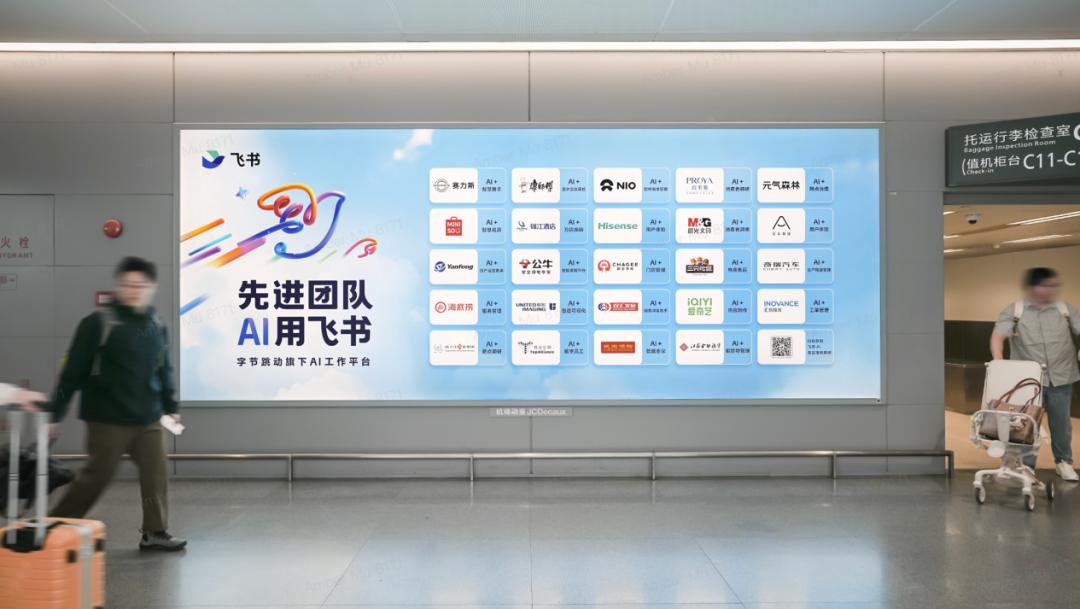
With its customer boundaries continuously expanding outward, Feishu has achieved high penetration density among leading enterprises in some industries. According to Feishu's disclosures, all six listed tea beverage enterprises in China are now using Feishu; 9 out of the top 10 listed automakers by market capitalization in 2025 have chosen Feishu; and 8 of the top 10 embodied intelligence enterprises by sales volume are also Feishu customers.
If the previous stage of enterprise collaboration software competition centered on user scale, organizational coverage, and management entry points, a new set of competitive standards is taking shape in the AI era: whether the platform can enable AI to integrate into real business operations, replicate the practices validated by leading enterprises across more industries, and serve as the underlying environment for enterprises to deploy AI.
Judging by this standard, the ARR growth, rising AI procurement rate, cross-industry customer migration, and concentration of leading customers collectively point to one fact: Feishu is no longer just a collaboration product that connects employees, but has begun to evolve into a platform that bridges AI and enterprise business operations.
Three Breakthroughs: How Feishu Arrived at the Starting Point of Becoming an AI Business Platform
When Feishu first entered the enterprise collaboration market, it stood out as an industry challenger with distinct product characteristics.
Its early customers were mainly concentrated in internet, technology, and consumer startup enterprises. These companies have a high proportion of knowledge workers, who are more sensitive to information transparency, cross-departmental collaboration, and organizational efficiency. Feishu built its initial product recognition through its meeting, online document, and collaboration experience, and was therefore long regarded by the public as an office platform more suitable for internet companies.
Feishu's first breakthrough was expanding from digital-native enterprises to new energy vehicle makers, as well as rapidly growing consumer and hardware enterprises. Automotive companies such as Li Auto, NIO, and XPENG needed to connect R&D, supply chain, production delivery, and sales services; enterprises like Anker Innovations, Pop Mart, and Genki Forest spanned product development, supply chain, and online-offline sales channels.
Compared with internet companies, these enterprises have longer business chains and more collaboration entities, imposing higher requirements on cross-departmental, cross-regional, and cross-system collaboration. Feishu thus began to extend from knowledge collaboration within offices to real business chains such as R&D, supply chain, and production delivery.
The second breakthrough took place in traditional industries including manufacturing, energy, and retail. Since 2024, enterprises such as Pang Donglai, Meiyijia, Shuanghui, MINISO, Dongming Petrochemical, Bull, Yadea, and Cha Baidao have successively become Feishu customers. Feishu's application scenarios further expanded from offices to frontline sites such as factories, retail stores, and supply chains.
The challenges faced by these enterprises are no longer limited to communication efficiency, but the operational efficiency of complex organizations. Large retail enterprises need to connect headquarters, regional branches, and a large number of stores; manufacturing enterprises need to integrate R&D, production, supply chain, and quality systems; energy enterprises pay more attention to permissions, security, and organizational governance.
What Feishu needs to support has gradually expanded from interpersonal collaboration to data, processes, and business rules in organizational operations.
The third breakthrough is expanding from national leading enterprises to regional industrial clusters. As its customer map covers regions including Jiangsu-Zhejiang, Sichuan-Chongqing, and Henan, Feishu has begun to enter more regional industries, and is trying to replicate the validated product capabilities and industry solutions from leading customers to more enterprises.
At this point, Feishu's expansion path over the past few years has become increasingly clear: internet enterprises helped it build product reputation, emerging industries validated its complex organizational capabilities, traditional industries broadened its business boundaries, and regional markets promoted the further replication of these capabilities.
Feishu's customer acquisition logic has also evolved accordingly: from winning a small number of benchmark customers through product experience, to forming demonstration effects through industry practices and AI implementation cases.
However, for enterprise software, what truly matters is not how many enterprises it enters, but how many core business segments of these enterprises it can penetrate. In the past, this meant whether the platform could connect R&D, manufacturing, stores, and supply chains; today, it means whether AI can access information, understand tasks, and execute actions in these segments.
This is also the real value left by the three breakthroughs. The internet, automotive, manufacturing, and retail industries have not only brought a batch of customers, but also a set of knowledge, data, processes, and permission systems that have been running in complex organizations. In the past, they were mainly used for interpersonal collaboration; in the AI era, they form the underlying environment for AI to understand organizations, participate in business operations, and execute tasks.
The organizational capabilities Feishu accumulated in the past have thus gained new value.
AI Integrates into Business Flows, Enterprises Begin to Re-select Platforms
The cross-industry expansion of Feishu's customer structure explains the breadth of its growth; the integration of AI into business processes further changes the depth of its commercialization.
In the previous era, when enterprises chose collaboration platforms, they mainly focused on the efficiency of communication, approval, and information flow. The differences between products were more reflected in office experience and organizational management capabilities.
Entering the AI era, enterprises have put forward new requirements: the platform should not only help employees write documents, summarize meetings, and find information, but also enable AI to enter business segments such as quality inspection, store operations, marketing production, and business analysis, and ultimately improve business performance.
The organizational adjustment of Neobio provides a side sample. According to Neobio, earlier this year, former CTO XU Lei was transferred to the position of CGO (Chief Growth Officer), whose responsibilities extended from digital system construction to promoting AI-driven efficiency improvement reforms and exploring business growth opportunities. This change means that AI is moving beyond mere technical deployment and entering the business agenda of enterprise management.
However, the closer AI gets to real business operations, the higher the difficulty of implementation. AI for personal use only needs to understand instructions and generate answers; AI undertaking enterprise tasks must accurately find internal information, identify the operation boundaries of different roles, invoke relevant tools, and deliver results to subsequent processes.
Therefore, whether the model is "intelligent enough" is only the starting point. The more complex question is: can it understand the organization and stably complete tasks in accordance with enterprise rules?
In July 2025, Feishu released the AI Application Maturity Model, dividing AI applications into M1 (Proof of Concept), M2 (Early Adoption), M3 (Production Ready), and M4 (Full Deployment). M1 and M2 mainly verify whether AI "can be used", while M3 and M4 further examine accuracy, permissions, security, stability, and whether AI can operate on a large scale within the organization. This framework attempts to answer not whether an enterprise "has AI", but whether AI truly meets the conditions for integration into production environments. To move AI from M1 and M2 to M3 and M4, model capabilities alone are not sufficient, and it is also necessary to connect the enterprise's knowledge, data, processes, and permission systems.
Feishu's collaboration products have precisely precipitated these organizational relationships: messages, documents, and knowledge bases store enterprise communications and knowledge, multidimensional spreadsheets carry business data, and calendars, processes, and organizational permissions connect personnel, tasks, and operation boundaries. In the past, these products mainly helped employees collaborate; after the emergence of Agents, they can also provide AI with the environment required to understand work, invoke capabilities, and participate in processes.
On this basis, Feishu has formed two Agent paths: native and open. Feishu aily enables enterprises to build native Agents using their own knowledge, business data, and processes; Feishu CLI and related open interfaces allow external Agents to invoke capabilities such as messages, documents, calendars, and multidimensional spreadsheets within the authorized scope.
During the "lobster farming" boom at the beginning of the year, many developers integrated OpenClaw with Feishu, which also reflects developers' attention to open Agent entry points. The combination of "native Agent + open interface" enables Feishu to not only host AI applications developed internally by enterprises, but also connect to the external Agent ecosystem.
However, the integration of AI into enterprises requires not only technology and platforms, but also people who truly understand business scenarios.
In addition to providing product capabilities, Feishu also uses mechanisms such as the "AI Pioneer" program to help enterprises identify and cultivate AI talents from frontline business teams, transforming AI construction from a special project led by the IT department into an organizational action with the participation of business personnel. The value of this mechanism lies in the fact that AI applications are more likely to be generated from specific practical problems, rather than remaining at the level of abstract technical demonstrations.
At Dongfeng Cummins, AI is applied to visual quality inspection of engine connecting rods, with the system's recognition accuracy remaining stably above 99.5%, and the inspection cost per image is about 0.005 yuan. At MINISO, AI is integrated into product identification, display inspection, and store patrol: product identification can be completed within seconds, and the efficiency of smart store patrol has increased by 51 times.
These cases collectively point to a change: the way enterprises evaluate AI is shifting from "whether a model is connected" to "whether business indicators are improved". When the effectiveness of AI can be measured by quality inspection accuracy, operational efficiency, and actual costs, the budgets accessible to enterprise software may further extend from administrative and IT departments to business and production departments.
As a result, AI is no longer just an added function, but has begun to become a reason for enterprises to choose platforms, expand procurement scope, and drive subsequent incremental purchases.
As More and More Enterprises Use AI in Feishu, "Feishu Penetration" Begins to Generate Compound Returns
With Feishu achieving high leading customer coverage in industries such as automobiles, tea beverages, large models, and embodied intelligence, "Feishu Penetration" has become an indicator to observe its industry penetration level.
"Feishu Penetration" is not equivalent to the overall market share, nor does it mean that relevant enterprises are using Feishu in all scenarios. However, the cost for an enterprise to replace its core collaboration platform is usually much higher than adding a single-point tool.
When multiple leading enterprises in an industry adopt the same platform in a concentrated manner, it at least indicates that this set of products has been tested in a number of complex organizations.
The first layer of compound returns comes from product capabilities. Large enterprises have more organizational levels and longer business chains, imposing higher requirements on security, permissions, process governance, and system interconnection. The complex demands they put forward can in turn drive the platform to improve its organizational governance and business collaboration capabilities.
Leading customers are therefore not just a source of revenue, but also participants in defining the problems that products need to solve. When the special needs of a single customer are abstracted into general capabilities, Feishu does not need to start from scratch again when serving the next similar enterprise.
The second layer of compound returns comes from scenario accumulation. The problems encountered by automotive enterprises in R&D collaboration, supply chain management, and sales services often have industry commonalities; the practices of retail enterprises in store patrol, employee training, and business analysis can also provide references for other chain brands.
When similar problems are repeatedly verified across multiple customers, the solutions for individual projects can be precipitated into industry methodologies. What Feishu can provide is no longer just product features, but also an understanding of industry problems and AI implementation paths.
The third layer of compound returns comes from industry trust. The replacement cost of enterprise collaboration platforms is relatively high, and the practices of leading enterprises can provide selection references for peers. When a solution has been running in the complex environments of similar enterprises, the verification cost and decision-making risk for latecomers will also be reduced accordingly.
The way the platform acquires customers may also shift from persuading them one by one to being driven by industry cases and peer experience.
The three layers of compound returns form an expansion path: complex customers drive product maturity, business practices are precipitated into industry methodologies, and leading coverage reduces the decision-making cost of latecomers. As a result, Feishu can move from competing for individual benchmark customers to forming customer clusters in an industry, and replicate the validated capabilities along the industrial chain and to regional markets.
Of course, "Feishu Penetration" itself does not mean that the competition is over, but it indicates that Feishu has entered the competitive range of industry leaders. In the next stage, the competition will no longer focus on who has more benchmark customers, but on who can drive continuous incremental purchases, precipitate replicable industry solutions, and scale up these capabilities to more industries, regional markets, and mid-sized enterprises.
The significance of Feishu's growth is therefore more than just a series of ranking improvements in the enterprise software market. It reflects a deeper industrial trend: AI is evolving from an office function into an organizational capability, and collaboration platforms are transforming from tools that connect people into business platforms that host AI operations.
This may be the real reason why we need to re-understand Feishu today.