Japanese automakers are collectively learning from China
"I think, we are losing to China."
On July 19, NHK of Japan aired a program that explored Toyota's R&D base. When asked about his views on the company, a Toyota engineer threw out this unsparing "sharp comment".
Akio Toyoda, Chairman and former President of Toyota Motor Corporation (Chairman means Chairman of the Board, President means CEO), also admitted frankly in the program:
"There is a strong sense of crisis within the company. We must abandon the arrogant idea of underestimating Chinese competitors. Clinging to the advantages accumulated in the past and subjectively assuming that we can maintain a leading position forever is the biggest risk."
If we turn back the clock ten years or even five years, it would be almost unbelievable that Japanese automakers could be defeated by their Chinese counterparts. But today, Japanese auto industry players not only openly admit their inferiority, but even start to collectively "learn from" Chinese automakers.
In the past three to four months, this cross-border "learning from masters" has reached a climax.
In March, Toyota launched its new energy flagship model bZ7, whose appearance and dimensions are highly similar to another model, Hyper HT A800, from its joint venture partner GAC. It is also equipped with Huawei's electric drive system, HarmonyOS cockpit, and Momenta's advanced intelligent driving system.
Yuji Nakajima, Executive Vice President of Toyota, even publicly stated: "The top priority at this stage is to procure complete vehicles from our partners."
In April, Toshihiro Mibe, President of Honda, went to Guangzhou to visit Chinese counterparts such as GAC; he also traveled to Shanghai to visit local vehicle factories and battery companies, and said to his entourage, "Faced with such strength, we have no chance of winning."
A month later, Honda, which regards technology as its foundation, announced that it would adopt the chassis developed by Chinese manufacturers.
In April, Nissan launched its new energy SUV model NX8, which fights alongside the N6 and N7 released at the end of last year. All three vehicles are built on the Tianyan vehicle platform of Nissan's joint venture partner Dongfeng, with their three core electric systems, cockpits, and intelligent driving systems all sourced from Chinese supply chains.
At the end of June, Ivan Espinosa, Global CEO of Nissan, said in an interview that in terms of technology, cost competitiveness, and R&D speed, China is setting the future industry standards.
"We will learn from China and promote this model to all our global businesses." he said.
This scene made Japan's well-known business media "Nikkei Sangyo Shimbun" sigh:
The Japanese automotive industry has fallen from a leader to a follower.
It also exposed an awkward fact: the popular Japanese-brand electric vehicles in China today are essentially Chinese cars "inside".
The three major Japanese automakers that once swept Europe and the United States and were at their peak, after experiencing the severe "torture" of the global market, finally stopped being stubborn, admitted that they are far behind their Chinese counterparts, and respected the "little brothers" in the fuel vehicle era as their teachers in the new energy era.
Japanese automakers have begun to turn to Chinese automakers for "reinforcements".
1
In the past 30 years, the evolution of Japanese automakers' attitudes towards Chinese automakers can be summarized as: Laugh at Chinese cars, doubt Chinese cars, and become Chinese cars.
Toyota, Honda, and Nissan all entered China through joint ventures at the turn of the century. At that time, Chinese automakers were not only far behind in technology, but also very primitive in supply chain, sales, service, management and other aspects, and could not be compared with the world-famous Japanese automakers.
It can be said that when Toyota and its peers came to China, they naturally carried the implication of "exchanging technology for market"; product R&D of joint ventures was basically controlled by the Japanese side.
At this stage, Japanese corporate executives almost did not hide their ridicule of their Chinese partners, and their words were so straightforward and sharp that they made people blush.
During the 2003 Tokyo Motor Show, then Nissan CEO Carlos Ghosn told The Wall Street Journal directly that foreign automakers provide technology and expertise to create value for joint venture factories; by contrast, current Chinese partners contribute almost nothing to the actual operation and management of joint ventures except for providing low-cost labor and sales channels.
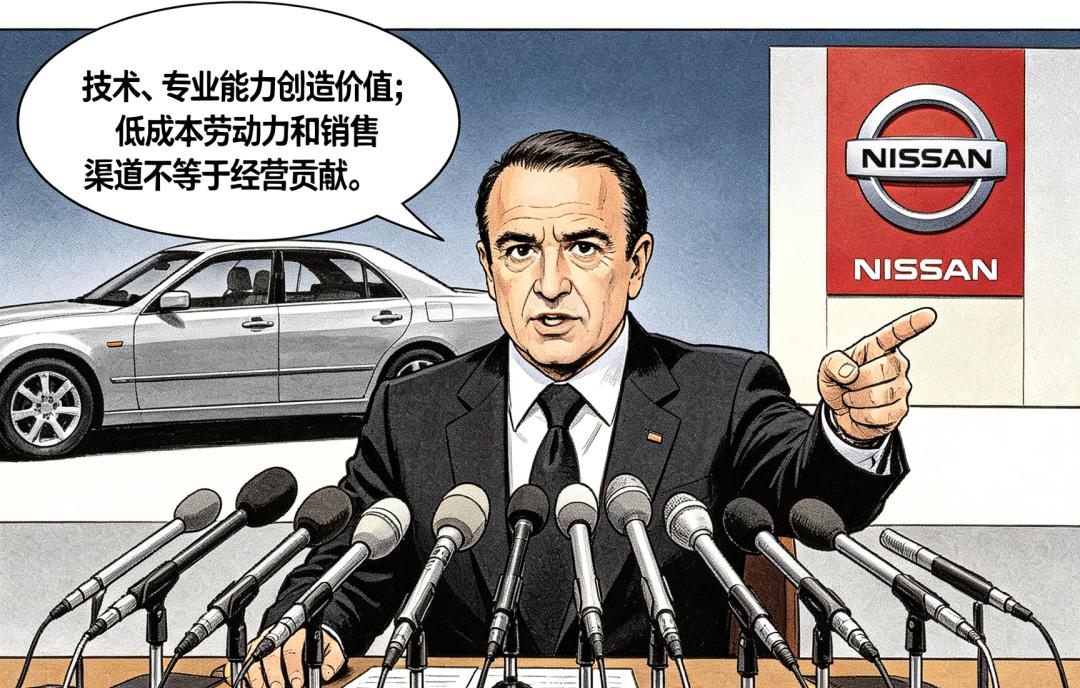
Image source: AI generated
Ghosn also said that the Chinese side must create more value in the future. As soon as this remark came out, the domestic automotive industry was in an uproar, but no enterprise could refute it forcefully.
Toyota also holds a similar view.
In 2008, Nikkei Sangyo Shimbun interviewed several engineers from Toyota's Powertrain R&D Division. They generally believed that China's complete vehicle manufacturing is just the assembly of parts; if the engines and transmissions supplied by Japanese brands are removed, it would be difficult to produce mass-produced passenger cars that meet qualified standards.
To be fair, this stimulating "radical view" is not nonsense.
Japanese automakers have decades of accumulation in the field of fuel vehicles, and their comprehensive strength is indeed beyond the reach of Chinese automakers in those days. Especially for engines, many domestic brands' self-developed engines have high fuel consumption and weak power, and still need to rely on Japanese manufacturers for long-term supply.
2
After 2016, the Chinese automotive market entered the new energy era, and local automakers began to collectively overtake on curves. At this stage, Japanese automakers' attitudes gradually changed from "ridicule" to "doubt".
In the business community, executives of companies such as Toyota publicly questioned that electric vehicles may bring more pollution.
At the end of 2020, Akio Toyoda, at a media event of the Japan Automobile Manufacturers Association (of which he is also the chairman), said that in a country like Japan where most of the electricity is obtained by burning coal and natural gas, electric vehicles may not necessarily be environmentally friendly.
"The more electric vehicles we make, the worse the carbon dioxide emissions will be... Do politicians know this when they call for phasing out all gasoline cars?" he said.
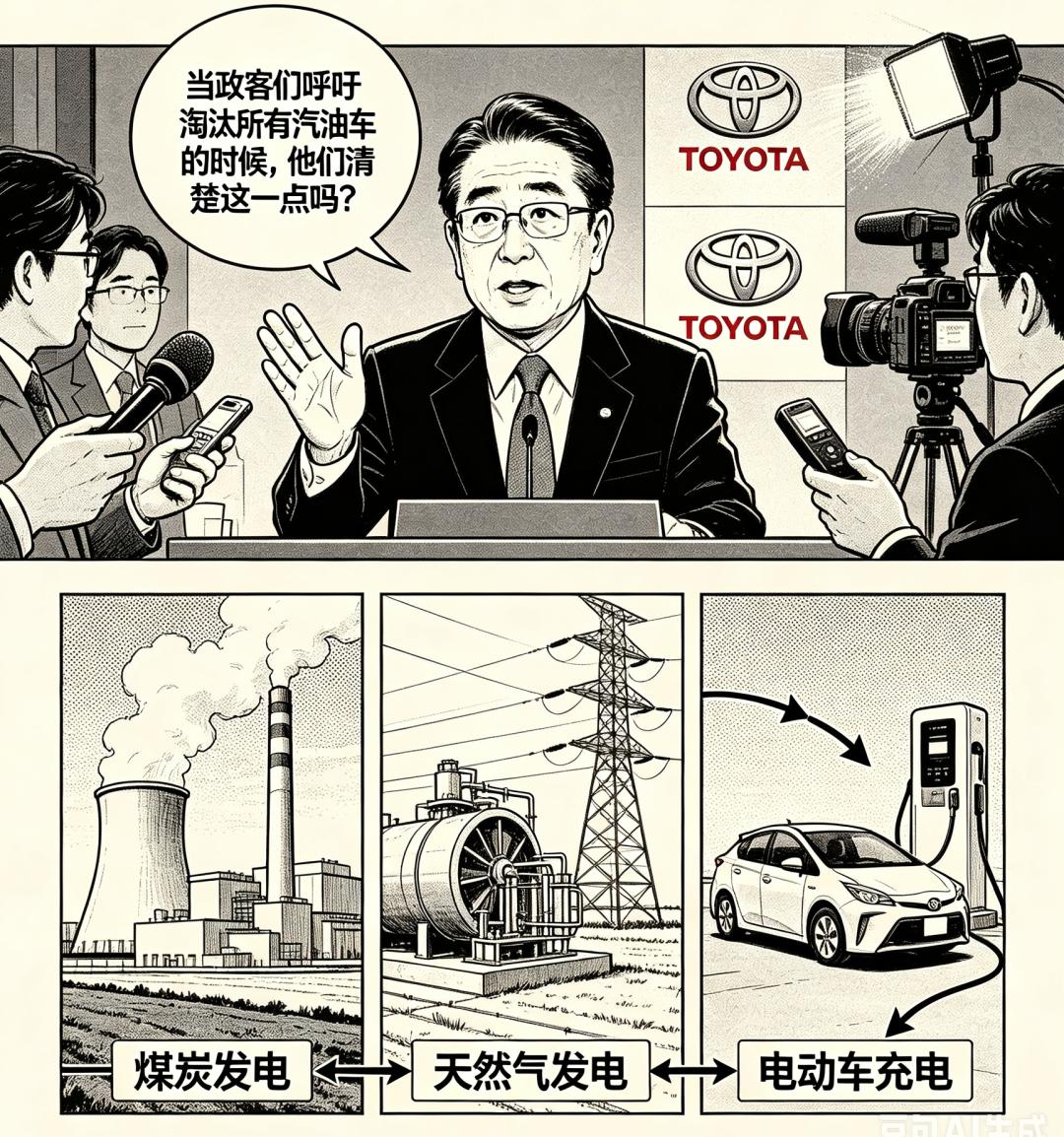
Image source: AI generated
In other words, although electric vehicles are good, they are not suitable for Japan's "national conditions".
By 2023, the electrification trend of the global automotive industry has become more than obvious. But Gill Pratt, Toyota's chief scientist, still supported hybrid vehicles at the Davos Forum.
He said that if the total amount of lithium resources is fixed, you can either make one long-range pure electric vehicle or produce a large number of hybrid vehicles equipped with small-capacity batteries. Allocating limited lithium resources to more vehicles can achieve greater overall carbon emission reduction.
In the same year, Honda also made a far-reaching judgment.
Compared with Toyota, Honda has a more positive attitude towards electric vehicles, and has evaluated and actually measured GAC's pure electric chassis. But in the end, Toyota decided to insist on self-developing the e:N pure electric architecture instead of directly adopting the solution from its Chinese partner.
Around the same time, Izumi Kawanishi, President of Sony Honda Mobility (a pure electric vehicle company jointly owned by the two giants), said that the development momentum of Chinese electric vehicles is strong, but in terms of the application of on-board information technology, it feels like just arranging smartphone icons, without bringing any surprises at the technical level.
In the following three years, the e:N series models were launched one after another, but their sales remained sluggish for a long time, directly dragging down Honda's electrification transformation; while the sales of GAC's new energy models rose steadily. If Honda had chosen to join hands with GAC at the beginning, it might have avoided this costly setback.
Nissan's attitude is more cautious.
During the Shanghai Auto Show in April 2023, Ashwani Gupta, COO of Nissan, said that the difference between Chinese brands and joint venture brands is very small, "Nissan is not going to catch up with Chinese electric vehicle brands, but will focus on product differentiation."
He said that the company will maintain the competitiveness of fuel vehicles and e-POWER hybrids, while accelerating the launch of pure electric vehicles to compete on the same stage with local Chinese automakers.
From today's perspective, the above remarks are very "absurd", but they also reflect the arrogance and sluggishness of the Japanese automotive industry towards electrification when the new energy era is surging.
In order to cater to the tastes of the audience, some Japanese media deliberately amplified the negative news about new energy vehicles in other countries, which further exacerbated the strategic misjudgment of Japanese automakers.
In the past few years, the so-called true and false news such as "electric vehicle graveyard", "battery pollution", "collision fire", and "thermal power generation polluting the environment" have been common in Japanese public opinion. Under the long-term influence of one-sided information, the Japanese public has a cold attitude towards new energy vehicles, and automakers are unwilling to make serious transformations.
Affected by multiple factors, Japanese automakers are trapped in place by "arrogance and prejudice".
Japanese automakers obtained a large number of patents related to new energy vehicles very early, and have rich technical reserves, but so far they have not been able to launch a new energy vehicle model with global competitiveness, and market cultivation is out of the question. The gap with Chinese automakers is widening.
Public data shows that in the first half of this year, new energy vehicles accounted for half of China's new car sales; while in Japan, this figure is only 4%.
3
Japanese automakers, who thought they had won all the arguments, eventually lost in the face of continuously plummeting sales.
In 2025, the global sales of Japanese cars were surpassed by Chinese automakers for the first time. This is also the first time the Japanese automotive industry has lost its crown since 2000.
In the Chinese market, the combined sales of Toyota, Honda, and Nissan fell from 4.72 million units in 2019 to 3.08 million units in 2025, and their market share dropped from nearly 25% at its peak to 12%.
Even in Southeast Asia, where Japanese cars have long dominated, Toyota and its peers have encountered strong challenges. In six years, the market share of Japanese automakers has decreased by 22%, while that of Chinese automakers has increased from less than 1% to 12%.
Behind the declining sales is the shrinking product competitiveness.
When Chinese automakers' new high-tech cars drive through the streets and lanes, the shortcomings of Japanese new energy vehicles are clearly exposed, and they even show a sense of incompatibility that lags behind the times.
Overthrowing and completely refreshing the product strategy has become the only way for Japanese automakers to save themselves.
It should be said that once the three Japanese giants are determined to change, their actions are very fast and their efforts are quite strong.
Their first step is to cut off the half-hearted and unproductive new energy product lines, and no longer insist on full-scale self-development and self-production.
Toyota launched its own e-TNGA pure electric platform as early as the end of 2021, and launched several bZ series models. However, compared with the products of Tesla and Chinese automakers, the reputation and sales of Toyota's bZ series are very mediocre, far from meeting expectations.
In April this year, Koji Sato took office as President of Toyota, and immediately launched a new energy strategy transformation.
One of the key actions is that Toyota no longer requires its Chinese business to wait for the Japanese headquarters to output the e-TNGA platform vehicle solutions, but can adopt cooperative platforms and joint development solutions. By the end of May, Toyota also cut the next-generation pure electric vehicle architecture LF-ZC.
Honda launched the e:N pure electric architecture around 2021, and the market performance of related models was also poor, with no obvious improvement for many years, prompting the management to make major adjustments.
In the first half of this year, Honda abandoned the next-generation pure electric platform Honda 0 Series announced two years ago, and the AFEELA project with Sony was also stopped. The Canadian battery factory was also frozen indefinitely. At the same time, Honda officially withdrew its global full electrification target for 2040 and no longer set a hard indicator for the proportion of pure electric vehicle sales.
Nissan's CMF-EV pure electric platform has also been cut, and it will only be used for pure electric vehicles in the Japanese and European markets in the future, not for the Chinese market. At the same time, Nissan suspended the supply of its self-developed pure electric model Ariya to the North American market.
More importantly, the three major automakers have fully delegated power to their Chinese teams and handed over the lifeline of new energy models to Chinese automakers.
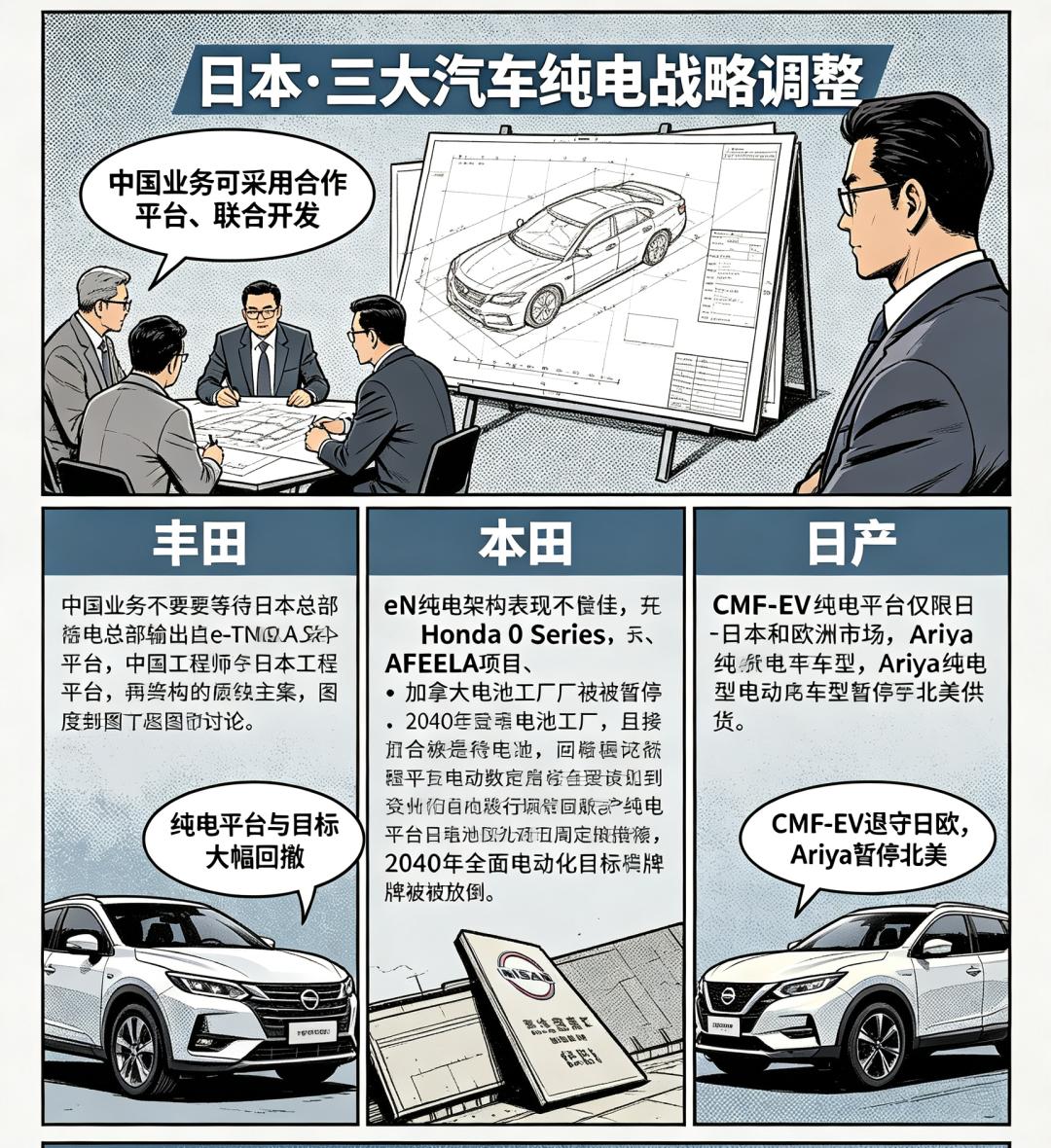
Image source: AI generated
In the past, the R&D process of Japanese automakers was generally that the Japanese headquarters set the plan, and China only did adaptive fine-tuning. But at the Beijing Auto Show in April this year, Toyota put forward the new action guideline "Made with China, for China", and implemented the Resident Chief Engineer (RCE) system, which greatly delegated the decision-making power of product planning and model development to the local Chinese team, which will lead the entire life cycle of the model.
At the same time, the way Toyota cooperates with two local automakers is also changing.
In the past, the main models of FAW Toyota and GAC Toyota were basically consistent with Toyota's global models, such as Corolla, Camry, Highlander, etc. Whether the cars sell well mainly depends on whether Toyota headquarters can make good cars.
But today, local automakers have more and more say in new energy models, especially GAC. The bZ series not only has a completely localized name, but also its R&D and supply chain adopt a large number of Chinese solutions, including Huawei, CATL, Momenta, etc. Toyota's new energy vehicle sales in China will increasingly depend on the capabilities of FAW and GAC themselves.
Honda also announced at this year's Beijing Auto Show that it will sell pure electric vehicles developed under the leadership of its joint venture partners and using the Honda brand in the Chinese market.
At the end of July, Honda announced that it had renewed its joint venture agreement with GAC until 2038. Under the new cooperation framework, GAC's scope of responsibilities has been greatly expanded, providing pure electric vehicle platforms, intelligent cockpits, battery supply chains, etc.; Honda will output hybrid technology and be responsible for chassis tuning, vehicle quality control standards, etc. The outside world expects that Honda's new pure electric vehicles built on GAC's platform will be launched in 2027.
Nissan "made way" for Chinese automakers a little earlier than Toyota and Honda.
As early as 2024, Dongfeng Nissan began to develop the Tianyan architecture to replace the CMF-EV platform. Last April, Nissan N7 was launched, which was the first pure electric vehicle developed under the leadership of Dongfeng Nissan without relying