Prices have tripled over the past decade. Why are shared bikes getting increasingly expensive to ride?
Shared bikes have raised their prices yet again.
In July 2026, Meituan Bike, Hellobike, and Qingju almost simultaneously raised their starting fares, consigning the old rule of "1.5 yuan for 30 minutes of riding" to history completely.
The three rivals, who usually fight tooth and nail over a single parking spot at a subway entrance, acted in perfect tacit understanding as if they had coordinated in advance when it came to raising prices.
Over the past decade, the price of a single shared bike ride has surged from 0.5 yuan to nearly 2 yuan, yet the industry still cannot shake off the fate of overall losses. The capital burned over these ten years could have fueled several booming startup trends.
Mobike was sold to Meituan, ofo collapsed due to capital chain rupture, and Bluegogo was taken over by Didi... The players on the field have changed round after round, but the books have always remained in the red.
None of the three giants that now occupy over 85% of the market can achieve stable profitability from the bike business itself.
After a decade, why are shared bikes still a losing business? If price hikes cannot fill the loss hole, why are the giants still clinging to this business tightly?
What you spend on shared bikes is enough to buy a used bicycle
One morning in July 2026, Zhang Wei scanned a Meituan Bike outside the Guomao subway station, and a line popped up on her phone screen: the starting fare has been adjusted to 1.88 yuan for 60 minutes.
She froze for a moment, recalling that last month during the Dragon Boat Festival, she rode Hellobike for 14 minutes and was charged 2.5 yuan, so she posted a complaint on her social media feed: "Bluegogo, how did your value go up so much?".
That day, Hellobike had just raised its holiday pricing from 1.5 yuan to 2.5 yuan, and now Meituan has followed suit.
In July 2026, Meituan Bike, Didi Qingju, and Hellobike successively updated their pricing rules in multiple cities including Beijing, Nanjing, Chengdu, and Zhengzhou.
Unlike previous price hikes, this time the platforms adopted a new pricing algorithm, and even the most frequent short-distance users felt the immediate sting of the increase.
Previously, the long-standing rule was "1.5 yuan for 30 minutes, extra time charged separately". Now Meituan sets the starting fare at 1.88 yuan, while Qingju and Hellobike both set it at 1.99 yuan. The basic riding duration has been uniformly extended to 60 minutes.
The starting fare is 0.4 yuan higher, but the duration has doubled. The unit price per minute has dropped from 5 cents to just over 3 cents, equivalent to a 40% discount. The longer you ride, the cheaper it gets, which on the surface looks like "more value without extra cost".
But the vast majority of users never use this "extra time". According to 2025 statistics from the China Bicycle Association, the average single riding distance for Chinese residents is 2.7 kilometers, with an average riding duration of 13.7 minutes.
For most people, cycling is just a 10-odd-minute trip from the subway station to the office. And it is precisely this group of people that has become the direct bearers of this round of price adjustments.
Taking Meituan as an example, for short-distance users who ride for 10 minutes, the cost has risen from 1.5 yuan to 1.88 yuan, an increase of about 25%, while the short-distance fare increase for Hellobike and Qingju has reached 33%. For users who ride for more than 45 minutes, the cost has dropped from the original accumulated 3 yuan due to overtime charges to the new starting fare.
However, the proportion of users who ride for more than 45 minutes during the morning peak is negligible. The existence of this preferential condition is more like a rhetorical device to make the price hike seem more reasonable.
Putting this round of price adjustments in the context of historical price curves, it is actually not abrupt at all.
When shared bikes first emerged in 2016, a single ride cost 0.5 yuan, with more than 20 brands crowded on the streets. At the peak of the subsidy war, users could even ride for free.
By 2019, Mobike was acquired by Meituan, ofo exited the market due to capital chain rupture, Didi took over Bluegogo and launched Qingju, and Hellobike, backed by the Alibaba ecosystem, turned the market from a melee of more than 20 players into a tripartite confrontation.
With the competitive landscape stabilized, the price finally had a unified baseline: 1.5 yuan for 30 minutes, a standard that lasted for more than three years.
Until 2022, the price hike targeted high-frequency users. Hellobike took the lead in raising the prices of weekly, monthly, and quarterly passes, and Meituan followed a few months later, with the 90-day pass rising from 60 yuan to 90 yuan, a 50% increase.
In the following two years, price hikes became more "hidden".
In 2023, Meituan reduced the starting riding duration from 30 minutes to 15 minutes in some cities; Hellobike and Qingju later compressed this number to 10 minutes. Now, the starting fare of shared bikes is approaching 2 yuan, nearly tripling over a decade.
The reasons for each price adjustment are similar: "rising operating costs" and "to provide better services". But from the user's perspective, prices have kept going up, while the riding experience has not improved accordingly.
On social platforms, complaints like "Who can bring down the price of shared bikes" and "I'm so angry that I spent 80 yuan buying a used bicycle" keep popping up.
Some netizens said that when they open the Meituan app, all they see are Hellobikes, and when they open the Hellobike app, all they see are Meituan bikes. They have to open both apps to ensure they can get a bike to ride every day. Good bikes have to be snatched, half of the bikes are broken, and the parking spots are getting farther and farther away.
Prices have gone up, but bikes are getting harder and harder to ride. What exactly is wrong with the shared bike business?
After a decade, why are shared bikes still a losing business?
Since the day shared bikes were born, it has been a business that "cannot balance the books".
Let's look at the financial statements first.
Meituan's 2025 annual report shows that the new business segment, to which shared bikes belong, recorded a full-year net loss of about 10.1 billion yuan. Didi's total revenue in 2025 was 226.7 billion yuan, and its innovative business, including Qingju Bike, autonomous driving, and intra-city freight, reported an adjusted loss of 2.63 billion yuan.
According to the prospectus disclosed by Hellobike in 2021, the company accumulated losses of over 4.8 billion yuan from 2018 to 2020. Among them, the shared two-wheeler business (bikes + e-bikes) contributed 91% of the revenue, but its gross profit margin was only 6.7%, providing very limited support to overall profitability.
None of the three giants can achieve stable profitability from the bike business itself.
The root cause lies in the cost structure of this business.
The manufacturing cost of a shared bike ranges from 700 yuan to 1,300 yuan. Calculated based on a service life of 2 to 3 years, the daily depreciation cost of a single bike reaches 0.5 to 0.8 yuan. Adding operating costs such as maintenance, cleaning, and electronic fence maintenance, the average daily comprehensive holding cost of a bike is about 2 yuan.
But this is only the static cost. The most intractable problem for shared bikes is scheduling and repositioning.
During the morning peak, bikes flow from residential areas to subway stations and office buildings; during the evening peak, they flow back to residential areas in the opposite direction. This tidal effect means platforms must invest a large amount of manpower to transport bikes across different areas.
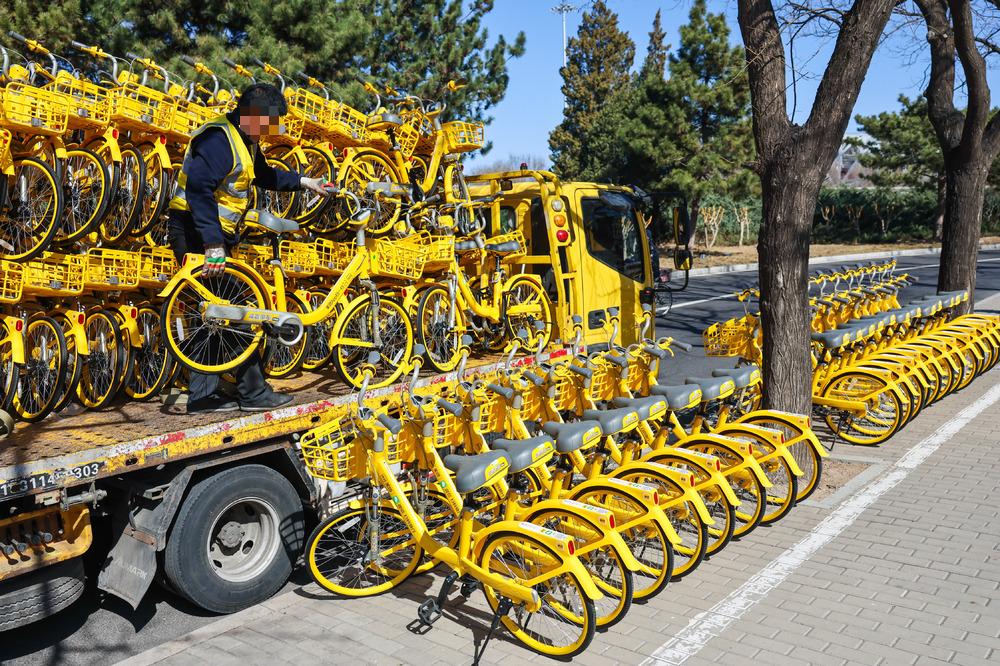
Taking Beijing as an example, the city's average daily riding volume reached 3.1164 million person-times in 2025, and all operating enterprises deployed an average of 2,940 operation and maintenance personnel every day, repositioning 238,400 bikes.
Every repositioning operation adds to the cost. No matter whether a bike is ridden 1 time or 10 times a day, its fixed costs such as depreciation, insurance, and operation and maintenance remain almost unchanged, but its revenue can differ by a hundred times.
The ceiling on the revenue side is equally obvious.
Data from the Beijing Municipal Commission of Transport shows that the average daily turnover rate of shared bikes in Beijing in 2025 was 3.67 times. Calculated at the pre-hike price of 1.5 yuan per ride, a bike can generate about 5.5 yuan of revenue a day, with a gross profit of 3.5 yuan.
This number seems acceptable, but it is only under ideal conditions.
The revenue of shared bikes is highly dependent on weather and seasons. The riding volume in northern cities drops sharply in winter, and high temperatures in summer also affect riding frequency, while extreme weather such as heavy rain, strong winds, and hail can almost reduce the daily turnover rate to zero.
Moreover, outdoor parking means bikes are exposed to wind, sun, and rain, leading to high maintenance frequency and high scrappage rates. Taking into account hidden costs such as premature bike scrappage and violation fines, the gross profit margin of shared bikes will only be even lower.
Government regulations have further compressed the profit margin of this business.
Cities have strict assessments on the total number of deployed bikes, parking areas, and service quality. In 2025, Shanghai filed and investigated 16 cases against shared bike enterprises that failed to clear illegally parked bikes in a timely manner, imposing fines of 158,000 yuan.
More critically, there are deployment quotas. The total number of shared bikes deployed nationwide has stabilized at around 18.2 million units, with the growth rate slowing significantly to 1.7%.
Among them, the total deployment volume in Beijing's central urban area is locked between 670,000 and 740,000 units, Shanghai's deployment does not exceed 1.1 million units, and Guangzhou drastically reduced its citywide appropriate deployment scale from the original 600,000-800,000 units to 300,000-480,000 units in 2025.
Costs are rigid, revenue depends on the weather, and the total deployment volume is firmly capped. The growth formula of "trading scale for profit", which has worked countless times, has completely failed in the shared bike industry.
The big loss hole has always existed, but the platforms have never stopped taking actions. Their directions are twofold: cost reduction and revenue expansion.
Cost reduction relies on refined operations, such as optimizing scheduling routes, reducing idle bikes, and extending the service life of bikes, in an attempt to push down the rigid cost line.
On the revenue expansion side, price hikes are the most direct response.
However, as we mentioned earlier, price hikes have already caused a lot of complaints from users. Platforms have also tried to launch new bike models with higher configurations, trying to exchange better riding experience for higher unit prices.
But the deployment volume of these new models is far less than that of ordinary shared bikes, and their prices are much higher. Therefore, most commuting users still ride those ordinary yellow, blue, and green bikes.
The real "killer move" is actually the membership system.
The three platforms have filled their apps with entrances to various riding packages, such as time-limited unlimited-ride passes, 90-day unlimited-ride passes, and single-day exclusive bike passes, in a dazzling variety.
Taking Hellobike as an example, a monthly pass costs 17.99 yuan after actual payment, with a renewal price of 20 yuan. Calculated based on 22 working days per month for a user, riding twice a day, the cost of a single ride is about 0.4 yuan, saving nearly one yuan compared to paying for each ride separately.
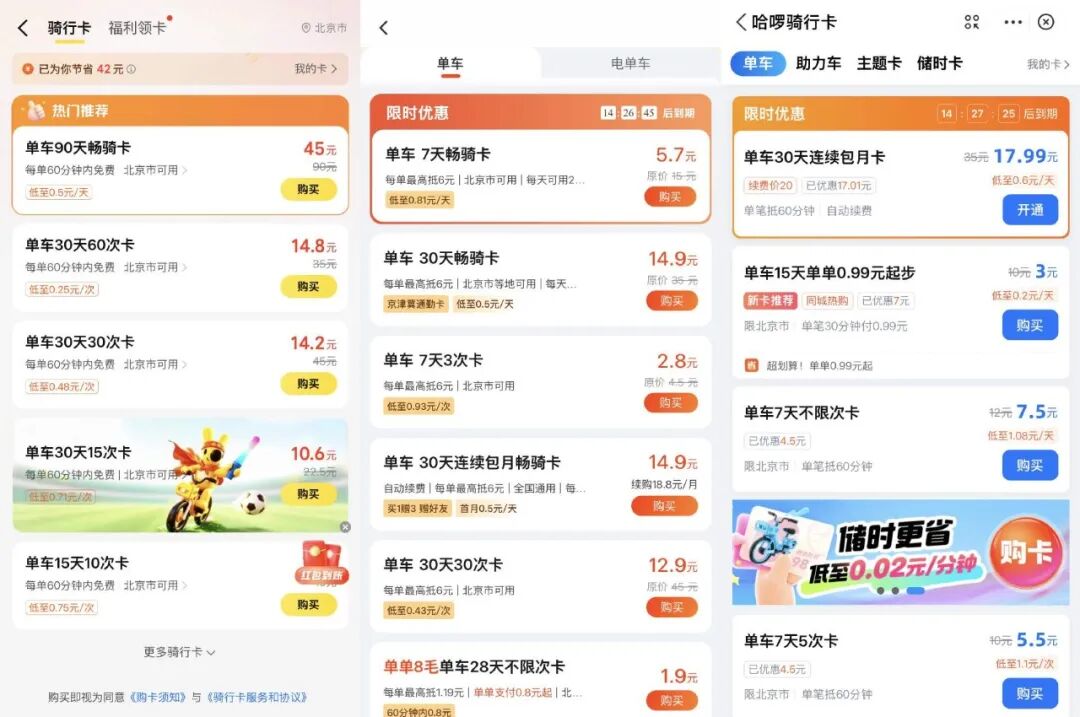
After doing this math, high-frequency users have almost no reason not to buy a membership pass.
This is exactly the effect the platforms want. By enclosing high-frequency users with a monthly pass, they can make these users contribute stable cash flow; in order to "get their money's worth", users will naturally prioritize the platform whose membership they have, changing their consumption habit from comparing prices across multiple platforms to sticking to a single platform.
But can the membership system fundamentally change the financial structure of the shared bike business? The answer is: it can alleviate the problem, but it is difficult to completely cure it.
The structural dilemma of the shared bike business still exists: rigid costs, revenue volatility, and government regulations are all hard nuts to crack.
The membership system can buffer losses on the books, but the depreciation rate of a bike will not decrease just because a user has bought a monthly pass. On the contrary, high-frequency riding accelerates bike wear and tear, leading to higher replacement and maintenance costs.
Therefore, even after the price hike is implemented and the number of members continues to rise, the shared bike business can at most maintain "reduced losses" rather than "huge profits".
Losing-money bikes are actually the cheapest billboards
Since the measures to stop losses can only achieve so much, why are the giants still clinging to this business tightly?
The answer may not lie in the bike business itself, but outside of it.
Shared bikes are a typical high-frequency, rigid-demand offline scenario. Users need to ride bikes every day, and they have to open the app every time. This "open rate" is something any internet platform can only dream of.
Users actively open the app, actively scan the QR code, and complete a real trip. Every step contributes real user behavior data with geographic location tags. This kind of scenario-embedded traffic can hardly be bought through external advertising.
So where does this traffic asset ultimately flow?
Hellobike's prospectus provides a very convincing figure: by the end of December 2020, 34% of Hellobike users had used two or more of the company's services. This means that for every three people who ride shared bikes, one will try other services on the platform.
This is not a phenomenon unique to Hellobike. Every time a user opens the app to scan a QR code, the platform gets a chance to show them other services. The high-frequency rigid-demand riding scenario provides a natural channel for converting users to low-frequency but high-value businesses.
Each platform has its own focus in operations.
Hellobike calls this path the "flywheel model". It uses high-frequency businesses such as shared bikes and e-bikes to drive low-frequency high-value businesses such as ride-sharing, ride-hailing, and car rental.
According to its prospectus, the conversion rate of Hellobike's shared bike users to other businesses is quite considerable: 40% to 60% of new users for e-bikes, carpooling, and electric vehicle sales come from existing bike users.
In 2020, the total transaction volume of Hellobike's carpooling business reached 7 billion yuan, making it the second-largest carpooling platform in China, exceeding the 5.8 billion yuan transaction volume of its shared two-wheeler