The biggest spender in this World Cup knows nothing about football | 2026 World Cup Consumption Report
With the winning goal in extra time, Spain lifted the FIFA World Cup Trophy again after 16 years, and this World Cup, spanning three countries across North America and featuring 48 teams, has finally come to a close.
This World Cup never lacked upsets, controversies, and last-minute thrillers, but what was even more bustling than the pitch was young people's spending power.
Did late-night takeout orders skyrocket? Did co-branded blind boxes sell out within seconds of release? Were fan bars fully booked with no available seats? During this past month of World Cup matches, how much money did young people splurge on "this tournament"?
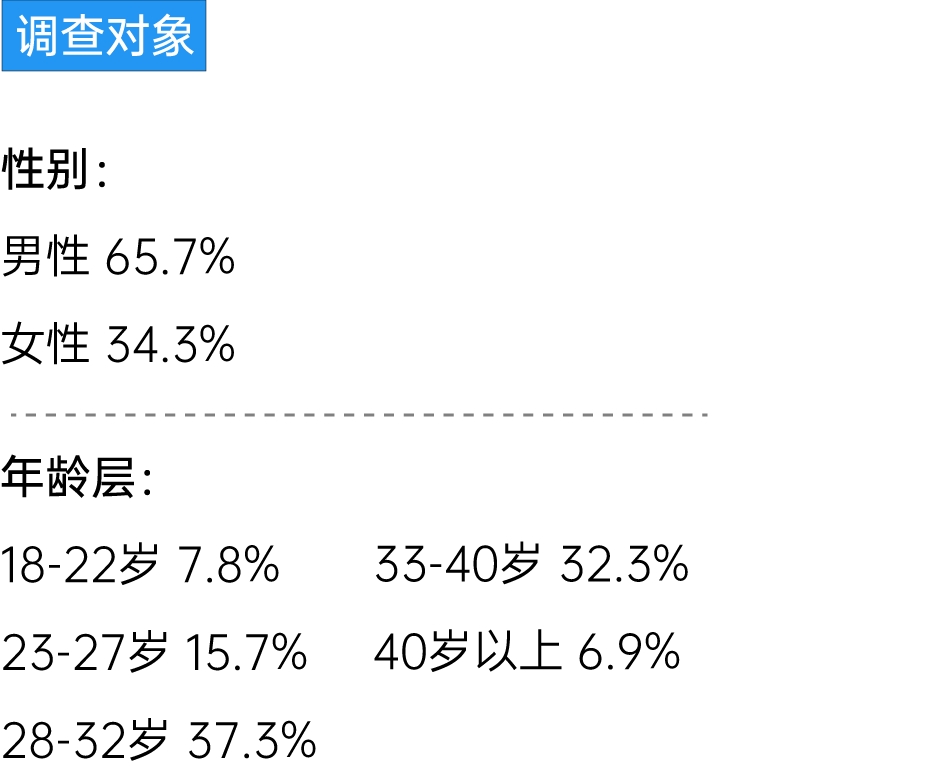
Now that the commotion of the stadium has faded, looking back at the consumption records from this period, we find that the vibe of watching the games this year has changed. Focusing on the viewing and consumption choices of young people for this World Cup, *Post-wave Research Institute* launched a small survey on World Cup consumption, collecting a total of 510 valid responses.

Is your impression of the World Cup still stuck on setting alarms to stay up all night and glued to the screen from start to finish? But for this year's US-Mexico-Canada World Cup, young people's viewing habits have already shifted somewhat.
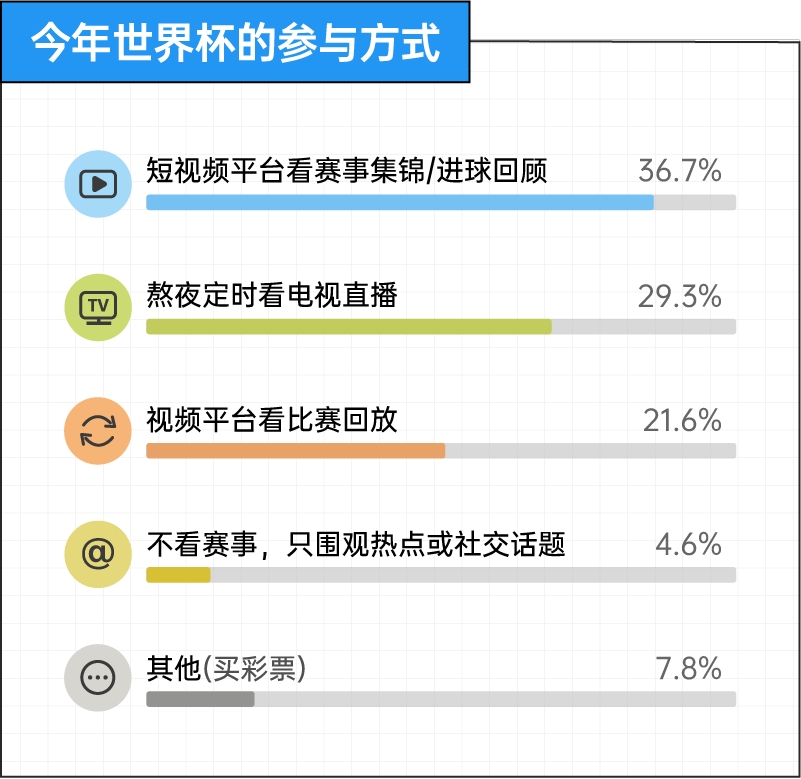
Survey results show that nearly 30% of young people still "watch the live broadcast on schedule", while 21.6% "find time to watch the replay". However, "watching match highlights on short videos" has taken the top spot with an advantage of 36.7%, becoming the most mainstream way of participation.
Even for events as grand as the World Cup, young people's attention has inevitably started shifting from "long live broadcasts" to "short-form content". Rather than staying up until midnight to watch the full match, it's better to spend 3 minutes the next day scrolling through all the goals — efficient, time-saving, and most importantly for us young office workers: no delay to work.
The definition of "watching the World Cup" is being rewritten. Is watching the full match the only way to count as following the games? Not anymore — scrolling through highlights in 3 minutes counts as deep participation.
Another point worth noting is that the vast majority of respondents who selected the "Other" option for participation methods wrote that they "bought sports lottery tickets". Nothing embodies a sense of participation more than "spending two dollars to support your favorite team" — if you lose, it's just for fun, if you win, it's double the fun.
Changes in participation methods reflect young people's attention habits, while the question of "where to watch" reveals young people's current preferences for viewing scenarios: nowhere is better than at home.
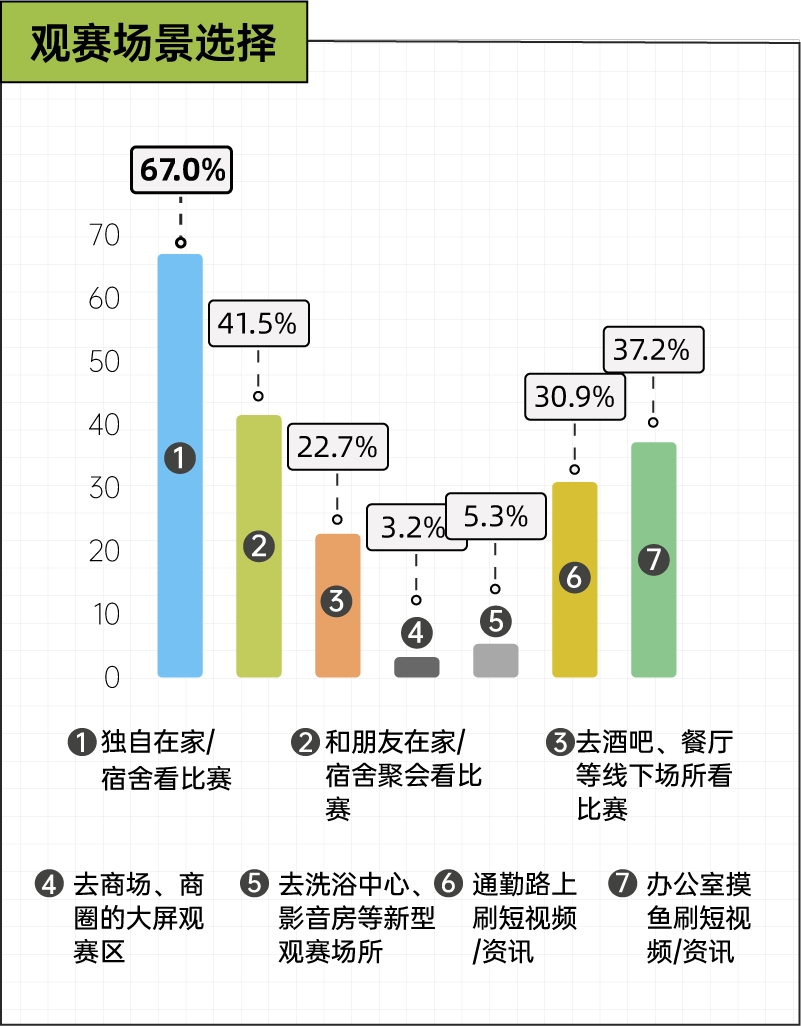
Watching the matches alone at home/dorm (67%) ranks first with a staggering lead, followed by gathering with friends to watch the matches at home/dorm (41.5%). Yet during this year's World Cup, only just over 20% of people visited offline venues such as bars, bathhouses, or large-screen viewing zones.
If the "primary viewing spot" for the World Cup in most people's eyes is home, then the second and third spots are the office desk and the commute to work: "scrolling through short videos/news at work while slacking off" and "scrolling through short videos/news during the commute" are listed with selection rates of 37.2% and 30.9% respectively. The most authentic daily viewing experience of this generation of young people is hidden in these fragmented moments.
There is also an objective factor behind the data: a large number of matches in this year's US-Mexico-Canada World Cup kick off in the morning — who wouldn't want to watch the games openly "while getting paid"?

When talking about "World Cup consumption", let's start with the simplest question: how much did you spend?
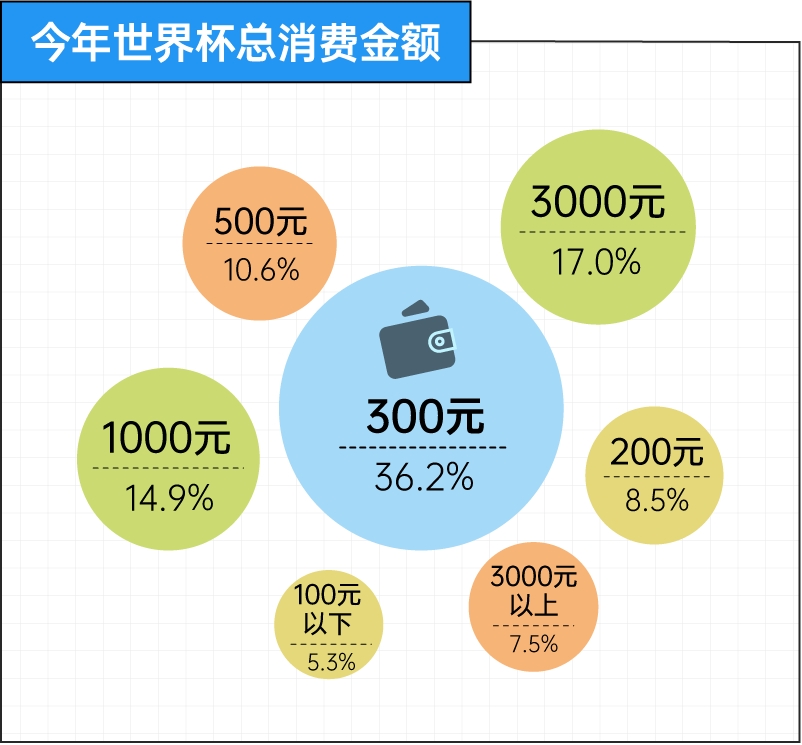
In this survey, the most concentrated range of total spending is 200-300 yuan, accounting for as high as 36.2%. Moving higher, there are a considerable number of people who spent at the 1000-yuan and 3000-yuan tiers, accounting for 14.9% and 17% respectively — they might have upgraded viewing equipment like speakers or projectors, qualifying as advanced consumers.
There are also 7.5% of heavy consumers who "spend for love with no upper limit", with total spending exceeding 3000 yuan.
It can be seen that 300 yuan is a watershed, and nearly half of young people keep their spending under this amount: roughly seven or eight late-night snacks for watching games, two or three cases of beer, or one or two favorite co-branded merchandise. Spending 300 yuan to buy a summer sense of participation can not only create a full sense of ritual, but also not bring financial burden.
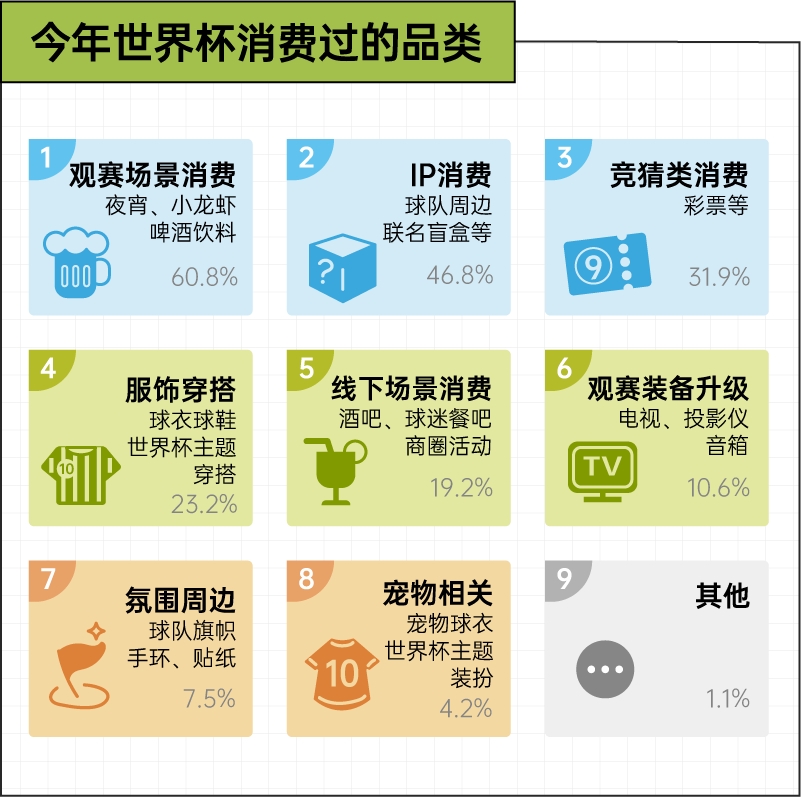
Going a step further, let's see where all the money in everyone's pockets went. Survey data shows that "food" is young people's top priority, with "viewing-scenario consumption" such as late-night snacks, beer, and crayfish ranking first with an absolute advantage. You might not understand the offside rule when watching the games, but your mouth definitely can't stay idle.
Next are "IP-related consumption" and "prediction-related consumption", both accounting for over 30%. However, the traditionally perceived main forces of World Cup consumption: clothing and outfits (23.2%), offline scenario consumption (19.2%), are instead ranked lower.
Although "pet-related consumption" ranks last in the survey, according to reports from Amber Consumption Research Institute, after FIFA opened up pet IP authorization for the first time this year, sales of official pet national team jerseys on TikTok US skyrocketed 1772% year-on-year. Yiwu merchants also smelled the business opportunity: pet jerseys with a wholesale price of more than ten yuan have been sold nearly 300,000 pieces by a pet clothing factory in Suzhou, Anhui, with the Argentina blue-and-white striped style accounting for 30% of sales.
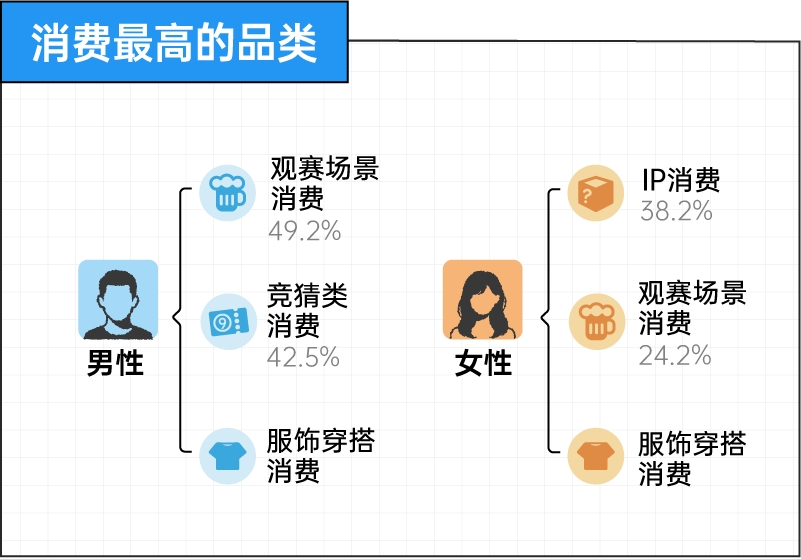
Looking at the categories with the "highest consumption" separated by gender, men's and women's money flows in completely different directions.
"Food" and "lottery tickets" are men's happiest, simplest, and self-explanatory choices, while the areas where women spend the most tend to be emotional and aesthetic: LABUBU co-branded blind boxes, FIFA World Cup Trophy fridge magnets... these are the things they are more willing to pay for.
And "clothing and outfits" have entered the Top 3 for both men and women, but the difference may be: men buy them to wear while watching the games, women buy them for fashion matching — different ways of using the same jersey, but behind them is the same "self-pleasure consumption".

From the previous survey data, it can be seen that "cooling down of offline viewing" is an obvious trend of this World Cup. Compared with the past bustling scenes where bars and fan restaurants were fully booked, are young people no longer paying for offline viewing venues?
Based on the "identity labels" that respondents chose for themselves, *Post-wave Research Institute* screened out the Top 3 viewing scenarios most favored by different types of football fans.
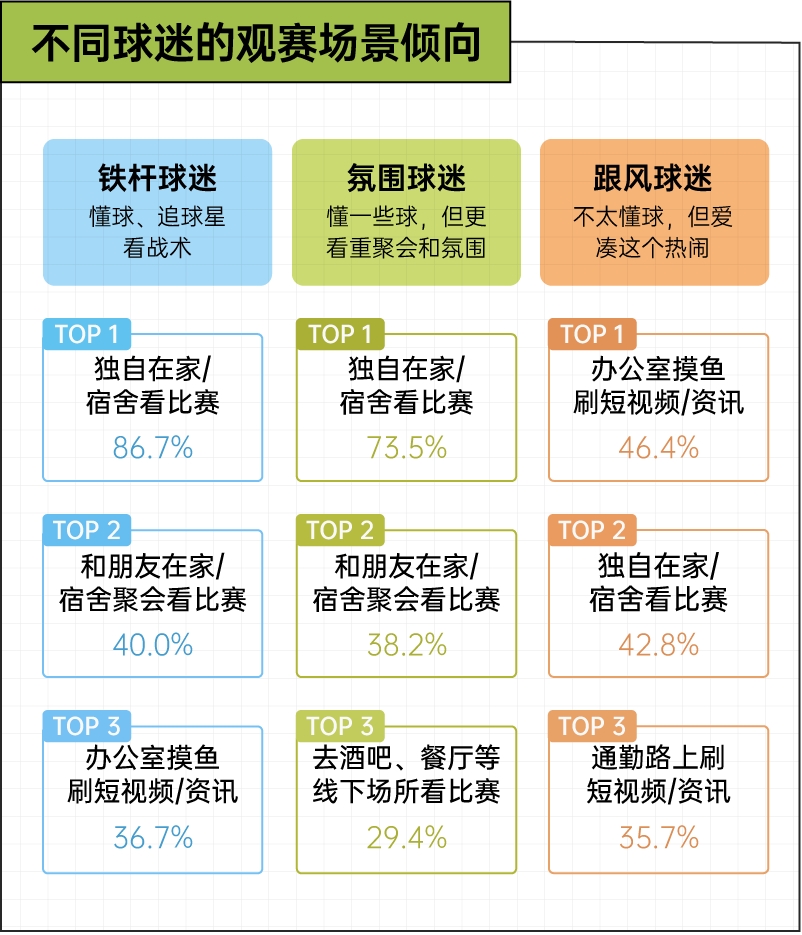
"Watching the matches alone at home" is the first choice for the vast majority of people — no interruptions, no need to accommodate others, which is perhaps the most basic respect for the matches. Even when it comes to socializing, they prefer the comfort of a small circle of acquaintances: "gathering with friends to watch the games at home" has a selection rate of around 40% among both die-hard fans and casual atmosphere fans.
Among the three types of fans, only atmosphere fans are still willing to reserve a Top 3 spot for "offline viewing venues", and the proportion is only 29.4%.
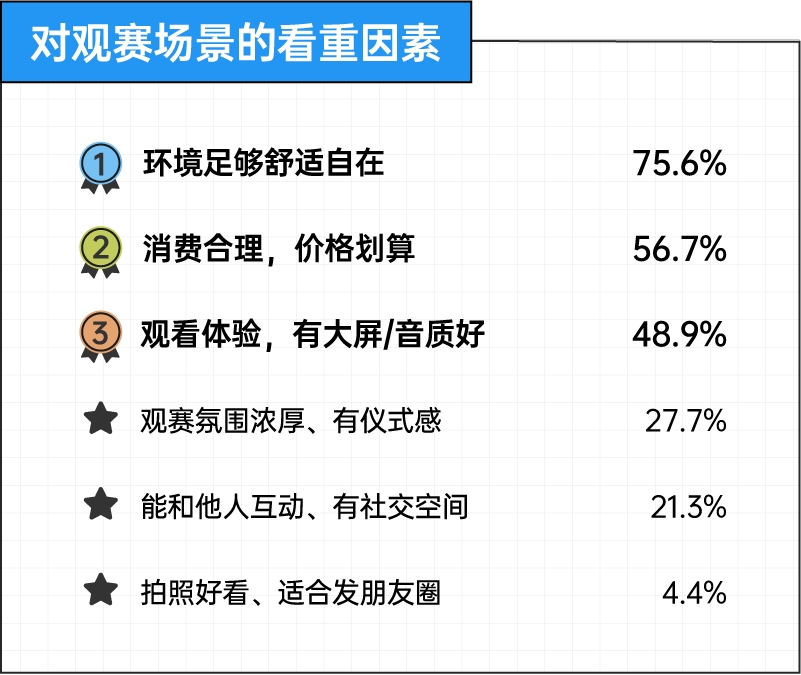
We further inquired about the "key factors they value" for viewing scenarios, 75.6% of people chose "the environment is comfortable and free enough", which led by a large margin and became the core demand of everyone. This means that sofas are more attractive than bars, pajamas are more competitive than going out, and the freedom to lie down whenever you want is more important than anything else.
The second factor is "reasonable consumption, cost-effective". A trip to a bar costs at least 100 or 200 yuan, while ordering takeout at home can be easily done for 50 yuan — when young people start to budget carefully, "cost-effectiveness" becomes the hard truth that beats "crowded and lively".
In addition, a large number of matches in the US-Mexico-Canada World Cup kick off in the morning and early morning, and the early matches have cut off the prime consumption time that bars are best at. Under the triple attack of time difference, cost-effectiveness, and comfort, offline viewing scenarios have thus degraded from "mass carnival" to "occasional ritual for atmosphere".
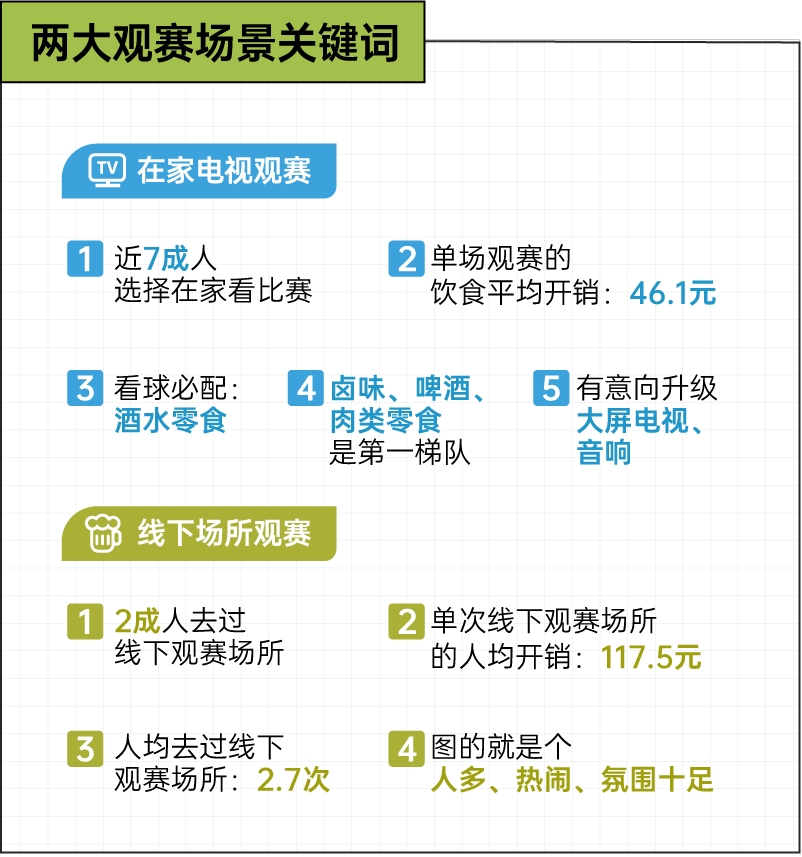
*Post-wave Research Institute* has filtered and summarized the keywords of two major traditional viewing scenarios, making it clear at a glance the reasons and preferences of young consumers for choosing different scenarios:

Compared with the Qatar World Cup four years ago, are young people's wallets fuller or thinner now?
41.5% of people "spent more", 36.2% of people's spending "remained basically the same", and only 22.3% said they "spent less this year". Nearly half of young people have increased their spending on the World Cup, but what's more interesting is that when we bring in "different types of fans", we can find that "casual fans" are propping up the overall consumption.
