Crazy? A former top Microsoft AI guru spent 6.7 million to acquire a company, just to let AI directly "take up the post of CEO".
A company is prepared to spend $1 million to acquire a genuinely operating business, not for profit-making purposes, but to conduct an AI experiment. Would you think this is a little crazy?
Over the past two years, nearly all players in the AI industry have been striving to build "AI employees": OpenAI aims to turn ChatGPT into a digital colleague, Anthropic hopes Claude will become a "super employee" in enterprises, and Google keeps integrating Gemini into various office software, expecting AI to take over more and more work.
However, a startup named Skyfall AI argues that this path is off track — they have put forward a more radical idea: Instead of letting AI replace a single position, it is better to let it manage the entire company directly.
To this end, Skyfall AI plans to invest up to $1 million (approximately 6.77 million yuan) to acquire a real B2B SaaS or e-commerce enterprise, and appoint AI as the CEO, who will be responsible for almost all business decisions ranging from pricing, marketing to finance and operations. The entire experimental process will be made public to let everyone witness together: Can AI truly run an enterprise?
Why did two former Microsoft AI executives decide to start a new business?
Briefly speaking, the two founders of Skyfall AI are both veterans in the AI industry.
Skyfall AI's co-founder and CEO Sam Pasupalak, together with CTO Kaheer Suleman, met at the University of Waterloo in Canada nearly 20 years ago. At that time, AI was basically in the "AI Winter" period, and the two decided to devote themselves to intelligent machine research.
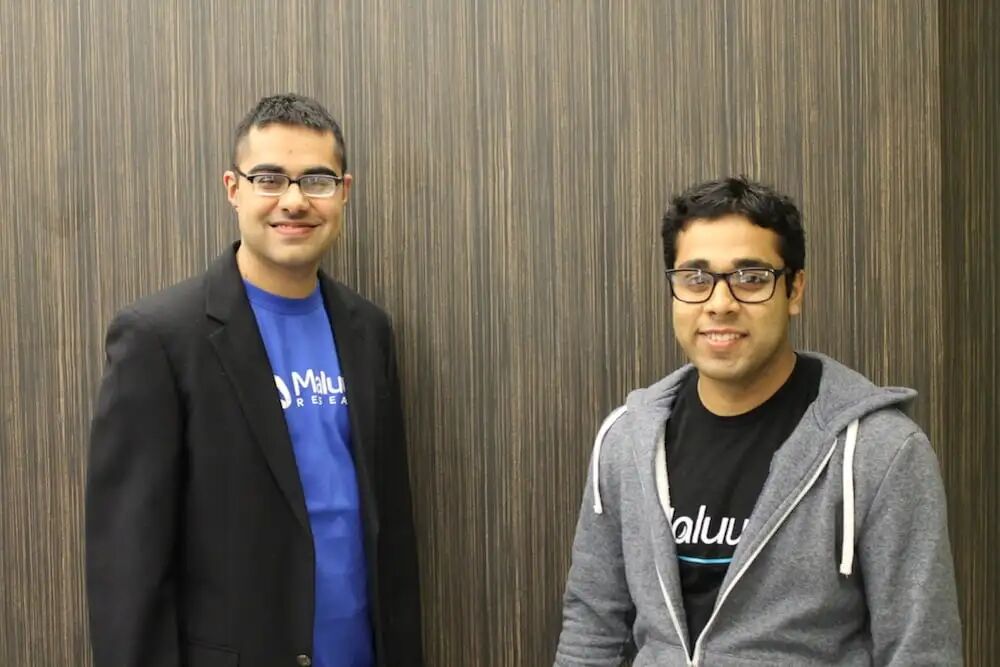
In 2011, they co-founded the deep learning company Maluuba, one of the world's earliest batch of deep learning startups, and once collaborated with Turing Award winners Yoshua Bengio, Richard Sutton and other AI scholars. It is reported that the early conversational AI developed by Maluuba was later deployed on hundreds of millions of devices through partners such as Samsung, LG, and BlackBerry.
According to Sam Pasupalak's recollection, the team once developed a Demo that could answer content from the entire *Harry Potter* book — today, large models can almost answer questions across the entire internet, which sounds no longer surprising; but in 2016, this was already at the cutting edge of AI research results.
Later in 2017, Microsoft acquired Maluuba for approximately $160 million, and built the Microsoft Canada AI Lab on this basis. Nearly a decade later, the two long-time partners joined forces again, hoping to build what they see as the first truly "Autonomous Enterprise" in the true sense.
The AI industry is all building "employees", but they want to build a "boss"
As mentioned at the beginning, most current enterprise AI products follow a very consistent line of thinking.
Companies like OpenAI, Anthropic, and Google all hope that AI can gradually take on the work of specific positions such as programmers, customer service representatives, salespeople, and marketers, while humans will gradually shift from "executors" to "supervisors".
However, Sam Pasupalak believes that this is only a kind of "local optimization" of AI capabilities. He points out that the marketing Agents and sales Agents developed by many startups are essentially just "Narrow AI" applications. The truly difficult problem is not completing a specific task, but the decision-making ability at the organizational level.
"Our goal is not to build another marketing Agent, but to popularize CEO-level capabilities for small businesses around the world."
In his view, if you really want to verify whether the "Autonomous Enterprise" concept is feasible, you cannot stay stuck in Demos, pilot projects, or lab environments — the only way is to buy a company and let AI actually run it.
According to Skyfall AI's plan, this AI system will be fully responsible for the enterprise's pricing strategy, marketing, customer support, financial management, and operations, and will continuously reduce human involvement over time. They have even set a very challenging goal for themselves: to double the company's revenue within 6 months, and publicly document all successes and failures throughout the process.
Compared with the common small-scale PoC (Proof of Concept) projects in the industry, this approach has higher costs and greater risks, but it also means that the experimental results are more convincing.
Skyfall AI: Today's LLMs Lack Continuous Learning Capabilities
So why do they think enterprise AI needs to be redesigned? Skyfall AI's answer is straightforward: today's large language models are getting better at answering questions, but not necessarily better at running a business.
Over the past few years, companies have invested trillions of dollars in AI infrastructure and large models. Therefore, vendors such as OpenAI, Anthropic, and Google must continuously prove that the existing large model architecture can still make continuous progress.
Sam Pasupalak explained: "Almost all resources are bet on LLMs, so people have to keep launching new Benchmarks, or cooperate with evaluation agencies to make models achieve higher scores in various tests. As a result, the entire research community is pursuing incremental n+1-style small performance improvements."
Of course, Skyfall AI does not deny that models like GPT-5.5 and Gemini are already very excellent, but they believe that the biggest shortcoming of these models is the lack of continuous learning capabilities.
To address this issue, Skyfall AI has released a new enterprise AI benchmark test — Morpheus. Unlike traditional Benchmarks that test a model's knowledge reserve or question-answering ability, Morpheus focuses on another problem: Can AI continuously adapt when the enterprise environment keeps changing?
Test results show that in a familiar business environment, cutting-edge models such as GPT-5.5 and Gemini perform well; but when competitors launch new products, consumer preferences change, or the market environment keeps fluctuating, the model's performance begins to decline significantly.
Skyfall AI believes that this shows that current large models are better at leveraging knowledge already learned during the training phase, rather than continuously learning and adjusting strategies in a changing real-world environment like a business manager. Therefore, simply expanding the model scale may not be sufficient to truly run an enterprise.
To solve this problem, Skyfall AI has proposed a new technical route — Enterprise World Models.
Simply put, they hope AI does not just understand text, but truly understands how an enterprise operates and evolves. The system needs to continuously simulate the chain reactions between various internal decisions of the enterprise, including factors such as product pricing, customer growth, recruitment, manpower allocation, operational efficiency, and long-term revenue changes.
CTO Kaheer Suleman also said that they are developing a Latent World Model: Traditional large models mainly predict the next word in the Token space, while they want AI to predict the future state of the enterprise in the latent space, focusing only on the key variables that truly affect the development of the enterprise, rather than all text information.
In Skyfall AI's view, this approach is more suitable for long-term planning, and more suitable for undertaking high-risk, information-incomplete decision-making tasks in enterprise operations.
Why do you have to buy a real company?
In fact, before deciding to acquire a real enterprise, Skyfall AI has conducted simulation training for many years. But they finally found that no matter how realistic the business simulation environment is, it cannot fully replicate the real world: real customers will not act according to a script, competitors will suddenly change their strategies, and the market environment may change overnight.
So Kaheer Suleman said that there is always an irreconcilable gap between simulation and reality, and the only way to solve this problem is to obtain real-world data.
To verify whether AI has the ability to run a business, last year they first let AI take over a company... Of course, it was a virtual company, the amusement park in the classic simulation management game *RollerCoaster Tycoon*. In the game, AI needs to continuously optimize operations, improve tourist satisfaction, and maximize revenue at the same time.
Through that experiment, Skyfall AI confirmed that AI is already capable of operating a complex simulated business system. Therefore, the next step is to acquire a real company — if the experiment goes smoothly, they even plan to challenge enterprises worth tens of millions of dollars next year.
It is not the first time for AI to serve as CEO
In fact, attempts to appoint AI as CEO are not uncommon.
Previously, Anthropic partnered with AI security company Andon Labs to launch Project Vend, allowing Claude to fully manage an office vending machine business. In the early stage of the experiment, employees successfully "fooled" the AI into purchasing a large number of tungsten metal blocks in bulk, and even made it sell goods at a loss, which once became a joke in the industry.
However, as the model continued to upgrade, by mid-2026, Project Vend had expanded to multiple office locations in San Francisco, New York, and London. Andon Labs even stated that the experiment later became "so boring that there was barely anything to watch", because the entire business could run stably and autonomously.
Even earlier, NetDragon once launched an AI CEO named "Tang Yu", and Polish spirits enterprise Dictador also appointed the robot CEO Mika, but they mostly played an auxiliary decision-making role and did not truly take over enterprise operations.
In contrast, the biggest difference of Skyfall AI is that it is willing to put its hypothesis to the test in a real business environment: purchasing a company with real customers, real revenue, and real cost pressure, and publicly documenting whether AI can truly increase revenue, reduce human intervention, and where failures occur.
However, even the founders of Skyfall AI do not believe that AI will completely replace the CEO.
Sam Pasupalak admitted that he spends more than half of his time every day on budgets, meetings, team coordination, and various operational matters. If all these tasks are handed over to AI, he can devote more time to strategic thinking. But when it comes to things like motivating employees, building trust, and interpersonal relationships, he believes that AI is still not competent enough at present.
Kaheer Suleman holds a similar view. He believes that even if AI takes over most of the enterprise's operational work in the future, humans still need to retain final supervision and responsibility, because genuine trust and accountability must still be shouldered by humans.
Therefore, what Skyfall AI wants to verify is not "whether AI will replace the CEO", but another more realistic question: if AI can take over the vast majority of the enterprise's operational work, can human managers finally focus more energy on strategy, innovation, and human collaboration?
And the answer to this question may not be truly revealed until that $1 million company is officially handed over to AI — so what do you think of this AI experiment?
Reference link: https://www.forbes.com/sites/victordey/2026/07/20/former-microsoft-ai-leaders-are-spending-1m-to-prove-ai-can-replace-ceos/
This article is from the WeChat official account "CSDN", compiled by Zheng Liyuan, and published with authorization from 36Kr.