On the Eve of Listing | Ranked the third globally in the mobile PMIC sector, with total losses of 1.5 billion yuan over three years, Xinmai makes its third attempt for Hong Kong IPO.
This article is about 3,400 words long, estimated reading time is 7 minutes
Author | PENG Xiaoqiu
Editor's Note: The Listing Eve column focuses on the critical moment when an enterprise charges into the capital market. Every prospectus holds the ambition, business cycles, and hidden worries of a company before its public listing. This is the 8th issue — CoreMile.
Yesterday, a power semiconductor company named "CoreMile" submitted its prospectus to the Hong Kong Stock Exchange for the third time (the previous two submissions were in June 2025 and January 2026), with Huatai acting as the exclusive sponsor.
CoreMile's core business is power semiconductors, which adopts the virtual IDM model — it does not build its own wafer fabs, but strategically invests in and holds approximately 16.76% equity in its key foundry partner Hangzhou Fuxin Semiconductor. This model pursues both the asset-light advantage of a fabless company and the process integration capability of an IDM.
Its products are divided into three categories: mobile PMIC, display PMIC, and power devices. According to third-party statistics, CoreMile's global market share in the PMIC sector was about 0.4% in 2025, and its share in the global MOSFET market was around 0.1%; in segmented tracks, it ranked third globally in smartphone PMICs (with a 2.9% share in 2025) and second globally in OLED display PMICs (with a 12.7% share in 2024).

1.5 Billion Yuan Losses in Three Years, and the Anonymous Major Client
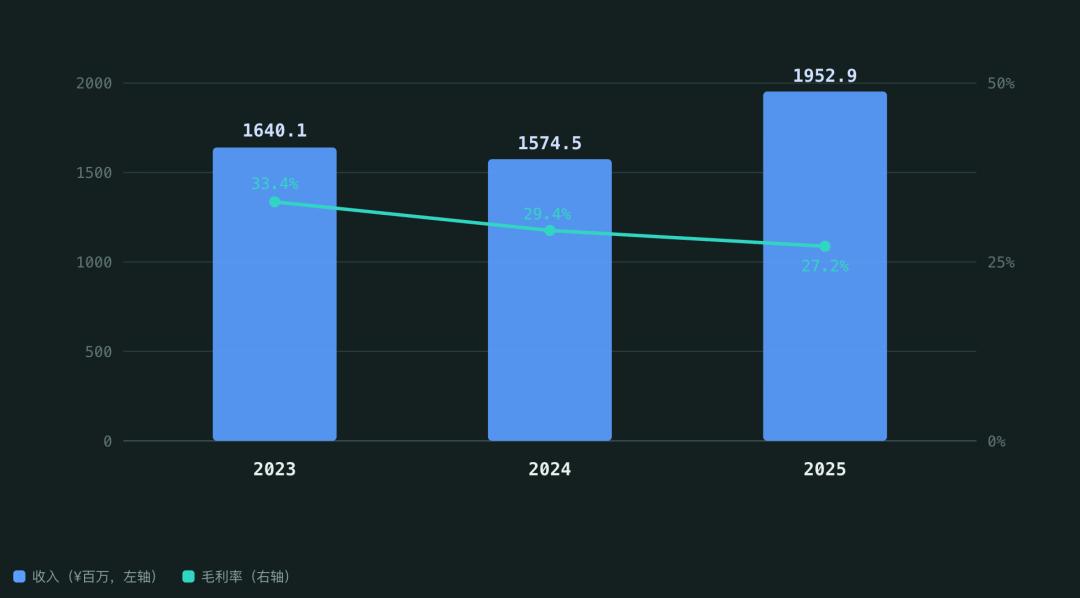
Performance-wise, CoreMile's total revenue from 2023 to 2025 was 16.40 billion yuan, 15.74 billion yuan, and 19.53 billion yuan respectively, but its revenue declined in 2024. Net losses reached 5.06 billion yuan, 6.97 billion yuan, and 2.78 billion yuan respectively, with a cumulative loss of around 14.8 billion yuan over the three years. By 2025, the loss appeared to be narrowing, and in the first four months of 2026, it even recorded a net profit of 280 million yuan.
(Source / Compiled by 36Kr)
It looks like the company is turning losses into profits, but this is not mainly due to improved operating performance, but rather the disappearance of a type of "interest expense".
If you refer to the non-IFRS (adjusted) financial metrics, the trend is completely reversed. The adjusted profit was 45 million yuan in profit in 2023, turned to a loss of 87 million yuan in 2024, and continued to a loss of 97 million yuan in 2025. The loss did not narrow, but expanded.
The difference between the pre-adjustment and post-adjustment results comes from non-cash expenses, specifically interest expenses related to redeemable liabilities, which amounted to as high as 503 million yuan, 546 million yuan, and 90 million yuan in 2023, 2024, and 2025 respectively. On February 27, 2025, CoreMile reached an agreement with its investors to immediately terminate these redemption rights, which caused this "interest expense" to plummet, naturally narrowing the annual loss.
(Source / Compiled by 36Kr)
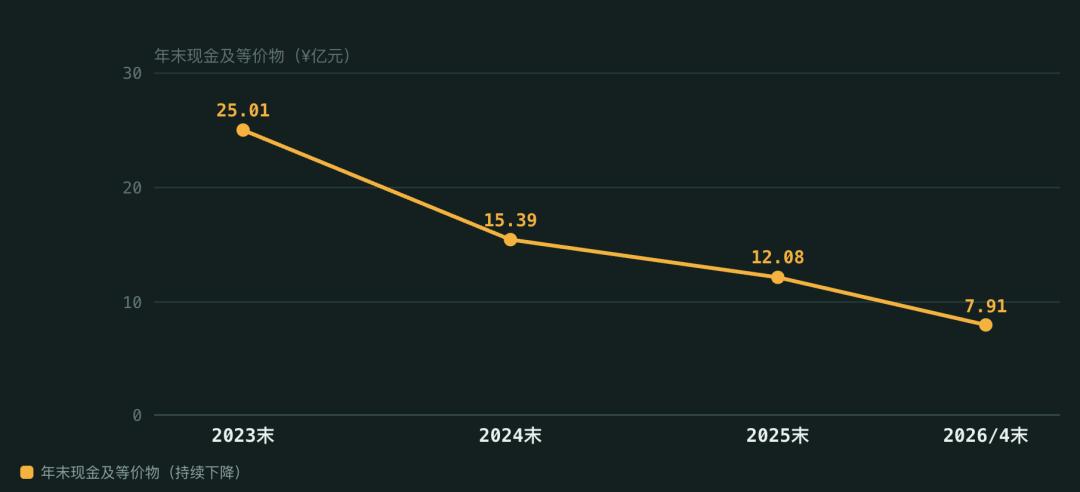
There is another signal at the operational level: CoreMile's cash flow from operating activities is unstable: +405 million yuan in 2023, -64 million yuan in 2024, +48 million yuan in 2025, and turned to -98 million yuan again in the first four months of 2026. Its cash reserves are also continuously depleting: year-end cash and cash equivalents dropped from 25.01 billion yuan in 2023 to 12.08 billion yuan in 2025, leaving only 791 million yuan by the end of April 2026.
(Source / Compiled by 36Kr)
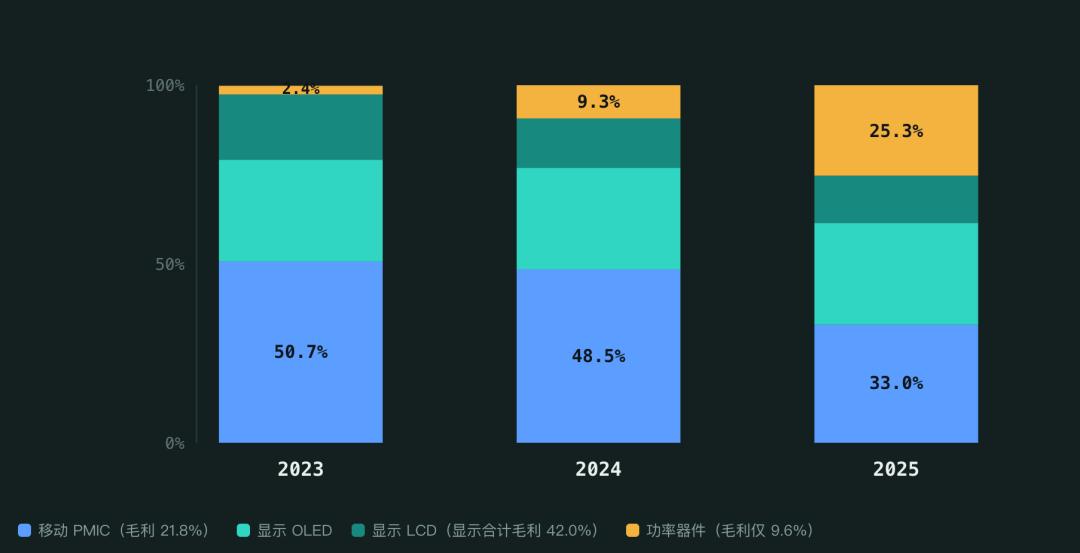
A company that ranks "third globally" still cannot generate stable cash flow on its own. The company itself also explicitly expects that a net loss will still be recorded for the full year 2026. Why does it keep incurring losses despite considerable revenue? A breakdown of the business shows that CoreMile's revenue comes from four segments: PMIC (including mobile and display), power devices, and others, with drastic structural changes.
Mobile PMIC is shrinking: revenue dropped from 831 million yuan in 2023 to 645 million yuan in 2025, with its proportion of total revenue falling from 50.7% to 33.0%;
Display PMIC is a bright spot: OLED display PMIC revenue grew from 466 million yuan to 556 million yuan (stably accounting for around 28% of total revenue), making it the growing segment within the PMIC business;
Power devices are exploding: revenue surged from 39 million yuan in 2023 to 494 million yuan in 2025, with its proportion of total revenue soaring from 2.4% to 25.3%, and even reaching 36.1% in the first four months of 2026.
The problem is that the fast-growing power device segment has the lowest gross margin. The gross margin of power devices was -74.4% in 2023 (early-stage products failed to enter the market, leading to full provision for inventory impairment), -4.6% in 2024, and just turned positive to 9.6% in 2025. In contrast, the PMIC segment has high gross margins: the overall gross margin of PMIC reached 33.1% in 2025, among which the gross margin of display PMIC was as high as 42.0%.
As a result, the more the company relies on power devices to drive sales volume, the more its overall gross margin gets diluted. The company's overall gross margin slid from 33.4% in 2023 to 27.2% in 2025, and dropped even lower to 26.2% in the first four months of 2026.
The unit economics make this more intuitive: in 2025, CoreMile shipped 492 million PMIC units with revenue of 14.59 billion yuan, with an average unit price of around 3.0 yuan; it shipped 733 million power device units with revenue of 494 million yuan, with an average unit price of only around 0.67 yuan. Using high-price, high-margin PMIC as the stabilizer and low-price, low-margin power devices to drive scale growth is CoreMile's current revenue structure, and also the root cause of the "revenue growth without profit growth" dilemma that cannot be easily solved in the short term.
It is worth noting that CoreMile's working capital indicators are improving. Inventory days turnover decreased from 144.8 days in 2023 to 84.6 days in the first four months of 2026, trade receivables turnover remained stably at about 30 days throughout the period, and accounts payable turnover was extended from 35 days to 51 days, indicating improved bargaining power. This is different from typical loss-making companies that face "slower payment collection", which is a positive factor.
(Source / Compiled by 36Kr)
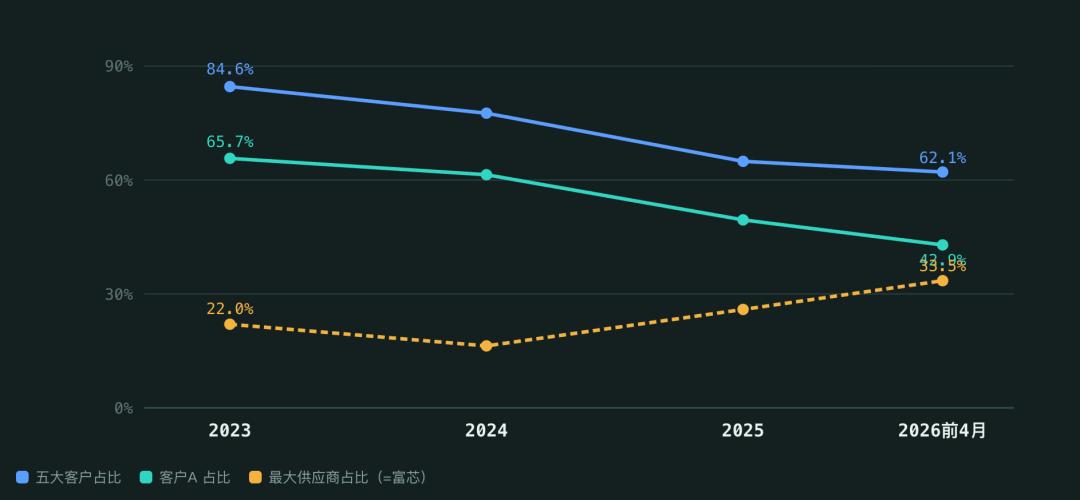
CoreMile's revenue is heavily dependent on a very small number of clients. From 2023 to 2025 and in the first four months of 2026, the top five clients contributed 84.6%, 77.6%, 64.9%, and 62.1% of total revenue respectively. Although the customer concentration is declining, it remains at a very high level.
One of these clients is very mysterious, referred to as Client A in the prospectus — a large multinational home appliance and consumer electronics group, which has been the company's largest client for more than ten consecutive years, contributing as high as 65.7%, 61.4%, 49.5%, and 42.9% of total revenue in each respective period. Based on this description, Client A is most likely Samsung Electronics. This means that a company that has not yet gone public once relied on a single client for nearly two-thirds of its revenue.
Supplier concentration is also high. The proportion of procurement from the largest supplier rose from 22.0% in 2023 to 33.5% in the first four months of 2026. This increasingly dominant largest supplier is exactly Hangzhou Fuxin Semiconductor.
The prospectus shows that CoreMile founded Fuxin in 2019 and was its sole shareholder at first; after introducing third-party investors through capital increase in 2021, it became a minority shareholder, currently holding about 16.76% equity, corresponding to 1.5 billion yuan in paid-in capital. This 1.5 billion yuan long-term equity investment is recorded in the financial statements as "financial assets measured at fair value with changes included in other comprehensive income" — the book fair value slid from 1.541 billion yuan in 2023 to 1.435 billion yuan in April 2026. In other words, the valuation of CoreMile's largest strategic investment in its own foundry is shrinking.
At the same time, Fuxin is also the supplier with the fastest growing procurement scale for CoreMile (referred to as Supplier G in the prospectus). The procurement amount from Fuxin surged from about 24 million yuan in 2023 to about 434 million yuan in 2025, and reached 231 million yuan again in the first four months of 2026.
It is both a shareholder, a major client (for Fuxin), and the largest supplier. This is the true nature of the "virtual IDM" model. The advantage is that it guarantees production capacity and customized process support; after listing, the two parties also signed a 12-inch wafer capacity guarantee arrangement for 2026. The hidden risk is that this 1.5 billion yuan heavy bet is placed on a private foundry whose own valuation is shrinking and in which CoreMile only holds a minority equity, bringing associated risks from related-party procurement and fair value fluctuations.

Pre-money Valuation Skyrocketed from 100 Million Yuan to 20 Billion Yuan
CoreMile's financing history is very interesting:
August 2020: Haibang Qiyue entered the investment, subscribing 25 million yuan, with a pre-money valuation of only 100 million yuan;
One month later (September 2020): Zhijing International invested 300 million yuan, pushing the pre-money valuation directly to 5 billion yuan. That means a 50-fold increase in just one month. The subsequent Series A round (September-November 2020) was also priced at a pre-money valuation of 5 billion yuan, attracting large institutional investors. Examples include Zhuhai Weiheng (a fund under GL Ventures, which invested 900 million yuan), Xinshengwei (also 900 million yuan), HSG Growth (formerly SCC, i.e., HSG, with 300 million yuan), Legend Capital (270 million yuan), Walden International (250 million yuan), Hubei Xiaomi Yangtze River Fund under Xiaomi (200 million yuan), and CATL (200 million yuan);
May 2022: The pre-money valuation rose to 10.8 billion yuan, with the China Integrated Circuit Industry Investment Fund Phase II leading the investment with 600 million yuan, and Xinchengwei investing 500 million yuan;
July 2022: Pre-money valuation reached 14 billion yuan, with GAC Group investing 100 million yuan, SAIC Motor investing 100 million yuan, and Shenzhen Venture Capital Group investing 70 million yuan;
August 2022 (Series B round): The pre-money valuation peaked at 20 billion yuan. No new valuation has been set since then. When Longyou Haibang transferred its shares in September 2025, the valuation still referenced the 20 billion yuan from the previous financing round.
The earlier you enter, the more you earn: Haibang (whose general partner is controlled by non-executive director XIE Li), which entered the market in August 2020 at a pre-money valuation of