In 2026, AI poses a crisis for mathematicians.
In 2026, the field of mathematics faced a wave of intensive "AI sieges".
On July 20, Levent Alpöge, an employee at Anthropic, posted on X.com that while watching the World Cup, he casually used Fable 5 to find a counterexample to the Jacobian conjecture, which caused a huge stir on X. This is because it is one of the top unsolved "cold cases" in the mathematics community, on which people have spent 87 years trying to prove its correctness; the Chinese mathematician Yitang Zhang's doctoral dissertation topic back then was directly related to this, and the setbacks in his dissertation later led him to scrape by doing odd jobs for many years.
This unofficial mathematical highlight moment for Anthropic came much later than its competitors. Two months earlier, OpenAI and Google were almost in a head-to-head showdown.
On May 20, OpenAI announced that one of its internal general reasoning models had autonomously disproven the "Unit Distance Conjecture" put forward by the legendary Hungarian mathematician Paul Erdős. This problem had plagued mathematicians for a full 80 years. Fields Medalist Timothy Gowers commented bluntly: "No previous AI-generated proof has come close to this standard."
Just one day later, Google's DeepMind struck back on a larger scale.
Their custom mathematical model AlphaProof Nexus autonomously solved 9 public unsolved Erdős problems, 2 of which had remained unresolved for 56 years. In addition, it solved several other problems, with the reasoning cost for each being as low as only a few hundred dollars.

DeepMind executive Pushmeet Kohli announced that AlphaProof Nexus had solved several problems 丨 X.com
The achievements of the three companies caused a sensation in both the mathematical community and public opinion.
A Leap in Capability
To understand the shocking level of the mathematics community this year, one can look back at this clear acceleration curve.
In July 2024, DeepMind's AlphaProof solved 3 non-geometry problems out of 6 in the International Mathematical Olympiad (IMO), reaching the silver medal level. This marked the first time an AI had achieved medal-level performance in the IMO. Note that at this time, the problems it solved all had known answers, not unknown or open-ended ones.
In October 2025, OpenAI claimed that GPT-5 had solved 10 Erdős problems, but this claim was publicly refuted within hours: GPT-5 did not solve them originally, but performed a "super literature search" to find previously little-known published papers.
At the end of 2025, DeepMind deployed the agent Aletheia. In the Erdős problem database, Aletheia selected 700 problems to attempt; it correctly solved 13 problems, 4 of which were new solutions, and the other 9 were again successful "super literature searches".
These three breakthroughs from May 2026 to now are fundamentally different:
First, the problems carry significant weight. The researchers of Aletheia themselves admitted that the 4 Erdős problems solved last year were mostly obscure, and some may never have been seriously attempted by experts. However, the "Unit Distance Conjecture" disproven by OpenAI this time is core and well-known; even with Erdős himself offering a reward for it, it has long remained unsolved, with its difficulty and status widely recognized.
The Jacobian conjecture, for which Anthropic Fable 5 found a counterexample, was listed by American mathematician and Fields Medalist Steve Smale as one of the "18 century-level mathematical problems of the 21st century". Although this time the AI only found a counterexample in three-dimensional space and it remains unknown whether the conjecture holds true in two dimensions, it is still regarded by several mathematicians as an important AI breakthrough due to the problem's high difficulty.
Second, it is more autonomous. Previously, AI solving mathematical problems was "semi-autonomous": the AI generated candidate solutions, which then required mathematicians to manually screen and correct minor errors. However, OpenAI's breakthrough in May had the model completely autonomously generate the entire proof. Going a step further, Google's AlphaProof Nexus no longer required mathematicians to perform quality checks. It used a formal language called Lean to autonomously complete correctness verification.
The working details of Fable 5 are still unknown to us now.
The Sensational News Could Not Have Happened Without Meticulous "Design"
The problem solved by OpenAI goes like this: if you place n points on a plane, what is the maximum number of pairs of points that are exactly 1 unit apart? Mathematician Erdős guessed in 1946 that the arrangement of a square grid is the optimal solution.
No matter whether you can solve this problem or not, I believe it is easy for you to understand. This is precisely one of the key points that made OpenAI's news successfully cause a sensation.
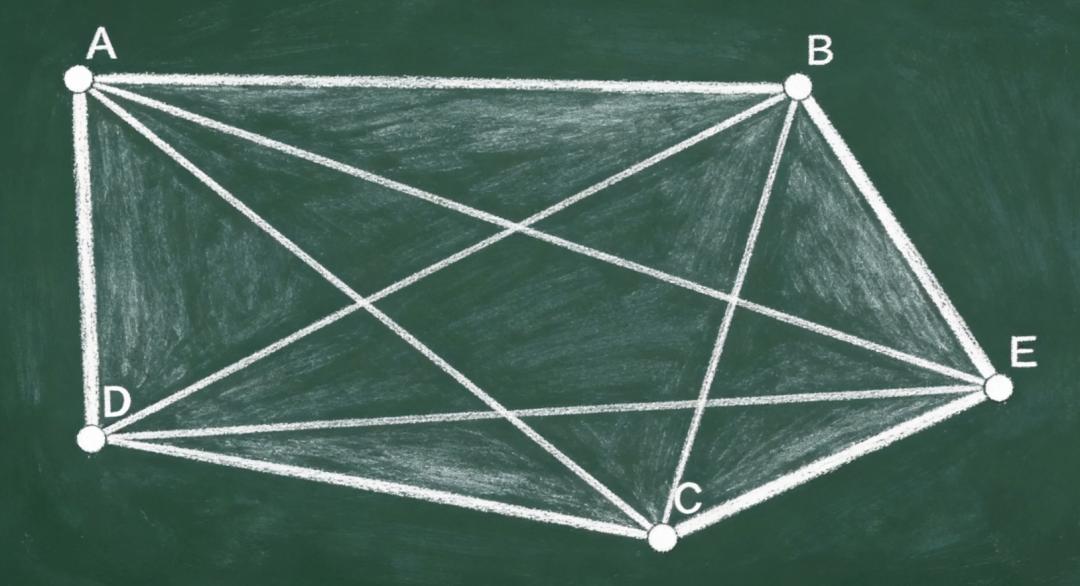
"OpenAI's mathematics team has professionals who deeply understand mathematical research. This team obviously spent a lot of time selecting which unsolved mathematical problems were potentially solvable. From the selected problems, they further carefully picked several problems that were most likely to yield results, simple enough for the public to understand, and sufficiently compelling to mathematicians", analyzed Li Xinyi, associate professor at the International Center for Mathematical Research of Peking University.
"They even had to consider that the proof should not be too long, so that mathematicians would not take half a year to review it."
The counterexample to the Jacobian conjecture proposed by Anthropic Fable 5 is even more concise, consisting of only a few lines of equations, making it very easy for other mathematical researchers to verify.
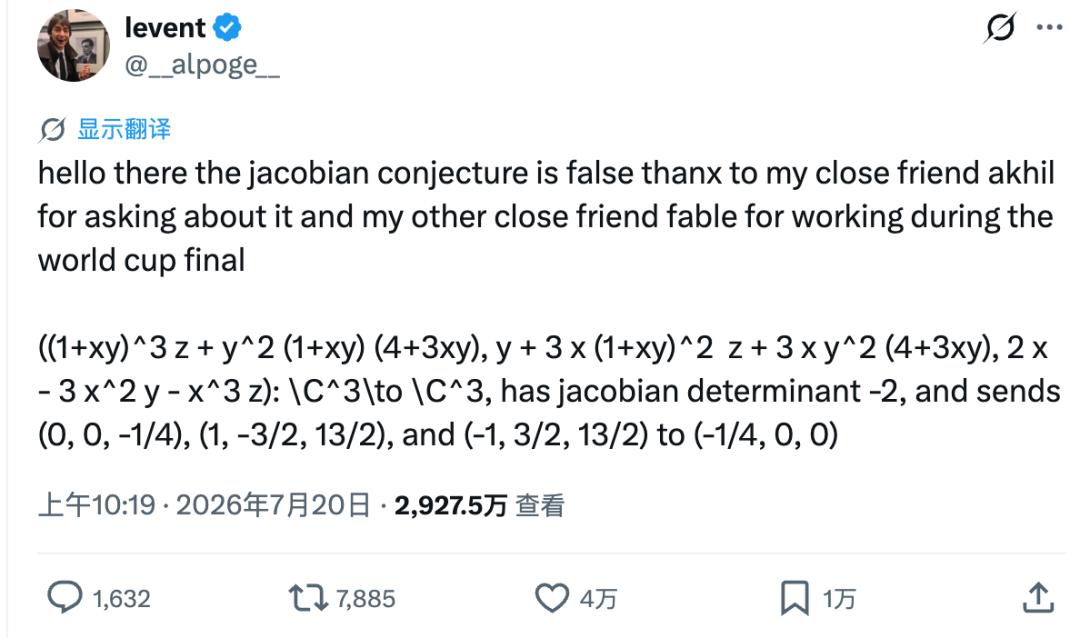
Levent's original tweet 丨 x.com
Yes, researchers must take "human-friendliness" into account.
AI Still Cannot Abandon Humans for Now
When an AI using a large language model writes some reasoning that "seems very reasonable", it is very difficult for the AI itself to confirm whether it has made any mistakes.
OpenAI used a general reasoning model. After receiving the problem, it generated a very long chain of thought in natural language (i.e., language that humans can read), with each sub-Agent handling a short natural language argument, connected in a chain, before finally arriving at a result.
However, natural language reasoning has an inherent weakness: the model may make a small mistake at a certain step in the reasoning chain, which eventually leads to a major error. So OpenAI invited 9 top mathematicians to manually review the proof. These mathematicians not only verified its correctness, but also significantly improved the original proof to make it more concise and general. Thomas Bloom, maintainer of the Erdős problem database, commented: "Humans still play a key role in discussing, digesting, improving this proof, and exploring its consequences."
During the reasoning process of DeepMind's AlphaProof Nexus, it temporarily got rid of relying on "humans" to prove its correctness using the Lean language; humans only confirmed the mathematical significance of the final result.
- The large language model generates proof steps in the formal Lean language;
- The Lean compiler checks whether each step is valid; if a step fails, Lean returns an error message, and the model makes corrections accordingly;
- This cycle repeats until success.
The idea of verifying everything with Lean sounds wonderful, but it is far from being fully practical. Simply put: the Lean language is strict and verbose, making it difficult for humans to directly write or understand, requiring "translation". However, the infrastructure of "translating existing mathematical theorems" is still far from complete.
Is AI's Mathematical Ability Superior to Humans?
Let's start with the conclusion: AI is not currently smarter than humans. It simply has no disciplinary barriers, no authority bias, and achieves results through massive computing power.
The AI proved that Erdős was wrong and that the Jacobian conjecture has a counterexample, rather than following the psychological inertia like most people, who, when facing an old conjecture by a legendary mathematician, try to prove he was right. It also has more patience to repeatedly attempt than those who try to find counterexamples.
AI is a "generalist", which also makes humans admire it. The unit distance problem solved by OpenAI in May belongs to the field of geometry, and the key to its success is that it introduced a seemingly unrelated tool from number theory in the field of algebra. It should be noted that modern mathematics is highly specialized; mathematicians studying combinatorial geometry usually do not delve deep into number theory, and vice versa. The distance between these two fields is like asking a cardiac surgeon to think of using immunological methods to treat diseases.
However, AI currently lacks the insight and exploration ability to advance in new directions. Li Xinyi gave this metaphor:
"If human mathematical knowledge can be compared to a concave-convex polygon, with the unknown part outside, a top mathematician may push the boundary far away at one sharp corner; a great mathematician like Hilbert can even go very far in several directions; and most of the time, the majority of mathematical workers fill in the concave parts — which is mathematically called 'taking the convex hull'.
"At this stage, the mathematical AI in the 'big news' is nothing more than turning knowledge into the convex hull of knowledge, rather than exploring further in unknown directions."
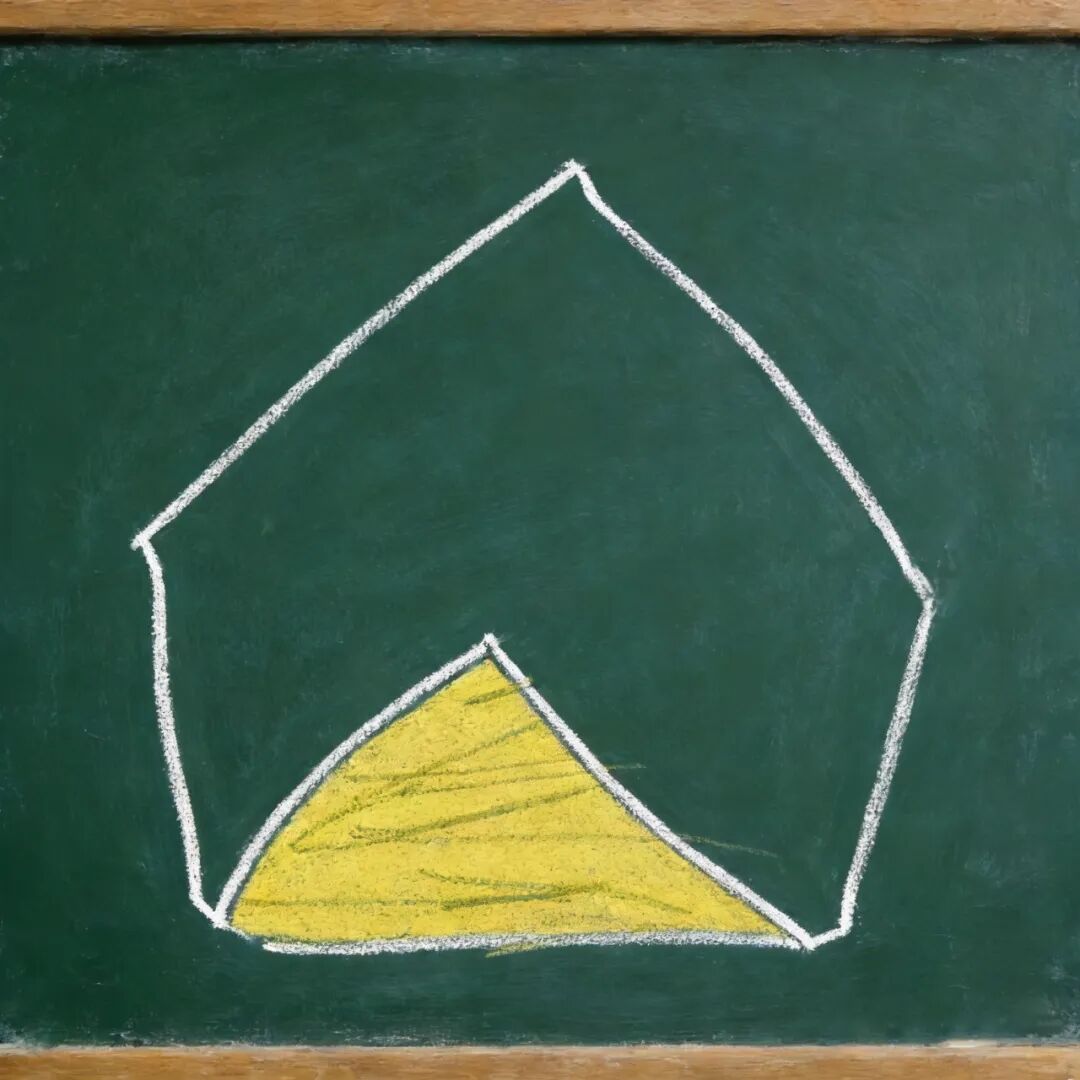
The yellow part is the "filling gap" work of AI
If one day AI masters the ability to move outward, it may indeed truly comprehensively surpass humans.
Mathematicians Foresee Numerous Crises
On June 2, 2026, 16 researchers from 15 universities released the Leiden Manifesto on AI and Mathematics. This manifesto received official support from the International Mathematical Union (IMU), and renowned mathematicians such as Terence Tao and Peter Scholze also publicly signed it.
The manifesto does not oppose the use of AI, and it also encourages mathematicians to understand emerging technologies. What it worries about is that in the process of using AI to generate results faster and more abundantly, some basic values of the mathematics community may be undermined.
The most immediate problem is that AI can quickly generate a large number of "seemingly correct" proofs, which may hide errors that are extremely difficult to detect. It only takes a few hours for AI to "complete" a proof; carefully reviewing it takes weeks or even longer. The number of mathematicians capable of reviewing papers is extremely limited, and the explosion of AI achievements will lead to "indigestion" in the peer review system; if a large amount of AI reasoning is directly published in the form of preprints or even press releases, it will be seriously misleading and take up space for truly valuable discoveries.
This concern was even immediately verified. Just a few days ago, when OpenAI launched GPT 5.6 Sol, it released a press release announcing that it had solved a mathematical problem that had been sealed away for 50 years. However, this achievement was not confirmed by external mathematical experts.
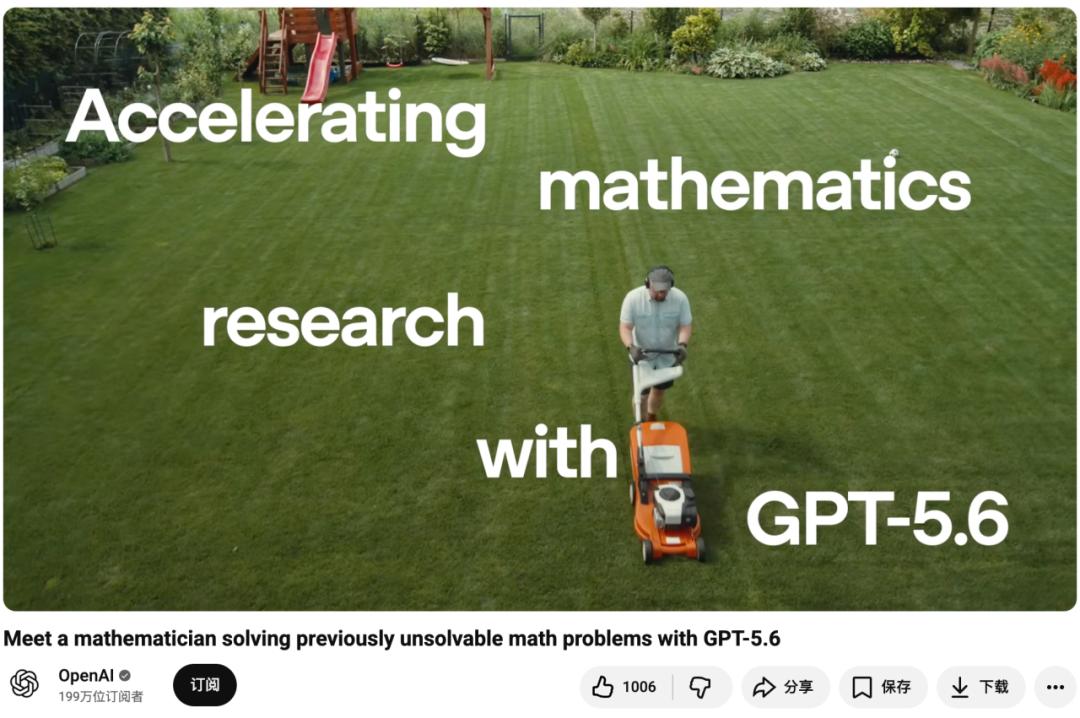
OpenAI also did not explain how much human labor was involved between "the agent solving the problem" and "the final 3-page result" 丨 OpenAI
Another issue is the attribution of achievements. Mathematical AI is built on a large number of previous research results, but when outputting, it often cannot reasonably attribute credits to contributors, which is unfair to mathematicians. Some training data also involves the use of papers and databases without permission, leading to new copyright disputes. And if mathematicians collaborate with AI to produce new mathematics, does this achievement belong to humans or AI?
The Manifesto also raises a more hidden threat: technology companies may begin to influence the orientation of the mathematics community. AI companies tend to work on problems that are "easy to do" rather than those with "profound significance". Against the backdrop of tight university budgets, this may change the incentive mechanism, implicitly encouraging researchers to engage in unequal collaborations with technology companies. If left uncontrolled, it may undermine the existing recruitment, funding, and recognition mechanisms, threaten the autonomy of researchers, and even affect the scope and depth of mathematical research itself.
Guokr
The value of mathematics is not just about getting more answers. It also includes understanding why answers hold true, determining which problems are important, and discovering new research directions from old knowledge. These abilities are formed through long-term discussions, debates, and inheritance within the mathematical community, and cannot be easily measured by "how many problems have been solved".
Therefore, the Leiden Manifesto on AI and Mathematics requires researchers to disclose their use of AI and computing resources, adhere to peer review, have human authors take responsibility for correctness and citations, and build public computing facilities independent of commercial companies.
What mathematicians want to defend is not just their own work. They also want to defend the right to decide "what mathematics is worth doing".
Thanks to Associate Professor Li Xinyi from the International Center for Mathematical Research of Peking University for his support of this article.
References
1. [1] Anthony Ha. OpenAI’s ‘embarrassing’ math. TechCrunch, October 19, 2025. https://techcrunch.com/2025/10/19/openais-embarrassing-math/
2. [2] Matthias Bastian. Leading OpenAI researcher announced a GPT-5 math breakthrough that never happened. The Decoder, October 18, 2025. https://the-decoder.com/leading-openai-researcher-announced-a-gpt-5-math-breakthrough-that-never-happened/
3. [3] Tony Feng et al. Semi-Autonomous Mathematics Discovery with Gemini: A Case Study on the Erdős Problems. arXiv:2601.22401v2. https://arxiv.org/html/2601.22401v2
4. [4] Tony Feng et al. Towards Autonomous Mathematics Research. arXiv:2602.10177v3. https://arxiv.org/html/2602.10177v3
5. [5] Rubin Pillay. The Aletheia Moment: Why Dismissing AI Reveals Fundamental Misunderstanding. Substack, February 17, 2026. https://rubinpillay.substack.com/p/the-aletheia-moment-why-dismissing
6. [