Sniping AMD's AI Conference? Nvidia Preemptively Discloses New Details of Vera CPU
On the eve of AMD's "Advancing AI 2026 Conference", NVIDIA pre-emptively unveiled more technical details of its data center CPU product, Vera.
This is not just another major strategic move by NVIDIA in the CPU space following Grace, but a complete unveiling of its vertical integration strategy shifting from "selling graphics cards" to "selling AI factories" —
Vera is the world's first processor purpose-built at the core level for Agentic AI.
NVIDIA also revealed that Vera Rubin NVL72 has entered the production ramp-up phase, with the platform's supply chain spanning over 350 factories across 30 countries and involving more than 300 partners.
Full Details of the Olympus Architecture Unveiled
On July 21 local time, NVIDIA published a blog post detailing the Vera CPU from a technical perspective.
The article points out that Agentic AI shifts more critical execution paths to the CPU.
Agents run code in sandboxes, invoke tools, retrieve context, interact with databases, analyze results, and then return information back to the model.
This process means the CPU is no longer merely an "auxiliary accelerator" but has become the core executor of control-intensive loops in the AI factory.
Agentic AI workloads primarily rely on:
Sustained strong single-threaded performance even when the socket is fully loaded;
Sufficient memory bandwidth per core to ensure data for multiple active execution contexts;
Predictable latency under concurrency, enabling agents to reliably complete predefined steps;
Efficient handling of irregular control flows, long dependency chains, and pointer-intensive data structures.
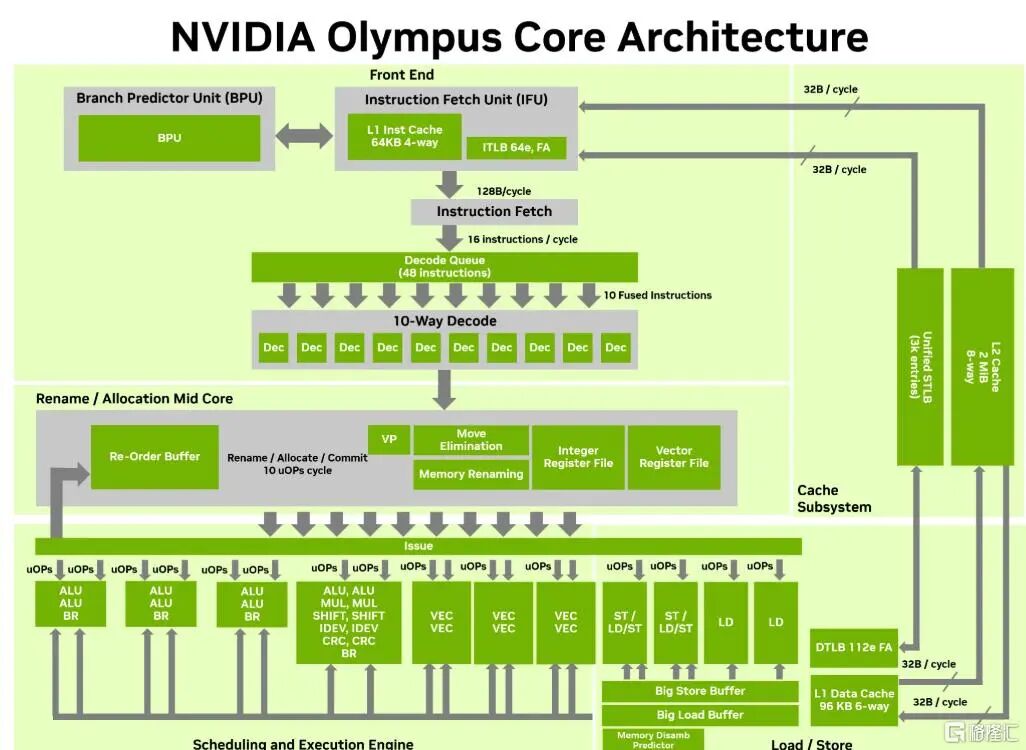
NVIDIA emphasizes that the Vera CPU is designed around agentic AI workloads, with a focus on boosting single-threaded performance under full-load conditions, centered on the Olympus core.
To address the complex branch prediction challenges of agents, the Olympus core introduces a key breakthrough technology: the Neural Branch Predictor.
Paired with a 10-wide decode engine, it efficiently handles the complex logic during agent runtime.
A single Vera integrates 88 such cores, supporting 176 threads, with its design clearly prioritizing "wide issue, deep pipeline" architecture.
In addition, Vera is the first processor to support FP8 precision directly in its CPU cores, further breaking down the numerical computing barriers with GPUs.
Beyond computing power, memory bandwidth is often the hidden bottleneck for concurrent agent execution.
Vera adopts the innovative SOCAMM2 LPDDR5X memory solution, delivering an astonishing 1.2TB/s of bandwidth.
This is double that of traditional DDR5 servers, while consuming less than half the power of the latter.
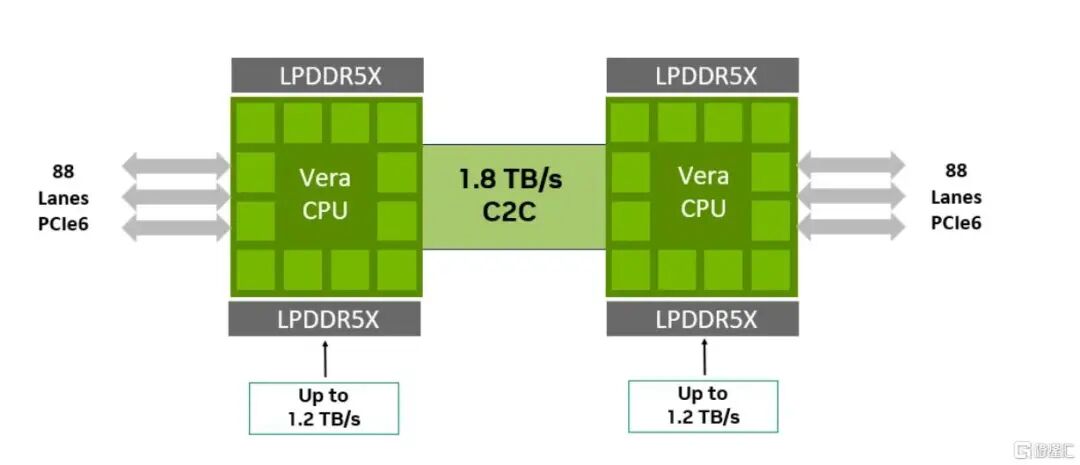
In testing, Vera maintains 90% of its peak bandwidth, ensuring that data supply never falls behind even when thousands of agents run concurrently.
According to NVIDIA's published benchmarks, Vera delivers significant optimization effects for agentic workloads:
Single-threaded Performance: Under full load, Vera's single-core performance reaches 1.8 times that of traditional x86 CPUs
Task Efficiency: Comprehensive performance of AI agent tasks improves by approximately 50%, with notably faster execution speeds in sandbox environments.
Concurrency Capability: Supports up to 1.6 times more concurrent agents running, with orchestration speeds improved by up to 2.2 times.
Compilation Speed: A single Vera compiles the Linux kernel in approximately 20 seconds, with per-core compilation efficiency roughly twice that of a top-tier 128-core x86 server.
NVIDIA's New Growth Curve
For a long time, the market has firmly labeled NVIDIA as a "GPU giant", but looking at its latest financial reports and product roadmaps, a new signal has been released —
It is systematically moving away from reliance on single GPU sales, and its full-stack layout around AI infrastructure has opened multiple new revenue streams beyond GPUs.
Among these, the networking interconnection business is the fastest-growing curve.
In the first quarter of fiscal 2027, NVIDIA's data center networking revenue hit a record $14.8 billion, surging 199% year-over-year.
As AI clusters scale from thousands of GPUs to hundreds of thousands, NVLink, InfiniBand, and Spectrum-X have become essential requirements for building "AI factories".
The networking business now accounts for approximately 20% of total data center revenue, marking that NVIDIA is no longer just a company selling computing power, but one selling "connectivity", locking in system-level competitiveness through physical interconnection barriers.
Following closely behind is its in-house CPU business. With the agentic AI-specific Vera CPU delivered to leading customers like OpenAI and Anthropic in June 2026, NVIDIA has officially entered the server CPU heartland long dominated by Intel and AMD.
Jensen Huang once stated: "Vera opens up an entirely new market. Every moment an agent waits for the CPU, the most expensive component in the entire facility — the GPU — is sitting idle."
NVIDIA built a brand new, agent-focused CPU from scratch.
This is a new market. Agent CPUs require ultra-fast responsiveness, and there will be billions of agents in the future that need CPUs built specifically for them.
NVIDIA's Vice President and CFO Colette Kress previously disclosed that NVIDIA's total CPU revenue in fiscal 2027 is expected to approach $20 billion, positioning NVIDIA to become a leading global CPU supplier.
In the future growth narrative, the ramp-up of the Vera CPU and Rubin GPU will be the primary growth drivers.
This article is from the WeChat Official Account "Gelonghui APP" (ID: hkguruclub), authored by Gelonghui Editor, and published with authorization from 36Kr.