Latest position adjustments of top star public fund managers: Zhang Kun reduced his holdings in baijiu, Li Xiaoxing "chases the light"
As the disclosure of Q2 2026 fund reports enters its peak period, the position adjustment paths of a number of star fund managers have gradually emerged. Products anchored to the technology mainline have achieved significant excess returns, while those adhering to traditional value sectors face net value drawdown pressure.
In the second quarter of this year, the A-share market showed distinct "K-shaped" divergence characteristics. The Shanghai Composite Index closed up 5.20%, the CSI 300 Index rose 11.90%, and the ChiNext Index surged by 36.35%. The technology sector, especially the AI infrastructure segment, enjoyed booming prosperity, while traditional pro-cyclical and domestic demand sectors faced pressure.
Under the extremely divergent market style, public offering star fund managers have different focuses in their investment strategies. From the perspective of positions, Zhang Kun increased his allocation to technology and reduced exposure to consumer sectors, drastically cutting holdings in baijiu and Hong Kong-listed internet stocks; Li Xiaoxing completely overhauled his portfolio, showing a strong preference for the technology track covering leading optical module makers such as Zhongji XuChuang and Eoptolink; Liu Gesong heavily invested in AI computing power and the semiconductor industry chain.
1
Zhang Kun Reduces Holdings in Baijiu and Hong Kong-listed Internet Stocks
Zhang Kun currently manages 4 funds, with a peak management scale reaching hundreds of billions of yuan, and is undoubtedly one of the most well-known fund managers in the public offering fund industry.
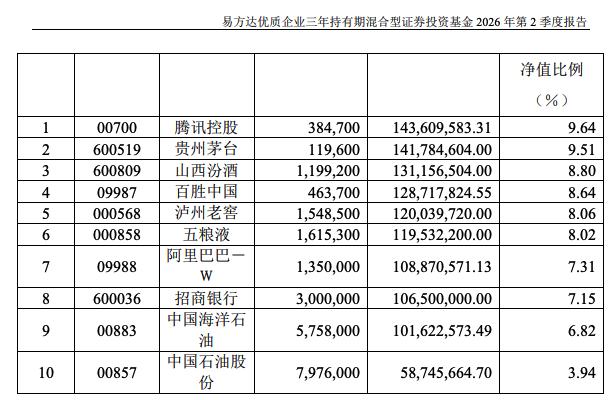
Image source: Q2 fund report
The E-Fund Premium Enterprise Three-Year Holding Period Mixed fund better reflects Zhang Kun's personal position adjustment ideas. The fund only added Zhang Qi as a co-fund manager on June 27 to jointly manage the product. According to the Q2 fund report disclosed on July 21, 9 of the top 10 heavyweight stocks were reduced by 10% to 30%. The "four major baijiu giants" — Kweichow Moutai, Shanxi Fenjiu, Luzhou Laojiao, and Wuliangye — had their holdings cut by 28,400 shares, 192,800 shares, 491,500 shares, and 454,700 shares respectively, with reduction rates of 19.19%, 13.85%, 24.09%, and 21.97%; Hong Kong-listed internet leaders Tencent Holdings and Alibaba-W were sold off by 102,300 shares and 510,000 shares respectively, with reduction rates reaching 21.01% and 27.42%; Yum China, China Merchants Bank, and CNOOC saw their holdings reduced by 23.78%, 37.50%, and 29.35% respectively.
E-Fund Blue-Chip Selected Mixed, the fund with the largest scale, added a new fund manager in May, but its position adjustment ideas are roughly the same. As of the end of the second quarter, the top seven heavyweight stocks were Tencent Holdings, Kweichow Moutai, Yum China, CNOOC, Luzhou Laojiao, Wuliangye, and Shanxi Fenjiu in sequence, with reduction rates of 47.98%, 47.13%, 46.34%, 41.40%, 51.76%, 70.68%, and 70.91% respectively during the reporting period; Alibaba-W, which ranked as the 10th largest heavyweight stock, had a reduction rate as high as 75.40%, with the remaining position market value only 466 million yuan; at the same time, two tech growth targets — SMIC and Dongshan Precision — both newly entered the top 10, with their stock prices rising by 76.33% and 153.97% respectively in the second quarter.
E-Fund Asia Select, managed solely by Zhang Kun, drastically reduced its holdings in South Korean semiconductor stocks in the second quarter. Although Samsung Electronics and SK Hynix were reduced by 39.48% and 56.36% respectively, they still ranked as the first and second largest heavyweight stocks.
"From various economic data such as social retail and employment, the downward pressure on the economy has exceeded expectations," Zhang Kun's team analyzed in the Q2 report. In the second quarter, listed companies with main exposure to domestic demand generally faced high operating pressure, and their stock prices experienced a double decline in performance and valuation. The current valuation level of domestic demand companies does not match the development space of a developing country that is moving toward a moderately developed country.
2
Li Xiaoxing Completely Overhauls His Portfolio
In the second quarter of 2026, Li Xiaoxing, a well-known fund manager under Yinhua Fund, carried out drastic adjustments to his portfolio.
Taking Yinhua Small and Mid-cap Mixed A, which has the largest scale, as an example, the fund operated at a high position in the second quarter, with a net value growth rate of 90.97% during the reporting period. Among the top 10 heavyweight stocks, only Dongshan Precision was retained, and the other 9 stocks were all replaced. Shennan Circuits, Sanhuan Group, Zhongji XuChuang, Zhongtian Technology, Hengtong Optic-Electric, Eoptolink, Lumentum, Yongding Co., Ltd., and Defu Technology are all new additions, which can be described as "standing in the light of the optical communication track".
Coincidentally, Yinhua Xinjia Two-Year Holding Period Mixed achieved a net value growth rate of 39.17% during the reporting period, with half of its top 10 heavyweight stocks replaced. Stocks such as Hygon Information, Alibaba-W, Zhangyuan Tungsten, China Coal Energy, and GigaDevice exited the top 10 heavyweight list, while Eoptolink, Zhongji XuChuang, Luxshare Precision, Industrial Foxconn, and Shennan Circuits are new entrants. Among them, the two leading optical module makers — Eoptolink and Zhongji XuChuang — have position market values as high as 465 million yuan and 435 million yuan respectively, ranking as the top two heavyweight stocks.
In the investment strategy and operation analysis section of the Q2 report, Li Xiaoxing's team also submitted a nearly 1,800-word "substantial analysis". Looking ahead to the second half of the year, Li Xiaoxing's team believes that the overall market risk is not significant. Although some sub-segments in the technology sector show overheating tendencies, if the expected rate of return is not overly high, a large number of targets that can contribute absolute and relative returns in the medium and long term can still be selected across the entire market. The AI narrative remains strongly resilient, and the sector can still be kept in an overweight state in the overall portfolio, while investment opportunities in other sectors are gradually emerging.
3
Liu Gesong Heavily Invests in AI and Semiconductor Sectors
Liu Gesong, who heavily invests in the technology track, has ushered in a "harvest season". The total scale of the 4 funds he manages (calculated by merging different share classes) reaches 25.735 billion yuan, all of which recorded positive returns in the second quarter, significantly outperforming their benchmarks.
GF Technology Pioneer Mixed, the fund with the largest scale, is managed solely by Liu Gesong. As of the end of the second quarter, its top 10 heavyweight stocks are GigaDevice, Cambricon, Eoptolink, Dongshan Precision, Zhongji XuChuang, SMIC, SGMICRO, Shengyi Technology, Naura, and Northern Huachuang, which are concentrated in the AI computing power and semiconductor industry chain.
Compared with the previous quarter, Cambricon, Eoptolink, SMIC, and Naura were increased in positions, with increase rates of 19.18%, 28.36%, 17.68%, and 36.14% respectively; Dongshan Precision and Zhongji XuChuang were reduced by 4.0878 million shares and 296,000 shares respectively, with reduction rates of 53.71% and 29.38%; the newly added heavyweight stocks mainly include GigaDevice, SGMICRO, and Northern Huachuang, all from the semiconductor sector.
In the Q2 report, Liu Gesong stated that when looking for investable industries from the perspective of supply and demand patterns in the first half of the year, he found that AI-related industries are still in a stage of rapid demand explosion, with a stable supply pattern, and market share may further concentrate on leading companies. Analyzing from the dimensions of industry prosperity and supply-demand patterns, he believes that AI-related industries are the most worthy investment direction in the second half of the year and even next year. If we still use the past mean reversion framework to view this round of industrial trend, we will miss the dividends of the times.
Looking ahead to the market, Yang Delong, chief economist of Qianhai Open Source Fund, told Times Finance that the CSRC recently held an institutional symposium, releasing its determination to stabilize the market, and financial institutions including insurance companies have entered the market one after another. Driven by multiple favorable policies, technology stocks rebounded sharply on July 21. Although this does not necessarily mean that the market has reversed, at least market confidence has been effectively boosted, laying a solid foundation for a new round of market rally in the future.
Yang Delong pointed out that from the market perspective, after nearly a month of adjustment, many technology stocks have accumulated a decline close to 50%, which has basically digested a large number of previous profit-taking orders. In the second half of the year, the market is expected to evolve from the technology sector "standing out alone" to multi-sector linkage, and the market's profit-making effect may further spread.
This article is from the WeChat official account "Times Finance APP" (ID: tf-app), written by Qiu Li and Wen Siting, edited by Wen Siting, and published with authorization from 36Kr.