Anthropic is mass-producing its own Lei Zhang and Xu Xin
In 2023, Yasmin Razavi made a remarkably bold decision.
Representing Spark Capital, she invested 75 million USD in an AI company that at the time had almost no revenue and no mature products.
The company was called Anthropic.
In just three years, the book value of that investment has seen a staggering change. According to a July 18 report from The Wall Street Journal, calculated based on Anthropic's latest valuation, the Anthropic shares held by Spark Capital are worth approximately 7 billion USD.
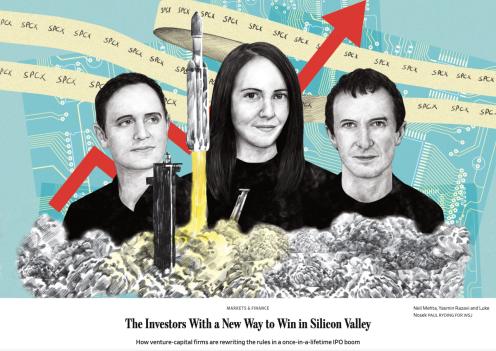
A 75 million USD investment has generated a near-hundredfold book return.
Stories like this were once familiar during the era of China's internet.
In 2010, when HSG's Zhang Lei invested in JD.com, the e-commerce firm had yet to prove it could grow into an industry giant. Back then, JD.com originally planned to raise roughly 75 million USD, but Zhang Lei believed that the core of future e-commerce competition would not be traffic alone, but supply chain and logistics capabilities. This ultimately led HSG to invest 300 million USD. Later, this deal became one of HSG's most iconic success stories.
Xu Xin's investments in NetEase and JD.com also took place when the two companies had not yet gained full market recognition. When she invested in NetEase in 2000, China's internet was in the trough following the dot-com bubble burst. NetEase's stock price plummeted sharply, and the market was deeply skeptical about the future of internet companies. But she believed in the long-term value of internet user growth and business models, and ultimately reaped substantial returns.
Today, Anthropic is creating its own "Zhang Lei and Xu Xin" generation of investors.
Yasmin Razavi at Spark Capital is betting on the exact same kind of opportunity: a company that has not yet proven its commercial value has the potential to become the next generation of technological infrastructure.
01
From 75 Million to 7 Billion
In early 2023, almost the entire AI industry's attention was focused on OpenAI.
ChatGPT had just launched a few months prior and quickly became a global phenomenon. Microsoft announced additional investments in OpenAI, and Silicon Valley investors began reassessing the opportunities brought by generative AI.
From investors' perspective, OpenAI possessed nearly all the advantages of a leader: it was the first to make the public recognize the value of large language models, had the strongest brand influence, and secured multi-billion-dollar support from Microsoft.
In many ways, OpenAI was on track to become the very definition of the AI era at that time.
In comparison, Anthropic did not have the influence it commands today. Founded in 2021 by former OpenAI researchers, the company aimed to develop safer, more reliable large language models. But from an investor's point of view, a noble mission does not equal proven commercial value.
In early 2023, Anthropic was still a company that needed to prove itself. It had a top-tier research team and had developed its own large model, Claude, but it was still far from being a fully mature commercial enterprise.
According to The Wall Street Journal, Yasmin Razavi conducted in-depth research on the AI industry before deciding to invest in Anthropic.

What she focused on was not short-term model rankings, but the long-term industrial structure. In her view, large language models would not just be ordinary software products — they could become critical infrastructure for the future tech industry.
If this judgment held true, then the key competition among model companies would not simply be about who has more users today. It would also mean that even if one model company had taken the lead, the market would still have room for other important players.
After months of discussions, Yasmin Razavi, on behalf of Spark Capital, led Anthropic's Series C financing, injecting 75 million USD into the company.
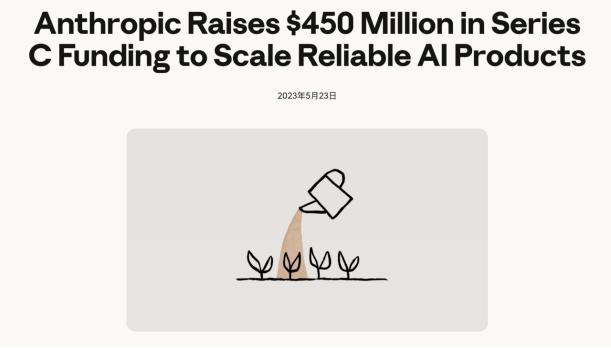
In the following years, Anthropic's development gradually validated Razavi's judgment about the AI industry landscape.
In 2023, Anthropic launched Claude 2 and further opened its API services to start exploring the enterprise market. In the same year, Amazon announced a 4 billion USD investment in Anthropic, integrating Claude as a core component of AWS's AI services. Google also continued to increase its investments and established cloud computing partnerships with Anthropic.
Continuous bets from capital and industry giants gave Anthropic the funding and computing power required to train cutting-edge models.
At the same time, Anthropic has blazed a distinct commercial path separate from OpenAI.
If ChatGPT first proved that large models could serve as consumer-facing products for the general public, Anthropic is working to demonstrate that AI can also function as essential infrastructure embedded in enterprise workflows.
Claude has gradually been adopted for enterprise use cases such as software development, knowledge management, and research analysis. According to Anthropic, as of October 2025, over 300,000 enterprise customers are using Claude. Among them, the number of large clients contributing more than 100,000 USD in annual revenue has surged nearly 7 times over the past year.
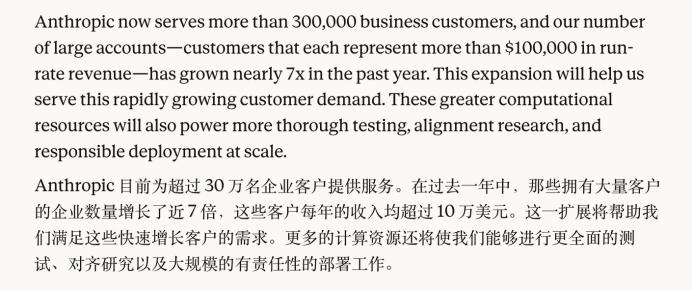
This shift has begun to reshape the market's perception of Anthropic: it is no longer just a follower chasing OpenAI, but a foundational model company that is building its own strong position in the enterprise AI market.
As Claude continues to grow in the enterprise space, Anthropic's commercial value has been revalued by the capital market.
In May 2026, Anthropic completed its 650 billion USD Series H financing, pushing its post-money valuation to 965 billion USD — exceeding OpenAI's then-valuation of around 852 billion USD, making it one of the highest-valued native AI companies in the world.
According to The Wall Street Journal, calculated based on Anthropic's latest valuation, the Anthropic shares held by Spark Capital are worth approximately 7 billion USD — back in 2023 when Spark made its investment, Anthropic's valuation was only around 4 billion USD.
The book value of that 75 million USD investment has grown nearly a hundredfold.
This is far more than a simple story of investment returns. More importantly, Razavi correctly identified Anthropic's unique position in the AI industry ecosystem.
02
Anthropic Is Producing a New Generation
of "Zhang Lei and Xu Xin" Investors in the AI Era
Spark Capital is not the only institution that placed a bet on Anthropic.
As Claude has increasingly become one of the most important foundational models outside of OpenAI, a growing number of investors and industry giants have joined this high-stakes AI gamble.
Their investment rationales are not identical: for venture capital firms, the key is to judge whether Anthropic has the potential to evolve from a technology startup into a major platform of the AI era. For tech giants, investing in Anthropic is intertwined with competition over computing power, cloud services, and the broader AI ecosystem.
Their common ground lies in placing early bets on Anthropic's potential to become a major AI player, long before the company had fully proven its commercial value.
A typical example is another group of early VC firms — alongside Spark Capital, Menlo Ventures is also one of the biggest winners in Anthropic's rise, with a story that is even more dramatic.
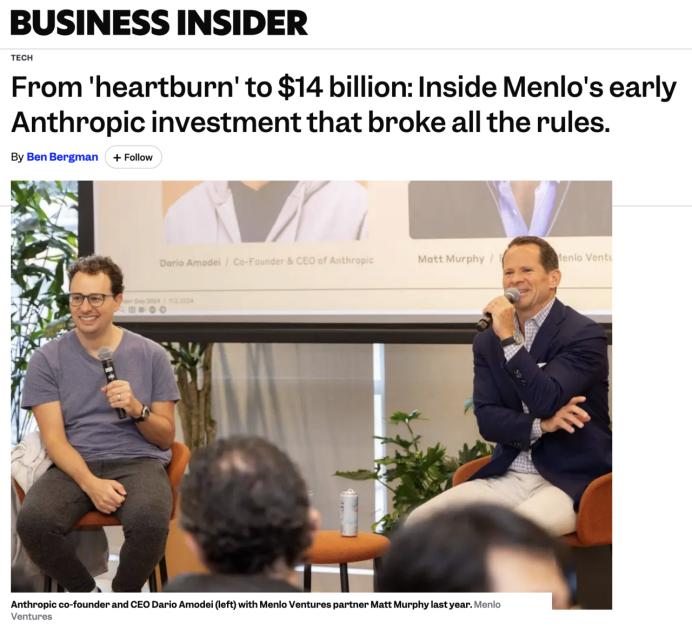
According to Business Insider, Menlo partner Matt Murphy was impressed by the team and their technical direction after a brief conversation with Anthropic CEO Dario Amodei, but there was still internal hesitation at the firm.
Ultimately, Menlo participated in Anthropic's Series C financing, but chose not to lead the round. Its competitor Spark Capital seized the opportunity and stepped in as the lead investor.
Looking back years later, Murphy admitted it was a regrettable decision: "I wish we had broken some of our rules in the Series C round."
Because the facts proved that Spark's bet paid off handsomely.
But Menlo did not completely miss Anthropic. A year later, during Anthropic's Series D financing, Menlo decided to increase its stake, leading the round and writing the largest check in the firm's history. Due to limits on single-investment sizes, Menlo even raised additional funds through a special purpose vehicle (SPV) to expand its investment scale.
Murphy believes that even when a market already has a clear leader, extremely valuable challengers can still emerge.
Today, that investment has become one of the most significant bets in Menlo's history. As Anthropic's valuation continues to surge, the book value of Menlo's Anthropic shares currently stands at approximately 14 billion USD.
For VCs of this type, the return logic generated by Anthropic is similar to the investment logic of backing companies like JD.com and Meituan during the internet era:
Acquire an equity stake before the company becomes an industry giant. If the judgment is correct, as the company grows, the early capital will generate returns far exceeding the market average.
For tech giants like Amazon and Google, the significance of investing in Anthropic is more complex. They are not simply betting on the growth of an AI company, but are also proactively securing positions in the race for AI infrastructure dominance.
In September 2023, Amazon announced a 1.25 billion USD investment in Anthropic, acquiring roughly a 10% stake in the company. Then, in March 2024, Amazon followed up with an additional 2.75 billion USD investment, bringing its total committed investment in Anthropic to 4 billion USD.
At the same time, Anthropic selected AWS as one of its primary cloud platforms, using Amazon's computing infrastructure to train and deploy the Claude model.
For Amazon, this was a two-pronged investment. On one hand, its ownership stake in Anthropic allows it to share in the AI company's growth dividends. On the other hand, by closely aligning with Anthropic, AWS has secured a key enterprise customer and a foothold in the AI application ecosystem of the new era.
The relationship between Google and Anthropic is more nuanced, as Google itself is one of the most critical competitors in the AI field.
From DeepMind to Gemini, Google has long invested in foundational model R&D and aims to maintain its technological leadership in the AI era. But at the same time, Google has also invested in Anthropic and become one of its most important cloud computing and computing power partners.
In early 2023, Google announced an approximately 300 million USD investment in Anthropic, acquiring roughly a 10% stake. In November of the same year, the two sides further expanded their partnership, with Google committing additional investments to bring its total cumulative investment to 2 billion USD.
Meanwhile, the two expanded their cloud collaboration: Anthropic would use Google Cloud infrastructure to train and deploy models, and deliver Claude services to enterprise customers through Google Cloud's Vertex AI platform.
In November of that year, Anthropic began using Google's latest generation TPU v5e accelerators for AI inference, while continuing to leverage related Google Cloud services. By 2025, Anthropic announced it would further expand its use of Google Cloud TPUs, planning to access up to 1 million TPUs to provide computing support for the future training and deployment of Claude models.
In other words, Google and Anthropic have a triple relationship: they are investor and investee, competitors, and critical strategic partners.
Historically, tech giants usually built competitive advantages through in-house R&D or acquisitions. But in the large model era, capital, computing power, and model capabilities have formed a far more complex web of relationships.
For both Amazon and Google, investing in Anthropic is not just a financial investment — it is a way to secure a place in the AI ecosystem for AWS and Google Cloud, against the backdrop of OpenAI and Microsoft forming a formidable AI alliance.
Additionally, among Anthropic's early investors, there is a very special wealth story tied to the "legacy" of FTX.
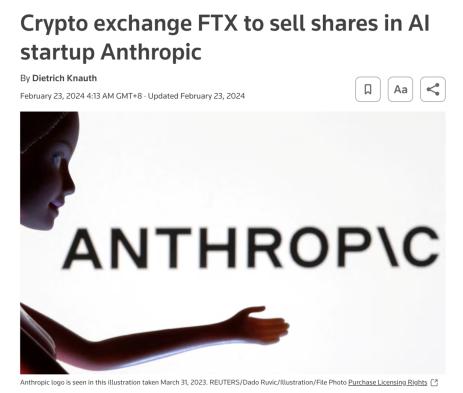
In 2021, funds under FTX invested approximately 500 million USD in Anthropic.
Back then, the hottest narrative in the capital market was still cryptocurrency. FTX was expanding at high speed, and Sam Bankman-Fried (SBF) had become one of the most high-profile figures in the crypto industry. In comparison, AI foundational models had not yet become the center of global capital pursuit.
No one expected the situation to completely change a few years later.
At the end of 2022, the FTX empire collapsed and entered bankruptcy proceedings. Meanwhile, Anthropic rose rapidly riding the generative AI wave.
The Anthropic shares held in FTX's bankruptcy estate transformed from an early-stage venture investment into one of its most valuable assets.
According to court documents, FTX and its affiliated Alameda Research previously invested approximately 500 million USD, holding roughly 7.84% of Anthropic's shares. In 2024, when FTX's bankruptcy management team sold these shares, the transaction value reached about 1.3 billion USD.
This investment became one of the few assets in FTX's bankruptcy estate that saw massive appreciation. It even carries a sense of generational transition: a company that rose to prominence during the cryptocurrency bubble and eventually collapsed left behind an AI investment that gained enormous value thanks to the next technological wave.
Of course, not all investors can obtain the same level of returns. The earlier you enter, the greater the potential return — and the higher the uncertainty you must bear.
When Spark invested in Anthropic in 2023, the company was valued at around 4 billion USD. Investors who entered later acquired shares at much higher prices, after Anthropic had already proven part of its commercial value.
This is the core logic of venture capital: The truly massive returns almost always belong to those who are willing to place their bets when the future is still uncertain.
This is what makes Anthropic's story so unique.
It has not only created an AI company valued close to a trillion dollars, but also generated a group of stakeholders whose wealth is tied to the company's success.