Just now, Nike announced the termination of Topsports' online distribution rights.
The rumors of Nike reclaiming online distribution rights from its authorized dealers have officially come to fruition.
On July 22, Topsports International issued an announcement stating that the company has received official notification from Nike, that starting from January 1, 2027, the Group's online platform sales of Nike products in mainland China will be fully terminated.
For Topsports, one of China's largest sports footwear and apparel retailers, this is no trivial channel adjustment. For the fiscal year ending February 28, 2026, online sales of Nike products contributed approximately 22% of Topsports' revenue. Topsports stated directly in the announcement that this termination will have a "significant negative impact" on the company's business in the short term, while the two parties will continue their offline sales cooperation.
Rumors of this channel adjustment began to circulate as early as a month ago. *Sports Business Watch* previously published an article on June 25 regarding Nike's plan to reclaim online first-tier dealer authorization. Less than a month later, the long-awaited development finally arrived.
Why does Nike want to redraw the online boundary with its dealers? How will this adjustment affect its price system and channel relationships in the Chinese market?
The following is the original article published by *Sports Business Watch* on June 25:
While re-embracing dealers, rumors are emerging that Nike will reclaim online distribution authorizations, and the brand is launching a set of channel "combination punches" in the Chinese market.
According to multiple media reports, starting from January 1, 2027, Nike plans to cancel online first-tier dealer authorizations. Once this is implemented, Nike products held by dealers at all levels will no longer be available on various e-commerce platforms, meaning that in the future, consumers will only have official flagship stores as their option to purchase authentic Nike products online. Topsports released an announcement after market close on June 25 stating that it has not received any official notification from the Nike Group regarding the termination of the brand's online distribution rights with the Group in mainland China. Pou Sheng International, another major Nike distributor in China, did not respond to market rumors.
For many years, Nike's business in China has operated on two networks. One is the self-controlled online ecosystem consisting of Nike's official platform website, official App, official self-operated stores on other platforms, and direct-operated physical stores; the other is a distribution network jointly supported by dealers such as Topsports and Shengdao, as well as downstream second-tier dealers and small and medium-sized sellers. The former focuses on brand image building, while the latter drives sales volume and inventory turnover.
Cutting off online distribution rights may seem like a simple channel adjustment, but at its core, it is a price defense battle.
Recapturing Online Pricing Power
This is not the first time Nike has made adjustments to its channels.
Several years ago, Nike promoted the global DTC (Direct-to-Consumer) strategy to reduce reliance on wholesale channels and draw more consumers into its self-operated stores. The goal of this strategy was clear at the time: direct sales mean higher gross margins, more complete user data, and stronger brand control.
However, Nike has been very restrained when it comes to its self-operated channels in the Chinese market, especially online. Nike did not start testing Douyin live streaming until 2024. Before that, Nike's relatively strong online self-operated channel in China was only its Tmall flagship store, which has extremely in-depth cooperation with the platform.
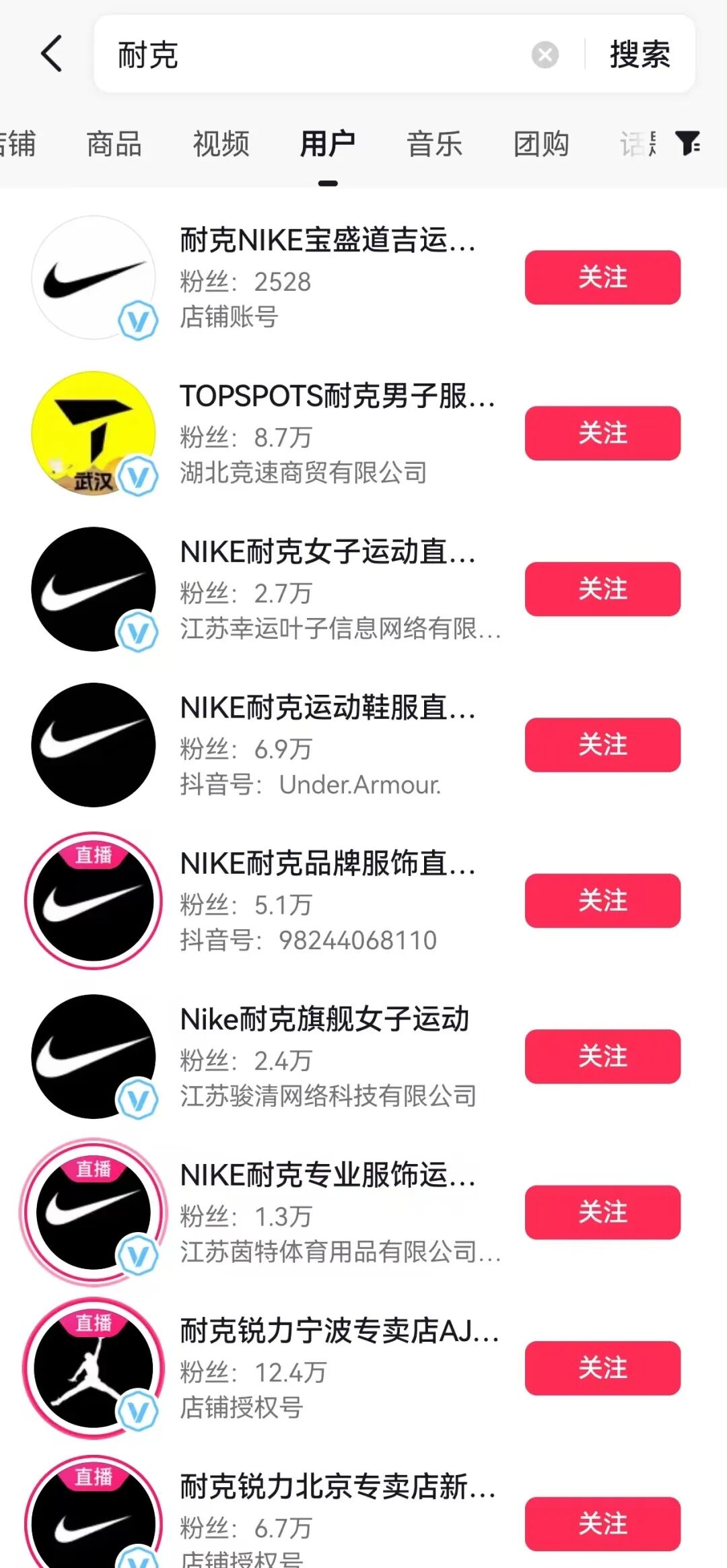
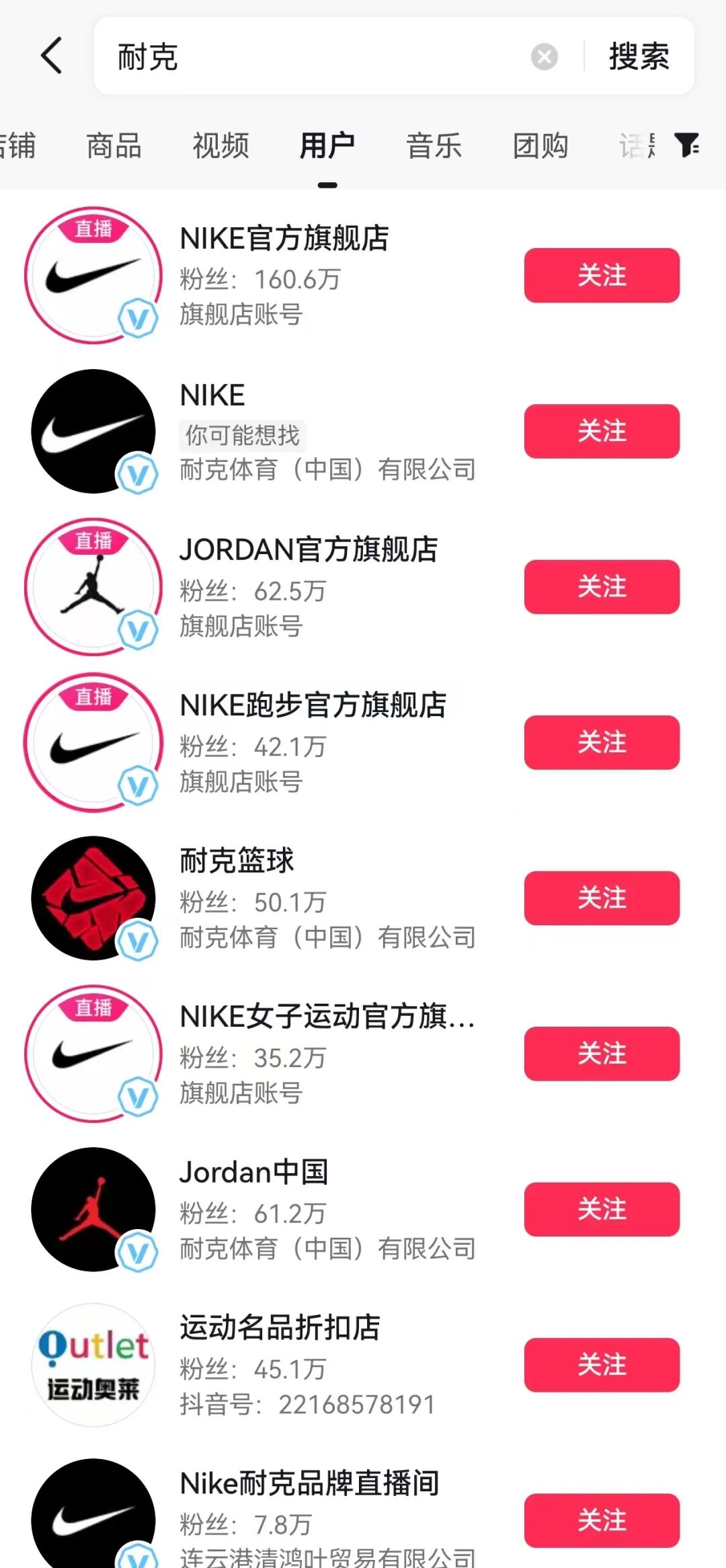
Searching for "Nike" on Douyin shows that after filtering by enterprise certification, there are still a large number of scattered sales channels on the platform outside of Nike's direct store system.
The reason is simple: China's e-commerce channels are extremely developed. Different consumers have different purchasing channels and shopping methods. For Nike, these scattered online shelves have helped it reach a wider range of Chinese consumers and built a richer sales network. Limited-edition products that are hard to buy through official channels are often bid up in price by dealers at all levels and the huge secondary market, enhancing brand value through a sense of "scarcity".
This state has persisted in the Chinese market for many years. When growth was ongoing, all parties could benefit: Nike gained sales volume and popularity, dealers made profits through product turnover, and consumers could find their preferred purchasing methods across different channels.
However, once the market enters a downward cycle, the original balance begins to loosen. First-tier dealers, second-tier dealers, small and medium-sized sellers, platform subsidies, and live stream promotions have become diverse. Especially under high inventory pressure, dealers at all levels naturally tend to exchange prices for cash flow, making discount clearance the most direct method.
In fact, there have been numerous cases in recent years where Nike's reissued shoe series failed to maintain their original price after launch. Not only have a large number of reissued shoes been sold off, but some classic models have also cooled down in the sneaker market, frequently appearing in discount sections.
This is the situation Nike is most reluctant to face right now: misalignment in brand perception has a more severe impact than declining revenue. The sense of scarcity that Nike has built up among young consumers over the years is being gradually diluted by increasingly frequent discounts.
Elliott Hill, Nike's CEO, also admitted on the second-quarter earnings call: "We have become a casual lifestyle brand competing through price wars in China."
Therefore, cutting off online distributors means bringing online shelves back to official stores, and putting discount rhythms, hit product supplies, and new product launches back under its own control. At least online, Nike hopes consumers will re-form the perception that if they want to buy new products or authentic products, they can only go through official channels.
Moreover, compared with third-party platforms like Douyin, Nike's previous online strategy seemed to place more emphasis on self-built platforms such as the Nike App, official website, and SNKRS App.
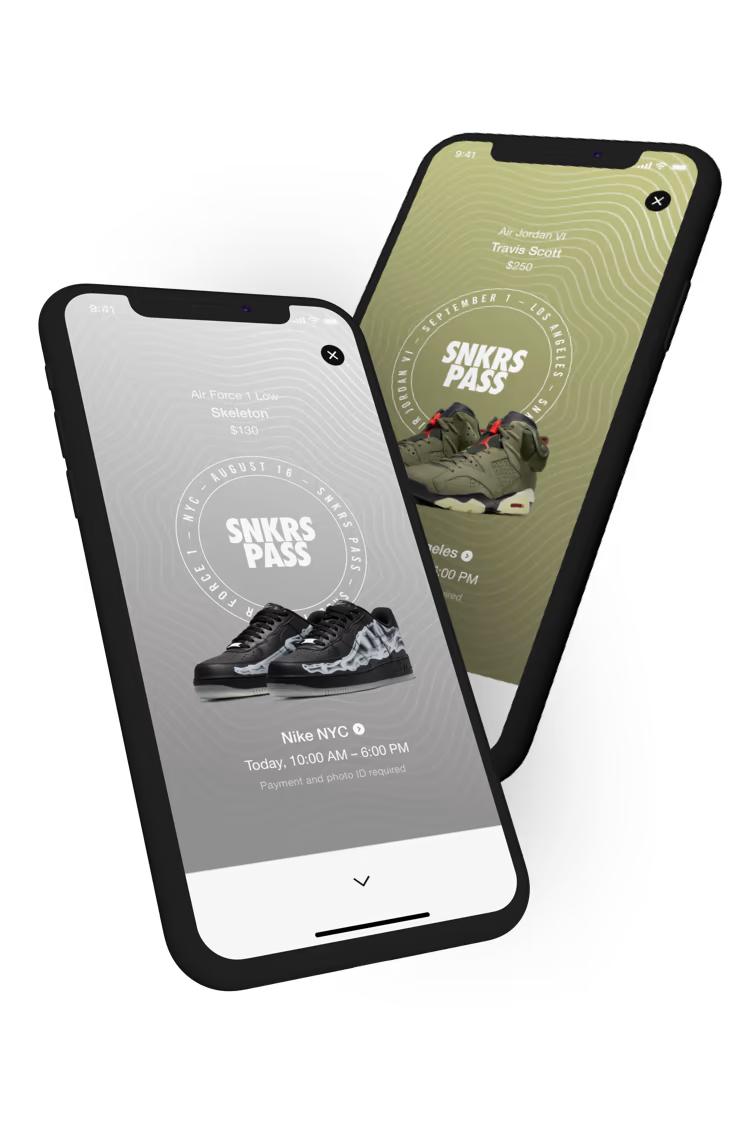
Sneaker enthusiasts are no strangers to the SNKRS App. During the sneaker resale boom from 2017 to 2022, limited-edition, collaborative, and popular sneakers saw their premiums continuously driven up, and SNKRS was one of Nike's most important self-owned launch platforms. Nike members could register for draws here to obtain purchase qualifications for popular sneakers. To a certain extent, SNKRS was once an important position for Nike to connect with "cultural consumers".
According to an official Nike statement disclosed by the media, the engineering teams of the Nike App and SNKRS have been merged into one team. This also means that in the future, Nike will further integrate its digital ecosystem resources to promote online retail and membership experiences in a more unified manner.
This also means that Nike will further integrate its digital ecosystem resources in the future to advance online retail and membership experiences in a more unified way. Cutting off online distribution rights is more about making room for Nike's own digital channels.
Dealers Are Forced to Seek "Nike Alternatives" Beyond Nike
In the past, large dealers like Topsports and Shengdao were deeply tied to Nike and Adidas. Their capabilities essentially rested on two things: securing top-tier brands' best-selling products and distributing these products to enough locations. Especially when Nike and Adidas were still in a period of rapid growth, whoever could get better products, open more stores, and cover more cities could reap greater channel dividends.
In the offline era, this was a profitable business. Large dealers were responsible for expanding their footprint, while brands quickly penetrated more cities and commercial districts through dealers.
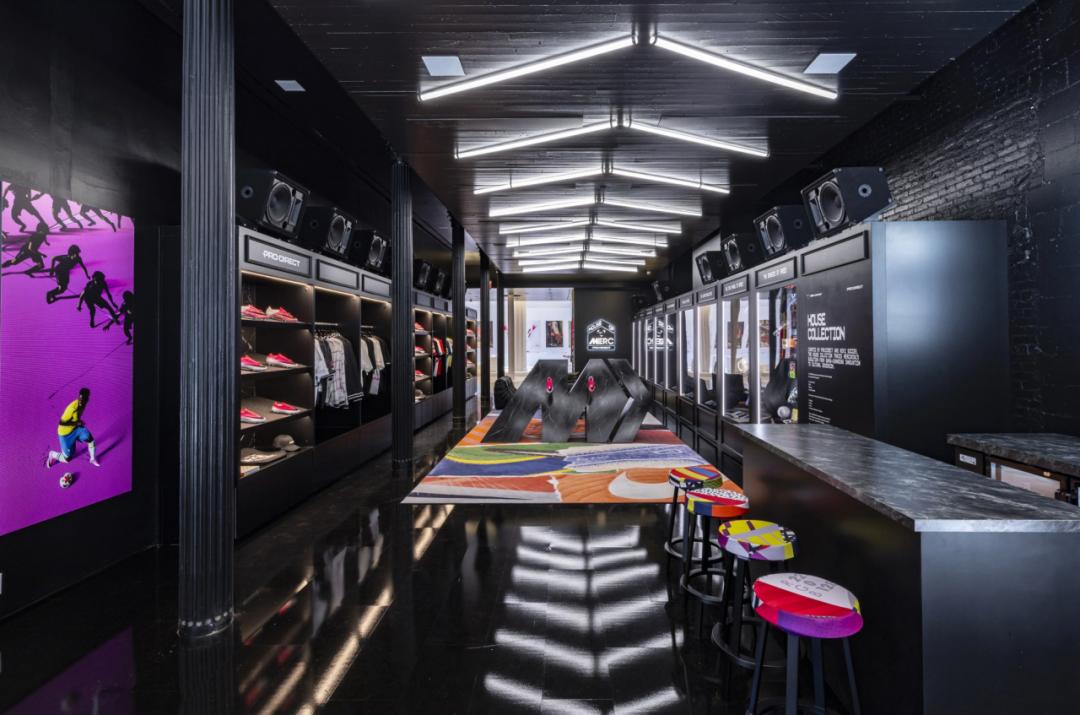
However, after the pandemic, the inventory held by dealers began to turn into a "quagmire", and online channels became an important outlet for clearance and turnover. In fact, this change did not only emerge after the pandemic. In the second half of the internet business era, channels were naturally the targets of transformation, and the pandemic only accelerated this process.
As a result, it can be seen that the increasing proportion of online business sales is becoming an unavoidable reality for dealers like Topsports. In fiscal year 2025, Topsports' direct-operated online business recorded double-digit year-on-year growth, accounting for over 30% of total revenue. In its latest annual report, Topsports also mentioned that its retail online business grew year-on-year, partially alleviating the pressure of offline foot traffic. On the other hand, Topsports has been accelerating the pace of streamlining its offline channels in recent years. According to financial report data, over the four fiscal years from 2022/23 to 2025/26, Topsports reduced its store count by 1,130, 421, 1,124, and 660 respectively.
The situation of Pou Sheng International, the parent company of Shengdao, is similar. In 2025, Pou Sheng International saw both revenue and profit decline, with operating profit nearly halving. On the offline front, the number of Pou Sheng International's direct-operated stores fell to 3,310 by the end of the year, with a net reduction of 138 stores throughout the year; on the online front, digital sales accounted for over 30% of total revenue, and the financial report specifically mentioned that its live streaming sales grew by more than 70% year-on-year over the past year.
If Nike truly cancels online distribution authorizations, dealers will lose more than just a sales window. For players like Topsports and Shengdao, online channels originally served the functions of customer acquisition, inventory clearance, and maintaining turnover. Simply retreating offline to become a "shelf" waiting for brands to supply products is obviously no longer feasible.
Therefore, in the past two years, large dealers have actually been looking for new paths. Topsports has long been unwilling to pin its fate entirely on Nike and Adidas, and has started introducing more niche sports brands in categories such as outdoor and running. It has successively secured operational cooperation in the Chinese market for high-end Norwegian outdoor brand Norrøna and professional British running gear brand SOAR. In addition to long-term distribution of international big names like Nike and Adidas, Pou Sheng International also represents brands such as Austrian outdoor brand DYNAFIT, Korean yoga brand XEXYMIX, and PONY. Furthermore, Topsports is also experimenting with self-built retail scenarios and membership operations.
Everyone knows that the era of making money relying on two international big-name brands is over.
The Chinese Market No Longer Gives Nike Time to Repair Slowly
In the second quarter of fiscal year 2026, Nike's revenue in Greater China fell by 17% year-on-year, with profits halving by 49%. The recently released third-quarter report ending February 28, 2026 shows that Nike's revenue in Greater China has dropped by another 10% — marking seven consecutive quarters of negative growth for Nike China. Even more unflattering figures are on the horizon: Nike management expects revenue in Greater China to decline by approximately 20% in the next quarter.
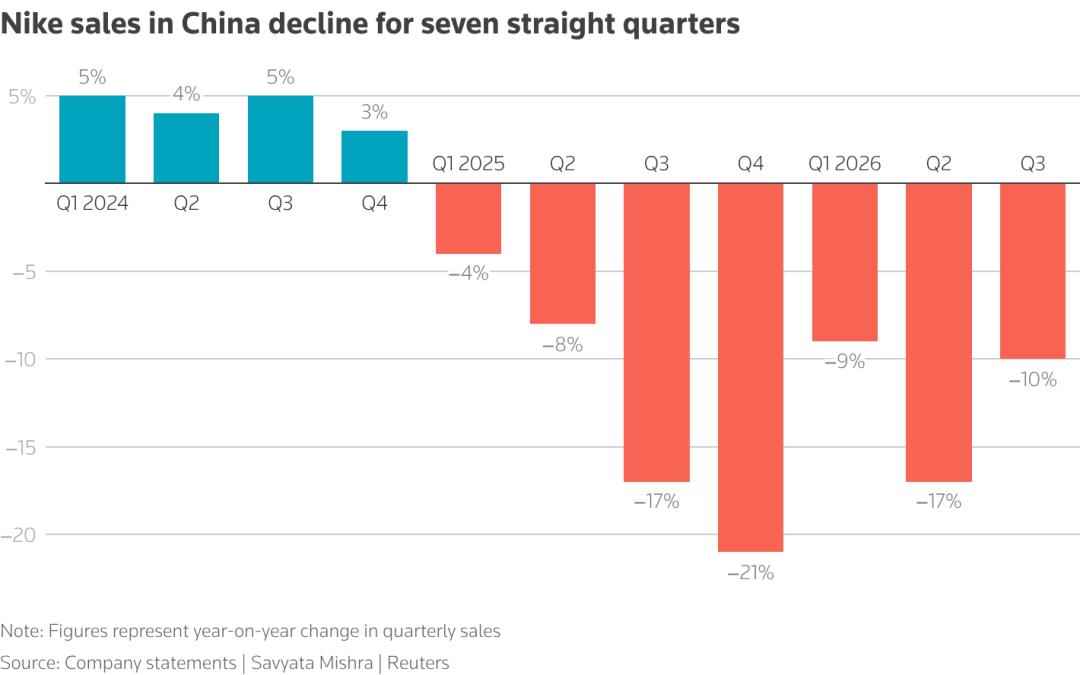
Ten years ago, such a scenario for Nike would have been unimaginable. Around 2015, the Chinese market was still Nike's most impressive growth model. At that time, Nike had just completed a round of channel and category adjustments, and the Greater China region returned to strong growth. In fiscal year 2015, revenue in Greater China grew by 18%, in fiscal year 2016 the growth rate further surged to 27%, and in fiscal year 2017 it still maintained 17% growth.
In those years, Nike almost hit all the right notes in China. Sports lifestyle began to become part of urban consumption, with basketball shoes, running shoes, Sportswear, and Jordan taking turns driving growth. Large dealers helped it expand into shopping malls offline, while the e-commerce dividend continued to amplify its influence online. Young people were willing to queue up for a pair of Nike shoes, and believed that the Swoosh logo represented better aesthetics, a stronger sense of athleticism, and a more international lifestyle.
Nike's direct-to-consumer story also became increasingly compelling in those years. From physical stores to the official website, from the Nike App to membership operations, Nike wanted to pull consumers directly into its ecosystem. By fiscal year 2020, Nike's Greater China region had achieved double-digit growth for six consecutive years, and its digital business was packaged as the next growth engine.
However, the Chinese market has changed too rapidly. Domestic sports brands are evolving. Anta is no longer just a cost-effective choice, and Li-Ning no longer relies solely on the "national trend" narrative. Xtep and 361° have become increasingly refined in the running scenario, and domestic carbon-plate running shoes have begun to enter the shopping carts of serious runners. In the past, many people bought Nike because it represented professionalism. Now, at least in some sports scenarios, the concept of "professionalism" has many more interpretations.
Consumers have also changed. Young people no longer naturally look up to international big brands, and the sports wardrobes of middle-class consumers have been redistributed. For running, people can choose On and HOKA; for outdoor activities, they can pick Salomon and Kolon; for fitness, lululemon is an option; and Adidas has reclaimed a share of mindshare in the retro shoe segment.
More troublesome is that price perception has also been altered. In the past, when a pair of Nike shoes was priced high, many people defaulted to assuming there was a valid reason for the cost. Now, when faced with the same price, consumers will first ask: Is it worth it?
On the fiscal 2026 second-quarter earnings call, Nike CEO Elliott Hill viewed the Chinese market as an unavoidable hurdle in this round of global recovery: "China remains one of the most powerful opportunities in the sports sector. But clearly, we need to reset our approach to the Chinese market, and the current progress is not at the speed we would like." Nike has not yet given a clear timeline for when this reset will truly take effect. The old saying that Chinese sports fans have heard for many years can be rephrased with a new subject:
There is not much time left for Nike to slowly repair the Chinese market.
This article is from the WeChat Official Account "Sports Business Watch", author: Diego, published with authorization from 36Kr.