Wildly hyped concepts face roadblocks in real-world deployment, what is the solution to WeRide's autonomous driving predicament?
The autonomous driving track has entered a decisive phase of mass production and commercialization, where the gap between leading players no longer lies in new concepts showcased at press conferences, but in the real closed loops of financial report data, deployed orders, and fleet operations.
As one of the few autonomous driving enterprises globally that have achieved dual primary listings on both the U.S. stock market and the Hong Kong stock market, WeRide has been a highly talked-about entity in the past two years. From the GENESIS world model to the WITT physical AI large model, its technical concepts have been continuously iterated; founder Han Xu has frequently spoken out publicly, releasing industry scoring standards, questioning peers' technologies, and rejecting the "endgame theory" of the track, constantly stirring up industry public opinion.
However, the popularity of public opinion cannot conceal the real-world gaps: weak fundraising capabilities in the capital market, L4 commercialization progress lagging behind Pony.ai, and L2 mass production scale falling behind Momenta and Horizon Robotics, creating a severe disconnect between technical narratives and industrial implementation. On one hand, it frequently outputs industry perspectives and defines technical standards, while on the other hand, its business scale and commercialization capabilities are steadily slipping behind.
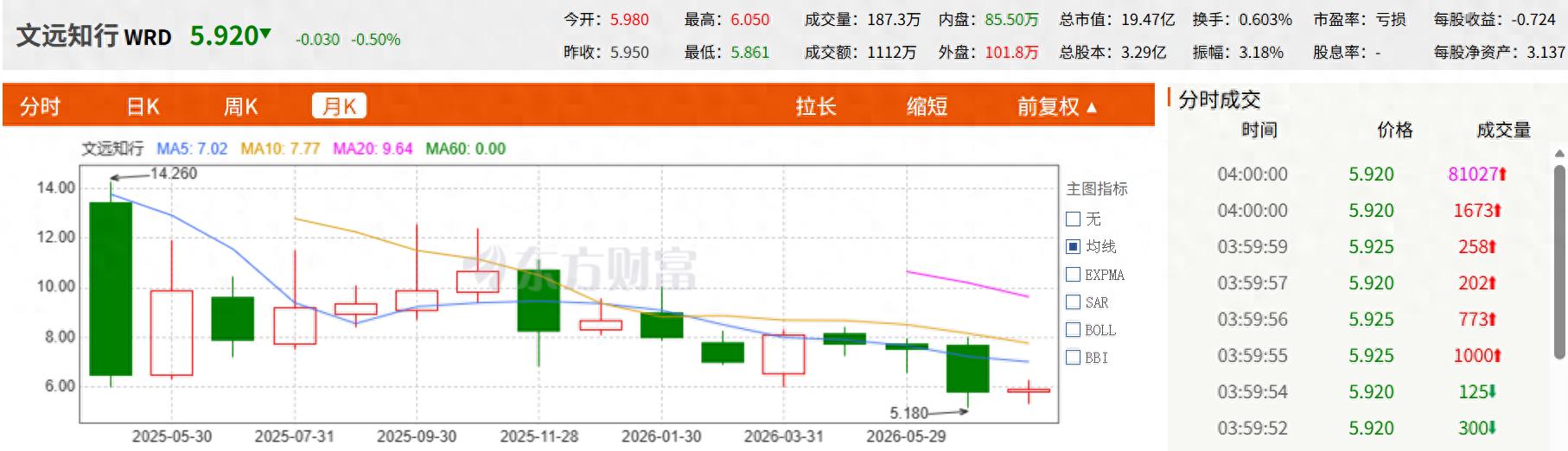
Post-listing performance of WeRide on the U.S. stock market
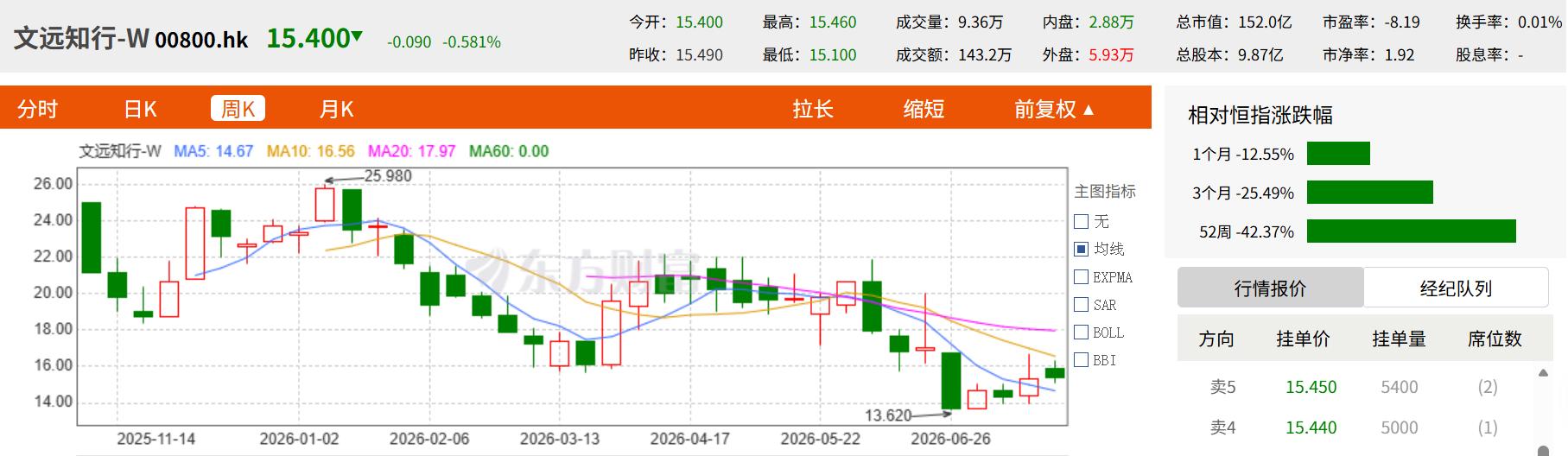
Post-listing performance of WeRide on the Hong Kong stock market
With Dual Listings in Place, Capital and Financial Fundamentals Remain Weak
Against the backdrop of a cooling primary market for autonomous driving and pressured secondary market valuations, WeRide has completed dual listings on NASDAQ and the Hong Kong Stock Exchange, effectively securing a top-tier capital admission ticket in the track and becoming the world's first Robotaxi stock. However, recognition from the capital market has not translated into tangible fundraising capabilities or financial health.
A horizontal comparison with Pony.ai, which listed around the same period, highlights particularly obvious gaps. Pony.ai raised HKD 7.7 billion through its Hong Kong stock listing, while WeRide only raised HKD 2.39 billion, a difference of over three times in fundraising scale. Both companies' shares fell below their issue prices on the first trading day, reflecting the secondary market's collective prudence toward the "high R&D investment, prolonged losses, slow deployment" model of autonomous driving enterprises. However, their subsequent trends diverged significantly: Pony.ai achieved valuation recovery driven by breakthrough performance including rapid revenue growth and single-quarter profitability, while WeRide continued to fluctuate weakly, reflecting insufficient capital confidence.
In terms of equity structure, WeRide completed a special capital operation in July 2026 and obtained exemption from the Hong Kong Stock Exchange. Founders Han Xu and Li Yan transferred 20% of Class B super-voting shares into a family trust, while firmly retaining full voting rights as "trust protectors". This operation created a new paradigm for corporate succession among Hong Kong-listed WVR (Weighted Voting Rights) structure enterprises, avoiding the risk of super-voting rights expiration, but also sowed long-term hidden risks: once the founder steps down, the company's core control and governance stability will face uncertainties.
Financial pressures are more intuitive. The 2026 Q1 financial report shows that WeRide's revenue reached 114 million yuan, a year-on-year increase of 57.6% — a seemingly respectable growth rate. However, in the same period, Pony.ai's revenue reached 236 million yuan, more than double that of WeRide, with a year-on-year growth rate as high as 145%. On the profitability front, WeRide's net loss for the period was 389 million yuan, with the loss scale continuing to expand; its R&D investment reached 363 million yuan, accounting for over 300% of revenue, a typical "burning cash for technology" model.
More alarmingly, the company's revenue structure is severely unbalanced, with over 80% relying on technical service income, and the monetization capability of its self-owned Robotaxi mobility business is weak; meanwhile, impairment losses on receivables surged by 1717.3% year-on-year, highlighting rising risks of delayed customer payments and hidden problems in business quality. The only bright spot is that it has achieved phased profitability in the overseas Middle East market, but partial profitability in a niche region cannot cover the company's massive overall losses.
Dual-Track Business Reality: Impressive Technical Concepts, Weak Deployment Results
WeRide focuses on two tracks: L4 fully unmanned autonomous driving and L2++ advanced assisted driving, and is the only enterprise globally that claims to have achieved large-scale commercialization on both routes. However, a breakdown of its real deployment data reveals that both business lines suffer from the problem of "narratives outperforming actual results".
1. L4 Robotaxi: The Most Licenses Globally, but Bottom-Ranked in Commercialization Efficiency
WeRide's core moat is its unique global qualification in the industry: holding autonomous driving licenses from 8 countries, with business deployed in over 40 cities across 12 countries, a total fleet size exceeding 2,800 vehicles, and a Robotaxi fleet of around 1,300 vehicles, realizing normalized fully unmanned operations in Guangzhou, Beijing, Dubai, and Abu Dhabi.
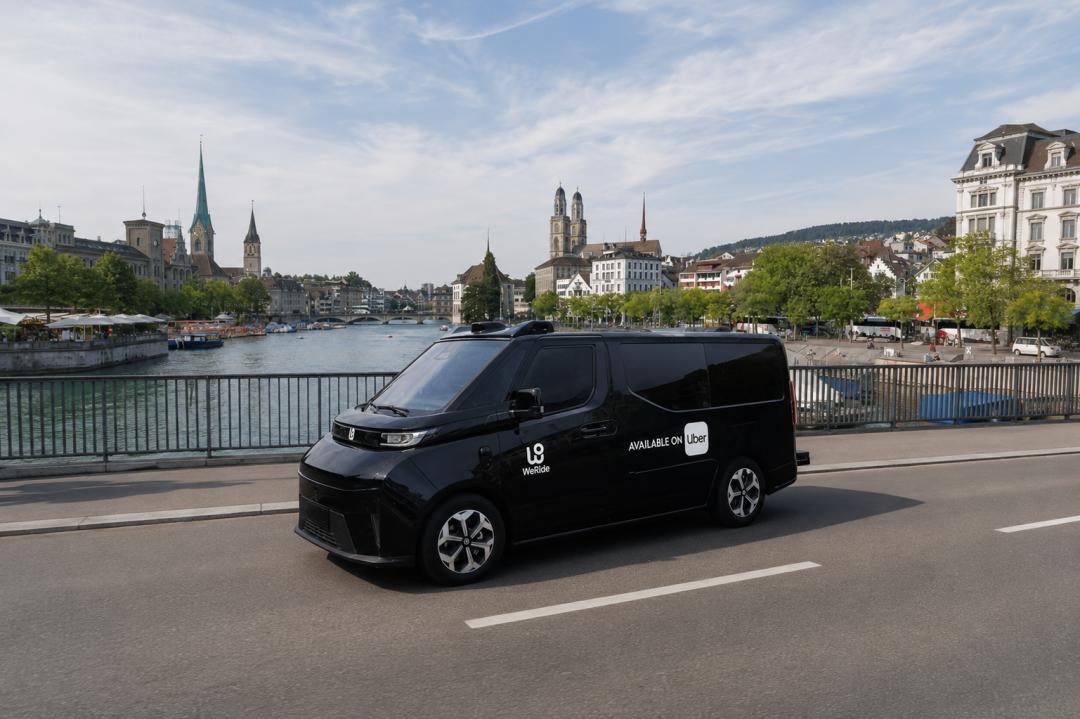
WeRide's Robotaxi GXR will open commercial operations in Zurich within this year
However, the number of licenses does not equal commercialization strength. Compared with Pony.ai, WeRide lags behind across the board in operational efficiency and profitability. In the domestic market, WeRide's Robotaxi only averages 17 orders per vehicle per day, with a peak of 28 orders, and no city has achieved per-vehicle unit economic profitability yet; in contrast, Pony.ai's Robotaxi in the core urban areas of Guangzhou and Shenzhen has long achieved normalized profitability, leading significantly in per-vehicle daily orders, user scale, and operation density.
In addition, WeRide's business layout is overly scattered, simultaneously developing multiple scenarios including Robotaxi, unmanned buses, freight, and sanitation vehicles, which drastically diverts R&D and operation resources. It cannot focus on the main track like Pony.ai to rapidly polish a commercial closed loop, ultimately leading to the awkward situation of "pilots everywhere, but no in-depth cultivation anywhere", with its global layout reduced to a superficial scale gimmick.
2. L2++ Mass-Produced Intelligent Driving: Championship Wins Fail to Conceal Weak Industry Positioning
Based on the one-stage end-to-end solution WRD 3.0, which is derived from its L4 technology, WeRide has won six consecutive championships in domestic intelligent driving competitions, making this its core argument for promoting its leading technology. Han Xu even stated bluntly that WRD 3.0 can score 80 points in comprehensive capability, second only to Tesla FSD's 95 points and far exceeding the industry average of 40 points.
However, competition results are outcomes of short-term sample scenarios, which cannot be equated with comprehensive mass production capabilities. On the commercialization front, WRD 3.0 has only secured two core clients: Chery Exeed and GAC Aion N60, with nearly 30 designated vehicle models in total. Its mass production installation scale and client volume are far inferior to Momenta and Horizon Robotics. The former has accumulated over 1 million mass production vehicles equipped with its technology, while the latter relies on self-developed chips to realize large-scale deployment of integrated software and hardware, firmly occupying a position in the industry's first tier.
Especially contradictory is that Han Xu publicly belittles his peers' technical capabilities, but deliberately avoids the real strength of Horizon Robotics' HSD solution. Leveraging its self-developed Journey series chips, Horizon Robotics has realized the end-to-end intelligent driving capability of integrated cockpit and driving with low latency and high stability, possessing strong industrial competitiveness in mass production adaptation, cost control, and full-scenario stability — by no means at the so-called 40-point level. WeRide defining industry technical rankings based on non-governmental competition results inherently lacks objective mass production verification and industry credibility.
3. Two Core Models: Sufficient Concept Innovation, Insufficient Industrial Implementation
In the past two years, WeRide has continuously launched cutting-edge technical concepts, successively releasing the GENESIS world model and the WITT physical AI large model, attempting to build a technical moat of "physical AI + world model". However, both core products have obvious shortcomings.
The GENESIS world model is called a "synthetic data magic tool" by Han Xu, claiming that it can replace real road test data and solve the industry's problem of scarce long-tail scenarios. But in actual deployment, this model can only cover basic weather conditions and simple road conditions, lacking physical simulation capabilities for extreme scenarios such as heavy rain, snow, dense fog, and complex human-vehicle interaction. The company is still investing heavily in deploying unmanned vehicles to collect real data, and the so-called "data freedom" has not been realized.
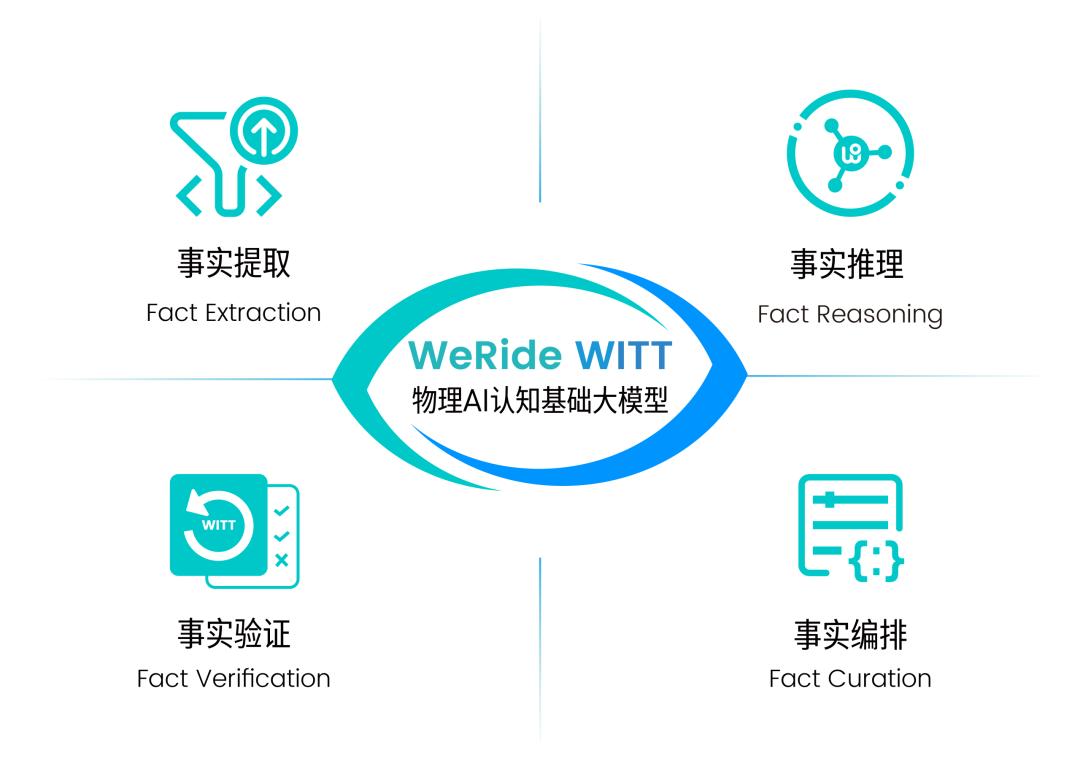
The WITT physical AI large model, newly released in July 2026, focuses on "minimum physical fact units", which can reduce model hallucinations and improve data efficiency. Official data shows its error rate is only one-third of that of general large models, with a 98% reduction in token costs. However, all these advantages are self-certified by the enterprise, with no verification from third-party authoritative institutions or mass production testing by automakers. Currently, it is only used for internal data filtering and model iteration, with no external commercial deployment scenarios, making it difficult to translate technical value into industrial value.
Benchmarking the Two Leading Players: WeRide vs Pony.ai
The divergence in development paths between WeRide and Pony.ai — two L4 leading enterprises that completed dual listings in the same period — accurately reflects the two industry survival modes of "focusing on narratives" and "focusing on deployment".
On the capital front: The two companies have similar listing timelines, but Pony.ai has stronger fundraising capabilities, greater secondary market valuation resilience, and more abundant cash reserves. WeRide has a limited fundraising scale, with significant cash flow pressure under continuous losses. Although its equity trust operation stabilized control, it also raised concerns about governance uncertainty in the capital market.
On the technical front: WeRide adopts a general L2/L4 algorithm architecture, which is simplified from L4 technology to adapt to mass production. Its advantage lies in low R&D costs, while its shortcomings are compromised safety redundancy and blurred technical stratification. Pony.ai insists on independent R&D of separate L4 and L2 technology stacks: L4 adheres to full-redundancy safety standards, while L2 adapts to the market demands of mass production, resulting in a more rigorous technical system and clearer safety boundaries.
On the commercialization front: This is the biggest gap between the two. Pony.ai focuses on the core Robotaxi track, achieving per-vehicle profitability in multiple cities and overall profitability in a single quarter. At the same time, it has established partnerships with leading automakers such as Toyota and BAIC, securing sufficient L2 mass production orders. WeRide has a scattered multi-line layout, with no profitable closed loop in domestic business, highly concentrated L2 clients, and weak risk resistance, only relying on overseas niche markets to maintain superficial financial resilience.
On industry posture: WeRide frequently outputs industry perspectives, judges peers' technologies, and questions the inherent logic of the track, with public opinion influence far exceeding its actual deployment results. Pony.ai has long been low-key and pragmatic, focusing on revenue, fleet scale, and mass production orders, rarely participating in industry public opinion games, and possessing higher industrial recognition.
Ten Questions for Han Xu
Based on Han Xu's core statements in public interviews over the past two years, combined with industry technical standards, commercialization data, and industrial laws, the editor has several confusing points to ask Han Xu.
1. Based on the MPI (Miles Per Intervention) average takeover mileage as the core basis, you proposed the industry scoring of "Tesla 95 points, WeRide 80 points, peers 40 points". What are the unified testing standards, full-scenario quantitative dimensions, and third-party verification data of this scoring system? Horizon Robotics' HSD has a larger mass production deployment scale and stronger full-scenario adaptability — why was it directly classified into the low-scoring tier?
2. You have repeatedly questioned that most manufacturers' world models are PPT products, claiming that domestically only WeRide's GENESIS has achieved deployment. However, Pony.ai's PonyWorld and Horizon Robotics' HSD simulation system have both been supported by mass production training and real vehicle iteration. Does this mean your evaluation criteria apply double standards? GENESIS has obvious shortcomings in extreme scenario simulation — does this mean it itself does not meet the standards of a complete world model?
3. You set the L4 access qualification standard of "100 vehicles with no responsibility accidents within half a year", denying the L4 R&D capabilities of most L2 manufacturers. Pony.ai fully meets your L4 access standards and has achieved large-scale deployment for many years — why have you never publicly benchmarked its mature L4 operation and safety data?
4. You emphasized that the difficulty gap between L4 and L2 is a thousandfold, making it hard for L2 manufacturers to break through technical barriers. However, Pony.ai has simultaneously realized L4 fully unmanned commercialization and large-scale L2 mass production, with no compromise on either technology stack. Why is this mature dual-track model not included in your industry cognitive system?
5. You used six consecutive championships in non-governmental intelligent driving competitions as evidence that WRD 3.0 is industry-leading, but competition scenarios are limited and the cycle is extremely short. The real full-scenario data and long-term stability accumulated by Momenta and Horizon Robotics through millions of mass-produced vehicles — do these not better represent the real level of mass-produced intelligent driving than short-term competition results?
6. You reject the 2026 industry endgame theory, believing that the track is far from being fully consolidated. However, WeRide's L2 order volume, revenue scale, and commercialization moat are all weaker than leading players. Against the trend of intensified industry involution and automakers' designated orders concentrating on leading players, what is the company's core breakthrough advantage?
7. You claimed that GENESIS can synthesize high-quality data and end the problem of data scarcity, but the company is still investing heavily in deploying thousands of unmanned vehicles to collect real road test data, continuously expanding real vehicle data collection. Does this indicate that your world model cannot replace real data, and the related technical narrative is exaggerated?
8. You publicly stated that the L2 architecture lacks full-dimensional sensor redundancy, has safety blind spots, and cannot meet L4 safety standards. However, WRD 3.0 is exactly a non-redundant solution simplified from L4 technology. How does this product avoid the safety shortcomings you mentioned? Is there any third-party long-term safety test data to verify its reliability?
9. The company launched a talent recruitment plan with an annual salary of 300-500 thousand yuan to compete with Silicon Valley, but the enterprise continues to suffer large losses, with no profitable closed loop in domestic business and only partial profitability overseas. How does it support long-term high human cost investment, and does it have a clear cash flow balance and profitability plan?
10. You have repeatedly criticized the industry for being keen on piling up technical concepts