Making a high-profile entry into the Chinese market, can Hilton Tanbo become the second "Hampton by Hilton"?
Hilton has drawn another sharp weapon from its arsenal.
Recently, Hilton Greater China held a press conference, announcing the introduction of its lifestyle hotel brand Tempo by Hilton to the Asia-Pacific market.
With this move, Hilton has completed the layout of five lifestyle brands in the Chinese market, including Canopy by Hilton, Curio Collection by Hilton, Signia by Hilton, Motto by Hilton, and Tempo by Hilton. At the same time, Hilton Group announced plans to double the number of its lifestyle hotels in China within the next few years.
Among them, Tempo by Hilton has been advancing at an exceptionally fast global pace. Having just signed its first property in Europe last year, the brand has now announced its entry into the Chinese market. According to official updates from Hilton's WeChat public account, the first batch of Tempo by Hilton hotels in China will be located in key destination cities such as Xiamen, Beijing, Chengdu, and Jiaxing, a clear demonstration of the brand's high level of importance attached to this market expansion.
So why is Hilton placing such heavy emphasis on Tempo? What changes will unfold after this powerful new player enters China's already fiercely competitive hotel market? Can the highly anticipated Tempo replicate the remarkable growth success story of Hampton by Hilton?
What Kind of Hotel Is Tempo?
To answer these questions, we must first return to the essence of Tempo itself — what exactly kind of brand is Tempo by Hilton?
When Hilton launched the Tempo brand in January 2020, its official website described it as an "upscale yet approachable lifestyle brand." In terms of pricing, Tempo's rate in the North American market ranges from $150 to $250 per night, slightly higher than Hilton Garden Inn and lower than Canopy by Hilton.
Tempo targets "modern successful professionals" with six-figure annual salaries. In Hilton's user profile, these consumers favor design-driven brands such as Tesla or Peloton, and are willing to spend a bit more to enjoy comfortable accommodation during travel, but refuse to pay for unnecessary luxury premiums that offer little practical value.
Therefore, Tempo follows a "lightweight lifestyle" approach: it omits grand lobbies, full-service dining options, and redundant facilities such as spas, reallocating the saved costs into various customer-centric details, including spacious cloakrooms, oversized illuminated mirrors, top-tier comfortable bedding, a quiet environment, and ergonomic modern office desks and chairs.
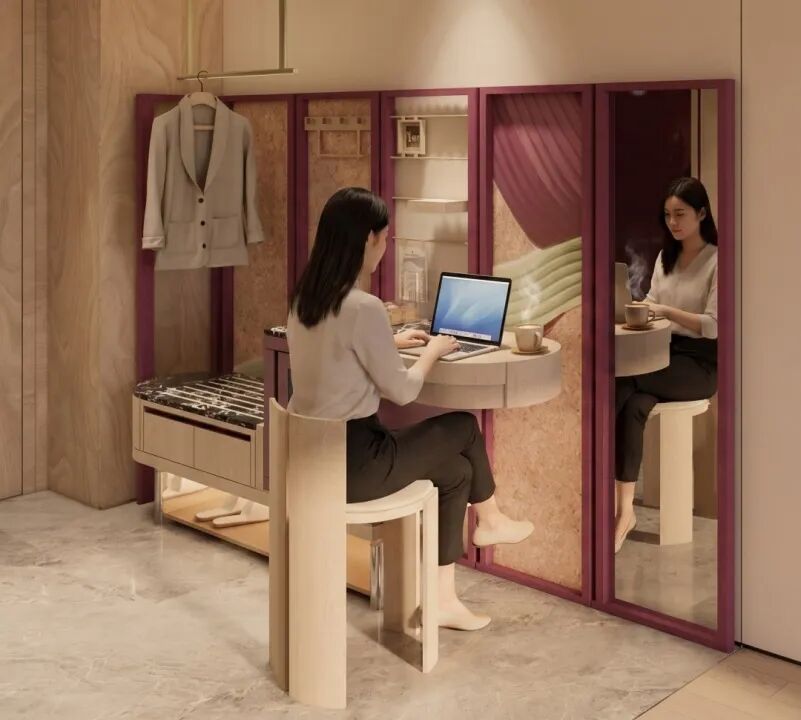
Rendering of the Ready-to-Go area in a Tempo by Hilton hotel guest room
Tempo's truly disruptive design is placed in the most prominent locations — the lobby and the front desk.
Traditional five-star hotels in the past mostly featured huge, spacious, and often deserted lobbies, where guests rarely stayed except for check-in and check-out procedures. Tempo has transformed this space into an all-day social venue.
From the officially released Chinese version renderings, we can see that Tempo's front desk does not have the traditional high partition counters. Instead, there is only a low long table, which looks more like a communal dining table than a typical hotel front desk.
The iconic Moonsong CAFÉ + BAR makes Tempo's lobby feel like a coffee shop and a co-working space during the daytime; when the lights are dimmed and the menu is updated to offer craft cocktails and specialty beers in the evening, it transforms into a relaxed and cozy gathering spot.
In this way, guest rooms are no longer the only source of revenue for the hotel. Coffee, dining, wellness, and social experiences have all become part of the hotel's commercial closed loop, solving the longstanding problem of low per-square-meter efficiency in hotel public areas.
On the other hand, this design is also intended to better meet the office and social needs of young elite groups.
It is easy to anticipate the kind of enthusiastic discussion this lobby design will spark on social media. This experiential difference also clearly differentiates Tempo in positioning from Hampton by Hilton and Hilton Garden Inn.
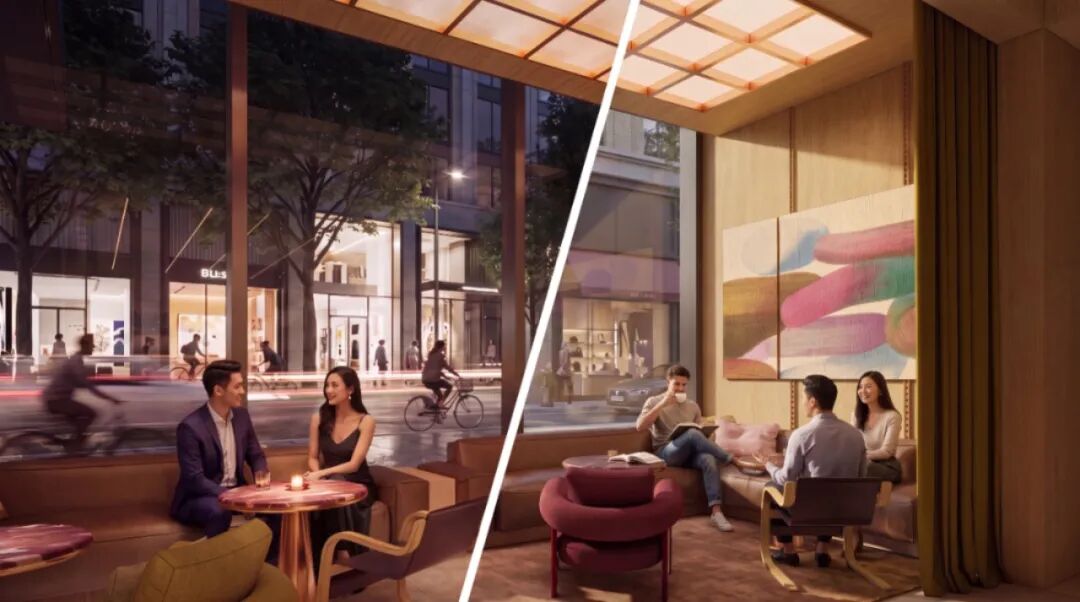
Rendering of the public space in a Tempo by Hilton hotel
However, this is not Tempo's most core competitive advantage. Its true masterstroke is solving a long-standing industry pain point: lifestyle hotels can finally be replicated on a large scale.
From its inception, Tempo was a standard prototype co-developed by Hilton and design firm Nelson Worldwide over a 14-month period, with a significant portion consisting of conventional, fully replicable standardized elements.
This means Tempo has transformed the lifestyle hotel model, which was previously limited to "niche boutique properties with unique designs for each location," into a scalable, standardized system, finally providing a solution to the pain points of traditional boutique lifestyle brands — difficult replication and slow return on investment.
When a brand can successfully tell both a compelling consumption story that resonates with young consumers and a wealth story that promises investors a quick return on their investment, Hilton naturally regards Tempo as a trump card to enter China's mid-to-upscale hotel market.
At this point, Tempo's strategic objectives have gradually become clear:
Internally, Tempo aims to carve out a new niche within Hilton's mature brand portfolio. As the younger generation of China's middle class advances in their careers, Hilton needs a more sophisticated and trendier brand to cater to this new demographic, filling a market gap while firmly retaining the high-end customer base that overflows from Hampton by Hilton within the Hilton system.
Externally, Tempo will enter the already fiercely competitive market, directly competing with international rivals and strong local players. Tempo needs to prove to Chinese investors that lifestyle hotels can not only be replicated on a large scale, but also be highly profitable.
Fighting on Two Fronts: What Opportunities and Challenges Does Tempo Face?
Tempo's first battlefield after entering China is not outside the Hilton system, but within Hilton's own brand portfolio.
For a long time in the past, Hilton's core business in China followed a "strong at both ends, weak in the middle" structure. On one end are the ultra-luxury flagship brands, Conrad and Waldorf Astoria; on the other end is the "super cash cow" represented by Hampton by Hilton, which, with the support of Jin Jiang, has swept across China's mid-tier hotel market.
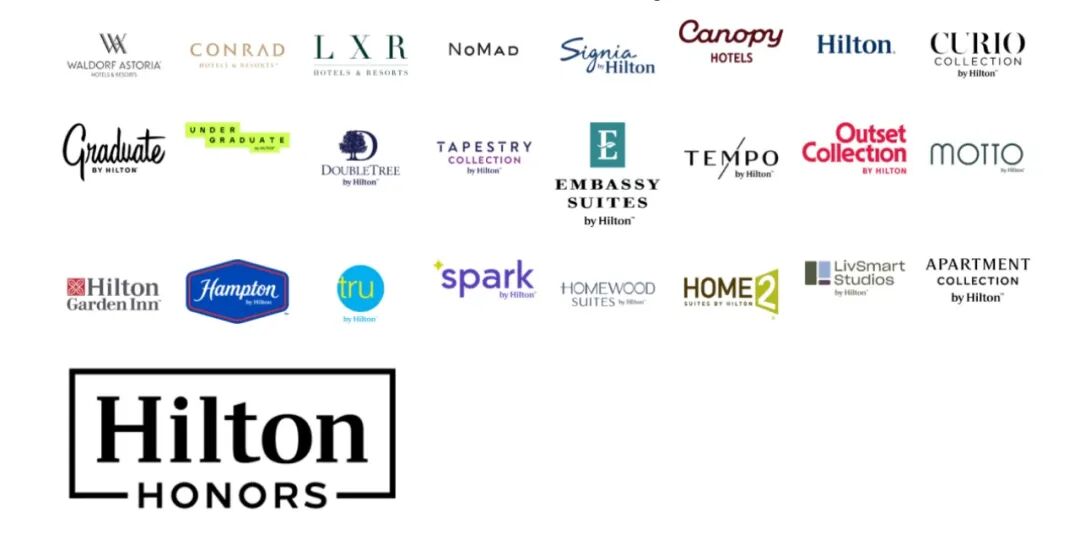
Hilton's brand portfolio layout, Source: Hilton official website
In the "mid-to-upscale and upscale lifestyle" segment, which offers the greatest premium potential and a large consumer base, Hilton still lacks a competitive brand. The lifestyle brands under the Hilton system either have overly high positioning or are too small in scale, resulting in a relatively low overall market presence. Tempo's entry into the Chinese market is designed to resolve this awkward situation.
However, Hilton already has an extremely mature brand matrix in China, which means that as a "newcomer," Tempo must, to gain a firm foothold, compete for customer groups, franchisees, and resources internally, breaking through the established market share of its sister brands.
First, competing for premium space and target customers with Hilton Garden Inn:
Hilton Garden Inn and Tempo have a highly overlapping target customer base. After Tempo enters China, consumers can pay a little more to upgrade to the cooler and more interesting Tempo by Hilton. This "pay a bit more for a better version" mentality will undoubtedly put pressure on Hilton Garden Inn's premium potential.
Second, competing for investors with DoubleTree by Hilton:
In June this year, Hilton launched the "Dacheng version" of DoubleTree hotels. We can clearly see that the hotel's design quality has been compromised to prioritize efficiency and cost reduction.
As a result, DoubleTree has entered Tempo's competitive scope — with highly overlapping positioning, Tempo has lower investment costs, a faster return on investment, and targets a young customer group with greater growth potential. For pragmatic Chinese investors, this is obviously more attractive, and it is likely to divert investment intentions away from DoubleTree.
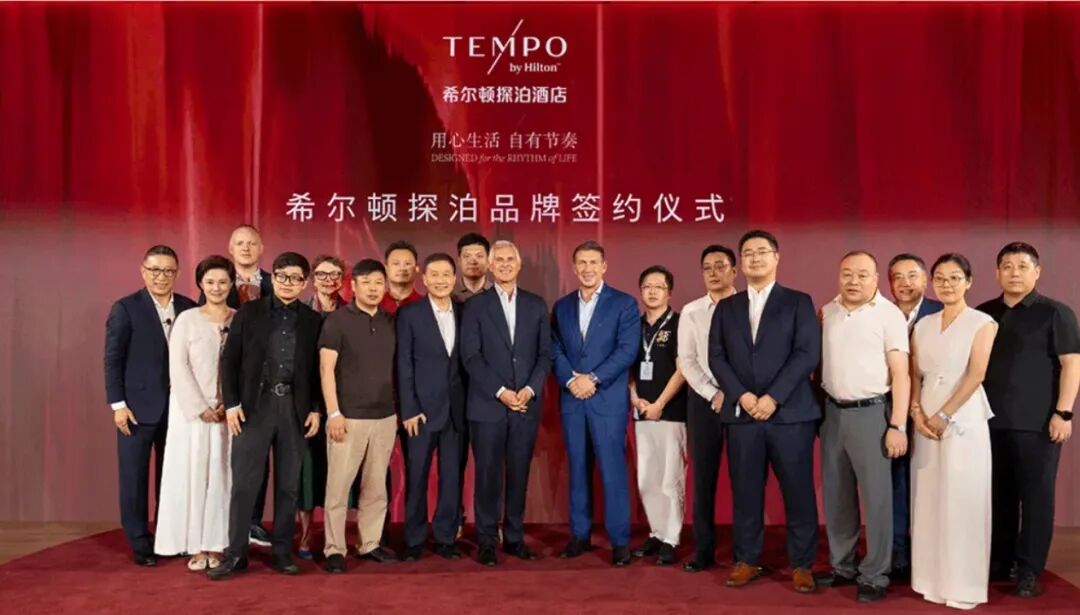
Signing scene at the Tempo by Hilton launch event
Outside the Hilton Group, Tempo also faces extremely fierce competition.
On one side is the "fierce rivalry" with AC Hotels by Marriott.
These two hotel brands are almost like twin stars in the "select-service lifestyle hotel" segment — both have eliminated the heavy full-service kitchen and large banquet halls, and coincidentally adopted the "coffee by day, bar by night" model as a breakthrough to attract young business travelers. Even their design adjustments, such as replacing traditional wardrobes with open hanging areas, are remarkably similar, and their pricing in the North American market is also comparable.
However, in the Chinese market, AC Hotels by Marriott has a first-mover advantage, having established a solid image as an international upscale hotel. Tempo by Hilton faces a tough battle, as it must prove that it has a better understanding of China's new middle class than AC Hotels by Marriott.
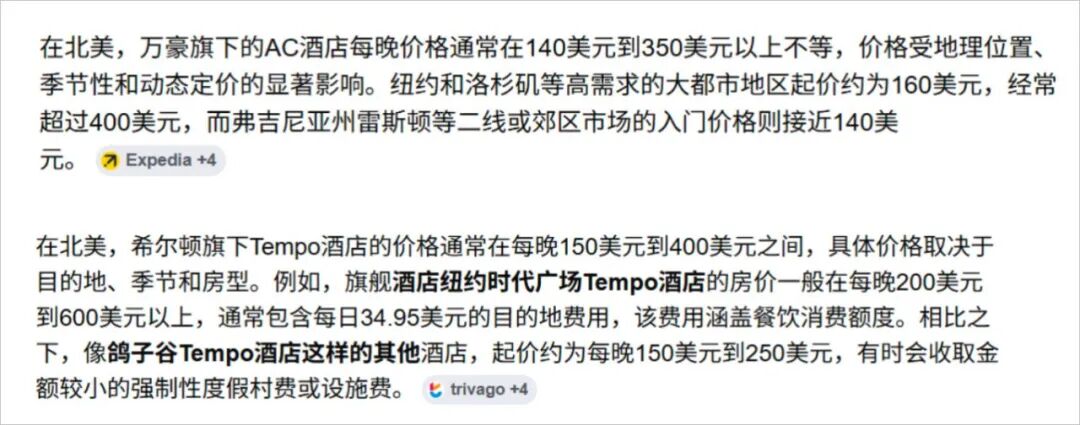
Image Source: Screenshot from Google Search
On the other side, it will face head-on competition from strong local Chinese hotel brands.
In this battlefield, Tempo will be besieged by multiple Chinese brands such as Atour, Manxin, and Orange Crystal.
Mid-to-upscale Chinese hotels represented by Atour not only have tremendous scale advantages, with leading positions in cost control and site selection, but have also established strong brand recognition among Chinese consumers. They also have a keen understanding of local aesthetic preferences and an astonishingly fast product iteration speed. Tempo will find it difficult to gain advantages in terms of scale, cost, and brand recognition, and this is destined to be an even more challenging battle.
Will Tempo Become the Second "Hampton"?
At the end of the discussion, we cannot avoid the question that everyone cares about: Will Tempo by Hilton become the second "Hampton"? Can it replicate the wealth-generating success story of Hampton by Hilton?
In fact, the moment this question is raised, we all understand that the success of Hampton by Hilton cannot be replicated.
Hampton's success is the result of a combination of multiple factors.
First, the right timing: When Hampton by Hilton entered China in 2014, there was no real international mid-tier hotel benchmark that had captured widespread public awareness, and there was a huge supply gap — a rare, once-in-a-generation market opportunity.
Second, favorable geographical conditions: Hampton by Hilton's success is also inseparable from its "strongest supporting partner" in the Chinese market, Jin Jiang International. The combination of "international brand recognition + local giant's operational capabilities" is one of the core reasons why Hampton by Hilton has achieved rapid development in China;
Third, harmonious human factors: As the first brand to successfully implement the model of "international brand endorsement + asset-light franchising + stable investment return," Hampton by Hilton has firmly occupied the mindset of Chinese investors, so much so that when many investors want to launch mid-tier hotels under an international brand, Hampton is the first brand that comes to their mind.
After Tempo enters China, it will face a red ocean market with severe excess supply and white-hot competition, without the support of a strong local partner, and it has not yet established a solid brand perception among consumers.
However, the good news is that Tempo and Hampton are fundamentally two different types of brands, and Tempo does not need to become the second Hampton.
Its real strategic goal is to become the most successful mass-market lifestyle brand within the Hilton system, completing Hilton's full brand portfolio.
As long as it can become the benchmark in the mid-tier lifestyle hotel segment, Tempo will have fulfilled its historical mission.
Tempo's story of being "youthful, stylish, and scalable" sounds very appealing. This is the right era, the right market segment, and a highly compelling new narrative that Chinese investors are willing to listen to.
But after experiencing the market's boom and subsequent cooling, investors have become more discerning and cautious, and will even directly compare Tempo's prices with Atour 4.0. If Tempo cannot demonstrate obvious advantages, the pragmatic and clear-headed Chinese hotel investors at this stage will not blindly trust international big names, and will instead unhesitatingly choose local brands with higher cost-effectiveness.
If Tempo succeeds, Hilton will be able to create a second growth curve in the mid-to-upscale lifestyle hotel segment, just like the one it achieved with "Hampton by Hilton." But the prerequisite is that Hilton must turn this narrative into reality with substantial real-world investment and execution.
This article is from the WeChat public account "Hotel Management Finance", written by Xinyi, and published with authorization from 36Kr.