Baidu's Dual Primary Listing via Board Conversion: The Capital and Industry Accounts Behind an "Identity Iteration"
Recently, Baidu released an announcement on the Hong Kong Stock Exchange: The company's board of directors has approved, in accordance with HKEX Guidance Letter HKEX-GL112-22, the voluntary conversion from secondary listing to dual primary listing on the Main Board of The Stock Exchange of Hong Kong Limited. The conversion is expected to take effect within the year. After the conversion, both the Hong Kong Stock Exchange and Nasdaq will be its primary listing venues, and its ADS and Hong Kong shares will remain interchangeable.
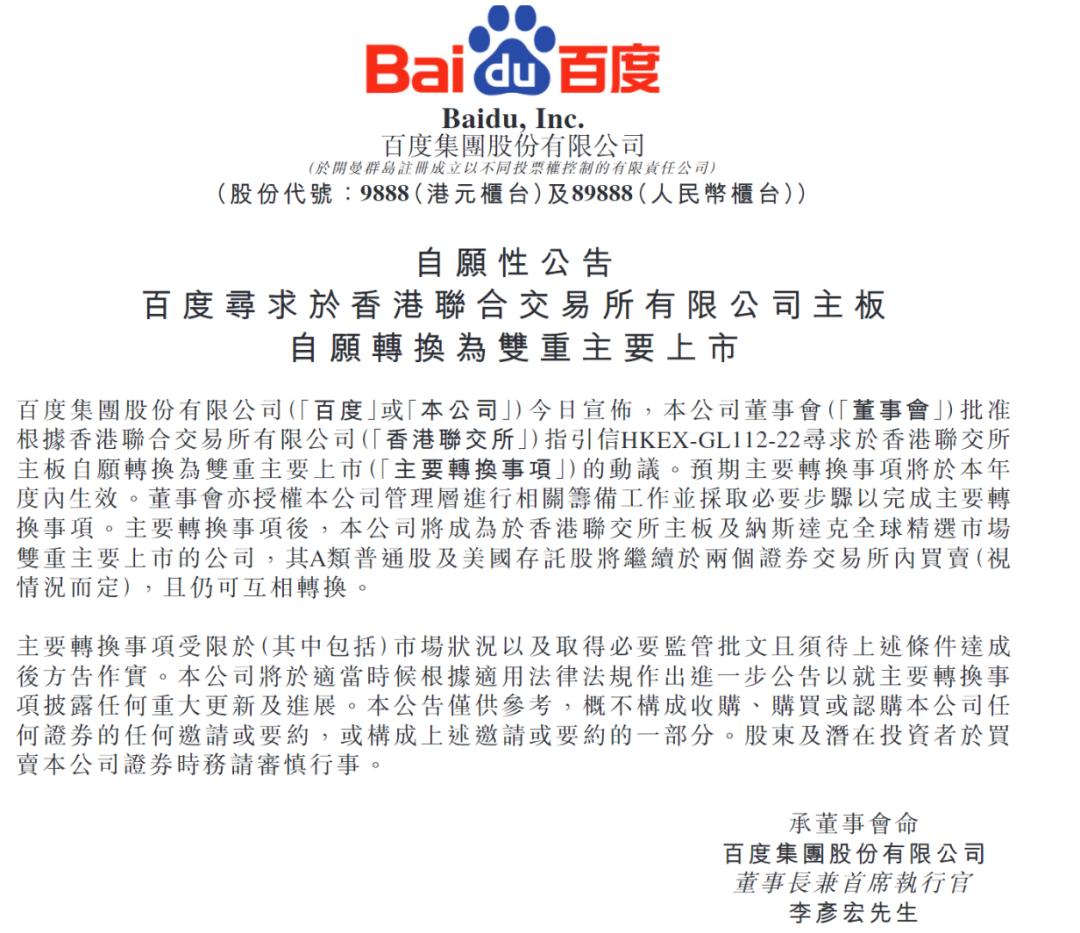
This news did not cause much stir in the financial circle — after all, Alibaba, JD, bilibili and other companies have already taken this step earlier, making Baidu a "latecomer" in this trend.
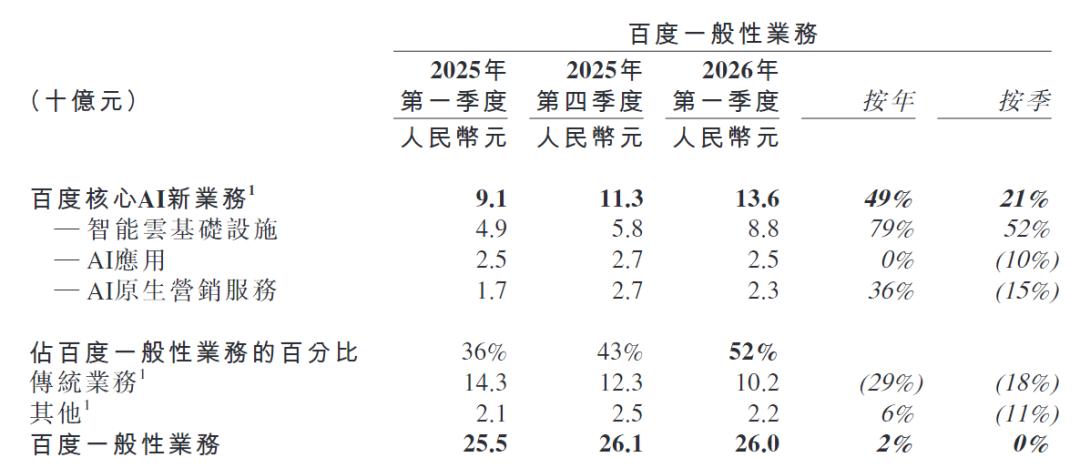
However, looking at a longer timeline, this move of Baidu is by no means arbitrary: In the first half of 2026, it just pushed its AI chip subsidiary Kunlunxin onto the dual-track "A+H" IPO path. In its Q1 financial report, AI-related businesses accounted for more than half (52%) of its core business revenue for the first time. The revenue from intelligent cloud infrastructure reached 8.8 billion yuan, a year-on-year increase of 79%, and the revenue from self-developed GPU cloud rose 184% year-on-year.
The adjustment of capital structure is never an isolated action. Below we will break down this "listing conversion" from three dimensions: the regulatory implications, the chain of driving forces, and the impact on valuation.
01
Secondary Listing vs Dual Primary Listing: The regulatory differences are far greater than the names suggest
Many retail investors tend to generalize the concept of "returning to list in Hong Kong" as a single scenario. In fact, Secondary Listing and Dual Primary Listing are two completely different systems in terms of rules and consequences.
Secondary Listing: The US stock market serves as the primary listing venue, while Hong Kong is a "secondary trading market".
Enterprises can enjoy several compliance exemptions from the Hong Kong Stock Exchange, with a fast process and low cost. However, their status in Hong Kong and the US is tied — if there is a delisting risk in the US stock market due to regulations like the Holding Foreign Companies Accountable Act, the listing qualification in Hong Kong will be affected accordingly. In addition, the stock codes of secondary listed companies carry an "S" suffix, which makes them ineligible for the Stock Connect program, so southbound capital cannot access them.
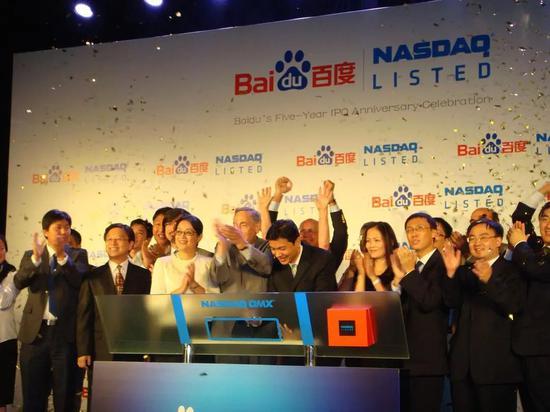
Dual Primary Listing: The status in Hong Kong and the US is mutually independent and equal, with each side applying local regulations on supervision, information disclosure and internal control.
This model significantly enhances the ability to resist policy fluctuations in a single market. More importantly, after removing the "S" suffix, the company can apply to be included in the Stock Connect program, opening up the capital channel from the Chinese mainland.
When Baidu returned to Hong Kong for listing on March 23, 2021, it adopted the secondary listing model. Its stock code 09888.HK carried the "S" suffix (later changed to Baidu Group-SW, where "W" represents the weighted voting rights structure).
After this conversion, the "S" suffix will be removed, and in theory, the company will obtain the access qualification to the Stock Connect program.
After the Hong Kong Stock Exchange revised its rules in 2022, it opened the "voluntary conversion" channel for Chinese concept stocks that were originally secondary listed (namely Guidance Letter GL112-22). Baidu is a leading case in this batch in terms of market size and public attention.
According to a report by *Securities Daily*, Zhang Yi, CEO of Guangzhou iiMedia Research Co., Ltd., stated that for Baidu, the core goal of a series of capital adjustments and industrial implementation actions in 2026 is to fully realize the value of the complete industrial chain covering "chips - framework - large model - industry applications", continue to increase investment in R&D of core artificial intelligence technologies, consolidate its leading position in the global AI industry competition, and achieve two-way resonance between industrial growth and capital value.
02
Why is Baidu taking this step right now
Judging only from the wording of the announcement, it is a "voluntary conversion". But in the context of Baidu's capital and industrial rhythm in 2026, three layers of demands are superimposed together.
The first layer: Hedge the long-term uncertainty in the US stock market and add double protection to the capital foundation.
Although the Sino-US audit regulatory negotiations have made phased progress, for long-term institutions holding Baidu's stocks, the tail risk of "what if something goes wrong in the US market" has never been completely eliminated. After converting to dual primary listing, even if an extreme situation occurs on the Nasdaq side, the Hong Kong entity will still exist independently, which gives institutional investors a peace of mind.
The second layer: Being eligible for the Stock Connect program is the real target that Baidu wants to achieve.
The current average daily trading volume of Baidu's Hong Kong shares is not very active. On July 21, the stock price of 09888.HK was about HK$106, with a total market value of about HK$289 billion and a PE-TTM ratio of about 194 times.
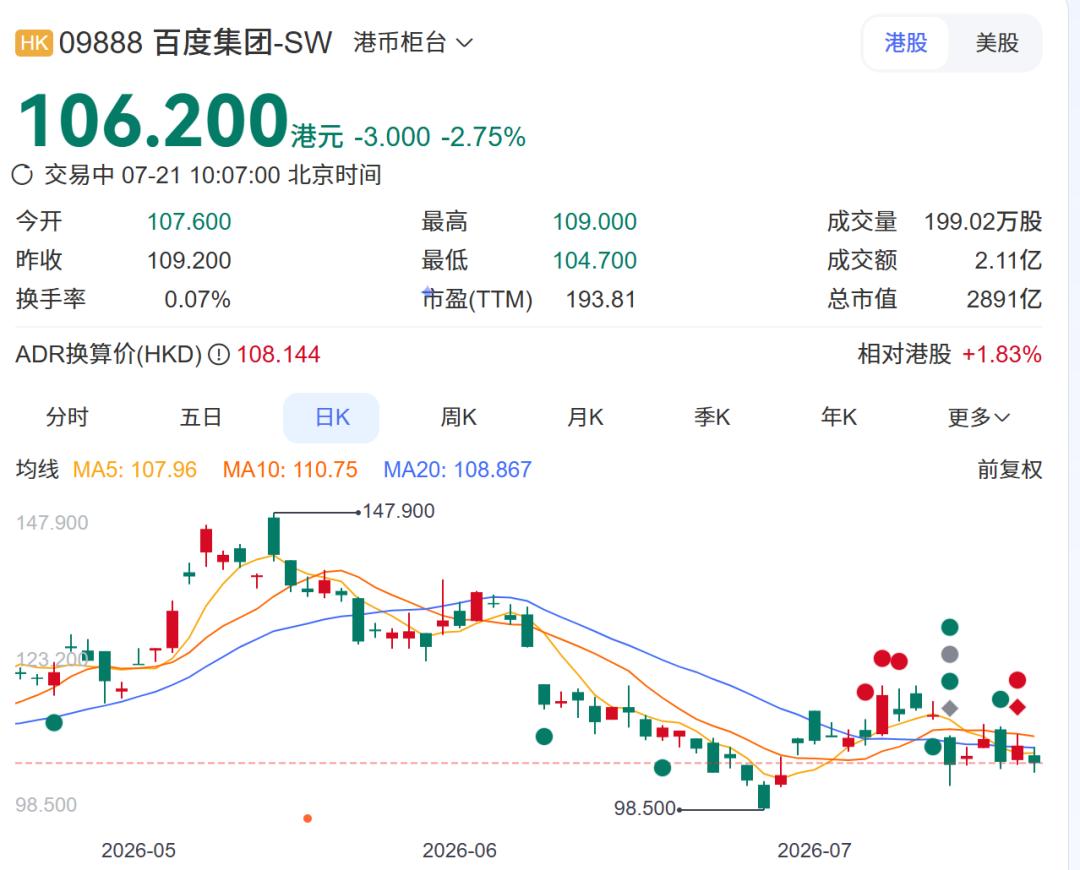
This relatively high PE ratio is partly due to recent fluctuations in profitability, and also reflects that the market is still in a tug-of-war on pricing between the "AI growth story" and the "traditional search business fundamentals".
Once included in the Stock Connect program, southbound capital can allocate its shares. The liquidity premium, coupled with mainland institutions' familiarity with the full-stack AI narrative, will have a potential repair effect on the valuation center. This is a path that has been partially verified after Alibaba converted to dual primary listing.
The third layer: Coordinate with the capital layout of Kunlunxin's "A+H" listing.
This point has not been sufficiently discussed in the market. In January 2026, Kunlunxin submitted its listing application to the Hong Kong Stock Exchange in confidential form, and in May, it completed the counseling filing for the Science and Technology Innovation Board, with Baidu maintaining its controlling stake.
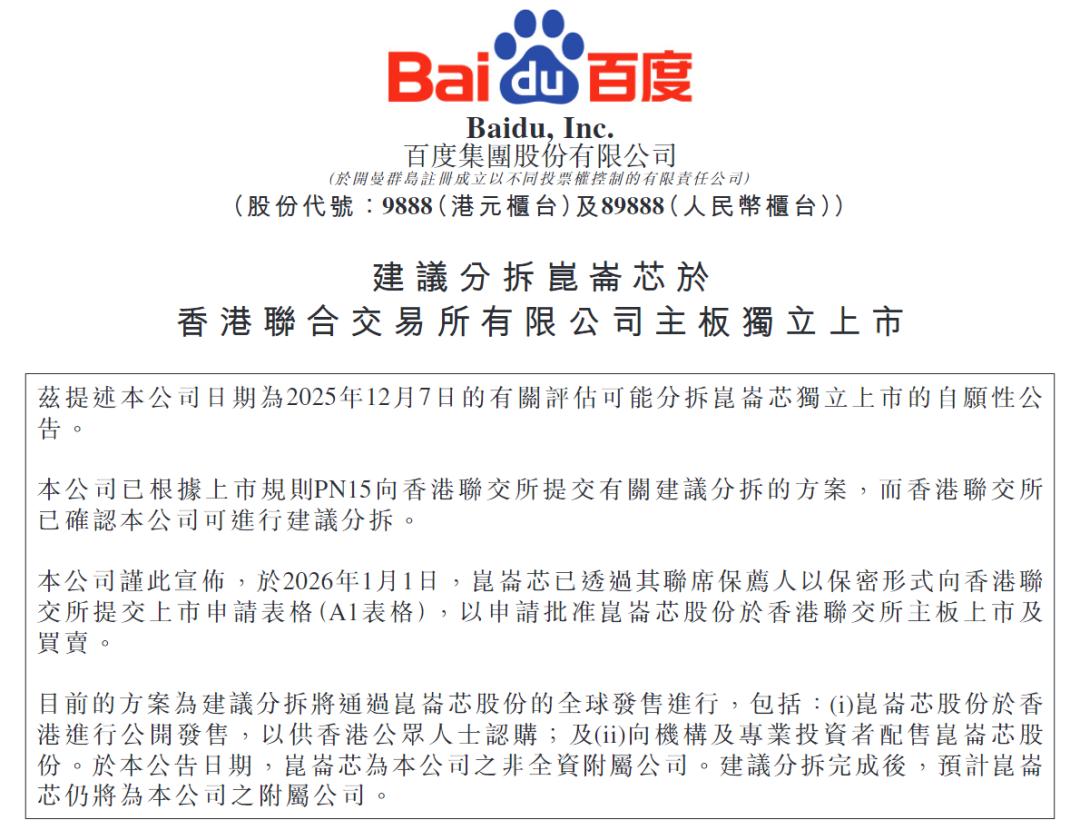
The parent company first rationalizes its Hong Kong listing status to dual primary listing, and then lets its chip subsidiary advance on the dual A+H track. The capital market structures of both the parent and subsidiary companies are moving towards the "dual main market" model, which follows the same underlying logic: reduce dependence on a single market, expand long-term capital sources, and match the capital-intensive and long-cycle characteristics of the AI computing power track.
Zhang Yi's statement is quite accurate: "The simultaneous advancement of capital and industrial actions reflects the long-term strategic logic of full-stack self-development that Baidu has adhered to for more than ten years."
03
Listing conversion does not mean automatic valuation re-rating: Stay rational and focus on three key points
This type of topic is easy to be over-interpreted as a "major positive news".
But objectively speaking, dual primary listing is a necessary but not sufficient condition for valuation repair. Three points need to be viewed separately:
First, the liquidity improvement brought by the Stock Connect program is real, but its magnitude depends on the weight of the stock and the inflow rhythm of passive capital.
Referring to previous batches of Chinese concept stocks that converted to dual primary listing, there is usually a pulse of passive capital increase and southbound allocation after being included in the Stock Connect program, but the medium and long-term valuation will eventually return to the fundamentals.
The current market divergence on Baidu is not about "whether investors can buy its shares", but about "with AI revenue accounting for 52%, why is it still valued according to the traditional internet stock logic".
Second, the price gap between US ADRs and Hong Kong shares is currently small, and the arbitrage mechanism will remain smooth after the conversion.
On July 21, Baidu's H shares were priced at about HK$106, and the converted price of its ADR was about HK$108, with a relative discount of about -2% to the Hong Kong shares, which is within the normal range. After the conversion, the ADS and Hong Kong shares will still be interchangeable, so the prices on both sides will not deviate for a long time. There is no logic that "the listing conversion itself creates arbitrage opportunities".
Third, the real key to valuation lies in the realization speed of AI commercialization.
The 79% growth rate of intelligent cloud revenue and the 184% growth rate of self-developed GPU cloud revenue in Q1 are indeed impressive, but the market is still observing: the billing price and gross profit margin of the Wenxin large model, whether the single-city operation model of the autonomous driving platform Apollo Go can achieve profitability, and the breakthrough of Kunlunxin in external customer expansion. These are the core variables that determine whether Baidu can evolve from a "controversial stock with a PE ratio of nearly 100 times" to an "AI leader with a premium valuation", or continue to fluctuate within a certain valuation range.

A point that is easily overlooked: After dual primary listing, Baidu needs to meet two sets of disclosure and internal control requirements from the SEC and SFC/HKEX at the same time, which will raise its compliance costs to a higher level.
For large technology companies, this cost is not a big burden, but the complexity of internal processes will increase significantly.
Conclusion
Back to the starting point.
Baidu's "conversion to dual primary listing" seems to be just a single announcement, but in essence it is one part of a series of actions in 2026: Kunlunxin's A+H listing, the iteration of Baidu's Hong Kong listing status, and the AI revenue exceeding 50% of total revenue.
The end of this development line is not just "returning to Hong Kong for listing", but to tell the full-stack self-development story of "chips - framework - large model - applications" in a capital structure with two independent markets, broader capital channels, and stronger regulatory hedging capabilities.
For investors, the trading window of this event itself may be very short — only an emotional pulse in the few days after the announcement. What is really worth tracking are three points: the implementation time of the conversion within the year, the inclusion schedule of the Stock Connect program, and the progress of Kunlunxin's IPO.
Only when these three points are realized one after another, can Baidu's "capital foundation" in the AI cycle be truly completed.
As for whether the valuation can break through the current predicament — that is a question to be answered by the continued growth of AI revenue and the improvement of gross profit margin. The listing conversion only cleans up the table, and the "dish of value" still needs to be served by Baidu itself through its own performance.
This article is from the WeChat official account "BoWang Finance", author: Heng Xin, and is authorized for release by 36Kr.