Starting from July, large language models have entered the "Infinity War".
Many years later, when the market looks back at July 2026, it will most likely stand as a critical watershed in the global large model industry competition.
Because more people may realize starting from this month that no model's performance ranking is ever permanently secure.
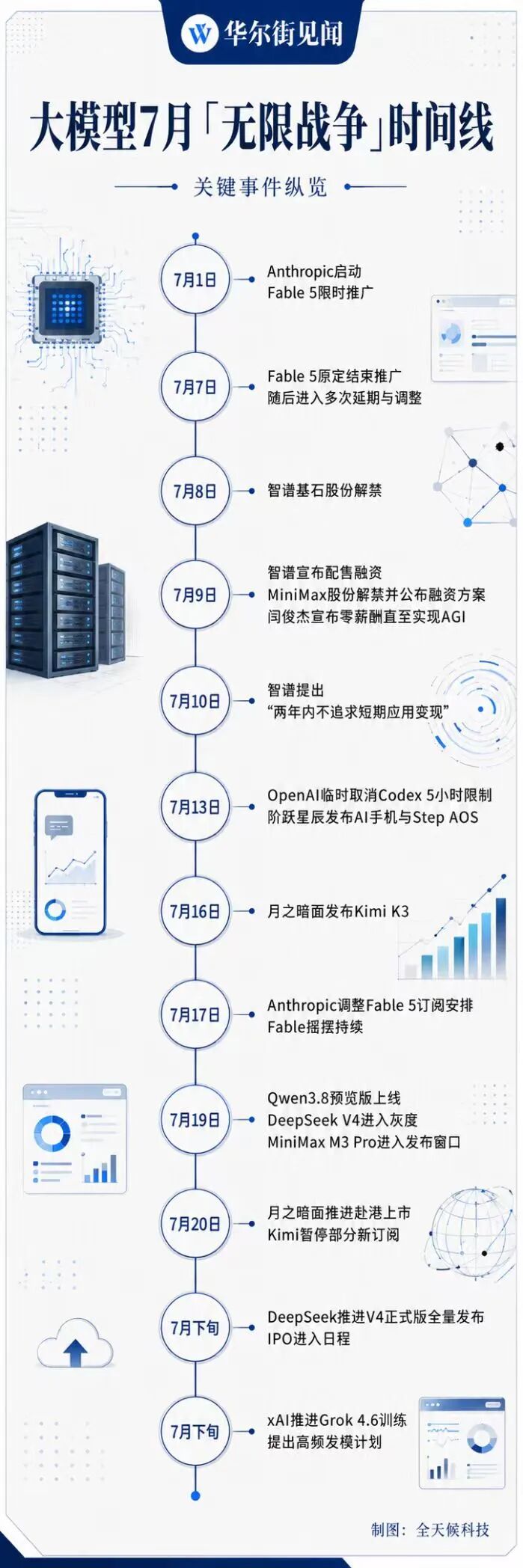
In just a few short weeks of this month, China's five leading independent large model companies were each busy with distinct priorities.
Zhipu secured HK$31.4 billion by issuing 4.2% new shares, unveiling an ambitious 2-year plan that prioritizes technological advancement over immediate monetization; MiniMax finalized a HK$16 billion placement plus convertible note package in the same week, with its founder announcing zero salary until AGI is achieved; Moonshot AI launched its top-tier open-source K3 model and accelerated preparations for its Hong Kong Stock Exchange listing filing; DeepSeek just completed a high-profile financing round exceeding 50 billion yuan, putting its IPO on the agenda; StepFun released an AI phone with no stated price or release date to explore the potential of integrated AI software and hardware.
The pace of overseas giants was equally intense. OpenAI temporarily lifted Codex's 5-hour usage limit and continuously rolled out reset quota allowances. Anthropic adjusted the pricing plan for its flagship Fable model four times within two weeks, announcing it would permanently retain Fable in its Max-tier subscriptions. Elon Musk's xAI released Grok 4.5, vowing to launch a new large model every month.
The market's fierce reaction first emerged on July 17, the day after Moonshot AI released Kimi K3: Zhipu's share price closed down 28%, and MiniMax dropped 16%. Although both staged strong rebounds on July 21, the two companies remained in a deep correction range compared to their previous highs.
When one unlisted model company releases a new model, the valuations of two already listed companies are immediately re-evaluated.
K3 may only be the trigger for this round of the model war.
On July 19, Alibaba's Qwen officially announced the preview launch of Qwen3.8 with 2.4 trillion parameters and its upcoming open-source release; on the same day, the official version of DeepSeek V4 began gray-scale rollout to some users, with a full release imminent. MiniMax's next-generation M3 Pro with 2.7 trillion parameters is also on track for release. xAI is currently training Grok 4.6 with 2 trillion parameters, expected to finish initial training within the month, and Elon Musk believes it may outperform K3.
The large model industry is becoming a field where "phased technological leadership" is very likely to be rewritten within months, or even weeks.
Competitors are doing their utmost to deliver higher-performance models to the market at an accelerated pace, while the boost that model parameters bring to valuation, market capitalization, and even financing capacity is transformed into ammunition for the next phase of model training.
This is the recursive realization of large model companies' "performance - market capitalization - financing - higher performance" cycle, and it has become an infinite war.
I
Launch and Re-evaluation
As a proposed open-weight model with 2.8 trillion parameters, K3 ranked first globally with a score of 1679 on the Arena front-end code blind test list on its release day, surpassing Fable 5, although Moonshot AI acknowledged in its official blog that K3's overall performance still lags behind Fable 5 and GPT-5.6 Sol.
Over the past 12 months, the record for the maximum parameter size of open-source models has been held by the Kimi model on multiple occasions, and K3 continues this trajectory. Its API output price is approximately 4 times that of previous Kimi models, and community reactions include both admiration for its performance and controversy over its pricing.
After K3 went online, demand quickly outstripped existing computing power capacity, prompting Moonshot AI to temporarily suspend new subscriptions and adjust its membership system for C-end users.
This incident coincided precisely with Moonshot AI's critical window for sprinting toward a public listing. A few days after the release, Moonshot AI had already informed investors of its Hong Kong listing plan, with an expected completion of listing in as fast as 6 months.
At the end of 2025, Yang Zhilin once wrote in an internal letter: "Our Series B and C financing amounts exceed the IPO proceeds and private placements of the vast majority of listed companies. Therefore, we are not in a hurry to go public in the short term, nor is going public our goal."
The transition from being in no rush to go public, to launching K3, to announcing a capitalization timetable took place in just half a year.
An investment banker close to Moonshot AI pointed out: "After Zhipu and MiniMax went public, their market capitalizations skyrocketed, with their price-to-sales ratios once exceeding 500x. This window is unlikely to remain open forever, but financing will always be a rigid demand for model companies."
It is conceivable that K3's Arena ranking, its 2.8-trillion-parameter record, and its comprehensive evaluation approaching the closed-source cutting-edge level will undoubtedly become core assets in Moonshot AI's future prospectus.
An important model launch is not only a technological debut, but objectively also constitutes a rehearsal for the financing narrative.
However, the market's first reaction to K3 was reflected in the share prices of the other two companies.
On July 17, Zhipu closed down 28%, and MiniMax closed down 16%. Goldman Sachs believes this reflects investors' high uncertainty about the long-term competitive landscape and sustainability of leadership positions for Chinese AI model companies.
Prior to this, Zhipu's GLM-5.2, known as a cost-effective alternative to Claude Opus 4.8, had dominated the user mindset for China's leading open-source models.
K3 can hardly directly affect Zhipu's short-term revenue, but it has shattered the "sustained leadership assumption" that underpins the market capitalization of leading models.
II
Market Capitalization is Ammunition
For model companies at the current stage, financing valuation and even market capitalization can hardly not be regarded as a key competitive factor.
On July 8, exactly half a year after Zhipu's listing, 25.68 million cornerstone investor shares were lifted from lock-up, accounting for approximately 5.76% of the total share capital. Nearly 70% of cornerstone investors, including JSC Fund and Taikang Life, had previously stated their intention to hold positions for the long term, and the share price rose 13.35% on the day of the lifting.
The next day, the placement plan was announced: Zhipu would place up to 19.78 million new H shares at HK$1588 per share, raising approximately HK$31.4 billion, with its intraday gain once exceeding 21%.
MiniMax presented a different scenario. Also on July 9, approximately 153 million of its shares were lifted from lock-up, accounting for 48.9% of the total share capital. Its tradable share ratio surged from less than 6% to around 50%, and its share price plummeted 17.98% that day, with market capitalization dropping from a peak of about HK$410 billion to roughly HK$93.3 billion.
The next day, MiniMax announced a financing plan totaling approximately HK$16 billion, including a HK$9.54 billion share placement and HK$6.5 billion zero-coupon convertible note, while Yan Junjie announced zero salary and offered 4% of his personal shares as team incentives.
The urgent refinancing needs of listed players stem from the rapid depletion of IPO funds.
As of June 30, the utilization rate of the approximately HK$48.96 billion raised from Zhipu's IPO was close to 94%.
In 2025, Zhipu's full-year R&D investment reached 3.18 billion yuan, with revenue of only 724 million yuan and a net loss of 4.718 billion yuan. Coincidentally, MiniMax's 2025 R&D expenditure exceeded 1.8 billion yuan, 3.2 times its revenue of around 570 million yuan for the same period. Under similar financial structures, the rapid depletion of IPO funds may just be the norm for model companies.
An analyst focusing on the Hong Kong stock AI sector admitted: "For many companies, going public is the final realization of performance, but for large model companies, listing may only mark the beginning of financing."
Zhipu's latest placement is about 6 times its IPO size, while MiniMax's is about 3 times. Both companies are simultaneously building A-share financing entry points.
MiniMax signed a STAR Market tutoring agreement with CITIC Securities on May 29, while Zhipu has completed tutoring acceptance and plans to raise no more than 15 billion yuan on the STAR Market. Once the A+H dual-platform structure is established, its financing capacity will be further strengthened.
The efficiency difference between the two placements intuitively demonstrates how valuation acts as a financing leverage.
Zhipu obtained approximately HK$31.4 billion in exchange for new shares equivalent to about 4.2% of its total post-issuance share capital. An investment banker close to the placement commented: "4% for 30 billion, on the premise that the market expects the company to reach a valuation close to one trillion."
The higher the valuation, the fewer shares need to be offered for a financing of the same scale, and the greater the equity space the company retains for next-generation model training.
The core assumption behind the market's nearly HK$1 trillion valuation of Zhipu at that time was that the "independent foundational model platform" has strategic scarcity in China, and the premise of this scarcity is continuous leadership.
K3's single launch shook this premise. The valuation drop is not just a number, but also affects the dilution rate of the next round of financing and the training budget for the next-generation model.
III
Five Quadrants, One Goal
Every company needs to answer the same question to the capital market: why it deserves continuous investment. The five companies have given five different explanations.
What Zhipu is trying to reach is the upper bound of models and the scarcity of infrastructure.
Tang Jie stated in *The Huge Wave Has Arrived* that "we will not pursue short-term application monetization in the next two years". This not only expresses technological conviction, but also sets an expectation framework for new shareholders who just bought shares at HK$1588, meaning that the company's operations should not be measured by short-term financial indicators.
On July 21, Zhipu also completed the acquisition of Zhongke Jiahe, a domestic AI heterogeneous computing company. The latter, which has deep expertise in the heterogeneous computing field, is regarded as one of the top AI infrastructure teams.
In the first quarter of 2026, Zhipu's MaaS platform disclosed annual recurring revenue reaching 1.7 billion yuan. Under its STAR Market plan, 12 billion yuan will be invested in general foundational large models, which may also be directed at the next-generation model after GLM-5.2.
MiniMax's strength lies in its global user base and AI-native products.
By the end of 2025, its cumulative users exceeded 236 million across more than 200 countries and regions, with over 70% of revenue coming from overseas. Although the market response to the M3 model launched in June was mixed, 80% of the HK$16 billion financing will be invested in AI infrastructure and model R&D, positioning its next-generation flagship model M3 Pro with 2.7 trillion parameters as imminent.
Moonshot AI is developing its developer ecosystem and continuously breaking records for model scale.
K3 is the latest chapter in this story. Yang Zhilin once outlined a long roadmap from K4 to K100, with each generation requiring new financing to support its development.
DeepSeek excels at independent architecture innovation, inference efficiency, and cost control.
The API gross profit margin of V4 exceeds 50%, with annualized revenue ranging from 2.8 billion to 3.5 billion yuan. In June, it completed its first external financing round of over 50 billion yuan, with a valuation of approximately 370 billion yuan. Its founder Liang Wenfeng personally invested over 20 billion yuan. The official version of V4 has entered a small-scale gray-scale rollout, with a full release on the horizon.
A company that had previously maintained high prudence towards commercialization and was renowned for using its own funds and inference efficiency is also preparing for an IPO, which in itself is the best illustration that the large model industry has entered the market capitalization competition phase.
StepFun is exploring the integration of software and hardware.
The STEPX Neo phone is equipped with the self-developed Step AOS system, but suppliers revealed that mass production is not planned. In the absence of mass production plans and specific pricing, this product's role as a strategic demonstration and financing narrative may outweigh its short-term sales significance.
The five different routes point in a similar direction: to maintain capital market confidence and ensure that the financing channel does not close. StepFun's expansion into hardware also reflects a deeper industry anxiety:
The business moat for general model APIs is very fragile. Users have no loyalty to models, only to cost-effectiveness. Companies must extend into products, ecosystems, systems, and even hardware to find locking capabilities beyond the models themselves.
IV
Double Kill of Performance and Price
The revenue side of large model companies may face attacks from two sources of pressure at any time:
First, performance catch-up from competitors;
Second, the never-ending price war.
Zhipu went through a complete cycle in the past three months. In April, it released GLM-5.1 and raised its prices by 10%, with its coding scenario cache price for the first time approaching that of Sonnet 4.6, marking the first time a domestic large model achieved price parity with leading overseas models in a core scenario.
The open-source release of GLM-5.2 on June 17, with over 740 billion parameters, reached Opus-level flagship performance in AI programming, and was regarded by developers as "an open-source cost-effective alternative with Claude-level programming capabilities". Zhipu's valuation remained at a high level supported by this narrative.
Then K3 was launched. From GLM-5.2 reaching the top to being surpassed, the pricing power brought by performance was taken away by performance itself in just one month.
How long K3's leading position can last remains unknown.
Within 72 hours of its release, Qwen3.8 was officially announced and its preview version went online, the official version of DeepSeek V4 entered gray-scale rollout, and MiniMax's M3 Pro was queued for release. Elon Musk also revealed that xAI is training Grok 4.6 with 2 trillion parameters, which is expected to complete initial training next week.
The pace of leaderboard updates is being compressed from monthly to weekly.
The pressure on the price line is equally urgent.
In the first half of 2026, major domestic players cut API prices 6 times, with 3 of them announcing permanent price reductions. DeepSeek V4-Pro's off-peak output price dropped to approximately 6 yuan per million tokens, about 1/30 of GPT-5.5's price. MiniMax was forced to permanently halve the price of its M3 model just one week after its release.
DeepSeek also introduced peak-valley pricing in the official version of V4, with peak-hour API prices twice the normal rate. Applying the grid's pricing logic to large models indicates two things: computing power constraints have become so real that price leverage must be used to shift demand from peak to off-peak hours, and tokens as a commodity are becoming more like electricity.
Search engines have data flywheels, social networks have relationship chains, operating systems have ecosystem lock-in, but large models only have a performance ranking that can be refreshed at any time and a price that can be broken through at any moment.
K3's launch only further amplified this problem.
When an open-weight model approaches or even surpasses closed-source flagship models in key scenarios, the market's pricing logic for