Liu Qiangdong's second logistics network
Recently, JD launched its first globally deployed RoboBase project in Huangpu, Guangzhou.
The project is planned to invest approximately 1 billion yuan, with a construction area of about 190,000 square meters. It is expected to be fully completed by the end of 2028, put into operation in 2029, and reach full production capacity in 2030, with an annual output value of approximately 1.75 billion yuan at that time.
This is not the revenue that JD can directly obtain, but the total annual output value of the entire industrial park. Judging solely by financial scale, RoboBase is far from becoming a new growth curve for JD.
However, it fills a physical link in JD's robotics ecosystem: integrating robotics enterprises, manufacturing resources, pilot-scale platforms, application scenarios, and industrial services into a single park.
At the 2026 World Artificial Intelligence Conference held last week, JD once again showcased its embodied intelligence data initiative: mobilizing up to 600,000 people to participate in data collection, accumulating 10 million hours of real human scenario videos and 1 million hours of robot body data within two years, and building an embodied intelligence data trading platform.
JD's roadmap is now quite clear. Instead of rushing to launch its own general-purpose humanoid robot, it is seizing the orders, data, scenarios, channels, and after-sales services required for the commercialization of robotics first.
What Liu Qiangdong intends to build is clearly not a robotics hardware company, but a second logistics network. The first network is responsible for keeping goods flowing, while this new network aims to keep machines operating continuously.
01.
JD Aims to Become the Largest Buyer in the Robotics Industry
In 2025, Liu Qiangdong described the previous five years as JD's "lost five years". Since then, JD has re-entered an expansion cycle, with food delivery, travel and hospitality, domestic services, and robotics businesses rolling out one after another.
All these businesses share a common logic: JD is not only competing for transaction entry points, but also penetrating into the supply chains behind these transactions.
Robotics is particularly well-suited to this logic.
In October 2025, JD Logistics announced that it plans to procure 3 million robots, 1 million unmanned vehicles, and 100,000 drones over the next five years for use in warehousing, sorting, transportation, and distribution.
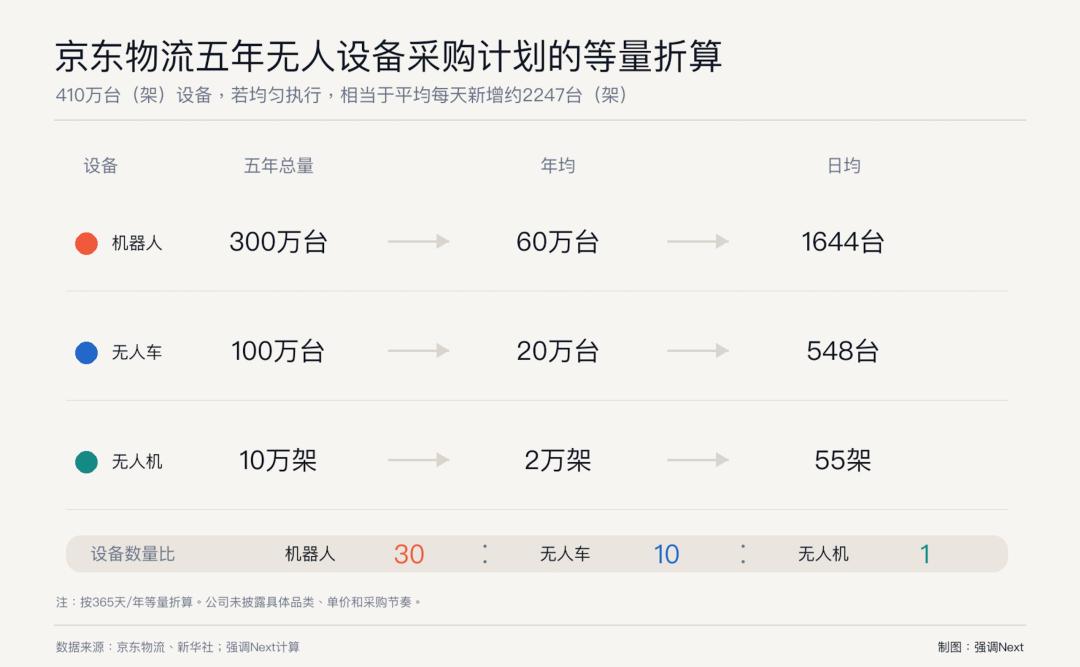
The 3 million robots are not all humanoid robots. JD has not disclosed specific categories, procurement amounts, or annual implementation timelines, but from the perspective of logistics scenarios, it will clearly include mobile robots, robotic arms, sorting equipment, and other dedicated automated devices.
Even so, this remains a rare large-scale order.
The robotics industry is not short of prototypes, financing, or exhibition demonstrations. What is truly scarce is large-scale real-world scenarios that allow continuous operation and repeated trial and error. Only when robots enter warehouses, stores, distribution stations, and homes can issues such as joint wear, recognition errors, insufficient battery life, and scheduling congestion be exposed.
JD happens to own all these scenarios.
From May to August 2025, JD successively invested in Agibot, Patsini, Qianxun Intelligence, Extant Robotics, Qiantuo Robotics, and RoboScience, covering robot body, tactile perception, motion control, and embodied models. In June this year, a JD-affiliated fund also participated in the over $200 million angel round financing of Boundless Dynamics.
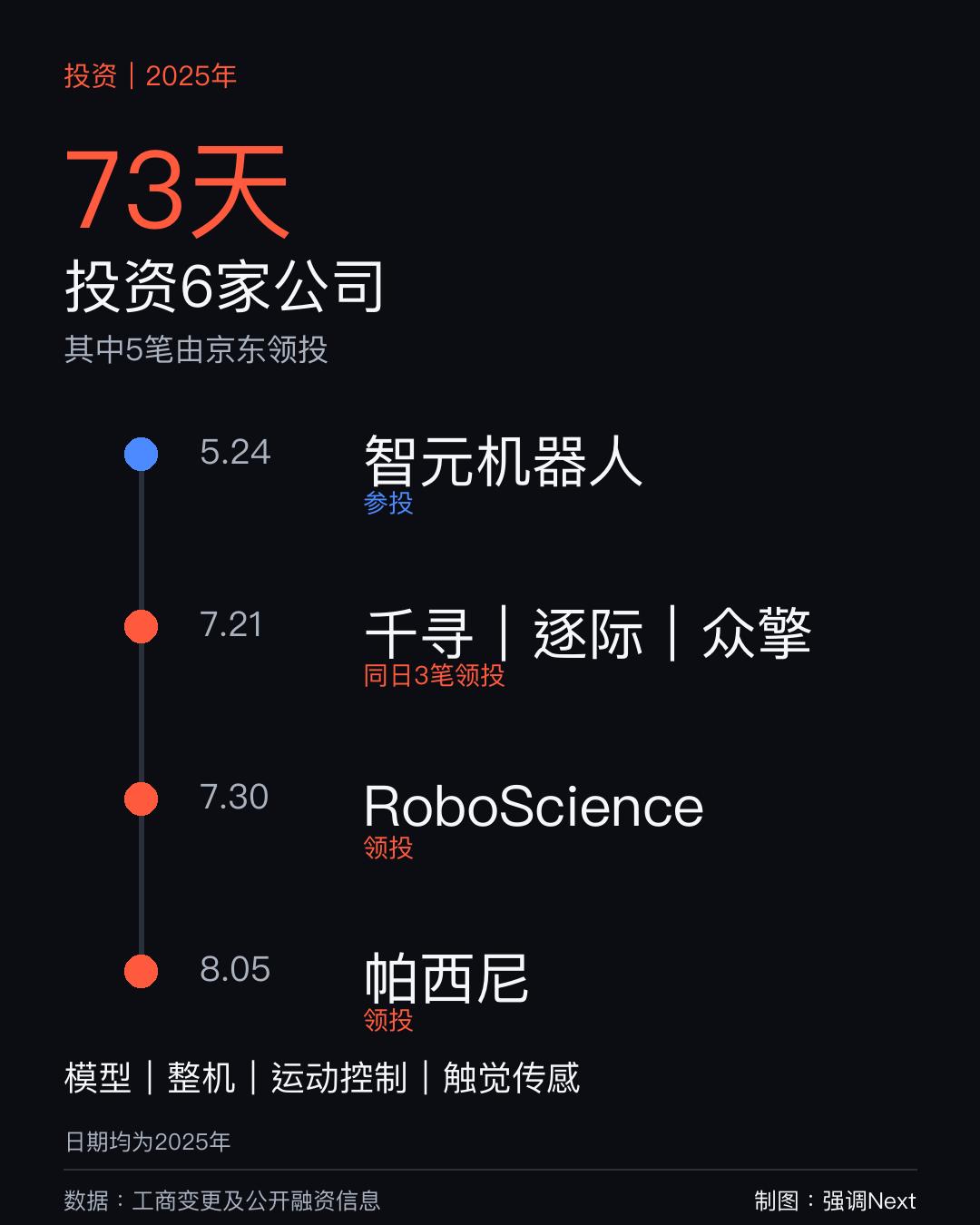
JD does not need to bet on a single robotics brand. It can collaborate with multiple manufacturers simultaneously, place their products in its own scenarios for testing, and then filter products using orders, channels, and after-sales systems.
Robotics companies gain orders, data, and an iteration environment, while JD obtains more suppliers and stronger procurement bargaining power.
In addition to orders, JD is also competing for robot training data.
There are two publicly stated versions of JD's first batch of open EgoLive datasets: the data scale disclosed in academic papers is 1680 hours, 65,866 task segments, and 346 real-world tasks. JD uses the description "first batch of 2000 hours" for external announcements.
Even calculated based on the paper's figures, the 10 million-hour target is nearly 5950 times the current scale. Averaged across 600,000 people, each person needs to contribute approximately 17 hours of data over two years.
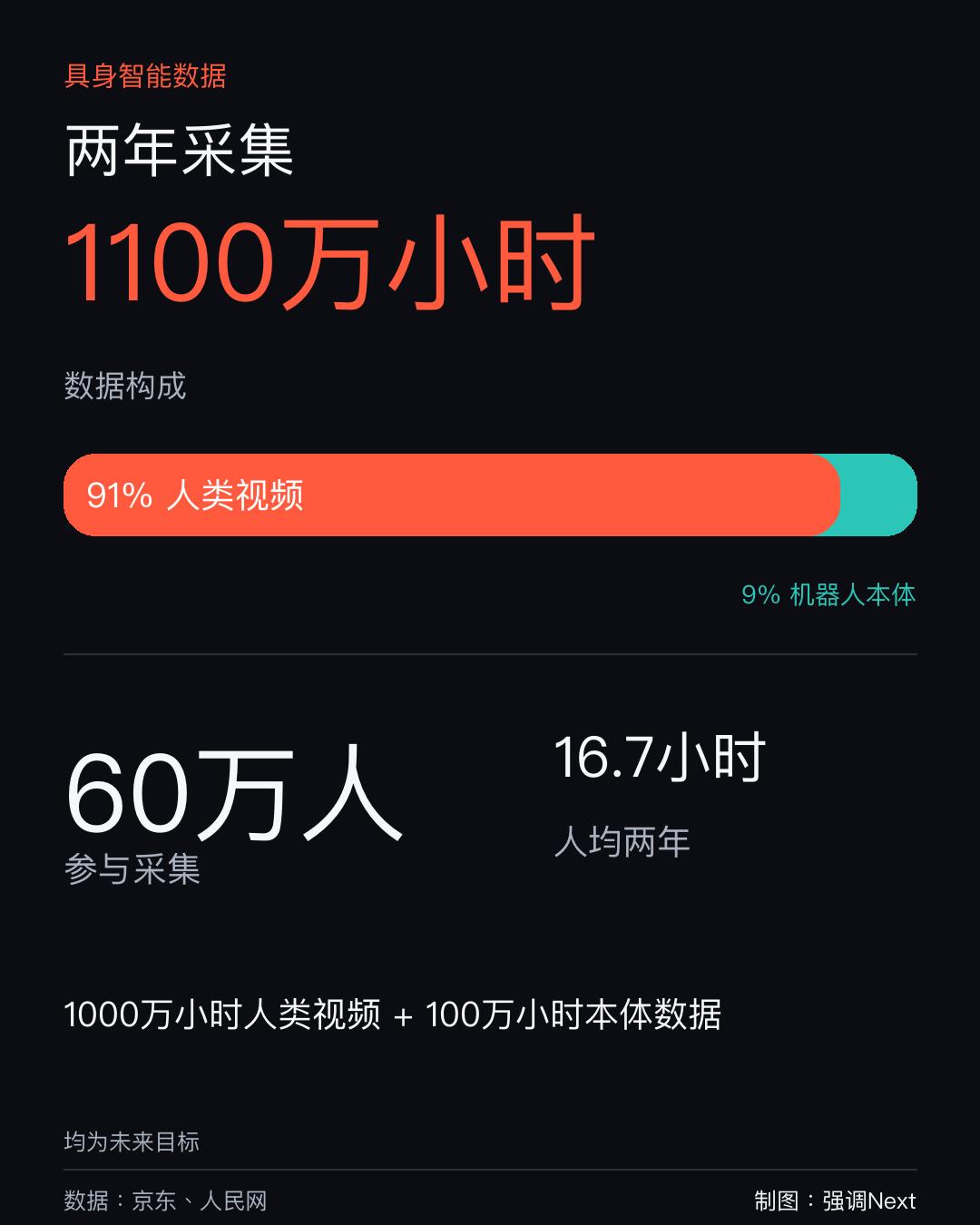
Orders determine what problems robots should solve, and data determines whether robots can learn to solve these problems. By grasping both ends at the same time, JD is essentially transforming its supply chain scenarios into training grounds for the robotics industry.
Amazon provides a more mature reference. Amazon claims that its global robot fleet has reached 1 million units, covering more than 300 facilities, with approximately 75% of customer orders processed with robot participation. Its DeepFleet model, trained on warehouse inventory movement data, can improve robot travel efficiency by 10%.
This is exactly the strategic value of JD's 3 million-robot procurement plan, as well as its inherent risk: Buying equipment is not difficult; the hard part is keeping them operating stably over the long term.
02.
What's More Valuable Than Selling Robots Is Preventing Them From Shutting Down
Once robots enter real commercial environments, competition criteria will change rapidly.
At exhibitions, comparisons focus on speed, load capacity, degrees of freedom, and motion capabilities. However, warehouses and factories evaluate uptime, failure rates, maintenance response time, spare parts supply, and total lifecycle costs.
The selling price of a robot is only the first cost. Joint wear, sensor failures, battery degradation, and software errors are all inevitable. If a robot is out of service for several weeks, the labor costs saved are likely insufficient to offset the operational losses.
On April 15, JD launched the "Robot Ambulance" service, providing fault diagnosis, battery swapping and recharging, maintenance and repair, testing and appraisal, and equipment recycling services for humanoid robots, quadruped robots, and AI companion robots.
JD plans to expand its on-site maintenance services to more than 50 core cities across the country in the next three years, and recruit more than 10,000 professional robot maintenance service personnel. Related services have also begun to expand to some overseas markets.
This is the most business-relevant part of JD's robotics layout.
It is difficult for a single robotics brand to independently build a nationwide network covering maintenance, spare parts, and reverse logistics. However, JD's existing maintenance system for mobile phones, computers, and home appliances can be migrated to the robotics industry, with a single service network supporting multiple brands simultaneously.
JD's standardized robot battery solution released at AWE also follows this direction. The solution attempts to unify battery structures, interfaces, and communication protocols, and has completed adaptation verification with multiple robotics companies.
This does not mean that JD has taken control of the interface standards of the robotics industry, but at least it has begun to participate in the formulation of equipment interfaces and communication protocols. Whoever can drive more brands to adopt the same set of standards will more easily gain control over subsequent procurement, battery swapping, maintenance, and recycling processes.
RoboBase further complements R&D, pilot testing, and manufacturing services. At least based on the currently disclosed actions, JD acts more like a platform organizer for the robotics industry, rather than a robotics brand betting on a single product.
What it sells is not just a single robot, but a complete set of commercial services ranging from data, procurement, deployment, to maintenance.
03.
What JD Lacks Most Is a Clear Cost Sheet
JD's robotics layout has an obvious gap: There are many strategic goals, but few unified financial and operational results.
In the first quarter of 2026, JD's revenue increased by 4.9% year-on-year, while fulfillment expenses rose by 18.5% year-on-year to 23.4 billion yuan. The proportion of fulfillment expenses in revenue increased from 6.6% to 7.4%.
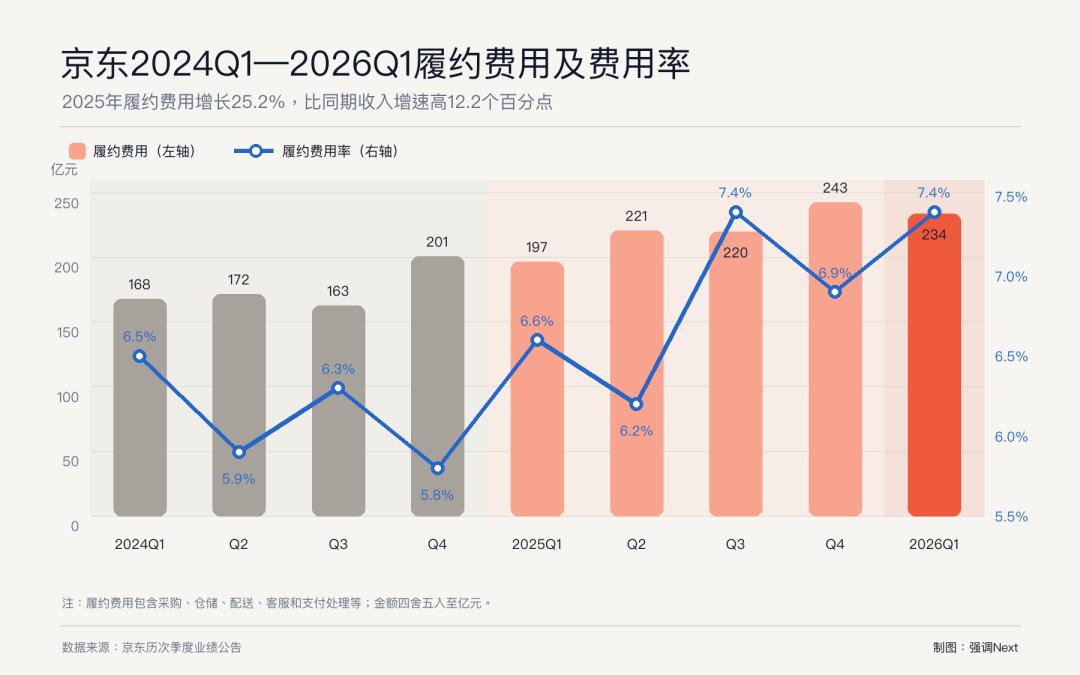
JD attributes this to the upgrade of fulfillment capabilities and investment in human capital. Fulfillment expenses also include procurement, warehousing, distribution, customer service, and payment processing. The growth cannot be simply attributed to labor costs, nor can it be concluded that robots have not produced any effect.
However, this set of data at least indicates that JD is still in the investment phase. Whether robots can reduce costs has not yet been reflected in the group's financial data.
JD is not completely without cases of cost reduction through automation. It once disclosed that after applying the "Smart Wolf Goods-to-Person System" at the Yiya Smart Wolf Warehouse at Beijing Daxing Airport, the logistics cost per order for apparel categories decreased by 50%, the operational space efficiency reached 2.5 times that of a traditional automated warehouse, and the outbound picking efficiency increased by 300%.
The problem is that these are single-warehouse, single-category cases provided by JD, and cannot be extrapolated to the entire logistics network.
As of the first quarter of 2026, JD has not separately classified its robotics business as a reporting segment, nor has it disclosed related revenue, investments, gross profit, and losses. There is also no unified standard for equipment utilization rates, failure rates, maintenance costs, and investment payback periods.
The 3 million robots represent a five-year procurement plan, the 10 million hours of data is a two-year collection target, and RoboBase will not reach full production capacity until 2030.
What JD needs most now is not to add more robotics projects, but to present a comparable cost sheet: after robots are deployed in warehouses, how much has the per-order fulfillment cost actually decreased? Can the saved labor costs cover procurement, depreciation, energy, and maintenance expenses? Can robot after-sales services become an independently profitable business?
If these questions remain unanswered, robotics will still only be a large-scale capital expenditure for JD. Only when the cost structure truly changes can it become the second JD Logistics.
04.
700,000 Jobs Cannot Rely Solely on 10,000 Maintenance Positions
The more machines JD procures, the more it cannot avoid the employment issue.
As of the end of March 2026, JD's ecosystem has more than 900,000 personnel, including company employees, part-time workers, interns, and personnel from affiliated companies. Over the past 12 months, total expenditures related to human resources and external personnel have reached 166.4 billion yuan.
Labor is not only the barrier of JD's supply chain, but also one of its heaviest costs.
In June this year, Liu Qiangdong proposed the "Nirvana Plan": JD has cooperated with more than 120 schools across the country, and plans to train 700,000 blue-collar employees such as couriers in batches to help them learn robot maintenance, upkeep, and operation skills.
The direction is correct, but the scale is difficult to match.
JD plans to recruit more than 10,000 professional robot maintenance personnel within three years, while the "Nirvana Plan" covers 700,000 blue-collar employees. These two sets of figures are not measured on the same scale: training does not equal job transfer, and 10,000 positions are not all the jobs JD has prepared for 700,000 people.
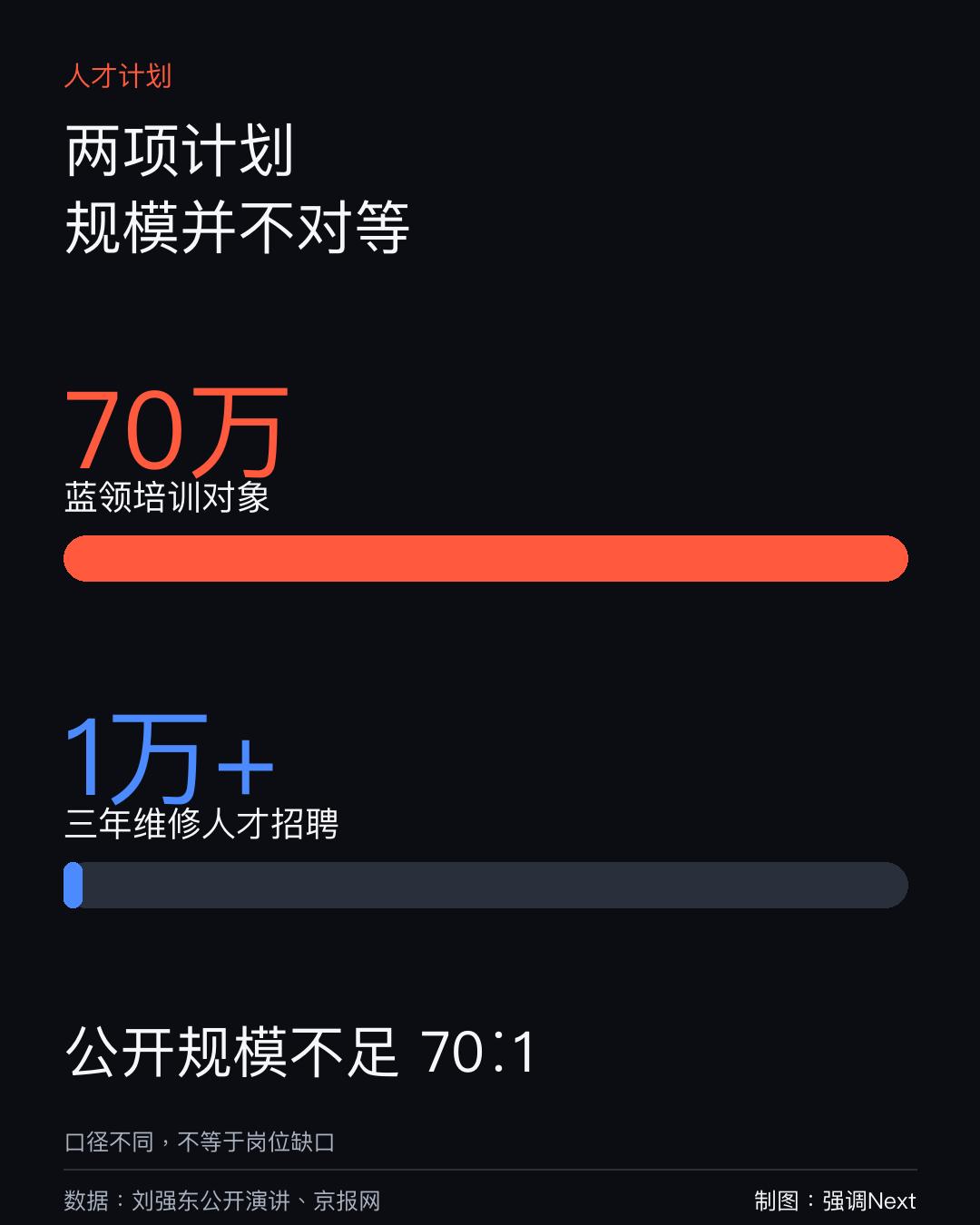
However, after the training is completed, how many stable, long-term technical positions with sustainable income can accommodate these employees remains a problem that JD has to face.
Robots may replace a large number of physically demanding jobs with standardized processes, but the newly added positions in maintenance, scheduling, and data processing may not be of the same scale. Robot maintenance also requires capabilities in mechatronics, software, and fault diagnosis, and not all couriers can complete the transformation in a short period of time.
For a period of time, JD is likely to bear two types of costs simultaneously: on the one hand, procuring robots, and on the other hand, continuing to pay huge labor costs and investing training resources for employee job transfers.
This is the most difficult part of Liu Qiangdong's second logistics network.
In 2007, the outside world questioned why JD insisted on delivering goods by itself. The self-built logistics system ultimately gave JD control over fulfillment timeliness, service quality, and after-sales experience.
Now the question has become: when more and more goods are moved and delivered by machines, can JD integrate robots, humans, and the supply chain into a single network?
What truly determines the value of this network is whether the machines can operate continuously, whether costs can truly be reduced, and whether the people who used to deliver goods can find their place in the new system.
This article is from the WeChat Official Account "Emphasis Next" (ID: leo89203898), Author: Qingyun, Editor: Xiaobai, published with authorization from 36Kr.