13 new brands have entered the Chinese market within 18 months, behind the fervent "expansion spree" of international hotel groups...
Recently, Hilton Tempo officially entered the Chinese market, marking a total of four new international hotel brands that have intensively launched in China in 2026. From Series by Marriott to Hyatt Select, from Garner to Hilton Tempo, why are leading international hotel groups collectively doubling down on the broad mid-range segment this year? How does their strategy differ from the category innovations of 2025? As stock renovation becomes a widely accepted trend and lifestyle becomes a core label, can Hilton break through in the fiercely competitive market relying solely on this concept? And can the brand premium of international giants withstand the scale encirclement from local hotel groups?
Launching Another Lifestyle Brand: Hilton Targets Lower-Tier Markets and Niche Segments This Time
In mid-July, Hilton officially introduced its lifestyle brand, Hilton Tempo, to the Asia-Pacific market, with multiple hotel projects signed in the Greater China region in the first batch, further expanding Hilton's brand portfolio in China.
At the Hilton Tempo brand launch event, Qian Jin, President of Hilton Greater China & Mongolia, stated that the introduction of the Hilton Tempo brand not only demonstrates the group's firm confidence in the long-term potential of the Chinese market, but also allows the group to seize significant opportunities to meet the growing demand of the new generation of travelers for high-quality lifestyle accommodation experiences.
The core "lifestyle" label was repeatedly mentioned at the launch event, which precisely reflects the profound changes in the global hotel industry over the past decade — "lifestyle hotels" are gradually evolving from a marginal niche concept into a core battlefield where global hotel groups reconfigure their brand architecture, customer positioning, and asset value.
Specifically, international hotel groups have taken intensive layout actions in this field in recent years.
Marriott acquired the innovative lifestyle brand citizenM, Hyatt acquired the well-known design hotel brand Standard International, Accor partnered with Ennismore to build a lifestyle platform, and InterContinental incorporated Six Senses, Kimpton, Hotel Indigo, and The Unbound Collection into its luxury and lifestyle segments...
These seemingly diverse operations actually point to the same direction: traditional hotel groups are complementing capabilities they previously lacked — the ability to create identity recognition, community connections, and contextual scenarios.
Today's hotel brands are increasingly unsatisfied with providing standardized accommodation services, but are trying to build deeper connections with consumers at the level of values and aesthetic tastes through the creation of lifestyle brands.
From the perspective of this new brand launch, the lifestyle brands of international hotel groups represented by Hilton are showing a trend of deeper penetration into lower-tier markets and more precise segmentation in China.
"In the past, there were common doubts that certain destinations were too niche, but today's market logic is changing," Alan Watts, President of Hilton Asia-Pacific, explicitly stated at the Hilton Tempo brand launch event in mid-July, adding that now is the best time to deeply cultivate China's segmented markets.
Behind this judgment is the dual driving force of the stratification of China's consumer market and the diversification of tourist destinations. As a result, among the ten Hilton Tempo projects signed in China this time, in addition to the core areas of first-tier cities such as Beijing, Shanghai, and Guangzhou, there are also emerging tourist destinations that have risen rapidly in the past two years, such as Wuzhen, Jiaxing, and Altay. These cities are not traditional business hubs, but have become hot spots pursued by the new generation of consumers thanks to their unique cultural endowments or natural landscapes.
In terms of customer positioning, the new generation of consumers, Gen Z, and Millennials are preset as the core target groups of Tempo. Balancing business, life, and emotional value needs has become the design concept, marking further segmentation of Tempo's product logic. It no longer attempts to satisfy all groups with a single function, but builds more targeted spatial narratives and experience designs around the lifestyle preferences of specific generations.
As the third new brand launched by international hotel groups in China this year, the launch of Tempo is not an isolated event. As Alan Watts said, Hilton has successfully built the Hampton brand, then launched Hilton Garden Inn, and now there are more than 100 operating Homewood Suites by Hilton hotels in China; Tempo is built on this foundation to make more targeted decisions.
As the lifestyle brands of international hotel groups penetrate from first-tier cities to niche destinations, and focus from all customer groups to segmented generations, their competitive dimension in the domestic hotel market is quietly upgrading; international hotel groups represented by Hilton seem to be trying to find answers from the precision of business and emotion.
13 New Brands Enter China in One and a Half Years: International Hotel Groups Step Up New Brand Launches
In fact, international hotel groups' new brand launches in China (including introducing existing brands and establishing new brands through cooperation) happen every year. These actions often represent the latest trends of the group's strategy in China, and thus have received wide attention from the industry.
/ Accelerating New Launches: Three Major Stock Renovation Brands Intensively Enter China
Since the beginning of this year, in addition to Hilton Tempo, many leading international hotel groups have launched new brands in China in the first half of the year, with a dense launch rhythm and convergent directions.
In June, Marriott announced the introduction of Series by Marriott to the Greater China region. As a soft brand under Marriott, it positions itself in the mid-range and high-end markets, aiming to allow independent hotels and regional hotel groups to access the Marriott system while retaining certain product flexibility, and mainly tap the value of existing hotels.
In May, Hyatt announced the signing of a master franchise strategic agreement for the China region with Huanyue International Holdings, an affiliate of the Dossen Group, to exclusively develop and operate Hyatt Select brand hotels in the Chinese mainland market. This brand features a modern minimalist style, adapting to both new construction and stock renovation paths.
In February, Garner, InterContinental's brand new mid-to-high end brand, officially opened its first store in the Greater China region at the 798 Art District in Beijing. Positioned as a stock property-friendly brand, it focuses on asset-light renovation and rapid rebranding, mainly targeting the mid-range and mid-to-high end stock market.
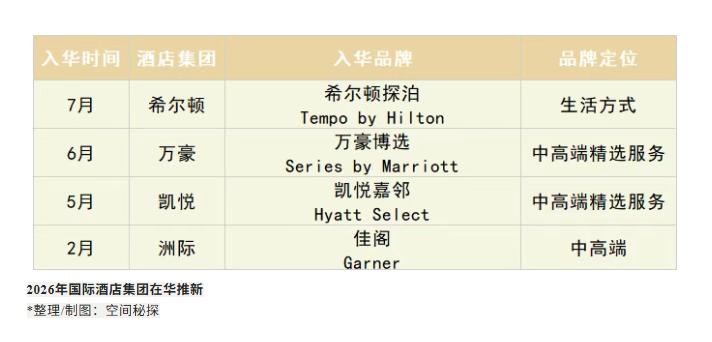
From the perspective of launch rhythm, the speed of new brand launches by international hotel groups in 2026 is not particularly fast, and most of them are chain brands under leading groups, with no new moves from mid-tier groups for the time being.
However, from the perspective of the categories of introduced brands, this batch of new brands has been fully polished in foreign markets. Garner is known as "the fastest-expanding brand in InterContinental's global history", while Tempo opened from Times Square in New York and has undergone three years of local market practice, with its profit model and expansion path fully verified.
More importantly, the positioning and hierarchy of this batch of hotel brands show a high degree of similarity. Almost all of them target the stock renovation and rebranding track, and are anchored at the mid-to-high end select service level. Only Tempo has not explicitly stated that it will lean towards stock renovation. Judging from its brand manual, its configurations such as guest room design, functional zoning, and lobby dining and drinking areas are not completely stock renovation solutions, and are mostly based on new construction.
But overall, leading international hotel groups have maintained a high degree of consistency in their new brand strategies in China this year. They have all set their sights on China's huge stock hotel market, trying to quickly enter this yet-to-be-integrated value trough through flexible models such as asset-light operation, soft brands, and franchising.
/ Mid-Tier Groups Gain Momentum with Diverse Brand Offerings
Looking back at last year, the trends of international hotel groups launching new brands in China were more complex, showing a pattern of coexisting diversification and differentiation.
On the part of leading international hotel groups, on October 22, 2025, Hyatt and Homeinns officially signed a master franchise strategic agreement for the China region to jointly promote the development of Hyatt Studios brand in China. This brand focuses on mid-to-high end long-stay accommodations, and plans to deploy at least 50 extended-stay hotels in emerging cities across China.
Around the same period, Apartments by Marriott Bonvoy under Marriott also targeted the mid-to-long term rental market. In May, Marriott International Group signed a cooperation agreement with Suzhou Huamao Center, announcing the introduction of Apartments by Marriott Bonvoy to the Greater China region for the first time, with plans to officially open in the second half of 2025.
Swissotel Living under Accor also chose this track, announcing its entry into the Chinese market in 2025, and opening its first Swissotel Living Shanghai Hongqiao in February this year.
In addition to the long-stay track, there are also new moves in the lifestyle and luxury sectors. In August 2025, the Asia-Pacific first store of Motto by Hilton, a lifestyle brand under Hilton, opened in Soho, Hong Kong, positioning itself as integrating into local life and targeting young customer groups.
On March 20 of the same year, MGM Resorts International officially launched the new luxury hotel brand MGM Huafu in Asia. The world's first hotel opened in Zhuhai in May 2025, and then reopened in Qingdao on New Year's Day 2026.
In addition, The Bower under Langham and Shilla Stay under Shilla Hotels & Resorts of South Korea also entered China in 2025. The new brand launch actions of international hotel groups can be described as very frequent...
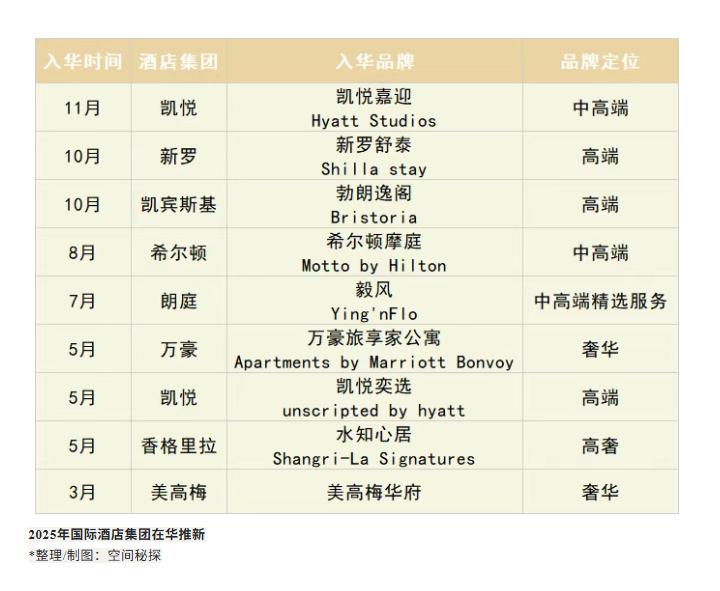
However, careful analysis shows that the rhythm and direction of new brand launches in 2025 are significantly different from this year.
First of all, Marriott and Hyatt simultaneously targeted the mid-to-long term rental track, introducing new extended-stay brands one after another, trying to capture the new demand for the integration of business travel and residential travel in China.
At the same time, the new brands launched by international hotel groups such as Hilton did not explicitly state that they were anchored in the stock renovation track, and only Hyatt Unbound Collection explicitly entered the high-end hotel stock renovation sector. This means that the 2025 new brand launch logic focused more on category innovation and customer group segmentation, rather than asset-side stock integration.
It is worth noting that many mid-tier international hotel groups chose to introduce new brands to the Greater China market in 2025. These brands focus on differentiated experiences and designs, trying to seize opportunities in niche markets and capture the first wave of "early-mover" dividends. The active participation of mid-tier groups is in sharp contrast to the 2026 pattern led by leading groups with highly convergent directions.
But overall, the speed of new brand launches by leading international hotel groups in 2025 was indeed slower than this year. Their main energy was still focused on promoting the opening of the first stores of brands that announced their entry into China from 2023 to 2024, and they did not show the obvious strategic commonality seen in 2026.
However, this also marks that from category innovation to stock renovation, from differentiated exploration to directional consensus, the logic of international hotel groups launching new brands in China is undergoing a subtle but profound shift.
The High-End Market Peaks: International Giants Double Down on Broad Mid-Range Rebranding and Renovation
Behind this new brand strategy of international hotel groups this year, it actually reflects a deep-seated anxiety.
In 2025, a rare signal appeared in the financial reports of the four major international hotel groups at the same time. Marriott's average daily rate in Greater China decreased by 0.2%, making it the only region in the world where its average daily rate declined; Hyatt's decreased by 1.8%; InterContinental's revenue per available room decreased by 1.6%. This set of data releases a market signal that cannot be ignored.
At the same time, the five major local hotel groups (Jinjiang, Huazhu, BTG Homeinns, GreenTree, and Dossen) have cumulatively opened more than 21,000 hotels in the mid-range segment. In the first half of 2025, local hotel brands accounted for as high as 90.4% of the newly opened hotels across China, while international brands accounted for only 9.6%. The broad mid-range segment is becoming the most crowded and certain track in China's hotel industry, and the competitive pressure faced by international groups is imaginable.
Returning to the new brand launches of international hotel groups this year, Garner under InterContinental is the most iconic case in this wave of penetration into lower-tier markets. The brand was launched globally in 2023, made its debut in the Greater China region in March this year, and has opened more than 100 hotels worldwide, setting a record for the fastest expansion in InterContinental's history.
The data of the first store in Beijing 798 is remarkable: it took only 2 months from owner negotiation to trial operation, the total renovation investment was about 800,000 yuan, and the renovation cost per room was about 8,000 yuan; after opening, the average daily rate climbed to 500-600 yuan, slightly higher than surrounding competitors.
It is worth noting that the 8,000 yuan per room of light renovation investment is mainly used for soft furnishings and brand identity system updates, rather than hard decoration reconstruction. Garner provides three optional solutions: light renovation, medium renovation, and heavy renovation, but has requirements for the basic condition of the property. The predecessor of the first store in Beijing 798 was the mature CitiGo hotel, which had a good hardware foundation.
Hyatt chose a path of "leveraging existing strengths". In October 2025, it signed a master franchise agreement with BTG Homeinns, planning to launch at least 50 Hyatt Studios hotels in 3 to 5 years. In May 2026, it signed another agreement with Dossen Group to jointly develop the Hyatt Select brand.
Its essence is a hybrid model combining international brands and local operations: Hyatt outputs brand standards and membership systems, while BTG Homeinns and Dossen provide property resources and lower-tier market channels. This model minimizes the entry threshold for international brands in China and maximizes the avoidance of risks caused by poor adaptability to the local market.
Marriott focuses on the select service segment. Its 700th hotel in China opened in Wuhan in March 2026. In 2025, it signed more than 200 projects, a year-on-year increase of 25%, with the four select service brands achieving a 40% growth in new signings.
In addition, Marriott's powerful membership system provides considerable confidence support for owners of stock renovation brands. Industry data shows that Marriott Bonvoy has more than 228 million global members, with direct sales accounting for more than 60%. This private traffic advantage has become its core chip to attract stock property owners.
Although they all seem to be anchored in the broad mid-range segment, the above three international hotel groups actually have different focuses in their new brand strategies in China. However, they all rely on a basic fact: by the end of 2025, the total number of hotels in China has exceeded 404,800, with a total of about 19.79 million guest rooms, representing an average annual compound growth rate of about 6.1%. But at the same time, existing hotels that have been open for more than 5 years account for about 60% of the total number of hotels in China, with a guest room scale of about 10.57 million. A large number of existing hotels have entered or are about to enter the aging cycle.
This vast ocean of stock assets is the underlying logic for international groups to compete for layout.
In fact, according to the understanding of reporters from Space Detective, among the first batch of signed Hilton Tempo projects, the Beijing Olympic Sports project was converted from the previously signed Wanda Moments hotel project. Although it is not a complete stock renovation, it also reveals the essence of the brand's compatibility with stock renewal to a certain extent.
This fact also indirectly confirms that from Garner's light renovation model to Hyatt's franchising, from Marriott's membership empowerment to Tempo's brand rebranding,