Tencent, Alibaba and ByteDance are waging a fierce battle in the AI office productivity sector.
20.97 million.
This is the monthly visit volume of WorkBuddy, the AI Agent office tool under Tencent, in June 2026. When it was first released 4 months ago, this figure was only just over 8 million.
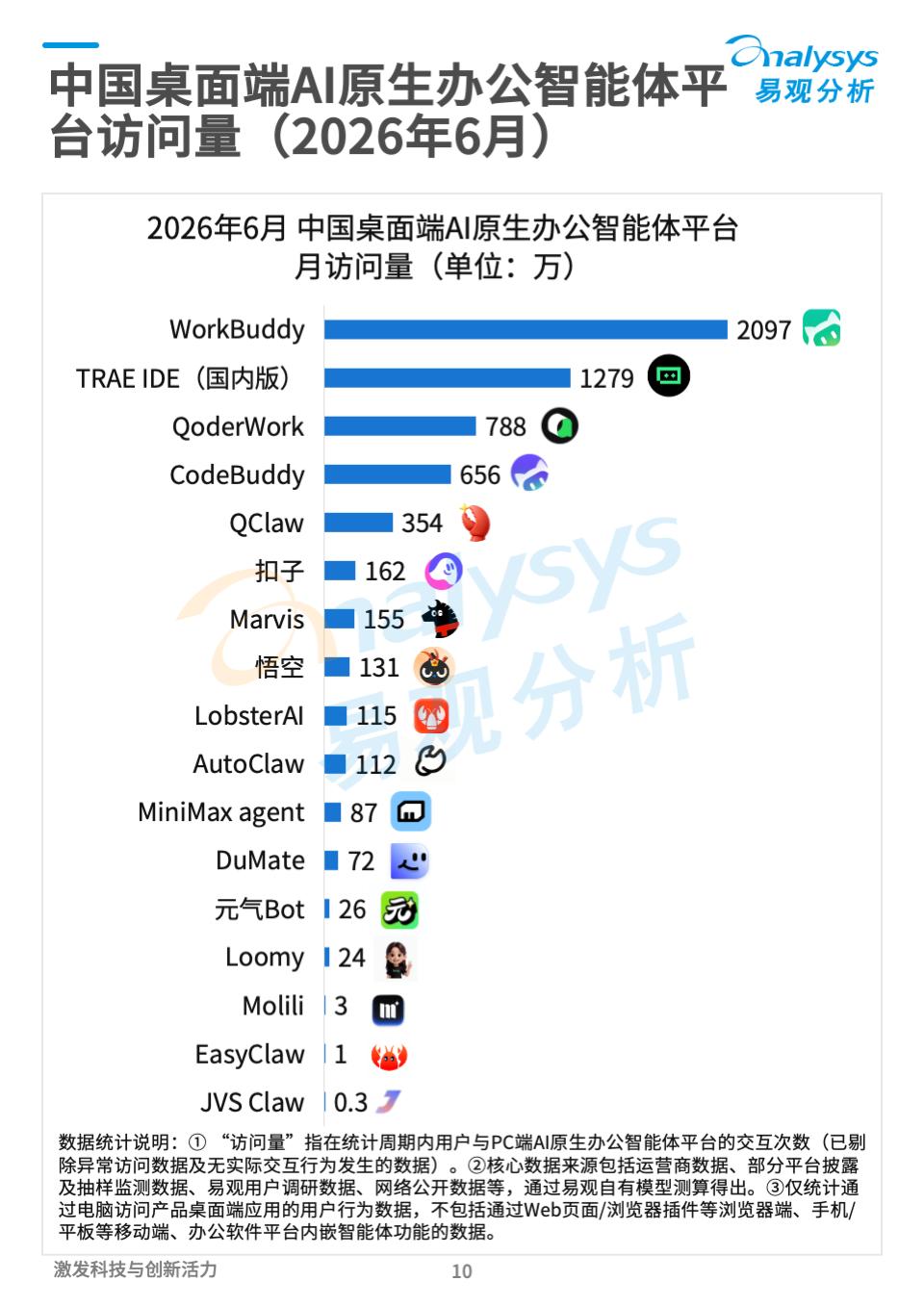
On July 20, Analysys released the "2026 Q2 China Office Agent Platform Market Insight Report". Among the 17 mainstream desktop-side AI-native office agents, WorkBuddy ranked first in visit volume, exceeding the sum of the second and third places.
The list confirms the rankings of each player, and a more noteworthy signal also emerged at the same time: the three major players Tencent, ByteDance, and Alibaba are almost all integrating their products under their respective banners.
On the same day, some media reported that the relevant business and part of the team of Tencent's QClaw product center will be adjusted to the 6th Cloud Product Division, merged into the same system as WorkBuddy, while the QClaw product itself will still operate independently. Alibaba took bigger actions. On July 21, according to *Caijing*, Alibaba will launch "Qianwen Office", integrating the three Agent products QoderWork, Wukong, and MuleRun into one, to be managed by Chen Yusen, the new CEO of DingTalk. The in-depth integration between ByteDance's Doubao and Feishu is also advancing.
This industry is in a period of rapid growth. The "2026 China AI Office Agent Industry Development White Paper" released by iiMedia Research shows that the scale of China's AI agent market reached 80.4 billion yuan in 2025, a year-on-year increase of 123.2%, and is expected to reach 696.8 billion yuan by 2030.
Now, all three players are sitting at the gaming table. The era of simply competing for model parameters is coming to an end, and the competition for the "entry point" and "integration" of AI office has already begun.
01. 60 Million Visits, Three Key Signals
First, let's look at what the report itself states. Analysys has counted 17 mainstream Chinese desktop-side AI-native office agent platforms this time. In June 2026, the total visit volume of these platforms exceeded 60 million times, and the entire industry is in a stage of rapid expansion.
In terms of ownership, the Tencent ecosystem's listed products include WorkBuddy, CodeBuddy, QClaw, and Marvis, with a total traffic of 32.62 million, accounting for more than half of the entire market; ByteDance's listed products are TRAE IDE (domestic version) and Kouzi, totaling about 14.41 million; the Alibaba ecosystem's products are QoderWork and Wukong, totaling about 9.19 million, the lowest among the three. The sum of the three is about 56.22 million, and the remaining traffic of about 4.4 million (the total in the table is 60.62 million) is shared by many other products.
It should be noted that the statistical caliber of this list is PC-side web visit volume, not DAU, let alone the number of paying enterprises. It reflects "who occupies user attention on the desktop entry point", not "who makes money".
However, in the AI office track, PC-side visit volume is precisely a signal that cannot be ignored.
AI apps on mobile phones can boost data through subsidies and advertising investment, but when a user opens a PC-side office agent, it mostly means that they really need to write documents, process spreadsheets, or reply to emails. From this perspective, the value of PC-side traffic is much more substantial than that of mobile-side traffic.

The list conveys several noteworthy pieces of information.
First, Tencent has secured its position at the desktop entry point.
From its release in March to June, WorkBuddy reached 20.97 million visits, climbing at a very fast speed in just three months. Among the 17 products, WorkBuddy alone took up about one-third of the total traffic. In this "first year of desktop Agent" that has lasted for more than half a year, Tencent is the one running at the forefront.
Different from general conversational AI, native office agents that are deeply integrated with documents, spreadsheets, and emails in office scenarios have a lower probability of users opening multiple products at the same time. This is because such products usually require installing plugins, binding accounts, and embedding into workflows, and the switching cost is much higher than opening a web page. Therefore, whoever occupies the desktop first will gain a first-mover advantage.
Second, it is still in the "entry point dividend period", and the competitive landscape of major players is far from finalized.
The list in June is only the "first half". After entering July, the situation will change significantly. The day after the list was released, news came out that Qianwen Office integrated the three agents QoderWork, Wukong, and MuleRun, bringing all brands, teams, and resources together into one basket. ByteDance is also accelerating. Reports say that ByteDance is internally discussing the in-depth integration of Doubao and Feishu. Although it has not been officially implemented, the direction is clear. There are major variables in the rankings of the next quarter.
Third, two types of players will be affected: independent Agents in the same track and previous-generation office software.
In the same track, the top positions on the list are almost all occupied by major players. The competition of office agents relies on the comprehensive strength of model capabilities, ecosystem traffic diversion (IM, documents, cloud drives), and organizational resource investment, which is exactly the home field of major players. Tencent has WeCom and Tencent Docs, Alibaba has DingTalk, and ByteDance has Feishu, each with its own ecosystem foundation. The three have almost taken over the entire market. The window left for startups and vertical players may be narrower than imagined.
The other side that is impacted is the previous-generation office software. Jiang Qingyun, an Agent developer, told *Dingjiao One* that tools like WPS essentially handle tedious operations that do not require much thinking, and can easily be bypassed or even replaced by powerful desktop Agents.
It should be noted that Agents will not make Word and Excel files disappear. What they deliver is still in these formats, but when the Agent becomes the first window users open when starting work, traditional office software may retreat from the entry point to the background, becoming an engine responsible for execution. This is also the reason why WPS and Microsoft have been in a hurry to embed AI functions into their own products recently.
Li Yingtao, a partner at Jiashi Consulting, also believes that once Tencent, Alibaba, and ByteDance enter this market, relying on their comprehensive advantages in traffic, services, technology, and capital, it will be difficult for WPS to become a platform-level player in the intelligent office agent field, but its market space will only be compressed, not disappear.
This also explains why major players have shifted from "horse racing" to "integration" in the summer of 2026. Half a year ago, each company was still encouraging internal teams to explore independently; now, resources are being concentrated, products are being merged, and brands are being unified. The market window period is shorter than imagined.
02. Tencent Leverages Ecosystem, Alibaba Focuses on Models, ByteDance Bets on Feishu
The report released by iiMedia Research states that Internet giants can rely on their existing ecosystems and massive user bases to form a closed office loop from instruction to delivery.
This is a common point shared by Tencent, ByteDance, and Alibaba, but there are differences in the ways each company competes for the entry point. Li Yingtao summarized to *Dingjiao One* that Tencent is a traffic entry point type, Alibaba is an enterprise infrastructure type, and ByteDance is a technology product type.
First, let's look at Tencent. Li Yingtao defines it as a "traffic entry point type", with "the core advantage being the distribution capability of high-frequency social traffic such as WeChat and WeCom, with low customer acquisition cost", but it also has obvious shortcomings: it still lags behind Alibaba in the in-depth understanding of complex processes on the enterprise side.
Jiang Qingyun also agrees with this point: Tencent's model is not its strong point. In his view, WorkBuddy was able to reach 20.97 million visits in three months "largely by catching the LLM Agent trend".
Before the rise of LLM Agents, this efficient working method of "directly operating files through the terminal" was almost only used by programmers. The combination of large language models and auto-executing agents allows ordinary white-collar workers to handle trivial work in the same way. WorkBuddy just stepped into this market at this time window.
In Jiang Qingyun's view, Tencent's self-developed model capabilities are actually not dominant. But Tencent's smart move is that it avoids direct competition at the model level, turning WorkBuddy into a model aggregation platform that integrates multiple models such as DeepSeek, Hunyuan, GLM, and Kimi, which users can access by recharging points. In this way, no matter whose model is running at the bottom, Tencent can make money, turning its own shortcoming into a business that earns platform commission.
However, Tencent is also making up for this shortcoming. On July 6, Tencent Hunyuan Hy3 was launched and first connected to WorkBuddy. According to the Analysys report, among users who choose their own models in WorkBuddy, the proportion of those who choose Hy3 has exceeded 60%. This is equivalent to walking on two legs: aggregating external models on one hand, and using Hunyuan to complement its self-developed foundation on the other.
In addition, WorkBuddy has particularly obvious advantages in communication channels. Users can operate their computers to complete tasks through their mobile phones, and then send the results to colleagues seamlessly via WeChat. The support of the WeChat ecosystem gives WorkBuddy a distribution and connection capability that is difficult for other products to replicate.

Alibaba has the strongest model capabilities, but product integration has just started, and the effect remains to be seen.
QoderWork itself ranks third on the list, with 7.88 million visits, which is not a poor number. Li Yingtao told *Dingjiao One* that Alibaba's foundation lies in the B2B sector. From Alibaba Cloud to DingTalk, Alibaba has accumulated the most complete enterprise service chain in China, and understands enterprise procurement processes, compliance requirements, and organizational operation methods. But its disadvantage is that its C-end traffic is not as good as Tencent and ByteDance, and it is running three Agent products QoderWork, Wukong, and MuleRun internally at the same time. Multi-front combat has led to scattered resources.
The integration idea of Qianwen Office is based on QoderWork, bringing together the capabilities and teams of the three products, and unifying the "Qianwen" brand.
This choice is reasonable. Jiang Qingyun believes that Tongyi Qianwen's strength at the model level is "much better than the other two". In the AI office track, model capabilities are not everything, but it is a key variable that determines the upper limit of product experience. If Qianwen Office can truly convert its model advantages into product experience advantages, it will have great potential for growth. But the integration has just started, and the fusion of products and teams takes time.
ByteDance's situation is the most delicate among the three.
TRAE IDE (domestic version) performs well in the programming track, but when ranked second in the office agent list, Jiang Qingyun commented that it is "a bit awkward", because TRAE IDE is actually competing with programming software like Cursor, and is not in the same track as WorkBuddy and QoderWork.
ByteDance's problem is that its product line is not clear enough. TRAE IDE focuses on programming, TRAE Work tries to integrate office functions to do things similar to WorkBuddy, and Doubao is an independent AI conversation product. Jiang Qingyun commented, "TRAE IDE is already very powerful in China, but TRAE Work is average. If ByteDance does not integrate, the positioning of these software will be very awkward." He added, "On the contrary, Doubao's office functions are doing well, and many people use it."
ByteDance is also weighing internally. According to media reports, the adjustment direction is the in-depth integration of Feishu and Doubao, rather than continuing to bet on TRAE Work. This idea is different from Tencent and Alibaba. AI capabilities can be directly embedded in Feishu's workflow, and users do not need to download an additional Agent client.
Li Yingtao believes that ByteDance's gene has always been technology-driven product iteration. Although this gives it advantages in model iteration speed and coding scenario entry, when migrating the "programming mindset" to the "office scenario", it will not only face the specific problem of average TRAE Work product experience, but also a more fundamental problem: the volume ceiling of the Feishu ecosystem itself, which is still not as good as WeCom and DingTalk, which is also one of ByteDance's disadvantages.
Of course, there is another possible direction. Just like OpenAI integrating Codex into ChatGPT, ByteDance can merge the capabilities of TRAE Work into Doubao. No matter which path it takes, the future positioning of TRAE Work is still unclear.
Behind the competition of the three routes, there is a more essential layer of user stratification. Jiang Qingyun admitted that professional developers with real complex programming needs currently hardly use domestic desktop Agents like WorkBuddy to write code. The biggest gap lies in the ability to handle deep tasks. These professional users are more willing to pay for overseas products like Claude Code and Codex, and even have multiple accounts each.
But he also emphasized that most tasks in daily office scenarios are trivial and do not require complex reasoning, and the capabilities of these domestic products are "more than sufficient". What really determines user choices are details at the product experience level, such as entry convenience, operation threshold, and whether additional network configuration is required. These are precisely the advantages that WorkBuddy has established through low barriers, no deployment requirements, and ready-to-use after download.
03. Who Can Convert Traffic into Revenue
Users' expectations for AI have changed from "can it chat like a human" to "can it really get the work done". This is why products like DingTalk, Feishu, and WeCom, which already have a large number of enterprise customers and real office scenarios, have become the main positions that major players bet on for AI office.
A more macroscopic driving force also comes from the huge and continuously expanding number of OPCs (One Person Companies) in China. Data from iiMedia Research shows that as of June 2025, the number of OPCs in China has reached 16 million; in the first half of 2025, the number of newly registered OPCs nationwide reached 2.86 million, and the growing OPC group has also become an important demand side and commercial driving force for AI office agents.
Li Yingtao said that the biggest difficulty in the next stage is not model capabilities, nor product functions, but "unit economic cost" - whether the AI business can achieve a positive return. At present, several relatively clear charging models have emerged in the industry:
The subscription system is the most mainstream way at present, charging a fixed fee monthly or yearly. The platform guides conversion through function stratification between the free version and the paid version. For example, ByteDance's TRAE follows a typical membership subscription route, and the Doubao Professional Edition also adopts the subscription system, with three tiers of pricing: Standard, Enhanced, and Premium.
The Token/point system ties costs to actual consumption. Tencent WorkBuddy adopts the parallel mode of "points + membership", where users recharge points to call different models, paying according to actual usage.
Private deployment is for large government and enterprise customers with rigid demands for data security and customized processes, realizing commercialization through one-time licensing fees plus annual maintenance fees. The enterprise market is