All flight tickets for the summer travel rush are sold out, yet airlines are suffering huge losses?
01
Recently, I chatted with friends working in hotels and travel agencies, and almost all of them summed up the situation in one word: tough.
My friends generally lamented that where all the summer tourists who used to come in previous years have gone, and many even asked me if people have stopped traveling altogether?
Yet the data from the civil aviation industry seems to come from a completely different world.
According to the data from VariFlight, in the second half of July this year, the number of domestic flight bookings exceeded 13.31 million, an increase of about 7% over the same period last year, while the number of inbound and outbound flight bookings exceeded 3.25 million, with a growth rate also around 7%.
Judging solely from this set of data, summer travel still seems to be booming.
But when I shared this data with Xiao Zou, a friend working at an airline based in Beijing, he smiled bitterly and said that everyone indeed has a "bright future" ahead of them.
Shortly after, he showed me a set of real operational data, stating bluntly that there was a typhoon last week. While the passenger load rate seemed acceptable on the surface, after factoring in the flight cancellations, the airline suffered staggering losses. The average ticket price dropped by nearly 8%, and after deducting fuel costs and landing fees, the remaining gross profit was more than 30 million yuan less than the same period last year, a shrinkage of nearly 40%.
This is not an isolated case for a single company.
According to data from Flight Manager cited by Reuters, from July 1 to 14 this year, the average domestic economy class ticket price was about 831 yuan, down 1.2% year-on-year, and still 6.1% lower than the same period in 2019.
In other words, even in the traditional peak summer travel season, the average price of each ticket is still about 10 yuan lower than last year.
At this point, I made a phone call to Lao Zhou, the head of a private airline.
He was silent for a few seconds on the other end of the line, then sighed, "The competition has indeed become extremely fierce."
Lao Zhou told me that the most obvious decline in their airline this year was on domestic routes with strong tourism attributes.
"Traditional summer escape routes like those to Northeast China and Xinjiang used to be peak seasons in previous summers, but this year the ticket prices just can't go up."
In contrast, short-haul international routes such as those to Japan, and flights connecting core business cities, have performed relatively stably.
The ones that are really struggling are those domestic routes that are highly dependent on family travelers, group tourists and seasonal visitors. Their passenger load rates don't look low, but most of the tickets sold are low-priced ones.
"There are still passengers, but the price gap is too big," he said.
Small and medium-sized airlines are having a hard time, and the three major state-owned airlines are also going through hardships as they welcome the summer season.
Last week, Air China, China Eastern Airlines, and China Southern Airlines almost simultaneously released their first-half performance forecasts. The three companies are expected to record a combined loss ranging from 7.373 billion yuan to 8.973 billion yuan.
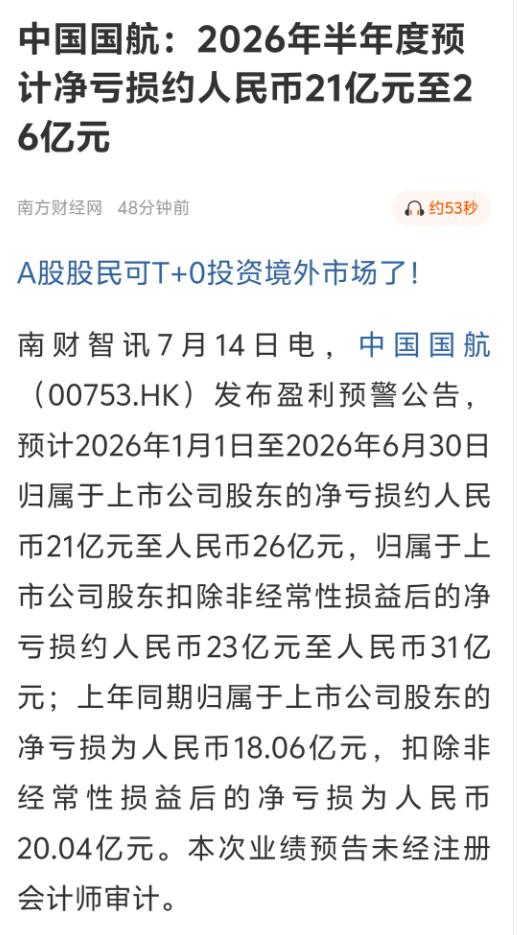
What's even more surprising is that in the first three months of this year, Air China, China Eastern Airlines, and China Southern Airlines made profits of 1.714 billion yuan, 1.633 billion yuan and 1.481 billion yuan respectively, with a total profit of 4.828 billion yuan.
Calculated backwards based on the half-year performance forecast, the three major airlines recorded a combined loss of about 12.2 billion yuan to 13.8 billion yuan in the second quarter.
All the profits accumulated during the Spring Festival travel rush were wiped out in just three months, and the airlines even lost an extra 7 billion yuan.
In Lao Zhou's view, this cold summer season is almost the most crucial opportunity for a turnaround for airlines that have already lost a lot of blood in the first half of the year.
Because according to the traditional business rhythm, many airlines usually operate at a loss from April to May, and the off-season comes again after October. As long as they make enough profits in July and August, the year-end financial statements can still look decent, and even nearly half of the annual profits are expected to be earned in these two months.
But this summer travel season, although airlines seemingly have no shortage of passengers, they have not ushered in the expected peak season.
02
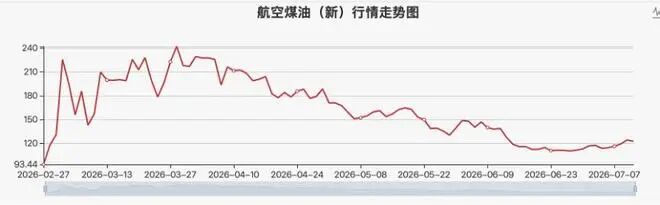
I asked Xiao Zou, the price of aviation fuel has fallen back a bit recently from its high point in the second quarter, why can't the ticket prices hold up?
He first mentioned the World Cup.
In the past month, many football fans stayed at home to watch the matches. Airlines originally expected that after the World Cup concluded, the suppressed travel demand would be fully recovered.
But a few days after the final, the booking curve did not suddenly rise as expected.
"At the end of the day, it's still the lack of consumer purchasing power, mainly in the domestic market."
Xiao Zou believes that this year travelers are more price-sensitive than in previous years. If ticket prices are lowered, the seats can be sold out quickly, but as soon as prices are raised slightly, the booking speed slows down immediately.
It is not particularly difficult to fill an airplane with passengers.
"The real skill is being able to sell tickets at a higher price than your competitors."
Data from the National Bureau of Statistics shows that in the first half of this year, the total retail sales of consumer goods only increased by 1.3% year-on-year, the per capita consumption expenditure of urban residents increased by 2%, and the retail sales of services still maintained a 5.3% growth rate. This means that people are still willing to travel, but they are spending much more cautiously than before.
Reflected in air tickets, if a single ticket is two to three hundred yuan more expensive, a family of three will have to spend nearly a thousand yuan extra. Consumers can choose to depart a few days later, switch to another destination city, and when the flight distance is not too long, they can even choose to take high-speed rail instead.
The data from the International Air Transport Association (IATA) is even more telling.
In May this year, China's domestic air passenger demand decreased by 6.2% year-on-year, while capacity decreased by 5.5%, making it the weakest performing major domestic air travel market in the world.
IATA believes that the fluctuation in ticket prices has pushed some price-sensitive passengers to ground transportation.
In fact, while air passenger flow is declining, domestic railway passenger transport is still growing.
The Yangtze River Delta Railway estimates that it will handle 190 million passenger trips during this year's summer travel season, with an average daily volume of over 3 million, representing a year-on-year increase of more than 3%. In the first half of the year, the Yangtze River Delta Railway transported more than 470 million passengers, also recording a growth rate of over 3%.
A few days ago, I tried to buy a soft sleeper ticket (either a lower berth or a berth that allows lying down) for an elderly family member. When I checked 14 days in advance, there were no tickets left at all. In the end, I could only buy a high-speed rail ticket, which only cost about 100 yuan more than the soft sleeper ticket.
This small incident also shows that traditional green train carriages and sleeper services have not lost their market. For price-sensitive travelers who are not in a hurry, a slower journey is still acceptable as long as they can save money.
What makes things even harder for small and medium-sized airlines is that after the market has shrunk, the business opportunities that were previously reserved for them have now been targeted by large airlines.
Lao Zhou described this situation vividly: "In the past, others were not willing to compete with you for the food in that rice bowl, but things are different now."
He said indignantly that several large airlines used to prefer operating traditional business routes departing from Beijing, Shanghai and Guangzhou, as well as some international flights originating from second-tier cities and relatively unpopular intercontinental destinations, which left room for private airlines to survive.
Now the situation has completely changed.
Lao Zhou gave an example that a private airline once launched a route to Northern Europe from a central Chinese city, trying to attract surrounding passengers through high-speed rail intermodal services.
But this spring, a large airline launched a flight on the same route from Beijing, and increased its frequency to daily flights during the summer season. The private airline soon found that there was no point in continuing to operate that route.
"Why would passengers in Beijing travel to another city to take a flight?"
Large airlines have a denser route network, more time slots at core airports, and a huge number of frequent flyers. The market that private airlines have cultivated over several years through low prices can be quickly taken away by these large airlines once they enter the market.
Behind the situation of too many airlines chasing too few passengers, what is truly scarce this summer travel season are the passengers who are willing to pay the peak-season premium for air tickets.
03
Just as airlines are worrying about ticket prices, regulatory authorities have also stepped in to take action.
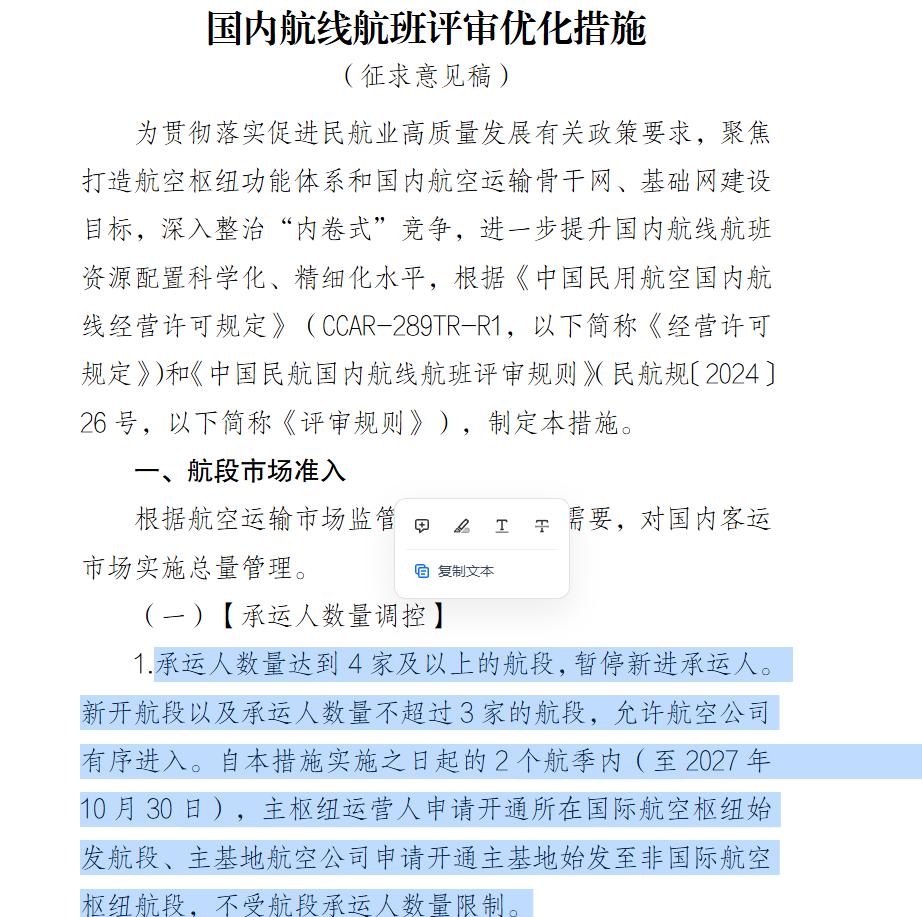
On June 25, the Department of Transportation of the Civil Aviation Administration of China (CAAC) simultaneously released two draft regulations for public comments, involving domestic route review and international air rights allocation. The documents clearly stated at the beginning that they would thoroughly rectify the cut-throat internal competition in the industry.
According to the new regulations, new airlines will be prohibited from entering domestic air routes that already have 4 or more operating carriers. For routes where neither the passenger load rate nor the passenger traffic volume meets the specified standards, no new operators or additional flights will be approved.
In addition, for international routes, in principle, no more than two Chinese airlines can operate on the same city pair. Long-haul international routes will mostly depart from the three major hubs of Beijing, Shanghai and Guangzhou, further enhancing the operational priority of the main hub operators and the airlines based at these core airports.
The two measures are planned to be implemented starting from the 2026-2027 winter-spring flight season.
In Lao Zhou's words, the regulatory authorities can no longer stand idly by: airlines are all flooding the same routes with flights at low prices, the passenger load rates have gone up, but in the end none of them can make any money.
But I asked him, since the market only cares about low prices, why don't airlines just keep cutting ticket prices?
Lao Zhou smiled bitterly and said that they can barely cut prices any further.
If an airline sells each ticket for dozens of yuan less, passengers may not even notice the difference. But when you multiply that by 200 seats on each plane and tens of thousands of flights throughout the year, that small discount is enough to eat up most of the airline's profits.
Speaking of which, Lao Zhou suddenly brought up China Southern Airlines.
There have been many complaints online recently about China Southern Airlines' economy class seats and in-flight meals, but Lao Zhou said that from the perspective of airline operations, China Southern Airlines has done a very smart job in the past two years.
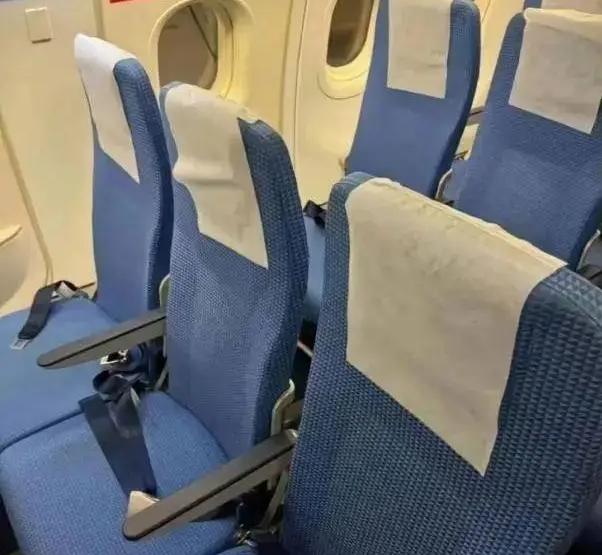
China Southern Airlines' overly tight seat layout once sparked widespread complaints from internet users
On routes with a high proportion of tourists and visiting relatives passengers, airlines can increase the number of seats to reduce the cost per seat. If the free in-flight meal is not good enough, passengers can also pay dozens of yuan in advance to buy a more substantial and varied meal.
Lao Zhou said that this is the real skill: among the same group of passengers, some are willing to spend more money for a better meal, while others just want something to eat at the lowest cost. Catering to both needs allows airlines to make profits in a reasonable and sustainable way.
It is worth mentioning that public data shows that the paid meal selection service has been launched at 100% of China Southern Airlines' self-operated domestic in-flight catering stations.
For markets with stronger business travel demand such as Beijing and Guangzhou, China Southern Airlines is taking a different approach.
The A321 narrow-body aircraft that the airline will start receiving from 2027 will be equipped with full-flat business class seats, which will be mainly deployed on domestic business routes in the future. Although the passenger experience will be almost as good as that on wide-body aircraft, narrow-body aircraft still have much lower operating costs than wide-body aircraft.
According to Lao Zhou's rough estimate, the hourly operating cost of a narrow-body aircraft is about 30,000 to 40,000 yuan, while that of an A330 wide-body aircraft is usually 60,000 to 70,000 yuan, which means the airline can save 20,000 to 30,000 yuan per flight hour.
He believes that as economic growth slows down, airlines need to recognize that the reasons why passengers buy tickets on the same flight can be completely different.
Leisure travelers want low prices, while business travelers value punctuality and reliability. Trying to cover all routes with a single cabin configuration and service standard may seem convenient, but in the end, the airline may fail to make any profits at all.
The wave of consumption stratification has now spread to an altitude of 10,000 meters. The era when airlines could just wait for passengers to come to them during the Spring Festival and summer travel peaks after getting aircraft and flight slots is completely over. Relying solely on local government subsidies will eventually lead to elimination by the market.
In the days ahead, airline operators need to carefully study each route, figure out what passengers want to save on,