The explosive popularity of Kimi K3 has triggered a "computing power shortage". Is Yang Zhiqi, who previously claimed "there's no rush to go public", getting anxious now?
Following the explosive popularity of Kimi K3, Moonshot AI, hailed as one of the "Six AI Rising Stars," has encountered a "computing power shortage."
On July 19, the Kimi team from Moonshot AI released an announcement stating that due to unforeseen computing power challenges, it has decided to suspend new C-end user subscriptions with immediate effect, and allocate all existing computing power to serving existing subscribed users.
Meanwhile, the Kimi team stated that it is ramping up computing power expansion at full speed. As new computing resources are deployed sequentially, more subscription slots will be gradually opened later until normal subscription services are fully restored.
It is reported that Kimi K3 is a new-generation model launched by Moonshot AI, with a parameter scale reaching 2.8 trillion, making it the world's first open-source large model at the 3-trillion-parameter level.
The latest front-end development leaderboard released by Arena shows that Kimi K3 scored an impressive 1679 points, surpassing Claude Fable 5's 1631 points and GPT-5.6 Sol's 1618 points to claim the top spot on the ranking.
However, Moonshot AI also openly acknowledged that the overall performance of Kimi K3 still lags behind the strongest closed-source models, Claude Fable 5 and GPT-5.6 Sol.
Notably, Yang Zhilin, Founder and CEO of Moonshot AI, mentioned in an internal letter last year that the company held over 10 billion yuan in cash and could raise even more capital from the primary market, stating "there's no rush to go public in the short term."
Yet, in 2026, the company's capital strategy has shifted rapidly. According to multiple media reports, Moonshot AI has already submitted a listing proposal to investors, with plans to complete its Hong Kong stock IPO in as little as 6 months.
Kimi Faces "Computing Power Shortage," Suspends New C-End User Subscriptions
On July 19, the Kimi team released an announcement stating that since the launch of Kimi K3, the company has received far more support than expected, but has also encountered unforeseen computing power challenges — over the past 48 hours, user requests have far exceeded the team's projections and are approaching the carrying limit of the existing cluster.
Therefore, to safeguard the experience of existing subscribed users, the team has decided to suspend new C-end user subscriptions with immediate effect, devoting all existing computing resources to serving subscribed users and ensuring that all their rights and interests remain unaffected.
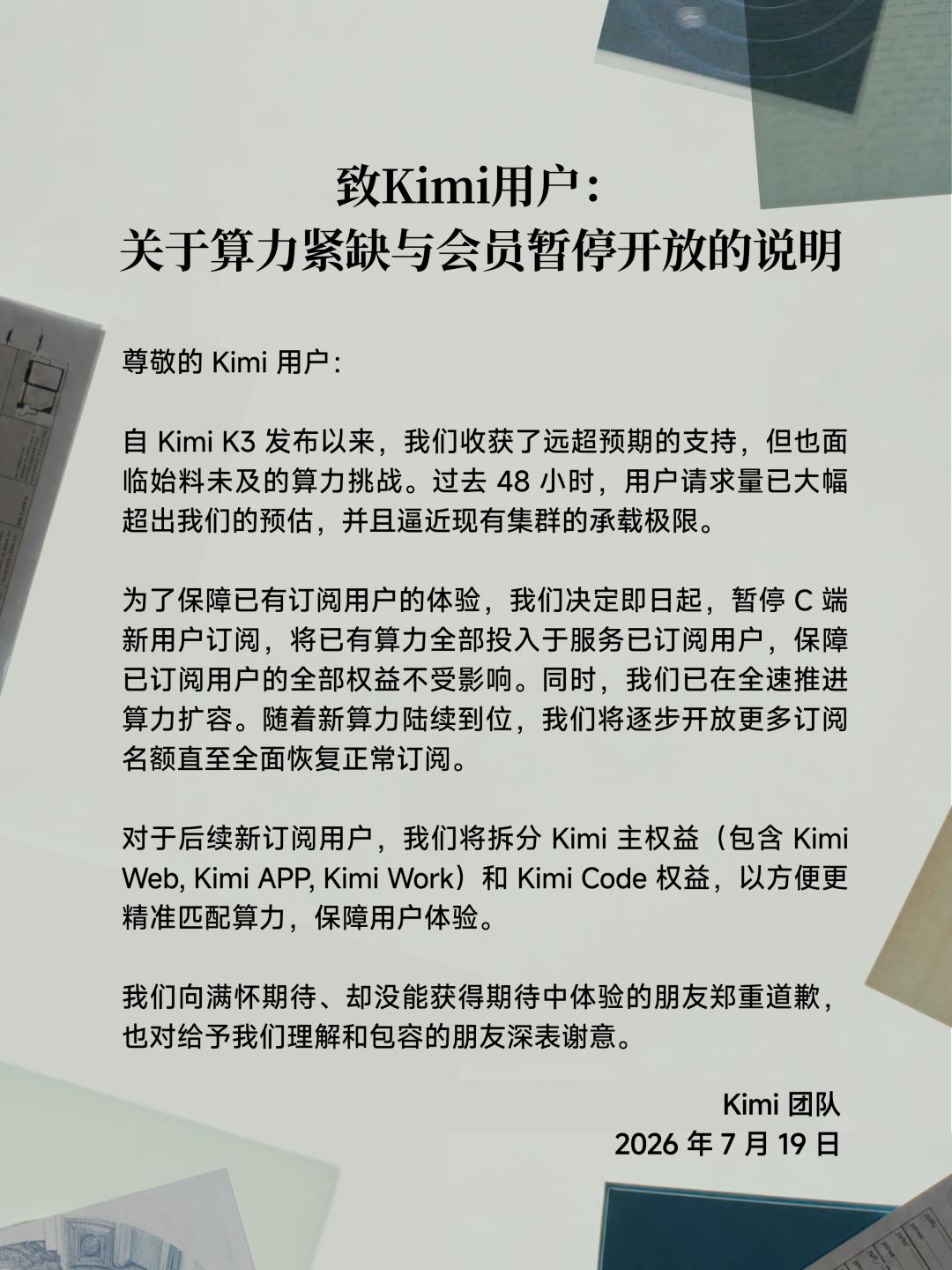
Addressing the insufficient computing power issue, the Kimi team stated that the company is already advancing computing power expansion at full speed. As new computing resources come online gradually, it will open up more subscription slots step by step until normal subscription services are fully restored.
For future new subscribed users, the Kimi team will separate Kimi's core benefits (including Kimi Web, Kimi App, Kimi Work) and Kimi Code benefits, to better match computing resources precisely and ensure a smooth user experience.
According to Banyuetan, computing power is a new form of productive force that integrates information computing capabilities, network transmission capacity, and data storage capabilities, mainly divided into general-purpose computing power, intelligent computing power, and supercomputing power.
Among them, intelligent computing power is primarily used for complex data analysis and artificial intelligence tasks. For a long time, China's computing power market has faced a structural contradiction of "relative surplus in general-purpose computing power and relative shortage in intelligent computing power."
In fact, it is not just the Kimi team; the "computing power shortage" problem may have become one of the key factors constraining the development of large models globally.
Back in January this year, Zhipu AI, known as the "first large model public company," released a restricted sales announcement for the GLM Coding Plan, stating that with the launch of GLM-4.7, the user base of GLM Coding Plan grew rapidly, leading to a temporary shortage of the company's computing resources.
At that time, Zhipu AI stated that it would temporarily limit sales of the GLM Coding Plan, reducing the daily available sales volume to 20% of the current level, to free up more computing resources for its "longtime users" and provide a smoother programming experience.
According to a report by Caixin, in April this year, mainstream model vendors including MiniMax, Kimi, and Zhipu AI all experienced issues such as overloaded API calls or service interruptions.
Beyond domestic large model players, overseas AI giants are also facing similar challenges. The Wall Street Journal reported in a March article that due to tight computing power, OpenAI was forced to scale back its business lines and abandon the Sora video generation application that had previously drawn widespread market attention.
In addition, Anthropic, another leading industry player, also faced the dilemma of frequent system outages and a sharp decline in service stability. In March this year, Anthropic announced that during peak hours from 5 a.m. to 11 a.m. Pacific Time on workdays, it would limit the amount of tokens users can access.
Kimi K3 Tops Front-End Development Leaderboard, But Overall Performance Still Has Room for Improvement
As the source of Moonshot AI's current "computing power shortage," Kimi K3 has recently been in the spotlight.
According to Moonshot AI, Kimi K3 is a 2.8-trillion-parameter model built on the KDA mixed linear attention mechanism (Kimi Delta Attention) and Attention Residuals technology, with native support for visual understanding and a 1 million-token context window.
Moonshot AI also stated that Kimi K3 is the world's first open-source model at the 3-trillion-parameter level, designed for cutting-edge intelligent scenarios such as long-range programming, knowledge work, and reasoning.
In terms of pricing, Kimi K3 adopts a pay-as-you-go standard: input is priced at 20 yuan per million tokens (cache miss) and 2 yuan per million tokens (cache hit), while output is priced at 100 yuan per million tokens.
According to NetEase Intelligence, in the front-end development leaderboard updated by Arena on July 16, Kimi K3 took first place with a high score of 1679, surpassing Claude Fable 5's 1631 points and GPT-5.6 Sol's 1618 points.
Arena stated that in the front-end domain, Kimi K3 ranked first in 6 out of 7 categories (branding and marketing, reference-based design, data and analytics, consumer products, simulation, and content creation tools), only placing second in the gaming category, behind Fable 5.
The impressive test performance of Kimi K3 quickly sparked heated discussions overseas. Russ Salakhutdinov, the mentor of Moonshot AI founder Yang Zhilin, posted publicly, praising the new Kimi version for bringing major breakthroughs to the open-source community.
In addition, Tesla CEO Elon Musk also commented on a related review report, exclaiming "Impressive."
However, Arena clearly noted that its leaderboard measures front-end web development tasks, including agent programming workflows that require multi-step reasoning and tool invocation, rather than the overall capabilities of the model.
Moonshot AI also acknowledged that the overall performance of Kimi K3 still lags behind the strongest closed-source models, Claude Fable 5 and GPT-5.6 Sol, but it demonstrates cutting-edge capabilities across the entire evaluation set, stably outperforming all other models.
A leaderboard released by independent evaluation firm Artificial Analysis corroborates this statement: Kimi K3 has an intelligence index of 57 points, lower than Claude Fable 5's 60 points and GPT-5.6 Sol's 59 points, but higher than Opus 4.8's 56 points.
Artificial Analysis also stated that compared to Moonshot AI's previous generation model, while K3's answer accuracy rate has increased from 33% to 46%, its hallucination rate has also risen from 39% to 51%.
Notably, after the news of Kimi K3 topping the front-end development leaderboard was released, the US stock market witnessed a "DeepSeek Moment 2.0" — the AI sector lost a total of approximately 470 billion US dollars in market value within 72 hours.
The 21st Century Business Herald pointed out that the core of this sharp decline in US stocks lies in the fact that Kimi K3 has targeted the lifeline of American tech giants: code generation is one of the tracks with the largest commercialization potential for AI, directly threatening the technological moat that overseas closed-source giants rely on to maintain high pricing.
According to statistics from Artificial Analysis, the average cost for Kimi K3 to complete a task is 0.94 US dollars, which is in the same price range as GPT-5.6 Sol's 1.04 US dollars, and only half of Opus 4.8's cost.
Zhang Yutong, President of Moonshot AI, recently revealed that data shows at the launch node of K3 on July 17, the company's annualized recurring revenue (ARR) recorded the largest single-day increase in history.
From "No Rush to Go Public" to Preparing for IPO
Tianyancha information shows that Beijing Moonshot AI Technology Co., Ltd. (referred to as "Moonshot AI") was registered and established in April 2023, with Yang Zhilin as the actual controller holding a 51.83% stake.
Public information shows that Yang Zhilin graduated from Tsinghua University with a bachelor's degree, obtained his doctorate in computer science from Carnegie Mellon University, and previously worked at Google Brain and the US startup FAIR. At the same time, he is also a technical contributor to some of China's earliest large models such as "Pangu" and "Wudao."
According to Yang Zhilin's mentor Russ Salakhutdinov, Yang could have stayed in the United States to join Apple, but he insisted on returning to China to start his own business. In his view, if he didn't even try to found his own company, he would regret it for the rest of his life.
Likely due to the high confidence in Yang Zhilin, Moonshot AI quickly attracted the attention of numerous capital institutions after its establishment.
According to Tianyancha, back in June 2023, Moonshot AI had already secured nearly 2 billion yuan in angel round investment from HSG, ZhenFund, Capital Today, and Lisi Capital.
The following month, Moonshot AI completed its Series A financing, with investors including BlueRun Ventures, Xianghe Capital, and Longzhu (Meituan).
At the beginning of 2024, Moonshot AI completed over 1 billion US dollars in Series A+ financing, pushing the company's valuation to 2.5 billion US dollars.
After that, Moonshot AI successively completed over 300 million US dollars in Series B financing and 500 million US dollars in Series C financing.
According to LatePost, Yang Zhilin revealed in his 2025 internal letter that from September to November last year, the average month-over-month growth rate of the company's paying users overseas and domestically exceeded 170%. By the end of the year, the company had over 10 billion yuan in cash reserves.
Yang Zhilin stated frankly that compared with the secondary market, he judged that the company could raise even larger amounts of capital from the primary market, hence "there's no rush to go public in the short term."
Facts have proven this to be true: since the beginning of this year, Moonshot AI has successively completed three more rounds of financing, pushing the company's valuation to break through 20 billion US dollars.
However, Yang Zhilin's attitude of "no rush to go public" is quietly changing. In May this year, Phoenix Weekly, citing a Bloomberg report, stated that Moonshot AI had notified its shareholders to officially start the dismantling of its VIE and red-chip structure, clearing obstacles for its Hong Kong IPO.
Some analysts pointed out that this move means the company has entered the IPO preparation phase. Huang Lichong, President of Huasheng International Capital, stated that dismantling the VIE and red-chip structure essentially clarifies the positions of control, responsible entities, and regulatory boundaries.
Huang Lichong analyzed that if everything goes smoothly, the listing could happen within a six-month to one-year window; if regulatory, shareholder, tax, and foreign investment arrangements are complex, the process may take longer.
Shortly after the launch of Kimi K3, Moonshot AI's listing plan also made new progress. According to a report from National Business Daily on July 20, Moonshot AI has sent a listing proposal to investors, planning to complete its Hong Kong stock IPO in as little as 6 months.
The report also mentioned that in June this year, Moonshot AI's annual recurring revenue (ARR) had reached 300 million US dollars, and achieved several-fold growth after the launch of the K3 model, leading the company to believe that the time for listing is ripe.
However, Moonshot AI has not yet made a public response regarding the latest listing timetable, nor has it publicly disclosed specific progress such as submission of listing applications or overseas listing filings.
Notably, on June 29, Moonshot AI released a statement noting that recently, multiple false financing and equity transaction information using the company's name have appeared in the market, and the company has discovered some institutions and individuals suspected of fraud.
In response, Moonshot AI issued a solemn statement on relevant matters: all of the company's financing activities are directly managed by the company itself; the transfer of the company's old shares (including common stock, incentive equity, etc.) must be approved internally by the company; the allocation of quota for the company's new share financing is confirmed based on the actual receipt of funds.
Radar Finance will continue to follow up on the progress of Moonshot AI's listing.
This article is from the WeChat public account"Radar Finance", written by Zhou Hui, edited by Meng Shuai, and published with authorization from 36Kr.