China's AI has laid all its cards on the table.
From July 17 to 20, 2026, in Shanghai, the World Artificial Intelligence Conference was held.
With an exhibition area of 100,000 square meters, over 1,100 enterprises, more than 3,000 exhibits, and over 300 global debut products. From the Kimi K3 large model to the super nodes of Huawei, Sugon, Alibaba, and ZTE; from humanoid robots to smart vehicles, from industrial agents to AI glasses... Almost all key players in China's AI sector made their appearances. However, if this event is merely regarded as a new product launch, the significance of this conference would be greatly underestimated.
What it truly demonstrates is not a single company or a single product, but an increasingly clear AI development path in China. It can even be said that all of China's AI cards have been laid on the table at this conference.
01
System-level competition, laid bare
The competition in AI, in the final analysis, is between China and the United States. In previous years, this competition mainly focused on models and chips, with China essentially following the U.S. lead: How to get closer to GPT? How to break through the chip bottleneck?
But this year in Shanghai, things are different. China has started to play its own cards.
Models and chips remain priorities, but China has gone a step further by establishing its own key focus areas beyond the U.S.'s primary priorities.
For large models, after DeepSeek, Kimi, Tongyi Qianwen, Zhipu, MiniMax, and StepFun are catching up with each other. Their performance continues to overtake that of the U.S., but the focus of competition has shifted:
In the past, the competition was about parameters, ranking lists, and how smart a single response could be; now, it is about reasoning efficiency, task execution, usage cost, and whether these models can truly integrate into enterprises' business workflows, as well as how to evolve from a "chatting software" into an agent that can call tools, understand the environment, break down tasks, and get work done.
For chips and computing power, the focus is no longer on keeping pace with NVIDIA, but on blazing a unique path of its own.
A computing power system consists of far more than just chips; it also requires high-speed interconnection, storage, networks, liquid cooling, scheduling software, and complete machine engineering. At this conference, Chinese enterprises' outstanding demonstrations are no longer isolated points, but the rollout of full-fledged super nodes and computing power systems.
Huawei's Ascend 950 super node made its first physical debut, and the "computing power wall" composed of thousands of card cabinets was one of the most eye-catching installations in the exhibition hall. Sugon presented the country's first fully domestically produced 100,000-card cluster, "Sugon 8000 (Dengfeng)", with all components from chips to heat dissipation independently developed. Alibaba's Panjiu AL128 super node is equipped with 128 self-developed AI computing cards in a single cabinet, assembled into a larger "computer". H3C, ZTE, and Kunlunxin also showcased their respective solutions.
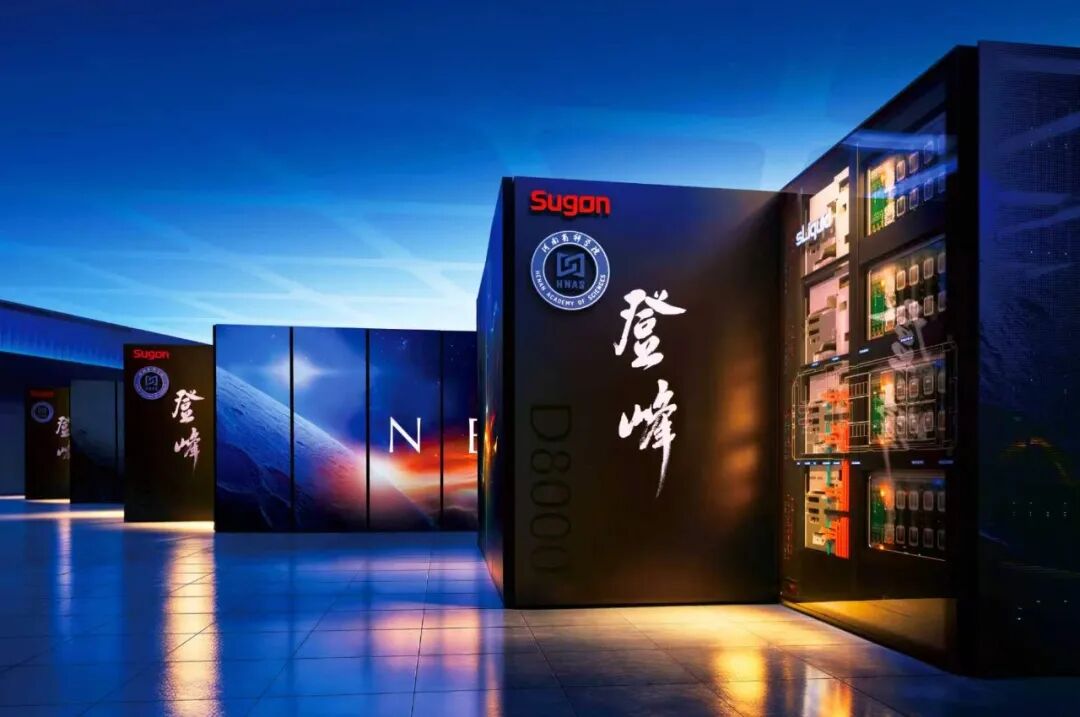
China's computing power sector is evolving from simply stacking servers to co-designing chips, interconnection, power supply, heat dissipation, and software.
Earlier, the adaptation of DeepSeek V4 to Huawei Ascend and Cambricon followed the same logic: full autonomy and optimization from the underlying chips to the algorithm level.
Behind this is a profound change: all links in China's AI industry chain are connecting at an unprecedented speed, generating systematic strength and comparative advantages through collaborative innovation.
Working in isolation, Chinese enterprises may not be strong enough in every single aspect, but now all these aspects are linked together, drawing on each other's strengths to achieve comprehensive advantages through systematic collaboration.
If chips are not strong enough, the gap can be filled by interconnection efficiency and cluster scale; if there is a gap in individual points, it can be compensated by systems engineering; if closed-source solutions are too expensive, open-source and low-cost reasoning can be adopted; if overseas supply is unstable, models, chips, servers, and cloud platforms can be mutually adapted...
This system is not yet perfect, but it means China's AI has achieved a maximum degree of autonomous closed loop, and is continuously forming a virtuous cycle on this autonomous basis — large models are adapted to domestic chips, domestic chips support domestic computing power, and computing power and algorithms are then integrated into vehicles, mobile phones, robots, and production lines, with all parties working together to get AI up and running first, and then make it run faster.
Once this closed loop is in motion, the flywheel will spin faster and faster.
02
Industrial acceleration, laid bare
Walking through this year's conference, the most obvious impression is that there are more functional and practical products that can truly perform tasks.
Robots are handling, assembling, and sorting; agents are operating software, processing documents, and executing enterprise tasks; AI is embedded in vehicles, glasses, earphones, medical devices, and industrial machines.
Enabling artificial intelligence to move from screens to the real world to perform tasks is not only the biggest difference between the AI development paths of China and the U.S., but also where China has the strongest foundation to build a leading advantage — The U.S. may be better at developing more powerful chips and smarter models, while China excels at rapidly integrating models into products, connecting them to factories, and embedding them into industries.
China boasts the world's most complete and largest manufacturing system, as well as a huge market for consumer electronics, smart vehicles, e-commerce, logistics, mobile payment, drones, and industrial internet — these are not just customers for AI, but also the soil where AI continuously trains and evolves.
A technology in the U.S. may first become a cloud service, but the same capability, when introduced to China, will soon be embedded into mobile operating systems, vehicle cockpits, robot bodies, and factory production lines.
Therefore, we see an exceptionally dense presence of humanoid robots at this conference, which have collectively transformed from "performance props" to "production tools".
In the past, the competition for robots was about whether they could walk or dance; now, enterprises are seriously answering: can they work continuously for eight hours? Can they handle tasks such as transporting, assembling, and quality inspection? Can they enter workshops, warehouses, and hazardous environments? Can the cost be reduced to an affordable level?
In these segmented industrial implementation areas, China is also waging a systematic battle.
Enterprises such as Unitree and Fourier Intelligence have drawn attention not just for their more flexible movements, but also because China has a complete supply chain that supports the rapid industrialization of robots — motors, reducers, sensors, batteries, controllers, structural components, coupled with large-scale manufacturing capabilities, enabling rapid iteration and cost reduction within a very short period.
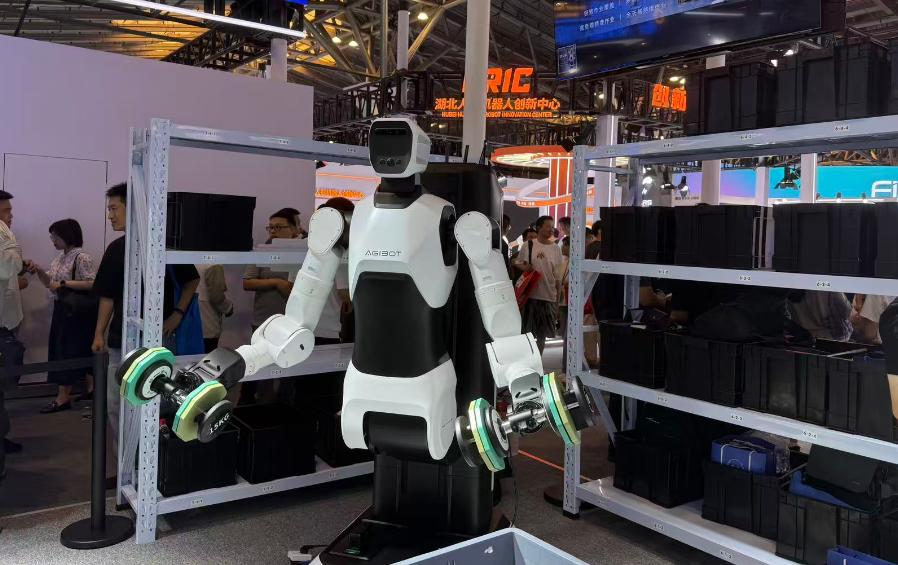
AI provides the "brain", and China's manufacturing provides the "body". Only by combining the two can a real artificial intelligence industry be formed.
The same is true for agents.
Previous large models required constant user prompting, but current agents are starting to understand goals on their own, break down tasks, call software, organize data, generate solutions, and continuously prove through practical results whether they are reliable, controllable, and cost-effective.
Therefore, at this conference, more and more enterprises are no longer talking about how powerful their models are, but about Token costs, call auditing, data security, and business closed loops.
H3C's Turing pilot platform has adapted to over 90 large models; China Telecom demonstrated a token security router that allows enterprises to clearly see who is calling the model, how many resources are used, and how much it costs; Kingsoft Office has integrated AI into enterprise data and office workflows to carefully manage costs...
These products may not sound flashy, but they signify that AI is truly starting to become a viable business — enterprises will not pay for imagination, but only for efficiency, cost, and results.
Looking back at the practices of the past one or two years, the U.S. has largely been striving to raise the upper limit of AI capabilities, while China has been working to lower the threshold for AI applications. Ultimately, the development of the industry will be measured by the popularization and accessibility of applications.
Chinese enterprises may not be the first to propose concepts, but they are often the fastest to turn concepts into products, scale up products into industries, reduce costs through large-scale operations, and then truly popularize the industry to benefit the public.
China has followed this path in the photovoltaic, power battery, new energy vehicle, and drone industries, and AI is very likely to follow suit.
03
Global cooperation, laid bare
The development of artificial intelligence should not be a solo performance of a single country, but a symphony of global cooperation.
At this conference, an event more significant than any individual product was the signing of the "Agreement on the Establishment of the World Artificial Intelligence Cooperation Organization" by 29 countries in Shanghai on July 16.
This intergovernmental international organization, with its headquarters in Shanghai, will carry out cooperation in AI technology, industry, talent, standards, security, and governance to help more countries enhance their AI capabilities.
This means that China's AI is evolving from building its own domestic ecosystem to establishing a global cooperation system, from pursuing self-development to participating in global growth.
For many years in the past, the rules and platforms of global technology were largely dominated by the U.S. and its enterprises, a phenomenon known as "tech hegemony". In the AI era, the U.S. still wants to continue this path: on one hand, it relies on NVIDIA, Microsoft, Google, Amazon, and OpenAI to hold the most advanced chips, models, and cloud platforms; on the other hand, it uses export controls, investment restrictions, and supply chain alliances to translate technological advantages into industrial advantages and establish clout within its own circle.
At the end of June this year, the U.S. hosted the second "Silicon Peace" Summit, where a total of 35 economies signed the "Joint Statement on the Partnership for Artificial Intelligence Opportunities"; at the same time, 10 new members including Argentina and Chile joined, expanding the total number of "Silicon Peace" initiative members to 24.
This circle excludes China and the vast number of developing countries.
On the eve of the Shanghai AI Conference, on July 6, the United Nations hosted the first intergovernmental global AI governance dialogue in Geneva, with representatives from both China and the U.S. in attendance, but their governance propositions showed clear differences:
China advocates that the United Nations play a central role in global AI governance to bridge the "intelligence divide"; the U.S. advocates for a set of self-dominated regulatory frameworks, setting standards through small circles like the G7.
Against this backdrop, the establishment of the World Artificial Intelligence Cooperation Organization is particularly significant. China's path of openness, inclusiveness, capacity building, and industrial cooperation is even more of a blessing expected by many developing countries.
For many developing countries, and even some developed countries, what they truly lack is not a powerful model, but computing infrastructure, AI talents, local data, industry-specific solutions, and opportunities to participate in the formulation of international rules — in the final analysis, things that are affordable, accessible, and customizable to their own needs.
This is exactly what China can offer: communication networks, data centers, cloud platforms, smart terminals, industrial equipment, helping to build digital infrastructure first, and then connecting AI with agriculture, healthcare, education, and other sectors.
The development of China's AI is not just about chips, computing power, and large models. When China's AI goes global, what it sells is not just a single model or a chip, but a complete set of industrial capabilities — from infrastructure to models, from equipment to applications, from talent training to operation and maintenance. This is where China has accumulated mature experience in fields such as communications, electricity, and transportation, and it is easy to implement and achieve tangible results.
In a sense, global AI will also be led by China and the U.S.: the U.S.'s advantage may lie more in exporting GPUs, models, cloud, and software; while China's advantage lies more in exporting industries, engineering, applications, ecosystems, and cooperation.
The two paths are not absolutely superior or inferior, but represent two different logics of AI globalization: one is to hold the high ground of technology, and the other is to expand industrial coverage; one consolidates advantages through export restrictions and supply chain alliances, and the other expands its circle of friends through openness, applications, and international organizations.
The security, risks, and governance of AI cannot, and will not, be resolved by a single country alone, nor will there be too many alternative solutions and paths. To a certain extent, it will essentially be led by China and the U.S., in a state of both cooperation and competition.
In the past, there was a relative lack of clear answers and actions on how China's AI participates in global development. The establishment of the World Artificial Intelligence Cooperation Organization is not only a clear answer, but also a firm action.
From now on, China has started to build platforms, connect partners, and participate in formulating the global development rules for the AI era. China's AI is also moving from technology to products to industries, and heading to the world —
This is what truly makes this conference more than just an industrial exhibition.
At the 2026 World Artificial Intelligence Conference, China has told the world with facts and actions: Global AI competition is evolving from a contest between models and between companies, to a competition between systems, and China will use its own system to provide solutions and contribute its own strength to global development.
Models, chips, computing power, agents, robots, terminals, global governance and cooperation... At this conference, China's AI has been presented in a comprehensive and three-dimensional manner.
How China's AI develops itself, builds advantages, and participates in and contributes to globalization —
All the cards have been laid on the table.
This article is from the WeChat official account "Huashang Taolue" (ID: hstl8888), authored by Huashang Taolue, and published with authorization from 36Kr.