Moutai's price has risen by 100 yuan, and the baijiu sector still has a 300 billion yuan gap to fill.
Written by | XIE Yunzi
Edited by | ZHANG Fan
Even Moutai's price hike failed to "rescue" the baijiu industry from its downward trend.
Prior to the press release on July 21, Kweichow Moutai's stock price dropped 1.47% to 1308 yuan per share; the Wind Baijiu Index also fell 1.47% in tandem to 2926.9.
Just one trading day earlier, driven by the price increase of Feitian Moutai, the entire baijiu sector opened higher and moved higher. Gujing Gongjiu hit the 10% daily limit, and numerous liquor enterprises including Kweichow Moutai and Luzhou Laojiao all rose by more than 5%.
In just one day, market sentiment cooled rapidly. After digesting the positive impact of the price increase, investors began to re-examine the structural dilemmas facing the baijiu industry.
This round of price adjustment took place on July 18.
Starting from that date, the official retail price of 2026 53% vol 500ml Feitian Kweichow Moutai was adjusted from 1539 yuan per bottle to 1639 yuan, and the sales contract price was raised from 1269 yuan per bottle to 1369 yuan.
At the end of March this year, Feitian Moutai just bid farewell to the "1499-yuan era", with its retail price increased by 40 yuan to 1539 yuan per bottle; the ex-factory price was raised from 1169 yuan to 1269 yuan. At that time, the company stated that the price hike was intended to "stabilize the core price base and restore profit margins for distribution channels".
For this latest price adjustment, Moutai stated that it follows the principles of matching supply with demand and balancing volume and price, to "adjust prices in line with market conditions". In plain terms — Moutai hopes its official selling price can move increasingly closer to the actual prevailing market transaction price.
36Kr checked the "Today's Liquor Price" platform, and found that on July 17, the day the price hike announcement was released, the market price of Feitian Moutai was close to 1650 yuan; although the wholesale market price almost always rises with each price increase, the arbitrage "speculative trading" profit space from reselling is disappearing. This is exactly the outcome Moutai is aiming for.
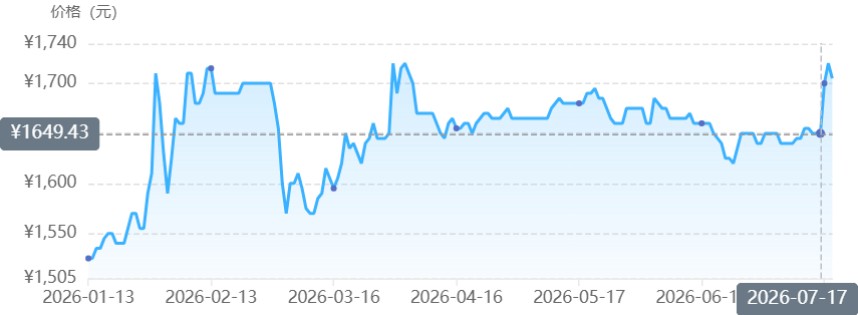
Screenshot from "Today's Liquor Price"
Over the past 30+ years, the growth logic of the baijiu industry was straightforward: distilleries only needed to secure distributors and push inventory onto them to generate revenue. However, amid mismatched supply and demand and stagnant sales, the traditional B2B distribution model has reached its end.
According to statistics from the China Alcoholic Drinks Association for the first quarter of 2026, the total social inventory value of the baijiu industry exceeded 300 billion yuan, the total inventory of publicly traded baijiu companies surpassed 170 billion yuan, and the industry average inventory turnover days hit 900 days.
Alcohol industry analyst XIAO Zhuqing told 36Kr that, apart from a handful of top-tier brands like Feitian Moutai, mid-premium and regional liquor enterprises generally face channel inventory backlogs ranging from half a year to several years. "Distributors lose money on every bottle sold, and price inversions have become the norm."
All these factors have forced liquor companies to undergo market-oriented transformation toward the consumer-facing C-end market, directly engaging end consumers. The difference is that Moutai has the solid foundation to carry out self-rescue efforts.
In 2022, the "i Moutai" platform was officially launched, and product pricing power gradually shifted back from distributors to the group. Financial report data can more intuitively reflect this dynamic of shifting market power.
In the 2025 fiscal year, direct sales channels including "i Moutai" saw their revenue share exceed 50%, reaching 84.54 billion yuan, surpassing the wholesale and agency channel revenue for the first time.
This marks that Kweichow Moutai's sales structure has undergone a major transformation.
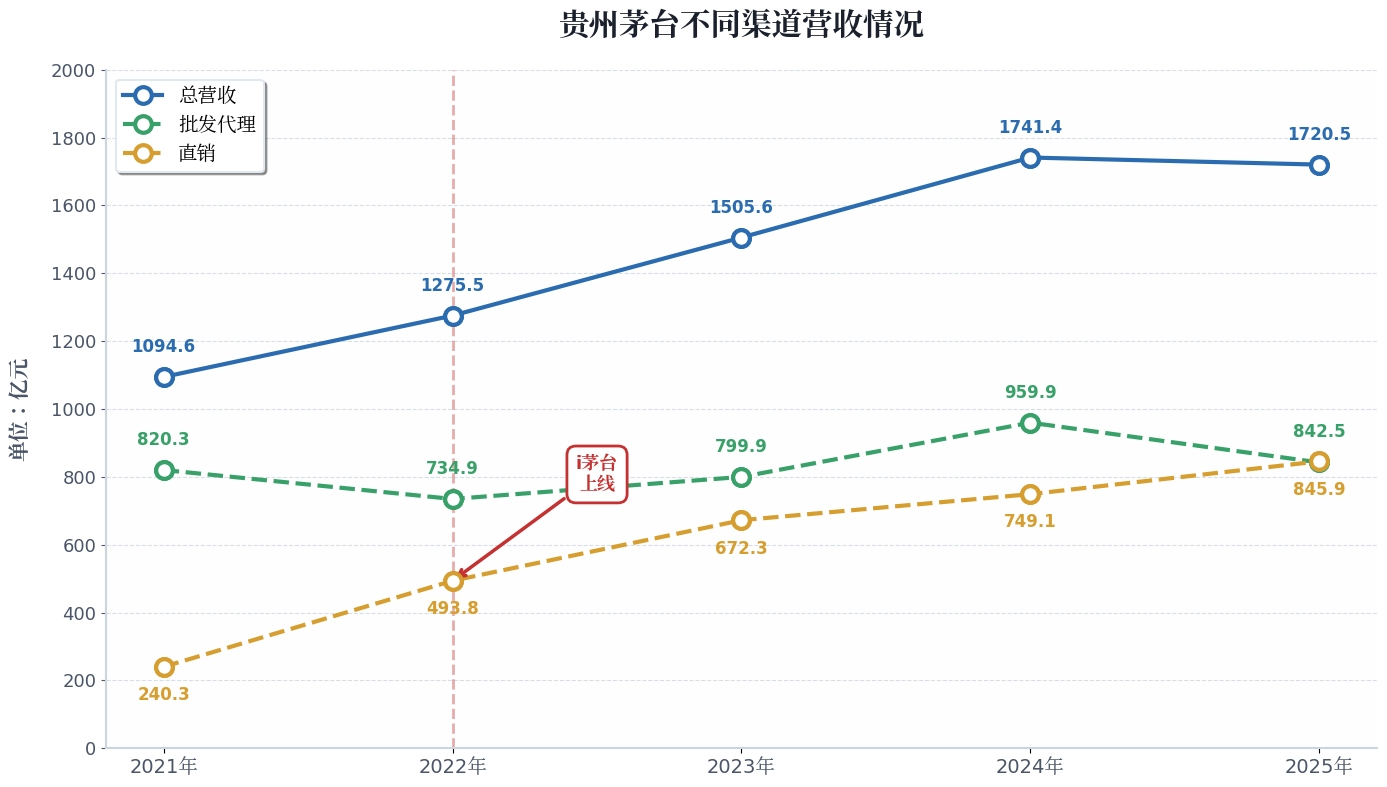
36Kr illustration based on Wind data
Chairman CHEN Hua once set the tone that Moutai is shifting its marketing system from "channel-driven" to "consumer-pulled".
"We will dynamically monitor market supply and demand changes, consumption trends, channel inventory levels, and terminal sales performance, conducting scientific analysis and judgment (on product pricing) that accounts for differences across product lines and regions" to "avoid sharp, volatile price swings".
It is worth noting that "adjusting prices in line with market conditions" implies potential price adjustments at any time. XIAO Zhuqing also emphasized that Moutai's future prices will not only rise but may also decline.
According to updates from the "i Moutai" platform, promotional activities for the Moutai 1935 product series will soon be launched.
In January this year, some products already underwent an active price cut. Premium Moutai was directly reduced from 2969 yuan per bottle to 1859 yuan, and Aged Kweichow Moutai (15 Years) was lowered from 5399 yuan to 3409 yuan. Moutai's dual-direction pricing model with both upward and downward adjustments has been formally established.
At the same time, from a financial perspective, price hikes on core flagship products will directly boost total revenue.
A research report from Shenyin & Wanguo Securities predicts that Moutai's first price increase will boost 2026 net profit by 2.5%-3%; the second price increase will add approximately 0.5% to net profit. The company's attributable net profit for 2026-2028 is projected to grow year-on-year by 4%, 10%, and 11% respectively.
However, the fundamental outlook for the entire industry is far less optimistic.
In the first half of 2026, among the 8 publicly traded baijiu companies that have released their performance forecasts, only Wuliangye reported projected earnings growth — a result of a "statistical gimmick" caused by significantly lowering the comparable base figure from the previous year.
Additionally, Shunxin Agriculture expects its net profit to decline 69% to 79% year-on-year; both Huangtai Liquor and Swellfun are reporting net losses.
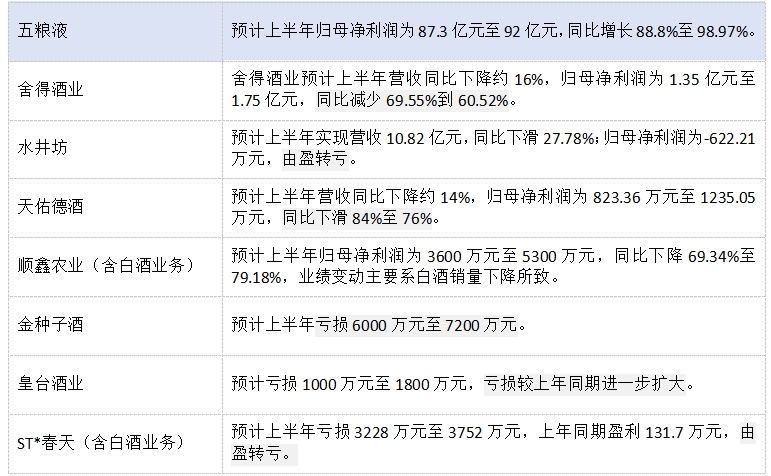
H1 baijiu industry financial forecast; 36Kr compiled from public data
Some analysts believe that the current decline in baijiu performance stems from long-standing structural contradictions across "consumption scenarios, end-user bases, and distribution channels".
"The baijiu consumer demographic is aging, younger generations have no established baijiu drinking habits; traditional consumption scenarios centered on banquets and gifting are collapsing; the longstanding distributor-led operational model is gradually losing effectiveness."
From these analysts' perspective, the baijiu industry cannot restore large-scale growth in the short term. XIAO Zhuqing added, "It will take at least 1 to 2 years to clear out the massive accumulated channel inventory across the entire industry. In the future, the value of a liquor enterprise will no longer be determined by the total payment volume from distributors, but by real, verifiable bottle-opening rates and repeat purchase rates."
It is noteworthy that during the shareholder meeting in June this year, Moutai's management explicitly stated that previous cross-border collaboration projects such as the "Sauce-Flavored Latte" partnership with Luckin Coffee and Moutai Ice Cream "do not align with the brand's long-term strategy. We do not chase fleeting internet celebrity fame, but pursue lasting brand vitality, and will exercise caution when advancing such collaborations in the future".
The underlying logic behind this decision is self-evident.
In the short term, the young consumers drawn in by the Sauce-Flavored Latte are highly unlikely to become paying customers for Feitian Moutai. Rather than diluting the brand value in exchange for ineffective, low-conversion traffic, it makes more sense to focus resources on high-net-worth demographics with higher conversion potential. The critical question remains: as the baijiu category as a whole loses appeal among the younger generation, will the exclusive "first-class cabin" of high-value consumers continue to shrink?
Clearing inventory and implementing market-oriented adjustments is only the first step. After surviving this challenging phase, all baijiu enterprises, including Moutai, must continuously explore how to develop effective product innovations that meet the real needs of the next generation of consumers. This is the key to the long-term sustainability of the entire industry.
*Disclaimer:
The content of this article represents the personal views of the author only.
All investments carry market risks, and prudence is required when making investment decisions. Under no circumstances shall the information or opinions expressed in this article constitute investment advice to any individual. Before making any investment decision, investors should consult professional advisors and exercise due caution if necessary. We do not intend to provide underwriting services to trading parties or any services that require specific qualifications or licenses to operate.

Follow for more updates