Small products stage a stunning comeback, large products secure their market positions. Why are all brands choosing Xiaohongshu for game promotion? | Game Trendsetter
Written by Shuguo Bei
Edited by Guopu
Suppose you are a game publisher with a limited budget, and you have to choose one of the three major social platforms Xiaohebox, Bilibili, and Xiaohongshu to focus on promoting your new game. Which one would you pick?
Intuitively, many people would first complain that "the options are completely unreasonable" — it's like asking who is most likely to win the World Cup among Brazil, Germany, and the Chinese national football team. Compared with the other two, Xiaohongshu seems completely incomparable at first glance. Why would it even be an option?
That statement is not entirely unfounded.
Xiaohebox rose to fame in its early days riding the explosive popularity of PUBG. Later, through services such as data querying, a dedicated gaming social atmosphere, and game sales, it accumulated a massive base of vertical gaming users, holding a dominant lead over other similar competitors. In addition, it has the most mature integrated marketing and distribution path — within the app alone, a product can complete the entire "exposure-search-conversion" process.
As for Bilibili, it is a household name among domestic users in China. Starting out relying on ACG culture in its early days, it has now amassed a top-tier mass internet user base.
Back in the channel era, Bilibili first entered the market by co-distributing games like *Houkai Gakuen 2*. Later, it licensed titles such as *Fate/Grand Order* and *Azur Lane*, which brought substantial revenue to the company. In the indie game space, it has also launched products including *Dead Cells* and *Snowdrift*. Its in-house development studio even released the breakout indie hit *Escape from Duckov* in 2025. Furthermore, its self-hosted comic convention Bilibili World has become one of China's top offline exposure channels for games, enabling more targeted ad placement.
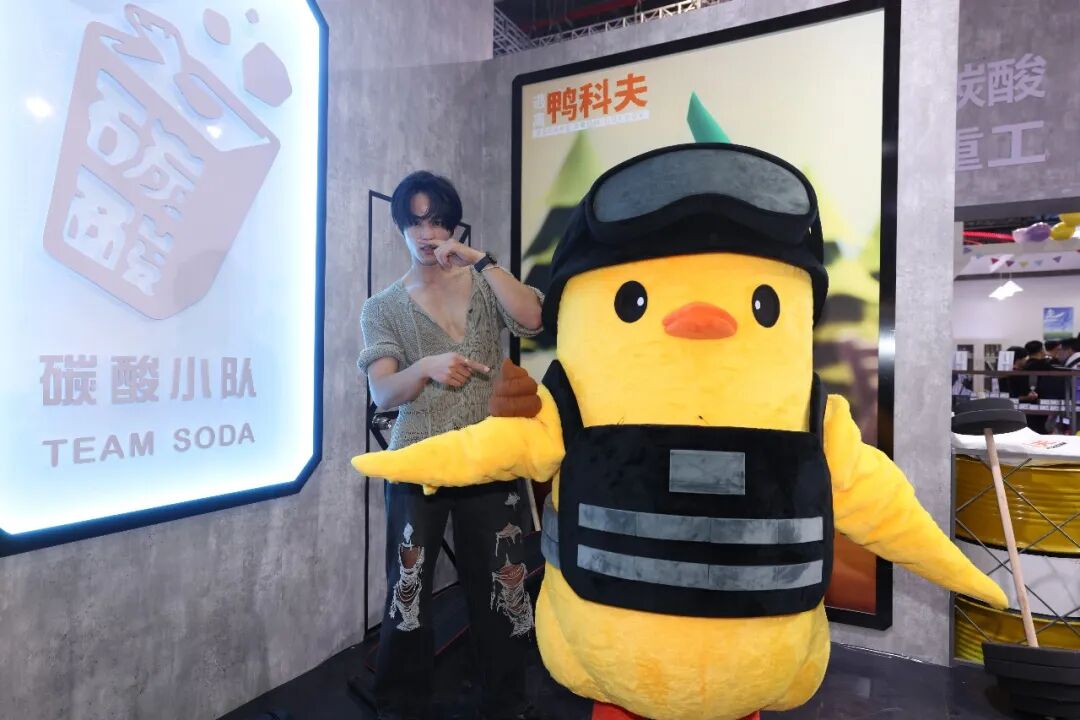
*Escape from Duckov* at BW2026
By comparison, Xiaohongshu seems to have nothing outstanding to offer for game promotion. It has no impressive track record, no inherent gaming cultural DNA, and even its once-unique algorithm advantage has faced growing challenges in recent years... But then again, if the Chinese national football team miraculously became a contender for the World Cup title, who wouldn't want to see what that's like?
What's more, Xiaohongshu has already made a promising start.
Many games have already reaped the benefits of promotion on Xiaohongshu. For example, *Dreamer Rookie*, which has over 460,000 pre-registrations on TapTap, was originally greenlit because the team's "little noob" IP character went viral on Xiaohongshu. After full development of the game began in 2023, the average traffic for related posts exceeded 100,000. Some high-profile mainstream new games have also long taken Xiaohongshu as their top exclusive promotion channel.
Smaller products that previously lacked exposure channels and marketing budgets have also found their target players through Xiaohongshu. Indie game producer Huolongguo shared his experience: since the game's first reveal in 2024, he has been doing self-promotion across Xiaohongshu, Xiaohebox, and Bilibili. Surprisingly, according to his statistics, the vast majority of the players he ultimately attracted came from Xiaohongshu.
Correspondingly, Xiaohongshu's official team has been continuously building and improving its game-related business system in recent years. The official topic "I Make Games on Xiaohongshu", created in 2023, has now accumulated 18.5 billion views. Last year, it held its first "RedLand" comic convention, covering an area of over 80,000 square meters with 3.9 billion total online exposures, and preparations for the next edition are currently underway.
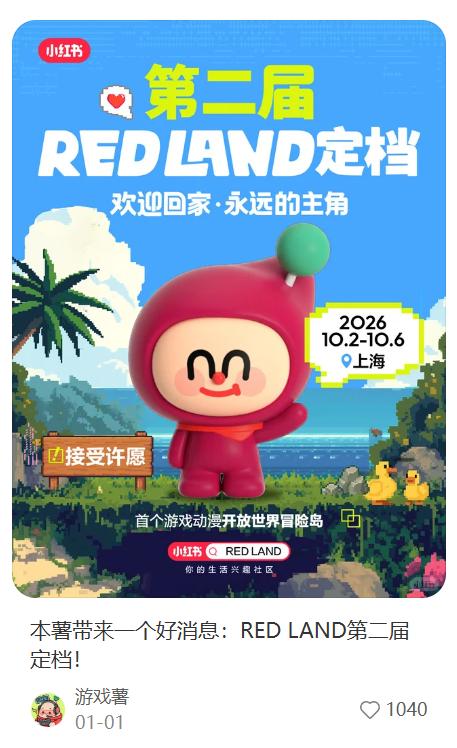
RedLand
Official data released by Xiaohongshu shows that compared to the previous year, searches for "games" on the platform increased by 70%, total annual game-related searches rose by over 70%, game-related content posts grew by 147%, and total watch time for game live streams increased by 250%. As of 2025, the monthly active users in the game-related community have exceeded 120 million.
Whether looking at historical data or platform capabilities, Xiaohongshu has likely become a critical promotion channel that game practitioners cannot afford to ignore. It is on par with other well-known platforms and has carved out its own unique core competitiveness in this space.
01
In fact, it is a natural fit. From its early days, Xiaohongshu positioned itself as a "grassroots recommendation platform" — and recommending games naturally falls under the category of "grassroots sharing". After years of operation, many of the shared content on Xiaohongshu now feels more personal and trustworthy. For a period of time, internet users widely regarded Xiaohongshu as a viable alternative to Baidu, and even found it more reliable, because "you can find solutions to even the most tricky problems on Xiaohongshu".
And a trustworthy platform is undoubtedly the best place for products to carry out content marketing and community operations — games are certainly no exception.
When it comes specifically to game promotion, Xiaohongshu also demonstrates unique advantages, such as high cost-effectiveness brought by low barriers to entry and low operating costs.
Compared to other platforms, heavy video-focused platforms like Bilibili and Douyin tend to capture users' emotions and attention primarily through dynamic video content. Creators who want players to remember their games must continuously update high-quality video content, and video view counts often become a core metric for players to judge product quality. Meanwhile, on Xiaohebox, without deep-level partnerships, many products may struggle to gain sufficient exposure, and the platform lacks more precise, user-targeted algorithmic push mechanisms.
Therefore, for products with mature operation teams and established marketing strategies, setting up a presence on Xiaohongshu is simply a "no-brainer" task. They just need to sync their existing prepared materials to Xiaohongshu, and they can often achieve solid results and spark discussions — even if the content is just simple images and text.
Indie game development teams have an even deeper understanding of this point. Most indie developers juggle multiple roles, and after finishing development work, they rarely have extra budget left for marketing and operations. For them, the optimal solution is usually to hand these tasks over to publishers — but not every team has the opportunity to sign a partnership with a publisher, nor does every product get sufficient resource support from a publisher.
Producer Qie Jingcha is used to posting game progress updates at regular intervals. Due to limited time and energy, she mostly uses image-text formats, and after finishing the posts, she uploads them all at once to mainstream social platforms like Douyin and Xiaohongshu. Soon after, she realized that other platforms are primarily video-focused, where image-text content gets very limited traffic and attracts little user attention.
But the team is small, and "it's impossible to make a video for every post". In comparison, promoting on Xiaohongshu feels far more comfortable.
Another advantage of posting promotional content on Xiaohongshu is the sense of "freedom".
Compared to other platforms, content on Xiaohongshu usually does not carry such a strong marketing purpose. The platform encourages content that features strong personal self-expression and emotional authenticity. Huolongguo says he often "posts whatever he dreams about", without following a strict fixed marketing schedule. Ironically, this very approach has helped his product attract many users who share the same wavelength.
The underlying logic behind this "freedom" comes from the authentic, human-like feel that the entire platform collectively fosters. For Xiaohongshu users, games are never a separate, isolated section — they are more like a natural part of sharing and discussing daily life: how to have fun, how to relax, what interesting things happened in and out of games, and so on. Yinghuo notes, "Users don't just talk about the game itself. They talk about social interactions, stories, and hobbies in daily life, all of which are deeply connected to games."
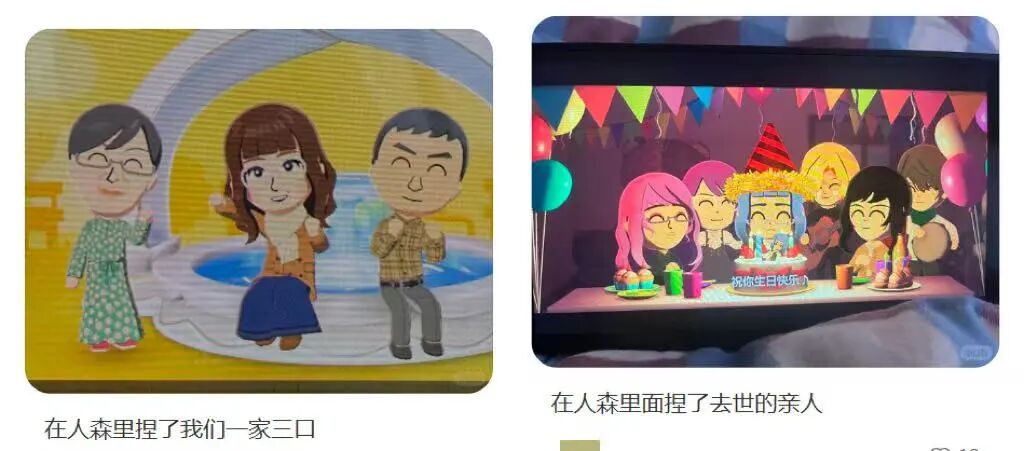
User shares on the platform
Many users shared that they created their family members as custom characters in the game *Friend Collection: Dream Life*
For example, Huolongguo's game is themed around job hunting. Works that are more closely tied to real life tend to get more attention on Xiaohongshu. Few people would discuss job hunting in vertical gaming communities, but such discussions feel completely natural on Xiaohongshu. After all, it is fundamentally a life-sharing platform, and users are more easily drawn to content that "seems related to their own lives".
And this authentic, human-like feel perfectly aligns with the most powerful marketing approach today: sincerity.
"Developing a game is a form of creation, and users posting content on the platform is also a form of creation. The two creative processes are fundamentally interconnected. When you share the insights you gained during game development, chances are high that users will be drawn to your genuine sharing." And users attracted through this kind of mutual resonance are more likely to understand the developer's design choices, empathize with them, and ultimately convert into paying players more easily.
All products that have achieved strong marketing results on Xiaohongshu have implicitly embodied this principle.
The domestic AVG game *Paper House*, released earlier this year, is a typical example. The game tells stories of the unique worries, hesitations, and reflections of youth, which made many players recall their own past and present experiences. Some players even experienced "physical reactions" while playing, bursting into tears.
Before the game's launch, in addition to regular promotional content, the development team Kaixin Chafang occasionally posted simple stick-figure comics that shared the stories and insights of two team members during the development process. In the comics, the two team members are depicted as a rabbit who always stays up late with red eyes rushing to meet game deadlines, and a bear. They share stories about the inspiration behind the game, development progress, and small mishaps like "we can't fill out the Steam report form correctly so the game can't be added to wishlists for now".
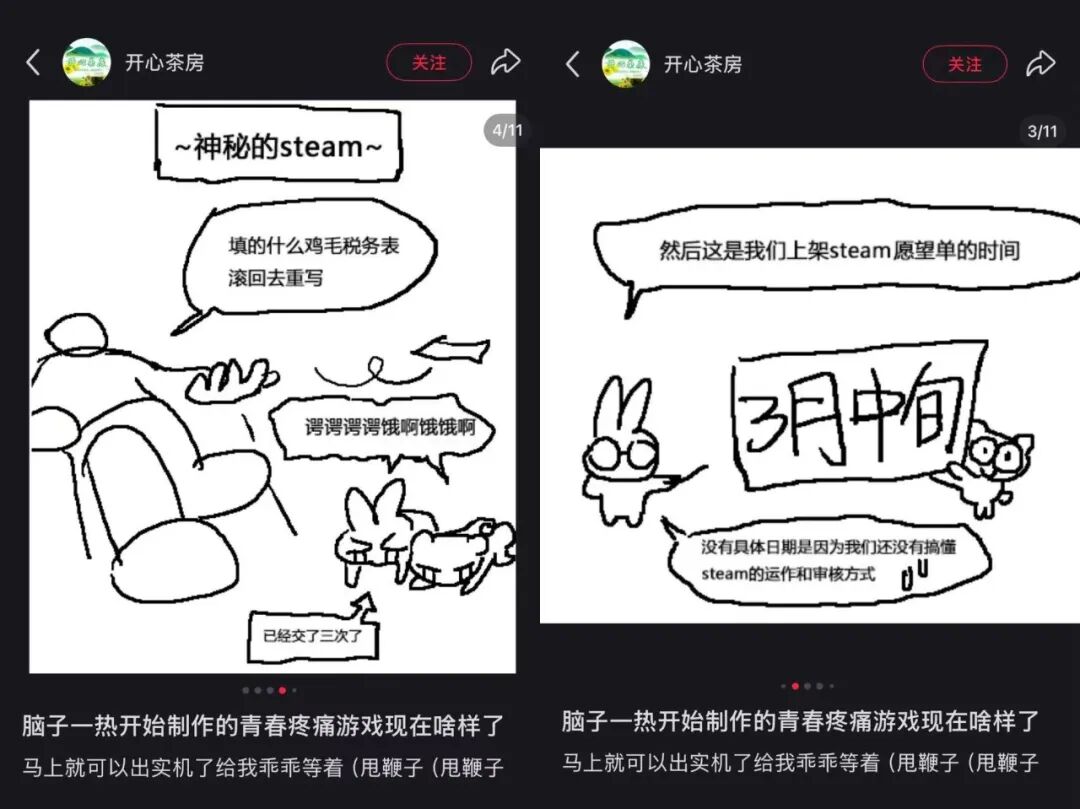
Shares from Kaixin Chafang
And the scenarios in the game's promotional content are mostly very life-like. The main characters, wearing traditional Chinese school uniforms or cotton jackets, hold hands with their little sister and take a group photo in front of a street stall decorated with lanterns during the Chinese New Year.
This kind of relatable, personally expressive content attracted many users with similar emotional resonance even before the game's launch, laying a solid foundation for *Paper House*'s success.
02
Of course, low barriers to entry do not equal low content quality.
The core of Xiaohongshu lies in the fact that it does not solely rely on KOLs — ordinary users' content also has the opportunity to be seen by many others. The official platform can connect potential interested users with creators, but whether the content can leave a lasting impression ultimately depends on the team itself.
Huolongguo was a finalist in the Tencent Game Creation Contest at the end of 2025. At the time, he casually posted a share post, which unexpectedly received official traffic support. But probably due to issues with content quality and the target user group, the post ultimately did not generate much buzz for the game. "The metrics looked good, but the audience was not the right fit — the resulting conversion rate was basically zero."
In other words, algorithmic traffic boosts can increase a post's exposure and likes, but whether the content can attract people, retain people, and attract the right kind of people still depends on the creator's own strategic thinking.
On Xiaohongshu, many products have adopted specific execution strategies in addition to regular promotional content. miHoYo launched the second beta test for its new life simulation game *Starfield Valley* in April this year, and set up accounts across multiple platforms for promotion. On Bilibili, the content is mostly PVs, as well as long-form "immersive white noise" companion videos. On Weibo, the team adds repost-and-giveaway campaigns to key promotional posts to attract user attention.
On Xiaohongshu, however, *Starfield Valley* added more image-text content tailored to the platform's characteristics. Simple text paired with cute animal characters from the game allows players to feel the sense of companionship and healing that the game aims to deliver, and such content is also very easy to spread on the platform.
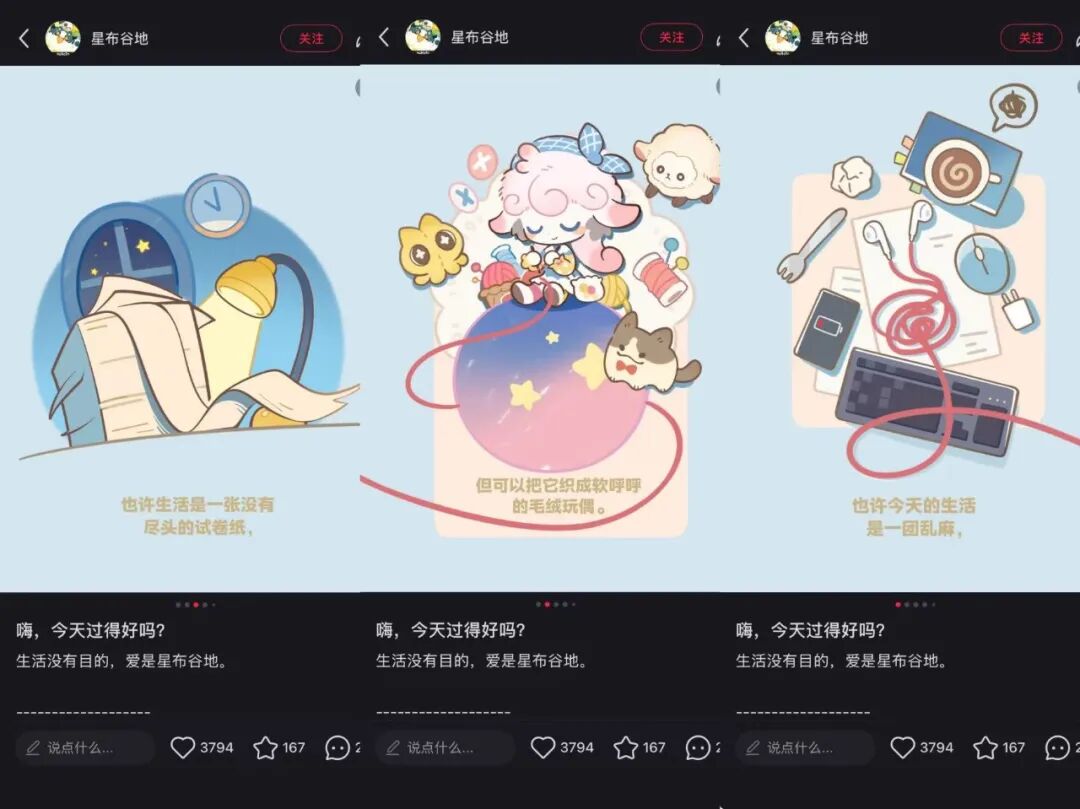
Promotional content for *Starfield Valley* on Xiaohongshu
In the indie game space, according to Yinghuo's observations, most teams do not initially know how to operate content effectively, and they need a process of learning and accumulating experience.
Before developing indie games, Qie Jingcha was an illustrator with no prior experience in game promotion.
Previously, Qie Jingcha had already gained a certain number of fans and popularity on Xiaohongshu as an illustrator. In the early stage of game promotion, in addition to posting game-related content on her personal account, she also shared some of her artworks.
But as game-related content attracted more fans, Qie Jingcha truly realized how huge the traffic gap can be between different types of content. On her account, interactive content like daily life rants and IP character sharing can get dozens or even hundreds of times more traffic than usual, while content that is purely for showcasing and sharing tends to perform much more modestly.
For this group of creators, Xiaohongshu has built a systematic content operation framework. During the "I Make Games on Xiaohongshu" campaign, development teams that post at least one piece of content stably every month can join the official community called "Indie Game Developers Alliance". By joining this community, creators can not only get official curated content guides, but also fill out forms to apply for extra traffic boosts for their posts.
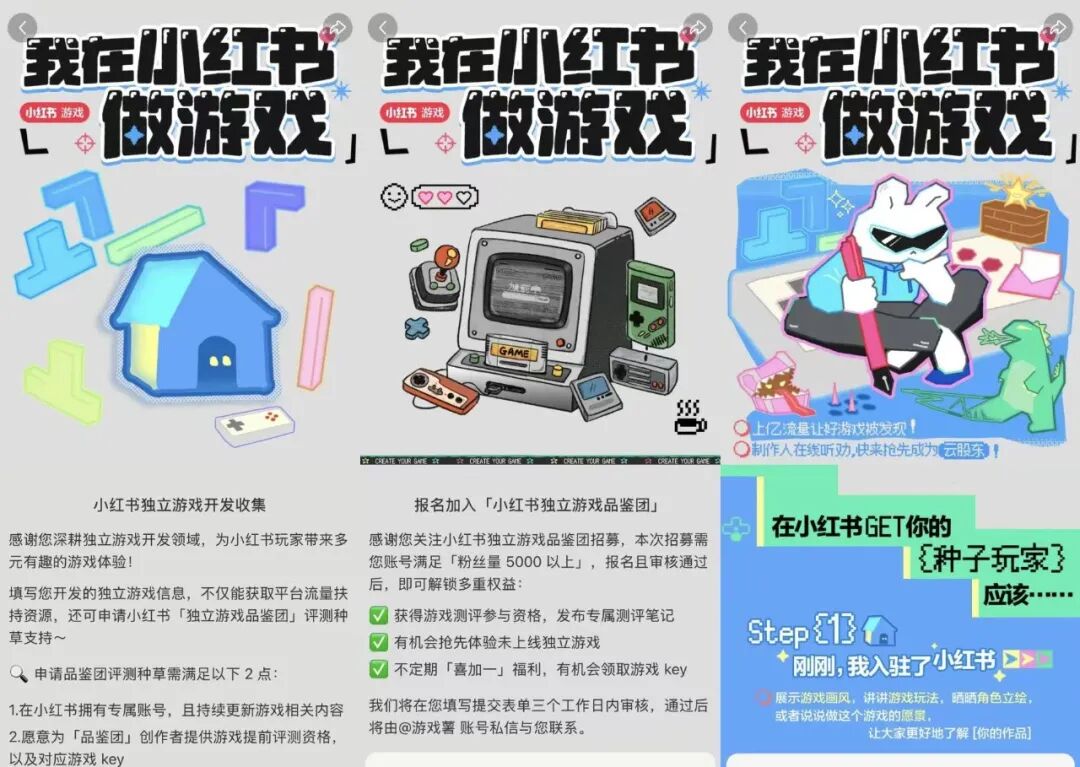
The "I Make Games on Xiaohongshu" campaign
The official team also continuously tracks these creators' posts and regularly supports high-quality content. Currently, the community has gathered around 3,500 developers.
Leveraging its life-focused and authentic user experience, Xiaohongshu provides a better communication platform for developers and players. For developers, they can meet and attract a group of loyal fans for their works