Building a reactor for power generation in 3 years with a $5 billion valuation, this startup aims to become the "SpaceX of nuclear power"
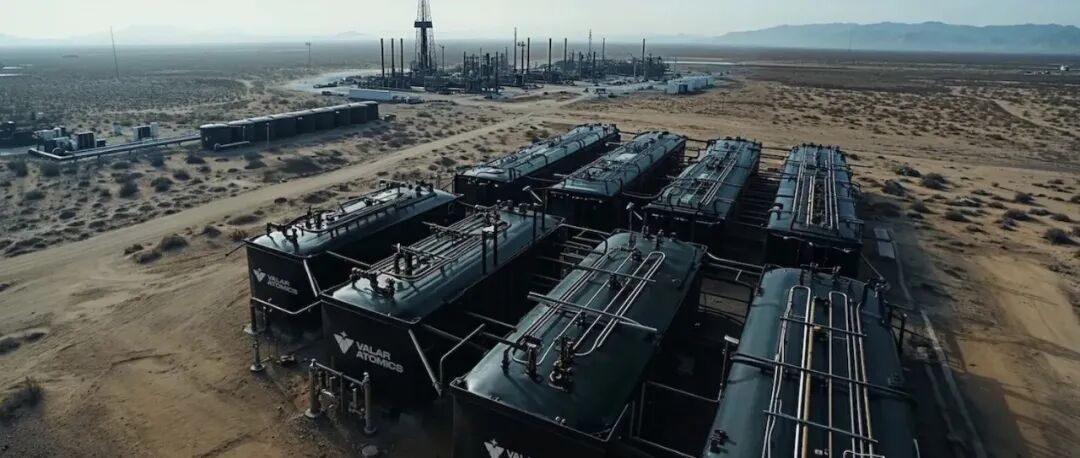
On July 1, 2026, in the Utah desert, a chip built on Nvidia's Blackwell architecture was powered on for the very first time by a nuclear reactor.
There was no ribbon-cutting ceremony, no suited executives lining up on stage. All that was there was a desktop computer connected to the reactor's output, briefly hosting a website called nuclearbite.com. The site displayed a real-time counter showing exactly how many uranium atoms were consumed the moment you loaded the page.
The company that pulled this off is Valar Atomics, founded just three full years ago. According to the latest updates, the firm is currently raising a new $1 billion funding round at a $5 billion valuation — a massive jump from its $2 billion valuation only three months prior.
This milestone is worth pausing to unpack. The last time a new nuclear power generation unit came online in the U.S. was back in 2000. Before that, the entire industry lay dormant for nearly 40 years, leaving behind little more than stacks of analog paperwork and meticulously drafted "paper reactors" — perfect on paper, but never actually operational.
Valar stepped in and built a fully functional, working nuclear power plant in just 3 years.
This company is trying to apply Elon Musk's playbook to become the "SpaceX" of the nuclear energy sector.
01 The Heir to the Manhattan Project Legacy
Founder Isaiah Taylor did not start out as a nuclear engineer. His great-grandfather was a nuclear physicist who worked on the Manhattan Project, and Taylor took a far more unorthodox path: back in high school he realized nuclear energy was a problem that "had a clear solution, but no one was actually building it." He waited nearly a decade for someone else to step up, and when no one did, he decided to build it himself.
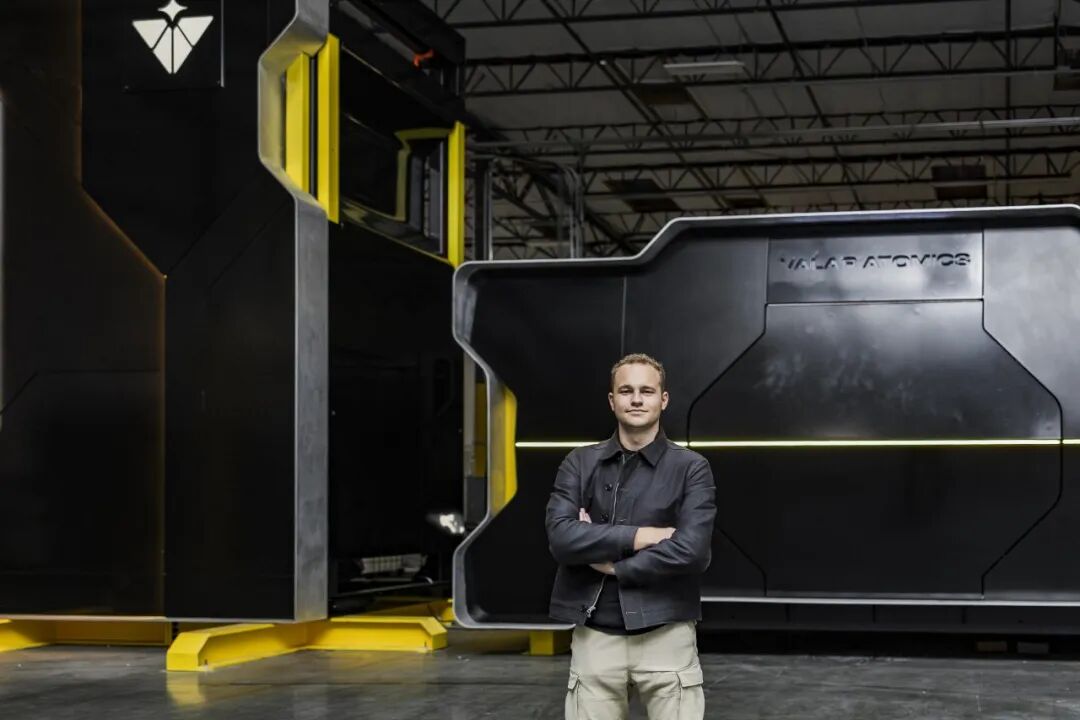
Valar Atomics Founder Isaiah Taylor | Image source: Valar Atomics
Valar Atomics is based at the San Rafael Energy Laboratory in Utah, a harsh, high-altitude desert landscape.
Taylor set an internal team metric called "tick rate" — a term borrowed from video games, referring to how frequently a game updates its state. For Valar, a "tick" is the time interval between each new reactor reaching criticality. From company registration to the first atom split: 2 years and 4 months. From that first reactor to the second unit, Ward 250, going online to generate power: 7 months. His stated goal is to shrink that interval down to just a few minutes.
That sounds like classic founder bravado, but the timeline speaks for itself.
Ward 250 is Valar's second reactor: a fourth-generation modular high-temperature gas-cooled reactor using TRISO fuel, helium cooling, and graphite moderation, built and operated under the U.S. Department of Energy's Reactor Demonstration Program framework. On June 18, 2026, Ward 250 achieved zero-power criticality, becoming the fifth new nuclear power generation unit to come online in the U.S. since 2000 — and the first ever DOE-authorized reactor built and operated entirely outside the U.S. national lab system.
Valar was able to take this path thanks to a critical, underused regulatory loophole: the public perception is that all nuclear projects must go through the NRC (Nuclear Regulatory Commission) approval process, which is designed for large-scale commercial deployment of mature systems and routinely takes more than a decade to complete.
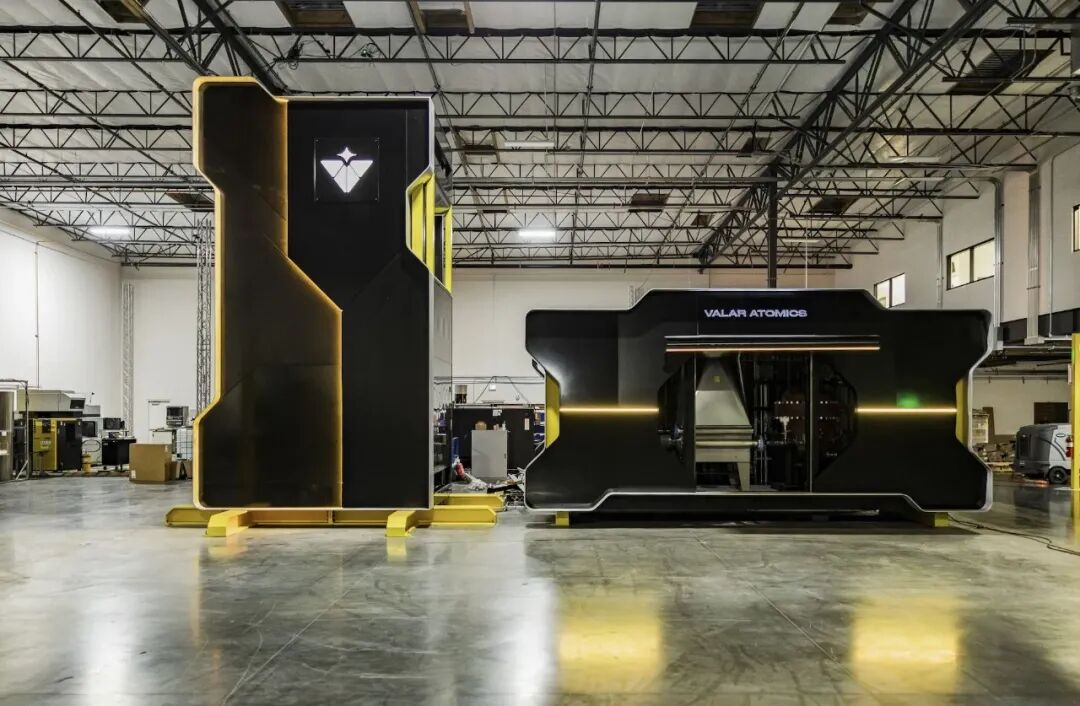
The experimental Ward 250 unit | Image source: Valar Atomics
But the U.S. has a second regulatory path: the DOE's test and demonstration oversight framework, written into federal law when the Atomic Energy Commission was split up decades ago, and almost entirely unused for 40 years. The Trump administration's Executive Order 14301, which mandated that three advanced reactors reach criticality on U.S. soil by July 4, 2026, finally activated this dormant pathway. Valar used exactly this process, finishing its milestone more than three weeks ahead of the deadline.
On July 1, Ward 250's power output was directly connected to a Blackwell system supplied by Nvidia, completing that historic "trickle power" delivery. Valar also announced a formal partnership with Nvidia to build a 30MW closed-loop AI factory that will consume zero local freshwater resources.
This marks the first time in U.S. history that an advanced reactor built by a startup less than three years old has powered an AI chip. By any standard, this is a milestone that no one expected to happen this soon.
02 A Nuclear Power Plant Built on First Principles
To truly understand what Valar is building, you have to start with a single "black box" component.
The Reactor Protection System (RPS) is the "brain" of a nuclear power plant: three independent systems run continuous real-time voting, and if any two detect the reactor entering an unsafe state, it triggers an immediate automatic shutdown — with zero manual override access at any point in the decision chain. For Valar, this was also one of the most critical safety components in the entire project.
When they went out for quotes, the price they got was $5 million, with a 2.5-year delivery timeline.
Valar negotiated for two months, but the vendor refused to budge. Finally, Taylor gathered the team and said: we'll build it ourselves.
The project lead was the company's head of instrumentation and controls, a Brown University dropout. He pulled together a team of 5 people, locked themselves in a conference room for 6 weeks, and walked out with a fully functional, production-ready RPS on the table — for a total cost of $400,000.
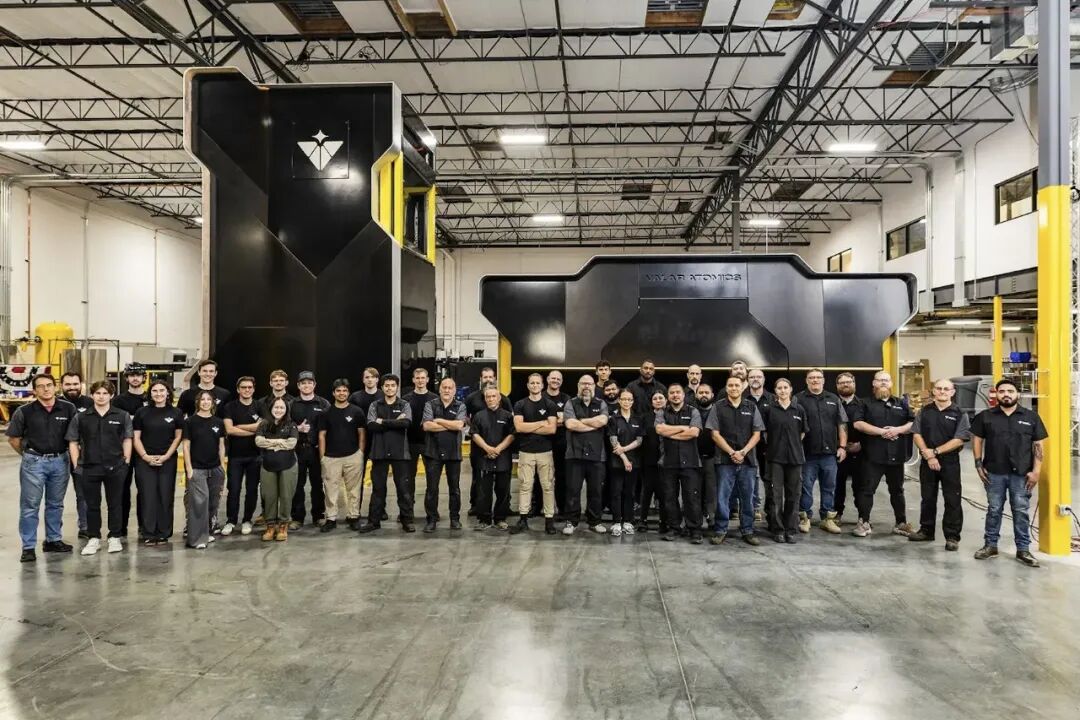
The Valar Atomics team posing for a photo in front of Ward 250 | Image source: Valar Atomics
When the original vendor found out what they had done, they started spreading rumors across the industry: "Valar is an unsafe company, they're going to get people killed." That RPS system was their core commercial moat — if anyone proved a 5-person team could build one in 6 weeks, the entire industry's pricing structure would collapse.
Stories like this repeat constantly across the company, but one detail stands out more than any other.
Valar needed thick concrete radiation shielding (a biological shield) to separate personnel from the reactor's radiation field. The traditional cast-in-place process takes roughly 3 months to complete. They wanted to use prefabricated interlocking concrete blocks instead, which would theoretically cut the total build time down to dozens of hours — but there was one unsolved problem: the microscopic gaps between two concrete blocks could never be perfectly sealed, allowing gamma rays and neutrons to leak through the seams. Worse, the concrete formulation had to satisfy three nearly contradictory requirements at once: high enough density to block gamma radiation, high enough structural strength to support stacking under its own weight, and a molecular composition that would not generate long-lived nuclear waste when irradiated.
Taylor assigned this problem to two team members: one 23 years old, the other 21.
Over the next three weeks, they traveled across the country collecting rock samples, flying back and forth with bags full of rock specimens. Every Friday night, their conference room turned into a makeshift lab: they set up acid baths to dissolve samples, used spectrometers to analyze their composition, logged every result, and headed out again the following week to source new materials. Three weeks later, they landed on the exact formulation — a problem industry experts had been writing "someone should solve this" papers about for 30+ years, that no one had ever actually delivered.
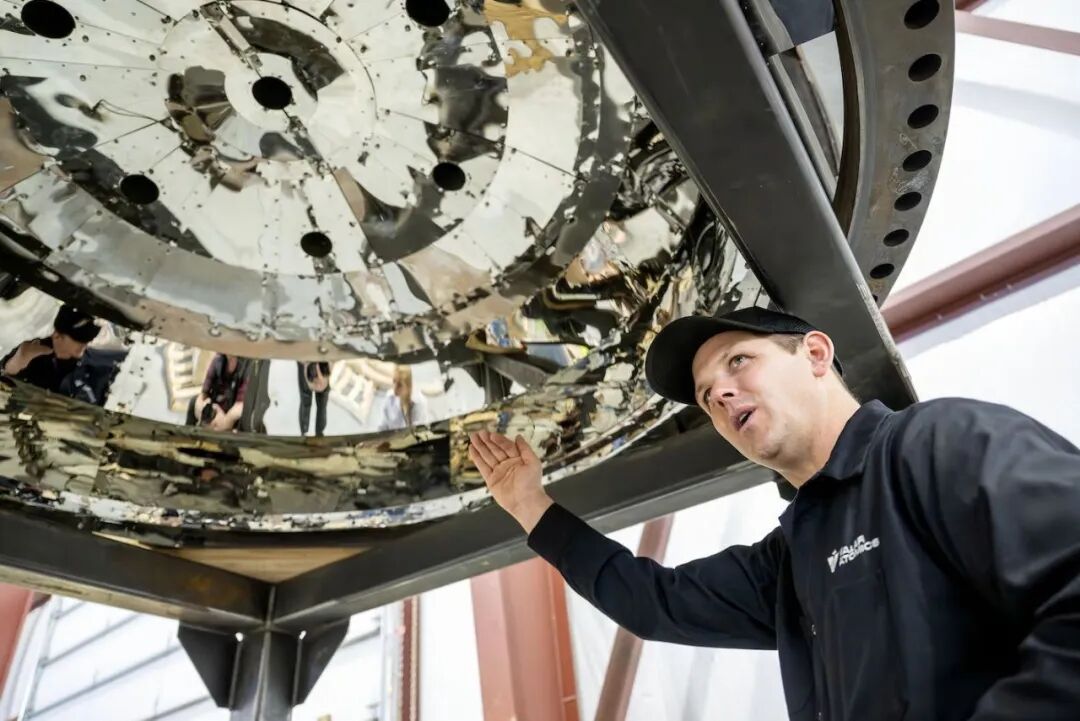
Utah Operations Director Jess Housekeeper shows off the top of the small modular reactor | Image source: desertnews
In the end, Valar used grout-free, bolt-free sine-wave interlocking precast blocks to finish the full biological shield in just 42 hours — down from the traditional 3-month timeline.
This approach is not about "we want to build everything ourselves." It's about vertical integrating any bottleneck that stands in the way of mass scaling, no exceptions. Whenever a vendor tells them something is "utterly impossible," they turn it into an internal project. The nuclear industry's sky-high costs are largely propped up by a supplier ecosystem that has not seen real competition in decades: nuclear energy was never inherently expensive — no one ever did the math to figure out what it should actually cost when you build it from first principles.
Taylor put it bluntly in a recent interview:
"This is a fake industry that hasn't actually built anything new in 40 years, and the tiny number of projects they do deliver are being charged at 100x markup."
03 Eliminating the Risk of a Three Mile Island-Style Incident
This is the part of Valar's story that draws the most scrutiny, and the part that deserves the most serious consideration.
SpaceX can afford to blow up a test rocket. They collect the data, iterate on the design, and build a new one. Their entire iterative flywheel is built on the premise that the cost of failure is manageable. Nuclear energy is nothing like that: even a minor incident, even one well below any dangerous threshold, even one that exposes zero people to radiation, can trigger public backlash on the scale of the Three Mile Island accident. Three Mile Island killed no one and injured no one, but it froze the entire U.S. nuclear industry for nearly 40 years.
Public perception of failure does not follow the rules of physics.
Taylor has a clear, counterintuitive answer to this concern, one that completely flips the foundational logic of nuclear safety philosophy.
Traditional nuclear safety frameworks focus on reducing the *probability* of accidents: layers of redundant systems, rigorous personnel training, precision monitoring, all designed to push the chance of any failure as close to zero as possible. That logic is not wrong, but it has a fundamental flaw: probability is inherently random. You can never account for every single possible failure mode, and there will always be an unforeseen variable that slips through. The cooling systems at both Fukushima and Three Mile Island were deemed "sufficiently reliable" in their original designs.
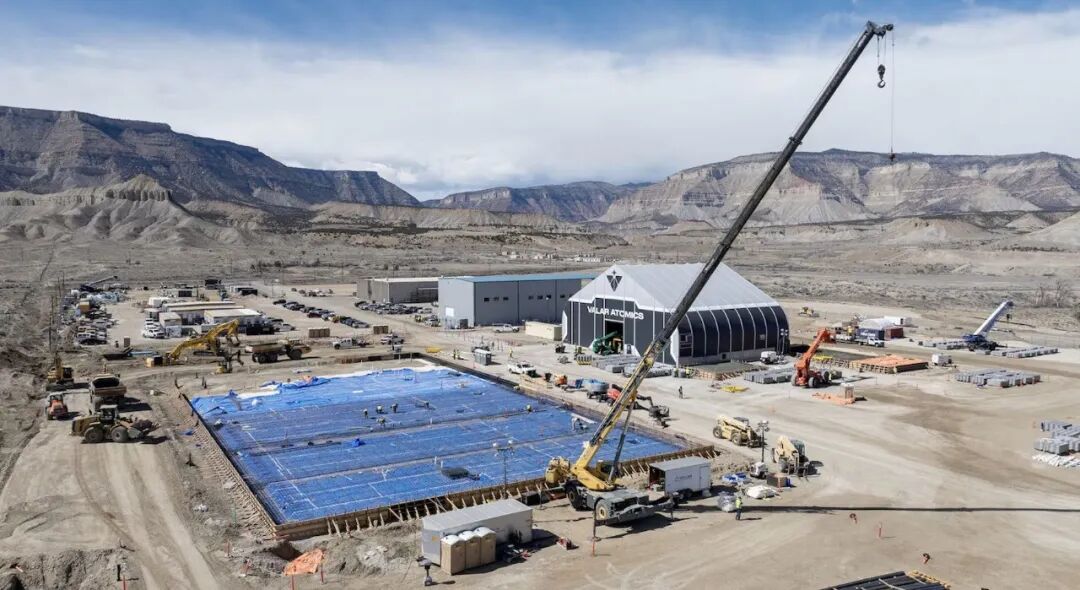
Workers continue preparations for the small modular reactor installation | Image source: desertnews
Valar's framework focuses on reducing the *consequence* of accidents instead — if a reactor is physically incapable of experiencing a meltdown by design, then no matter what goes wrong, the worst possible outcome is bounded and contained.
Ward 250's TRISO fuel particles are individually wrapped in multiple layers of ceramic and silicon carbide, so they cannot rupture even at extreme temperatures. Helium coolant produces almost no complex chemical reactions. The graphite-moderated reactor's geometric design allows decay heat to dissipate entirely through natural convection, even with zero active cooling running.
They are planning a public demonstration: trigger an emergency shutdown, then cut all power to the reactor — every safety system, every circulation pump, every control circuit — and do absolutely nothing, then observe the unit for two full days. They already completed this exact test at their Hawthorne test facility, using resistive heaters to simulate full-power nuclear core temperatures, then cutting all power. The passive cooling system dissipated all decay heat through natural water circulation, with zero active intervention required.
This is the real prerequisite for the "SpaceX of nuclear energy" vision to work: it's not that "we are comfortable with failure," it's that the design physically eliminates any possible path to catastrophic failure.
04 Capital Bets on a New AI Energy Paradigm
Of course, there are still plenty of skeptics.
Nuclear engineer Dr. Nick Touran has publicly argued that Valar's real business model is not "deploy one reactor" but "deploy hundreds of reactors in a single region" to create a distributed "nuclear power farm." He warns that concentrating that many reactors in one area will not proportionally reduce safety and security risks — it will create entirely new, untested hazards at scale.
Dr. Anna Erickson, a nuclear engineering professor at Georgia Tech, put it even more directly: Valar has never built a full commercial-scale reactor, and no other company in the U.S. has ever pulled off what they are claiming to do. There is still a very long road between a 37% power demonstration test and delivering stable, continuous power to a full-scale data center.
The $5 billion valuation is not pricing in today's 37% power output — it's pricing in a future where nuclear energy solves the entire AI infrastructure energy crisis.
JPMorgan analysts project that total investment in small modular reactors could reach $9 trillion by 2050 — but between 2026 and 2050, there are far too many unknown variables to predict.
But none of these doubts are stopping investors from backing Valar, and the core reason is that the company is already a core part of the new infrastructure logic being built for the AI era.
Large language model companies are buying up every available unit of compute at a frantic pace, compute needs massive amounts of power, and the existing electrical grid cannot keep up. That means every viable solution to the energy supply crisis is attracting unprecedented attention and capital. At the very end of that chain are companies like Valar — five years ago, almost no one would have taken their technology seriously, but in the middle of the AI infrastructure investment boom, their entire value proposition suddenly makes perfect sense.
Valar's backers are not investors who are naive to technical risk. They are betting on a single thesis: as AI compute demand continues to explode, and energy supply becomes the real hard bottleneck, small modular nuclear reactors that can operate independently, off the main grid, will become an extremely scarce critical infrastructure resource.
Whether that thesis is correct remains to be seen.