China Huaneng and China Three Gorges "withdrew", while Yajiang River entered, and a vice-ministerial central SOE ranked 22nd among central SOEs is taking charge of a river.
Huaneng and China Three Gorges have exited, with Yajiang Group integrating the Yarlung Tsangpo River's energy assets.
Forward Energy notes that two companies recently completed industrial and commercial registration changes.
The original shareholder of Nyingchi Huaneng Energy Development Co., Ltd., China Huaneng Group, has withdrawn, with China Yajiang Group Co., Ltd. taking over full ownership. The legal representative has changed from Li Chaoyi to Hu Shenghong. Just one day later, the original shareholder of China Three Gorges Tibet Yarlung Tsangpo Hydropower Development Co., Ltd., China Three Gorges Corporation, also withdrew, and the company became a wholly-owned subsidiary of Yajiang Group, with its legal representative also changed from Zhou Yushu to Hu Shenghong.
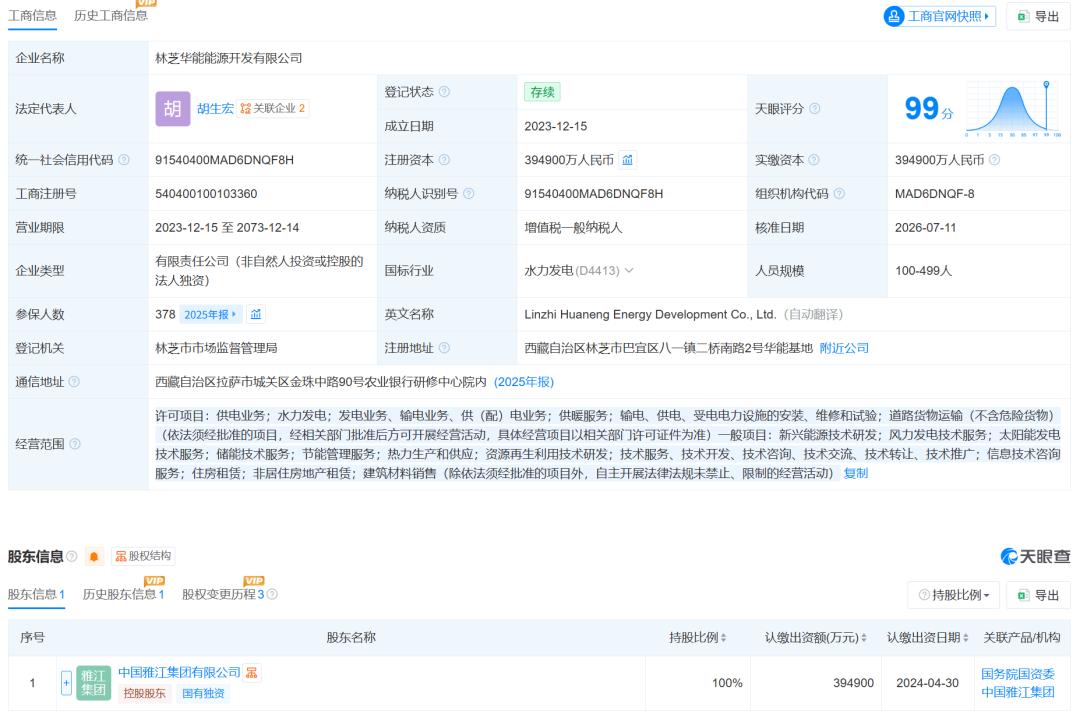
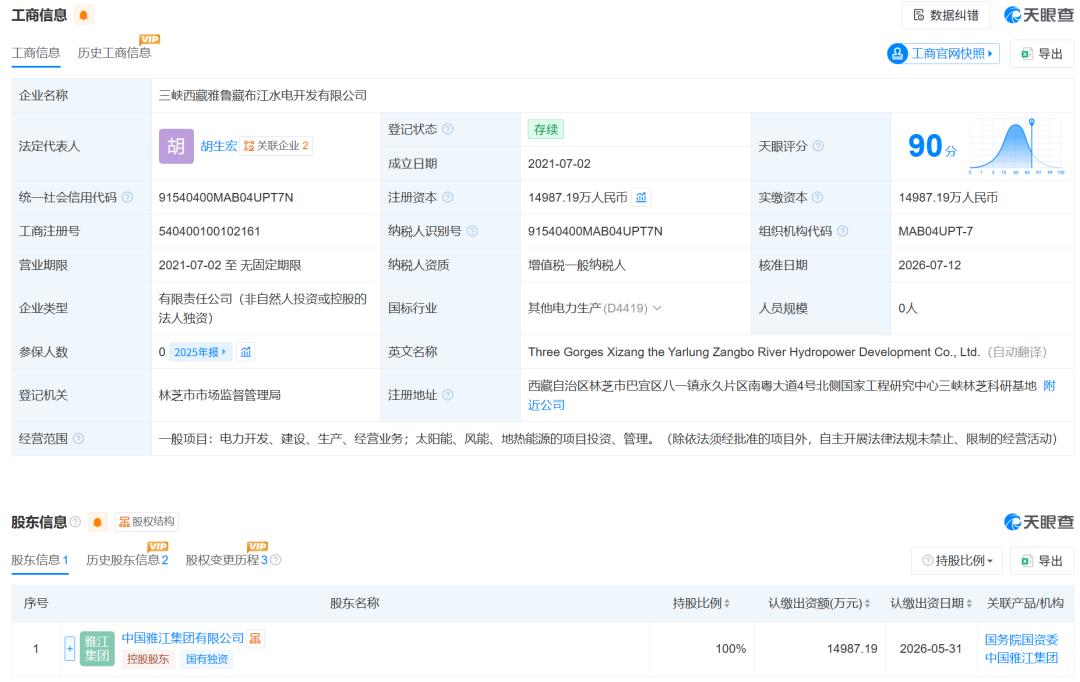
These two transactions involve one company with a registered capital of 3.949 billion yuan, and the other with approximately 150 million yuan. One is Huaneng's comprehensive new energy platform for tributaries in southeastern Tibet, while the other is China Three Gorges' project company focused on the preliminary development of the main stream. By combining them, Yajiang Group now possesses a complete asset matrix covering "main stream + tributaries, hydropower + wind, solar and energy storage".
This is no ordinary equity acquisition. It marks the implementation of the "one river, one principal entity" development framework.
01
The Significance Behind the 22nd Ranking
On July 19, 2025, the State Council approved the establishment of China Yajiang Group Co., Ltd. Zhang Guoqing, Vice Premier of the State Council, attended the inauguration ceremony and unveiled the company's plaque. On the same day, the construction of the downstream hydropower project on the Yarlung Tsangpo River began, with Li Qiang, Premier of the State Council, traveling to Tibet in person to attend the ceremony.
In the list of central state-owned enterprises (SOEs) under the State-owned Assets Supervision and Administration Commission of the State Council (SASAC), China Yajiang Group ranks 22nd, right after China Three Gorges Corporation and before China Energy Investment Corporation. The first 54 enterprises on the list are vice-ministerial-level central SOEs, and Yajiang Group is one of them. With a registered capital of 240 billion yuan, it exceeds the 211.5 billion yuan of China Three Gorges Corporation.
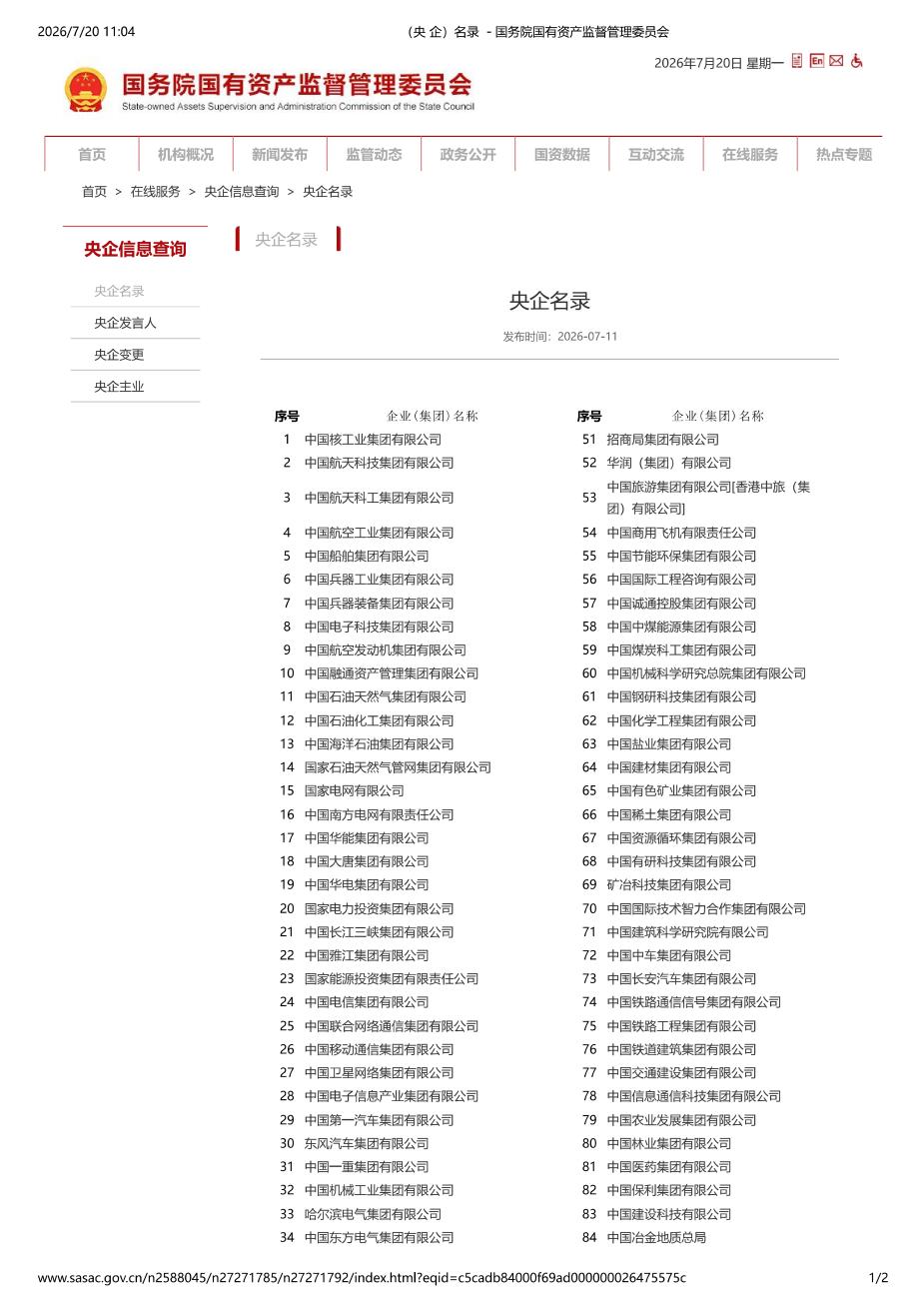
This ranking is not arbitrary. The first 10 central SOEs on the list are military-related enterprises, while positions 11 to 21 are energy central SOEs covering oil, power grids, and power generation. Yajiang Group's 22nd-place ranking places it right next to China Three Gorges Corporation and China Energy Investment Corporation.
Within the power generation group sequence, it is positioned after China Three Gorges and before China Energy. This placement sends a clear signal: Yajiang Group is no ordinary new central SOE. Its priority in the national energy strategy is on par with that of China Three Gorges and China Energy Investment Corporation.
Historically, the number of central SOEs decreased from 196 in 2003 to 98 in 2017. In July 2025, Yajiang Group became the 99th central SOE, and 8 days later, Chang'an Automobile Group joined the list, bringing the total back to 100. After 8 years, the count of central SOEs has returned to three digits. Among the two newly added enterprises, Yajiang Group is a vice-ministerial-level entity, while Chang'an Automobile is a bureau-level enterprise. Yajiang Group is the only vice-ministerial-level central SOE specially established for a single engineering project.
02
Why Did Huaneng and China Three Gorges Exit?
Forward Energy believes that the withdrawal of Huaneng and China Three Gorges cannot be regarded as a simple asset divestment.
For a long time, multiple power central SOEs have separately deployed hydropower projects in southeastern Tibet, leading to persistent problems such as scattered resources, insufficient coordination in planning, and redundant investment. Following the reform concept of "one river, one principal entity" for river basin development, SASAC is promoting the unified aggregation of existing energy platforms in the Yarlung Tsangpo River basin, which were previously scattered across various power generation central SOEs, under the control of Yajiang Group. The goal is to achieve unified planning, unified construction, unified dispatch, and unified power transmission for the river basin's resources.
This logic is not unfamiliar in the history of China's hydropower development. The Yalong River basin is a typical example of "one entity developing one entire river" — as the single development entity, the Yalong River Hydropower Development Company under SDIC Group has maximized the utilization of water resources.
The scale of the Yarlung Tsangpo River far exceeds that of any other river in China. With a total planned investment of 1.2 trillion yuan, 5 cascade hydropower stations are planned, delivering a total installed capacity of 60 million kilowatts and an annual power generation of 300 billion kilowatt-hours. Its installed capacity is 2.67 times that of the Three Gorges Project, and its annual power generation is 3 times that of the latter. The model of multiple central SOEs developing separately is almost unfeasible for a project of such enormous scale.
The withdrawal of Huaneng and China Three Gorges essentially acknowledges this reality. The two companies differ greatly in size, yet their integration logic is consistent: placing existing assets into a unified platform.
03
The Organizational Framework Built in One Year
From July 2025 to July 2026, Yajiang Group spent one year establishing a framework covering the entire industrial chain.
In September 2025, Construction Management Company 1, Construction Management Company 2, and Electromechanical Engineering Management Company were established in Nyingchi, Tibet. In October, New Energy Company (with a registered capital of 1 billion yuan), Materials and Equipment Company (2 billion yuan), Tendering Company (100 million yuan), and the Chengdu Branch were successively founded. In November, the Ecological and Environmental Protection Company was incorporated into the group through equity acquisition.
In April 2026, Yajiang Group took the lead in establishing Yaxia National Hydropower Technology Innovation Center Co., Ltd. in partnership with PowerChina, China Energy Engineering Corporation, China Electrical Equipment Group, and Dongfang Electric. The joint venture has a registered capital of 2 billion yuan, with Yajiang Group holding a 53% stake.
In July, the acquisition of the two companies from Huaneng and China Three Gorges was completed.
Within just one year, Yajiang Group grew from scratch to 8 subsidiaries and 3 branch institutions. This is not the normal expansion pace of an ordinary enterprise. The organizational framework construction of a new central SOE usually takes two to three years, but Yajiang Group completed this process in just 12 months.
04
A Key Detail and a Broader Context
The legal representative of both companies after the registration changes is the same person — Hu Shenghong. Public information shows that Hu Shenghong serves as the legal representative of both entities simultaneously.
This arrangement indicates that the integration is not limited to the equity level, but will extend into actual operational management.
How the two companies will coordinate their businesses, integrate their personnel, and revitalize their assets requires a unified decision-maker. Nyingchi Huaneng Energy has hundreds of employees, while the number of employees participating in social insurance at China Three Gorges Tibet Yarlung Tsangpo Hydropower Company is zero. The former is a mature platform with a full team and operational capabilities, while the latter is more of a project carrier. The difficulty of integrating the two is completely different.
The fact that the same person is in charge of both companies shows that Yajiang Group is serious about advancing the integration — it will not stop at simply putting up a brand name.
This integration takes place against the backdrop of accelerating professional restructuring of central SOEs. It is estimated that 10 to 10 groups of strategic restructuring of central SOEs and more than 50 groups of professional integration of local state-owned enterprises will be completed in 2026. The country will support enterprises with strong innovation capabilities to serve as principal entities, carry out horizontal integration of similar businesses and vertical integration of upstream and downstream industrial chains, to reduce industry "involution".
The establishment and asset integration of Yajiang Group is the most representative case in this process. It is not a merger of two central SOEs, but a new central SOE specially established for a specific major project, with relevant assets then injected into it. This model of "setting up the principal entity first, then injecting assets" is rarely seen in the restructuring of central SOEs.
Recently, the Beijing Equity Exchange and the Shanghai United Assets and Equity Exchange have successively disclosed 13 new energy equity transfer projects involving central SOEs such as China National Nuclear Corporation, China Energy Investment Corporation, and State Power Investment Corporation. On one hand, there is "acquisition" — concentrating advantageous resources on core platforms through strategic restructuring. On the other hand, there is "divestment" — disposing of inefficient or non-core assets through professional integration. Yajiang Group's takeover of the assets from Huaneng and China Three Gorges belongs to the former category.
The 240 billion yuan registered capital, 1.2 trillion yuan project investment, and 22nd ranking on the central SOE list — these figures indicate that this is no ordinary resource integration. It is an institutional response to the question of "how to efficiently promote a super-large engineering project".
The withdrawal of Huaneng and China Three Gorges is not a failure, but a rational division of labor. For a river of the Yarlung Tsangpo's scale, shifting from separate development by multiple entities to unified coordination by a single principal entity is the choice with the lowest overall cost. Yajiang Group has built its organizational framework within one year, and the next step will be to verify whether this framework can support the weight of the 1.2 trillion-yuan mega project.
This article is sourced from the WeChat official account "Forward Energy", written by Wang Mengjiao, and published by 36Kr with authorization.