Where does the funding come from? A review of the "money bags" for urban renewal
As urban regeneration serves as a critical driver for advancing high-quality urban development and improving residents' quality of life, financial security stands as a fundamental prerequisite for its smooth implementation. In response to the massive funding demand of urban regeneration, a diversified capital portfolio framework combining central fiscal funds, local special-purpose bonds, financial credits, social capital, and resident contributions has gradually taken shape.
This year marks the release of the 15th Five-Year Plan for Urban Regeneration (hereafter referred to as the Plan), which explicitly sets the goal to "build a sustainable investment and financing system for urban construction and operation", and deploys policy measures from three dimensions: improving fiscal support policies, optimizing financial support measures, and actively attracting social capital participation.
In June, the Ministry of Housing and Urban-Rural Development, the National Development and Reform Commission, and the Ministry of Finance jointly issued the Statistical Survey System for Urban Regeneration, which includes statistics on urban regeneration funding (as shown in the figure below). The funds are mainly divided into three categories: national budget funds, social capital, and other funds. Among them, national budget funds cover central budget funds, provincial budget funds, municipal and lower-level budget funds, local government general bonds, and local government special-purpose bonds. Social capital encompasses contributions from property right entities, operating subjects, residents, and credit funds from financial institutions. Considering data availability, this report sorts out the funding situation focusing on central budget funds, local government special-purpose bonds, and credits from financial institutions for reference by all stakeholders.
Central Budget Funds: Expected to Exceed 3.1 Trillion Yuan in 2026 to Support Urban Regeneration
Central budget funds act as the "ballast stone" of the urban regeneration funding system, functioning to guide development directions and leverage social investment. They mainly come from channels such as central budgetary investment, other central fiscal funds (including subsidy funds for urban affordable housing projects, central fiscal subsidy funds for supporting the implementation of urban regeneration initiatives, etc.), and ultra-long-term special treasury bonds.
(1) Central Budgetary Investment: 970 Billion Yuan Allocated in 2026 to Support Urban Regeneration
Central budgetary investment refers to the fiscal funds arranged by the state for fixed asset investment, which has long supported urban regeneration through channels such as "affordable housing projects". In 2025, the National Development and Reform Commission officially established a special fund for urban regeneration under central budgetary investment, shifting the support for urban regeneration from scattered arrangements to focused special guarantees, marking a historic leap in the support intensity of this channel for urban regeneration. Such funds are typically used to support public welfare-oriented and foundational projects.
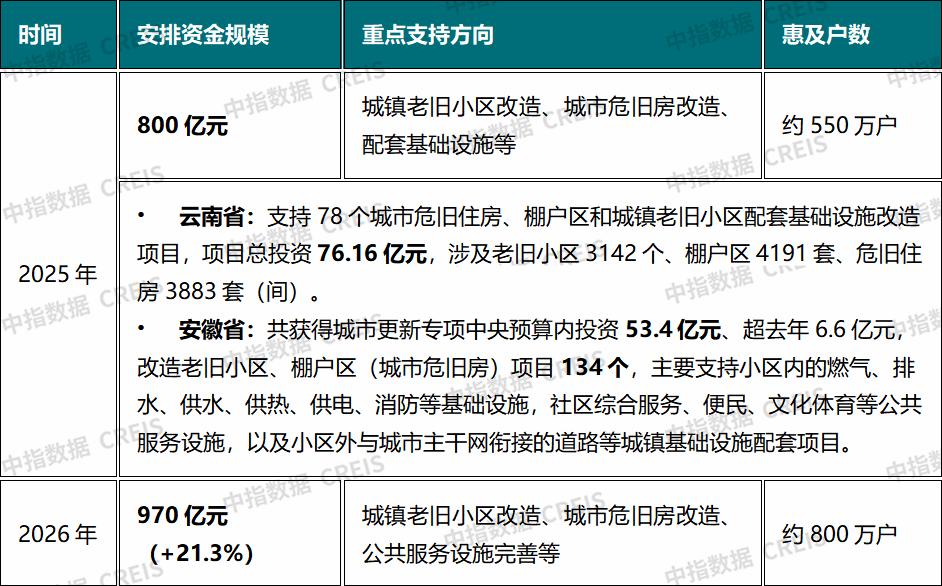
Table: Overview of Urban Regeneration Supported by Central Budgetary Investment
Source: China Index Academy Comprehensive Compilation
In 2025, 800 billion yuan of central budgetary investment was allocated to support urban regeneration. Yunnan Province received support for 78 projects with a total investment of 76.16 billion yuan, accounting for 9.5% of the total, covering 3,142 old residential communities, 4,191 shantytown units, and 3,883 dilapidated housing units. Anhui Province received 53.4 billion yuan, accounting for 6.7%.
In terms of fund changes, the 2026 central budgetary investment for urban regeneration is arranged at 970 billion yuan, an increase of 170 billion yuan over 2025, representing a growth rate of about 21%, bringing the fund scale to a new level.
(2) Other Central Fiscal Funds: Funds for Urban Regeneration in 2026 May Exceed 560 Billion Yuan
■ Central Fiscal Subsidy Funds for Urban Affordable Housing Projects: Funds for Urban Regeneration in 2026 May Exceed 400 Billion Yuan
The subsidy funds for urban affordable housing projects are a comprehensive fiscal channel through which the central government provides transfer payments to support local housing security and urban regeneration. Jointly managed by the Ministry of Finance and the Ministry of Housing and Urban-Rural Development, they belong to transfer payments for shared fiscal authority.
In 2024, the Ministry of Finance and the Ministry of Housing and Urban-Rural Development revised the Administrative Measures for Central Fiscal Subsidy Funds for Urban Affordable Housing Projects, clarifying that the scope of subsidy fund support includes housing security, urban village renovation, old urban community renovation, and shantytown (urban dilapidated housing) renovation. Following the principle of combining rewards and subsidies, 80% of the funds are allocated based on the volume of various tasks, and 20% are set aside as reward funds. The implementation period of the subsidy funds lasts until 2027, and an assessment will be conducted upon expiration to determine whether to continue or extend the policy.
In terms of main features, firstly, the coverage scope continues to expand. From the early focus on shantytown renovation and public rental housing, it has gradually extended to old community renovation (since 2019), affordable rental housing (since 2021), and supporting infrastructure for urban village renovation and allocated affordable housing (since 2024);
Secondly, the scale remains relatively stable. In recent years, the annual total scale of subsidy funds for affordable housing projects has remained around 700 billion yuan. The 2026 budget is arranged at 672.41 billion yuan, a decrease of 35.39 billion yuan from the 2025 implementation figure.
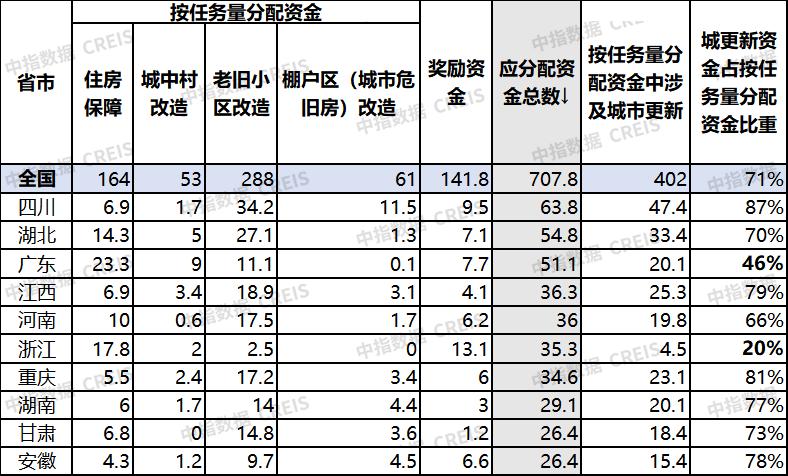
Table: Distribution of Subsidy Funds for Affordable Housing Projects in 2025 (Budget Figure, 100 Million Yuan)
Data Source: Ministry of Finance, China Index Academy Comprehensive Compilation
In 2025, the national budget for subsidy funds for affordable housing projects is 707.8 billion yuan (total distributable funds), of which 566 billion yuan is allocated based on task volume and 141.8 billion yuan is reward funds. Among all provinces and municipalities, Sichuan Province ranks first with 63.8 billion yuan of distributable funds, and Hubei and Guangdong also have distributable funds exceeding 50 billion yuan.
Among the funds allocated based on task volume, the national total for urban regeneration (sum of urban village renovation, old community renovation, and shantytown renovation) is 402 billion yuan, accounting for 71%. Among provinces and municipalities, Sichuan Province also ranks first with 47.4 billion yuan for urban regeneration, accounting for as high as 87% of the funds allocated based on task volume. Subsidy funds for urban regeneration in provinces and municipalities such as Hubei, Jiangxi, and Chongqing all exceed 20 billion yuan. The proportion of subsidy funds for urban regeneration in Zhejiang, Guangdong and other provinces is less than 50% of the funds allocated based on task volume, with Zhejiang accounting for only 20%, as more funds are used for housing security.
In October 2025, the Ministry of Finance pre-allocated 566 billion yuan of the 2026 partial central fiscal subsidy budget for urban affordable housing projects. Combined with the 2025 fund allocation situation based on task volume, it is estimated that the 2026 subsidy funds for urban regeneration will still exceed 400 billion yuan.
■ Central Fiscal Fixed Subsidy: Funds for Urban Regeneration in 2026 May Exceed 160 Billion Yuan
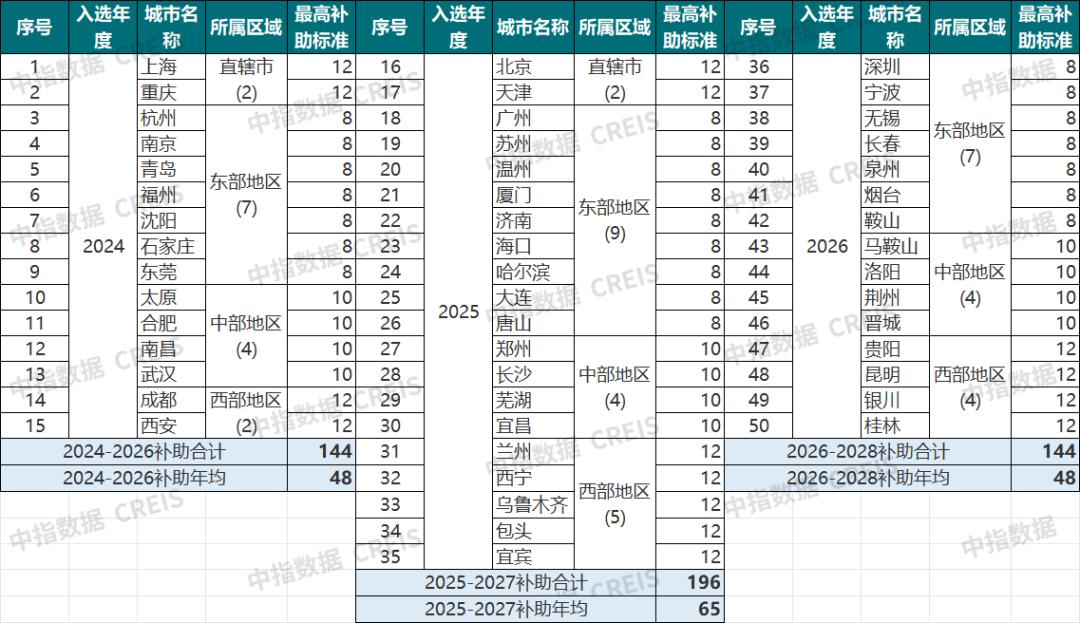
In 2024, the Ministry of Finance and the Ministry of Housing and Urban-Rural Development launched a selection mechanism for demonstration projects of the "Central Fiscal Support for Urban Regeneration Initiative", selecting cities through competitive selection to provide fixed subsidies, supporting cities to explore the establishment of sustainable urban regeneration mechanisms and shore up infrastructure weaknesses. By 2026, a total of 50 cities have been supported over three years, gradually forming a national demonstration pattern.
The subsidy standard stipulates that the total subsidy for each city in the eastern, central, and western regions shall not exceed 800 million yuan, 1 billion yuan, and 1.2 billion yuan respectively. Calculated based on the maximum subsidy standard for each city, the total three-year subsidy for 15 cities in 2024 is 144 billion yuan (northeastern cities follow the eastern region standard, the same below), the total three-year subsidy for 20 cities in 2025 is 196 billion yuan, and the total three-year subsidy for 15 cities in 2026 is 144 billion yuan. Calculated on an annual average basis, it is expected that 50 cities will receive more than 160 billion yuan in central fiscal subsidies in 2026.
Table: Summary of Central Fiscal Support for Urban Regeneration Initiative (100 Million Yuan)
Data Source: China Index Academy Comprehensive Compilation
(3) Ultra-Long-Term Special Treasury Bonds: 1.6 Trillion Yuan Allocated in 2026 to Support Urban Regeneration
Ultra-long-term special treasury bonds are an important tool for the central government to strengthen counter-cyclical regulation and support the "two key areas" (implementation of major national strategies and security capacity building in key fields). The urban regeneration sector (mainly through the construction and renovation of urban underground pipelines) has become one of the core support directions for the "two key areas" construction. Previously, the National Development and Reform Commission has clearly stated that 1.6 trillion yuan will be allocated in 2026 to support the construction and renovation of urban underground pipelines such as gas, drainage, water supply, and heating pipelines, accelerate the improvement of weaknesses in urban underground pipeline construction, and enhance urban disaster prevention, mitigation capabilities, and comprehensive carrying capacity.
Local Government Special-Purpose Bonds: Expected to Exceed 3500 Billion Yuan in 2026 for Urban Regeneration
Local government special-purpose bonds are a critical funding channel for local governments to support urban regeneration, featuring advantages such as large scale, financing accessibility, wide coverage, and low capital cost. The relevant investment directions for urban regeneration mainly include affordable housing projects, old urban community renovation, shantytown renovation, urban village renovation, affordable rental housing, and urban underground pipeline infrastructure construction. In 2024, regulatory authorities explicitly included qualified urban village renovation projects into the support scope of special-purpose bonds. At the end of the year, the General Office of the State Council issued Document No. 52 (Opinions on Optimizing and Improving the Management Mechanism of Local Government Special-Purpose Bonds), which clearly expanded the investment scope of special-purpose bonds and the scope of using them as project capital, with urban regeneration included.
Among the investment areas of new local government special-purpose bonds, the China Index Academy has focused on monitoring real estate-related fields, including affordable housing projects, affordable rental housing, shantytown renovation, old urban community renovation, land reserve, and other types. Through further detailed breakdown, the issuance of urban regeneration-related special-purpose bonds can be analyzed. According to incomplete statistics from the China Index Academy, the scale of urban regeneration-related special-purpose bonds exceeded 3500 billion yuan from 2024 to 2025. In the first half of 2026, urban regeneration-related special-purpose bonds exceeded 1800 billion yuan, a year-on-year decrease of about 14%. Among them, urban village renovation-related special-purpose bonds were close to 800 billion yuan, reaching 66% of the total of last year, with a year-on-year increase of 34%.
Among all provinces and municipalities, Beijing ranks first with about 380 billion yuan of urban regeneration-related special-purpose bonds issued; Shandong Province ranks second with over 220 billion yuan; Provinces such as Guangdong, Hebei, Henan, and Sichuan have issued more than 100 billion yuan.
Financial Credit Funds: China Development Bank Issued More Than 7800 Billion Yuan in Loans in 2025, Expected to Maintain Strong Support in the Future
In May 2025, at a press conference held by the State Council Information Office, the State Administration of Financial Regulation stated that it would study and introduce a special administrative measure for urban regeneration project loans, clarifying loan condition standards to meet the financial needs of urban regeneration initiatives. At the end of May this year, the 15th Five-Year Plan for Urban Regeneration was officially released, explicitly requiring to "give full play to the role of various financial institutions, guide financial institutions to provide financial services for urban regeneration projects within their business scope in accordance with market-oriented and legal principles, and refrain from adding new implicit local government debts. For projects with controllable risks, commercial sustainability, and meeting specified conditions, market-oriented models such as comprehensive development, syndicated loans, and project investment are allowed to provide support".
Financial credit funds are the largest source of social capital in the urban regeneration investment and financing system, mainly divided into two categories: policy-oriented finance (with the China Development Bank as the core) and commercial finance (commercial bank loans, etc.), which play an important "leverage driving" role for fiscal funds.
(1) Policy-Oriented Finance: China Development Bank as the Main Force, Issuing More Than 7800 Billion Yuan in Loans in 2025, Expected to Maintain Strong Support During the 15th Five-Year Plan Period
The China Development Bank is the absolute main force of policy-oriented financing in the urban regeneration sector. Relying on its positioning of "development-oriented finance" and the advantage of long-term low-interest funds, it provides systematic support for urban regeneration. Based on the eight main tasks of urban regeneration, the China Development Bank continues to increase medium and long-term investment and financing efforts. In 2025, the China Development Bank issued 7863 billion yuan in loans to the urban regeneration sector, focusing on supporting the renovation of old urban communities, as well as the renewal and transformation of old blocks, old factory areas, and urban villages.
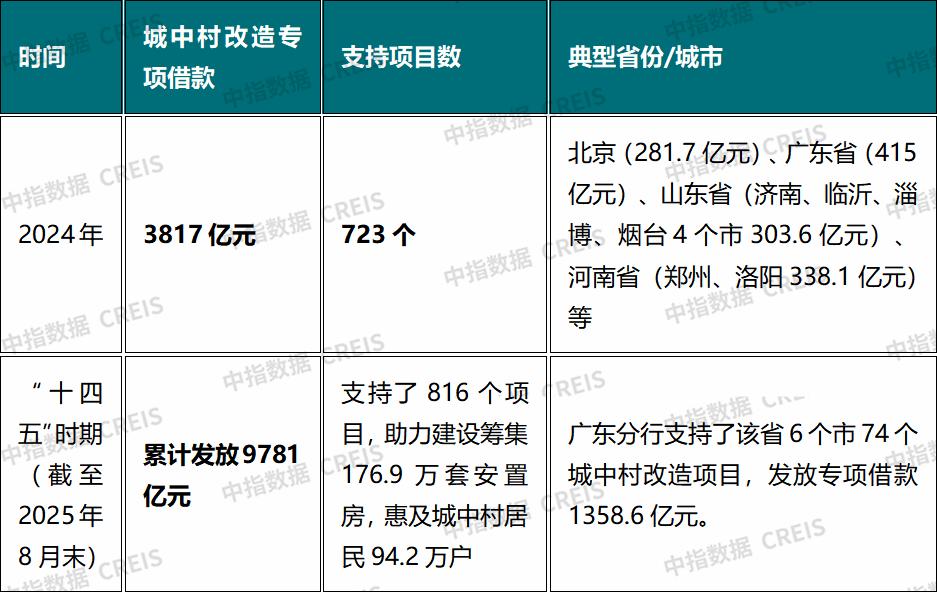
In 2023, the central government specially deployed the establishment of special loans for urban village renovation, and the China Development Bank undertook the main financing tasks. In 2024, the China Development Bank issued 3817 billion yuan in special loans for urban village renovation, supporting 723 projects. By the end of August 2025, the total special loans for urban village renovation issued during the 14th Five-Year Plan period reached 9781 billion yuan, supporting 816 projects. During the 15th Five-Year Plan period, the China Development Bank is expected to increase project development and reserve efforts, give full play to the role of a policy-oriented financial institution, and help promote high-quality urban regeneration.
Table: Overview of Special Loans for Urban Village Renovation Issued by the China Development Bank
Source: China Index Academy Comprehensive Compilation
Source: China Index Academy Comprehensive Compilation
The Agricultural Development Bank of China has simultaneously participated in the financing of urban village renovation and urban regeneration by using special loans for urban village renovation and urban-rural integration loans, but its overall scale is smaller than that of the China Development Bank, with a focus on promoting the citizenization of agricultural transfer population and the renovation of urban-rural fringe areas.
(2) Commercial Bank Credit: Gradually Forming Hierarchically Adapted Credit Products
In 2025, many state-owned large banks and joint-stock