On the Eve of Listing | Net Profit in Q1 Nearly Tripled the Full Figure of Last Year, A Shenzhen-based Storage Company Makes Another Attempt for Hong Kong Stock IPO
This article is approximately 3,100 words long and is recommended for 7 minutes of reading
Author | Peng Xiaoqiu
Editor's Note: The "Eve of Listing" column focuses on the critical moment when enterprises sprint to the capital market. Every prospectus hides the ambition, cycle, and hidden worries of an enterprise before its listing. This is the fifth issue – XTX.
On July 9, Shenzhen-based storage chip design company "XTX" submitted its application to the Hong Kong Stock Exchange for the second time. In fact, XTX had already submitted its prospectus on January 9 this year, but it became invalid six months later. This IPO is jointly sponsored by GF Securities and CITIC Securities.
Who is XTX? It is a fabless storage chip company founded in Shenzhen in 2014, focusing on code-type flash memory chips, namely NOR Flash and SLC NAND Flash. These chips are specially designed to store the code for device startup and operation, and are used in routers, sweeping robots, smart home devices, and industrial equipment. According to CIC's caliber, the company's revenue from code-type flash memory ranked fifth among global fabless enterprises in 2025.

Earning nearly three times the profit of last year's full year in a single quarter: Is it strength or the industry cycle?
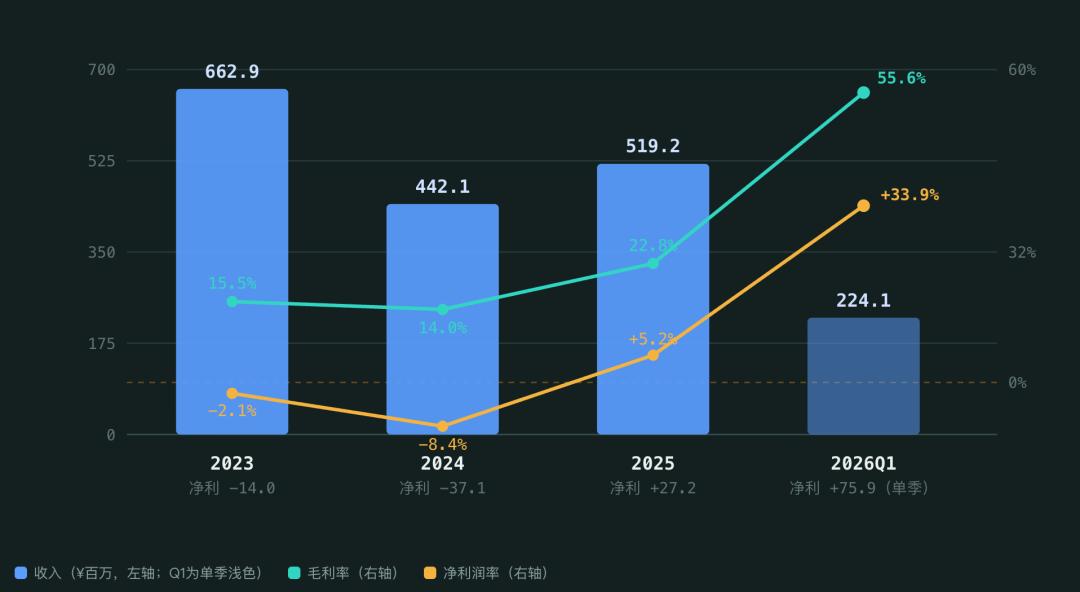
First, look at a set of staggering figures. In the first quarter of 2026, XTX recorded a revenue of 224 million yuan, a year-on-year increase of 77.4%; its net profit reached 75.889 million yuan, equivalent to 278.8% of the full-year net profit in 2025 (27.216 million yuan). The gross profit margin surged from 14.4% in the same period of the previous year to 55.6%, with a net profit margin of 33.9%.
The company earned nearly three times the full-year profit of last year in just one quarter, and its gross profit margin nearly quadrupled within a year. What kind of business can achieve this? The answer is: the industry cycle.
(Image source / Compiled by HardKr)
If we extend the timeline, this company is a typical storage cycle stock. The prospectus itself acknowledges that the flash memory chip industry usually follows a cycle of three to four years. XTX was profitable from 2019 to 2022 before the track record period; subsequently, the industry entered a downward phase, with a loss of 14.026 million yuan in 2023 and 37.136 million yuan in 2024; in 2025, the industry recovered, and the company turned around to make a profit of 27.216 million yuan; in the first quarter of 2026, the industry faced overall supply shortages, leading to an explosion in profits.
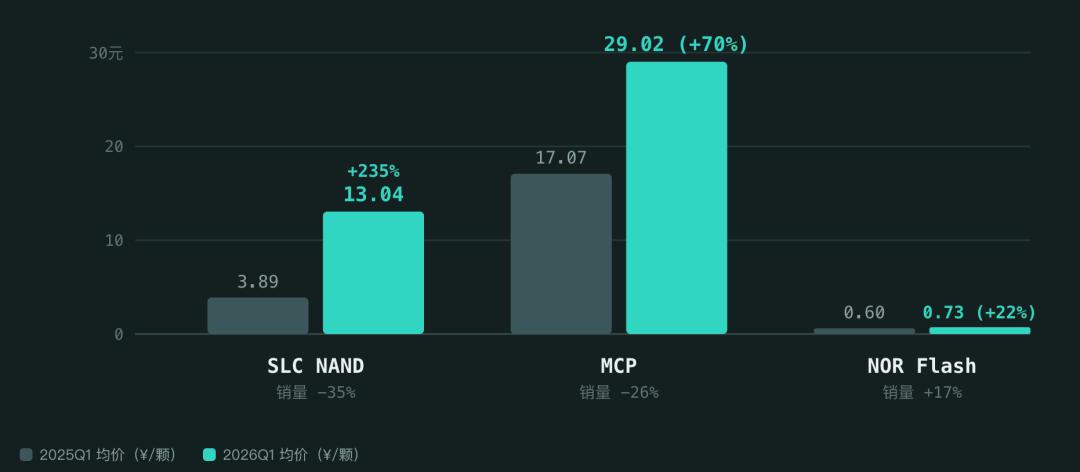
The driving force behind this profit surge is not higher sales volume, but higher selling prices. Let's break down the average selling prices:
(Image source / Compiled by HardKr)
SLC NAND Flash: The average price in 2026Q1 was 13.04 yuan per unit, compared with 3.89 yuan in the same period last year, an increase of 2.35 times. However, sales volume actually dropped from 17.468 million units to 11.461 million units;
MCP: The average price rose from 17.07 yuan to 29.02 yuan, an increase of 70%;
NOR Flash: The average price rose from 0.60 yuan to 0.73 yuan, an increase of 22%.
In other words, the huge profits in 2026Q1 are largely the result of SLC NAND's plummeting sales volume and skyrocketing prices. The prospectus shows that the improvement in profitability stems from tightening industry-wide supply that pushed up market pricing, coupled with a successful reserve strategy amid structural supply shortages. In plain terms, the industry faced shortages and price hikes, while XTX had stockpiled low-cost wafers.
Stockpiling is a very important strategy for this company. At the industry trough in 2023, it defied the trend and increased its wafer procurement volume by 45.5%, with the average wafer price that year dropping by about 29.9% compared to 2022. The cost was a net outflow of 192 million yuan in operating cash flow in 2023. As of March 31, 2026, its inventory reached as high as 424 million yuan, with inventory turnover days of 330, nearly a full year of inventory.
When market conditions improved, low-cost inventory became a money printer. In 2026Q1, the proportion of sales costs in revenue plummeted from 85.6% in the same period last year to 44.4%.
But the flip side of the coin is also stated in the prospectus. From 2023 to Q1 2026, the company recorded total inventory write-downs of 43.5 million yuan, 23.6 million yuan, 11.2 million yuan, and 3.4 million yuan, totaling approximately 81.7 million yuan.
The "tuition fee" from the wrong bet on the last round of stockpiling, and the losses in 2023 and 2024, were exactly the bills of the last round of industry downturn. For this cycle, the third-party forecasts cited in the prospectus are extremely optimistic: the global flash memory market will have a compound annual growth rate of 48.5% from 2025 to 2030, reaching 538.5 billion U.S. dollars in 2030.
Interestingly, despite a net loss of 37.14 million yuan in 2024, XTX declared dividends of 30.9 million yuan, and another 20.6 million yuan in 2025. The total dividends over the two years amounted to 51.5 million yuan, nearly twice the full-year net profit in 2025. According to the pre-IPO shareholding structure, Long Dongqing, the actual controller, controls approximately 62.3% of the voting rights directly and through concert party arrangements, meaning the majority of the dividends flow to the founding team.
In addition, XTX's R&D expenses dropped steadily from 85.222 million yuan in 2023 to 47.318 million yuan in 2025, with their proportion in revenue falling from 12.9% to 9.1%; the total number of R&D personnel was cut from 126 at the end of 2023 to 76 at the end of 2024, a decrease of 40%. The official explanation is to optimize marginal positions and temporarily reduce investment in power management and MCU products.
As of March 31, 2026, the company has only 165 full-time employees, 74 of whom are in R&D. However, the narrative in the prospectus talks about the dual-wheel drive of storage+ and AI+, as well as the layout of computing-in-memory (CIM) AI chips. In other words, the strategic narrative is adding new directions, while R&D investment is decreasing.
It is reported that this is not XTX's first attempt at an IPO. On April 28, 2022, the company submitted a listing application to the ChiNext Board of the Shenzhen Stock Exchange, and subsequently passed the review meeting of the ChiNext Listing Committee. Getting the approval was a sign of imminent success, but on December 30, 2023, the company voluntarily withdrew its application.
Why? The official reason given in the prospectus is that the approval process is expected to take a long time and involves uncertainties. But a subsequent disclosure is even more thought-provoking: on January 3, 2024, the Shenzhen Stock Exchange sent a letter to the company, pointing out that the forecast submitted by the company to the Shenzhen Stock Exchange in October 2022 stated that its 2022 revenue would be about 930 million yuan, with a net profit of 165 million to 185 million yuan.
However, the audited actual figures submitted in March 2023 showed revenue of 748 million yuan and a net profit of about 76 million yuan. The revenue was nearly 200 million yuan less than the forecast, a decrease of 20%; the net profit realized was less than half of the lower limit of the forecast, a decrease of more than 54%. The Shenzhen Stock Exchange urged XTX to ensure the accuracy of the information disclosed in its listing application documents.
According to a report by The Paper, the Shenzhen Stock Exchange imposed a written warning as a self-regulatory measure on the company, and the then-sponsor and accounting firm also received regulatory letters; the prospectus states that this was only a written reminder and is not considered an administrative penalty.
More subtly, this A-share past incident also hurt the business itself. When explaining the revenue decline in 2024 (from 663 million yuan in 2023 to 442 million yuan in 2024), the prospectus also pointed out that "our previous A-share listing application attracted market attention, after which sales volume experienced a temporary decline".

Seven years of stagnant valuation: State-owned capital that invested in 2018 cashed out entirely at par
2018 was the highlight year for XTX's financing. In August, the SZVC group (Shenzhen Venture Capital, Shenzhen Hongtu Xinghe, Shenzhen Luohu Hongtu), Ningbo HSG Zhisheng (Pu Xun, Managing Director of HSG China, has served as a non-executive director of the company since August 2018), and Jiaxing Danen collectively increased their capital by 169 million yuan; in November, Shanghai State Investment invested 150 million yuan in a single transaction, obtaining approximately 9.2% of the equity. Based on this calculation, the post-investment valuation was about 1.63 billion yuan.
Seven years have now passed, what is the pricing basis for Pre-IPO old share transfers in 2024-2025? The prospectus shows that it is about 1.62 billion to 1.67 billion yuan. For seven years, the valuation has hardly moved at all.
Thus, on the eve of the IPO, early institutional shareholders are lining up to cash out completely:
Shanghai State Investment: From September to November 2025, it transferred all of its shares to Tianjin Huatian, Shenzhen Xintongtong, and Qizhong Dingyuan in four transactions, at a price of 16.02 to 16.20 yuan per share, recovering a total of about 150 million yuan. It invested 150 million yuan seven years ago, and took back about 150 million yuan seven years later. Excluding capital costs, it exited almost at par on paper.
SZVC Group: Shenzhen Luohu Hongtu cashed out all its shares, transferring 1.7 million shares to Quhe Xinxin; Shenzhen Hongtu Xinghe and Shenzhen Venture Capital partially reduced their holdings.
Long Dongqing, the actual controller himself, also transferred 1.6 million shares to Tianjin Huatian in August 2025, cashing out about 25.6 million yuan.
The mysterious initial shareholder Ms. Shen Yue (who held 30% of the shares when the company was founded) transferred another 925,900 shares to Shenzhen Taikeyuan in October 2025, cashing out about 15 million yuan, and still holds 9.3% of the shares. The prospectus does not disclose her relationship with the actual controller.
Who is taking over these shares? The largest buyer is Tianjin Huatian – Huatian Technology, a major A-share packaging and testing enterprise. It directly acquired 2.7% of the shares, and then obtained another 7.4% through Shenzhen Xingangtong (Huatian contributed 99.19% of the capital, while the GP controlled by Long Dongqing accounts for 0.81%), totaling about 10%. Huatian is precisely the controller of one of XTX's top five suppliers. A supplier taking a deep stake in its client creates a two-way dynamic of industrial synergy and interest alignment. The remaining buyers are funds under Jiangxi Financial Control, electronic component trader Taikeyuan, and several partnerships newly established in 2025.
The prospectus discloses that the per-share cost of the above Pre-IPO transactions is at a 70.33% to 70.66% discount to the median of the proposed issue price. In other words, the company's proposed issue valuation is about 3.4 times the 16 yuan per share transfer price of this batch of transactions, and more than 3 times the private equity valuation that has not increased for seven years. This also stems from the profit statement of the first quarter of 2026, which was ignited by the price surge in the storage industry.
It is worth mentioning that HSG's Ningbo HSG Zhisheng did not sell a single share, still holding 9.6% of the shares and remaining the largest institutional shareholder.
Long Dongqing, Chairman and General Manager of XTX, is 49 years old. He graduated from Fudan University with a bachelor's degree in Electronics and Information Systems in 1999, and just obtained a Master of Business Administration degree from Tsinghua University in June 2025. His resume is that of a standard veteran of foreign semiconductor companies: he worked as a design engineer at Renesas, in product marketing at STMicroelectronics (2003-2010), and as China Channel Manager at Freescale (2008-2010). In fact, his core expertise lies in marketing and channels, not front-end chip design.
Wang Bin, Deputy General Manager, is 46 years old, with a bachelor's degree in Electronic Information from Central South University, and has been engaged in sales at STMicroelectronics, Freescale, and Dolby successively; Ai Kanglin, Deputy General Manager, is