On the Eve of Listing | The Owner of "Pleasant Goat" Makes Second Attempt for Hong Kong IPO, Aulton New Energy Lost 1.47 Billion in Nearly Three and a Half Years
This article is approximately 2,800 words long and is recommended to be read in 6 minutes
Author | PENG Xiaoqiu
Editor's Note: The Listing Eve column focuses on the critical moment when enterprises sprint toward the capital market. Every prospectus conceals the ambition, cycles, and hidden worries of an enterprise before its IPO. This is the seventh issue — Aulton New Energy.
On July 19, Aulton New Energy once again submitted a listing application to the Main Board of the Hong Kong Stock Exchange, with China Merchants Bank International as its exclusive sponsor. In fact, this marks the second time Aulton New Energy has filed an application; the first submission was made on December 12, 2025, but lapsed after six months without passing the hearing.
What's notable is the company's actual controller — CAI Dongqing, Chairman and General Manager of Aulton New Energy. The 57-year-old founded Alpha Group (002292.SZ) in 1997 and has served as its Chairman and General Manager ever since. Alpha Group produced the animated series Pleasant Goat and Big Big Wolf. In June 2016, he co-founded Aulton New Energy with ZHANG Jianping, a veteran in battery swap technology, plunging into the capital-intensive electric vehicle battery swap track.
Ten years on, from 2023 to the first four months of 2026, Aulton New Energy recorded a total net loss of approximately 1.47 billion yuan; its revenue plummeted from 1.155 billion yuan in 2023 to 677 million yuan in 2025, nearly halving. After completing its last round of financing in early 2022, no new capital has entered the company for four consecutive years.

Revenue Declined for Three Straight Years, "Losing Money on Every Deal" for Three Consecutive Years
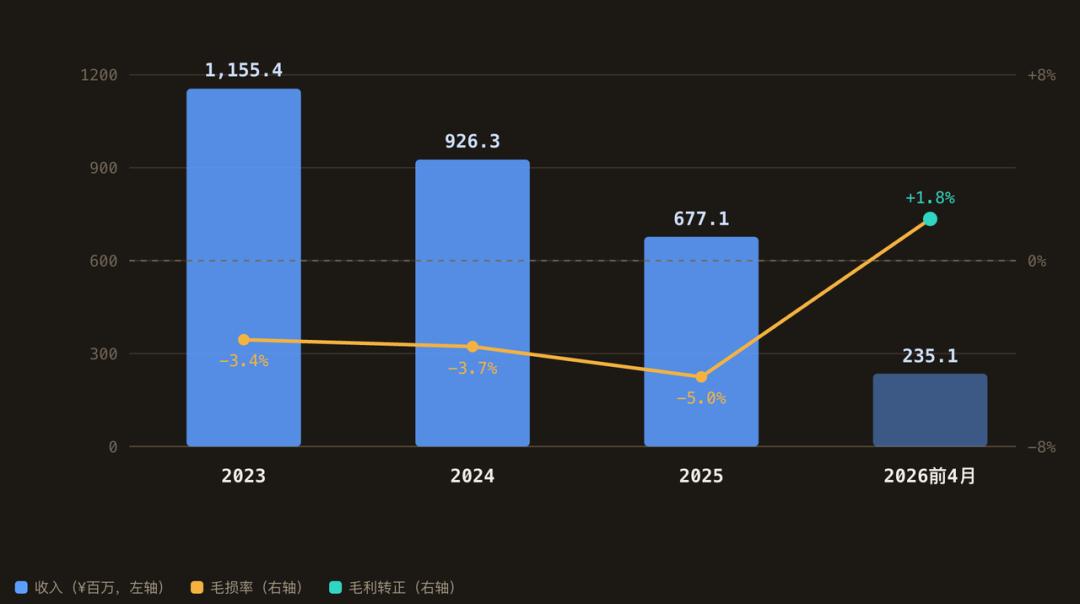
In terms of performance, Aulton's revenue reached 1.155 billion yuan, 926 million yuan, and 677 million yuan respectively from 2023 to 2025, with year-on-year declines worsening each year: 19.8% in 2024 and 26.9% in 2025. Over three years, its revenue shrank by 41.4%.
(Image source / Arranged by 36Kr Hardcore)
A company that claims in its prospectus to be a "mature player in China's battery swap industry" and ranks third in China by revenue from battery swap station operation services is witnessing its core business visibly shrink.
Even more striking than the revenue decline is its gross margin, which remained negative for all three years. From 2023 to 2025, Aulton recorded gross profits of -39.854 million yuan, -34.102 million yuan, and -33.893 million yuan respectively, with gross margins of -3.4%, -3.7%, and -5.0%. In plain terms, for every 100 yuan of revenue generated, the direct costs alone amounted to 103 to 105 yuan — not including sales, administrative, and R&D expenses. This means the business, where more sales translate to greater losses, has been operating at a loss for three years.
It posted a net loss of 655 million yuan in 2023, 419 million yuan in 2024, 307 million yuan in 2025, and a further loss of 91.432 million yuan in the first four months of 2026, totaling approximately 1.473 billion yuan in losses.
The net loss narrowing from 655 million yuan to 307 million yuan may seem like an improvement, but breaking down the 655 million yuan loss in 2023 reveals that 281 million yuan came from changes in the book value of redeemable liabilities — essentially the fair value fluctuation of the redemption rights held by Pre-IPO investors. This item still accounted for 121 million yuan in 2024. On May 28, 2024, the relevant redemption rights were terminated per a termination agreement, and this item was subsequently written down to zero.
In other words, the significant narrowing of losses from the 650 million yuan level to the 300 million yuan level is largely an accounting result stemming from the elimination of non-cash items after the termination of the valuation adjustment mechanism terms.
The company's self-reported adjusted loss (calculated under non-IFRS standards, excluding changes in redeemable liabilities and share-based payments) reflects its true operating performance. From 2023 to 2025, the adjusted losses amounted to 370 million yuan, 290 million yuan, and 281 million yuan respectively, corresponding to adjusted loss rates of -32.0%, -31.3%, and -41.4%, with 2025 actually marking the worst performance among the three years. In the first four months of 2026, the adjusted loss reached 73.065 million yuan, with a loss rate of -31.1%. In summary, the real operating loss rate under the adjusted metric has consistently hovered around 30% with no substantial improvement.
Aulton's revenue is divided into two main segments:
Self-operated Battery Swap Station Services, which accounted for 64.3% of revenue in 2025. This segment involves building its own stations and charging taxi and ride-hailing drivers for battery swaps. It is the hardest-hit area for losses, with gross margins of -16.2%, -20.1%, and -21.4% from 2023 to 2025, and still at -18.6% in the first four months of 2026. This means for every battery swap a driver performs, Aulton subsidizes roughly 20% of the cost.
Battery Swap Operation Solutions, which refers to selling battery swap stations to local urban investment companies and energy firms, selling battery swap modules to automakers and battery manufacturers, plus providing contracted operation services. This segment generates positive gross margins, with operating service gross margin reaching 62.0% in 2025. However, the gross margin from equipment sales stood at only 8.6%, rising to 17.9% in the first four months of 2026. The problem is that equipment sales revenue collapsed from 519 million yuan in 2023 to 150 million yuan in 2025, plummeting by 70%.
Notably, since 2024, third-party station investors and automakers have comprehensively tightened their capital expenditures. This has led to a set of the most revealing operational data in the prospectus:
Self-operated stations are shrinking. There were 321 stations at the end of 2023, dropping to 291 in 2024, further down to 236 in 2025, and 214 by the end of April 2026, resulting in a net closure of 107 stations over more than three years;
The number of break-even stations is decreasing. Among self-operated stations, 57, 53, and 38 achieved break-even status respectively from 2023 to 2025. In 2025, out of the 236 stations, approximately 84% were operating at a loss;
Battery swap prices are declining. The actual rate per battery swap dropped from 34.2 yuan in 2023 to 22.7 yuan in the first four months of 2026, representing a 34% decrease. As stated in the prospectus, this is due to both promotional offers to attract new users and reduced power delivery per swap caused by battery aging;
Factories are underutilized. The utilization rate of battery swap station production lines fell from 57.9% in 2023 to 9.2% in the first four months of 2026, while the corresponding utilization rate for battery swap modules dropped from 77.4% to 17.5%;
R&D spending has been cut in half. R&D expenditure was slashed from 76.36 million yuan in 2023 to 37 million yuan in 2025. Among the 1,149 employees, the R&D and digitalization teams have only 58 people, accounting for 5% of the total workforce, while 949 are battery swap station operation staff, making up 82.6%. A company that claims to be technology-oriented has fewer R&D personnel than the combined number of sales and administrative staff.
In the first four months of 2026, Aulton finally recorded a gross profit of 4.12 million yuan with a gross margin of 1.8%, and its operating cash flow turned positive at 10.873 million yuan. However, a closer look reveals that its self-operated stations still posted a gross loss of 23.703 million yuan during this period; the positive turnaround was driven by a surge in equipment sales revenue of 828.218 million yuan, which nearly doubled year-on-year, as well as cost savings from station closures. Net loss for the period still reached 91.432 million yuan.
(Image source / Arranged by 36Kr Hardcore)
The prospectus also disclosed that a net loss is still expected for the full year 2026. What is rather striking is that according to third-party data, as of the end of 2025, among more than ten comparable players in China's battery swap industry, none have achieved company-level break-even or sustained profitability.
By revenue from battery swap station operation services in 2025, Aulton ranks third in China, with approximately 502 million yuan (including the caliber of operation services + self-operated station battery swap revenue).
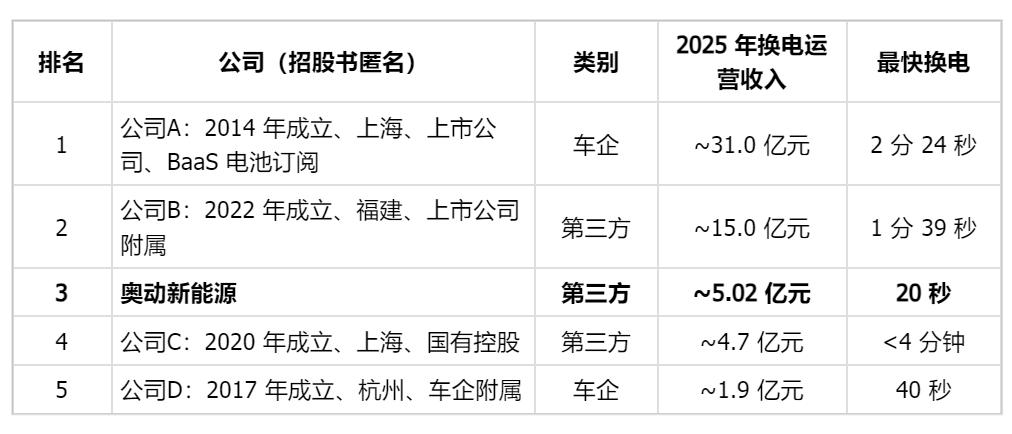
(Company A and B are inferred to be the battery swap platforms under NIO and CATL respectively)
As shown in the chart, the top-ranked player's revenue is six times that of Aulton, while the second-ranked player, established only in 2022, achieved three times Aulton's revenue within three years. Aulton's advantage lies in its 20-second ultra-fast battery swap, the fastest in the entire industry. However, speed did not translate into scale. The total market size of the industry expanded from 1.5 billion yuan in 2020 to 18.5 billion yuan in 2025, and is expected to reach 76.5 billion yuan by 2030, representing an 11-fold growth of the market pie in five years. Yet Aulton's revenue has moved in the opposite direction during the same period.

Financing Story: 8 Rounds of Financing Totaling 2.95 Billion Yuan, NIO Capital as the Earliest Investor
From 2018 to 2022, Aulton completed eight rounds of financing, totaling approximately 2.946 billion yuan.
Pre-A Round (April 2018): NIO Capital (Hubei Jiahu) invested exclusively 250 million yuan at 7.33 yuan per registered capital share, giving a post-money valuation of approximately 4.5 billion yuan;
Series A (Settled in March 2019): NIO Capital added 150 million yuan at 8.14 yuan per share, with a post-money valuation of approximately 5.6 billion yuan;
Series A+/A++ (2020-2021): Investors including Guangzhou Jinxian, Fujian Aoxing, TERRAS, Huakes, and Fujian Aoying entered the market, all at 8.14 yuan per share, with a total investment of approximately 890 million yuan;
Series B/B+/B++ (Second Half of 2021): Guangjin Kaide (under Guangzhou Financial Holdings) led the investment with a single 600 million yuan contribution, followed by Enze Haihe (backed by Sinopec Enze Fund) with 250 million yuan, Guangzhou Chuangdongke with 200 million yuan, and Samsung SVIC38 as participants. The investment was priced at 12.14 yuan per share, with a post-Series B valuation of approximately 11 billion yuan;
Series B+++ (January 2022): Shanghai Changlian, Guangzhou Yaoying, and other investors contributed a total of 235 million yuan at 12.55 yuan per share, resulting in a post-money valuation of approximately 11.9 billion yuan.
What is thought-provoking is that firstly, NIO Capital invested in a "rival to NIO". NIO itself is the biggest proponent of the battery swap model, yet NIO-affiliated capital bet on Aulton, a third-party battery swap player, at the lowest cost (7.33 yuan per share) back in 2018, and still holds 5.53% of the shares as the third-largest shareholder to this day.
Secondly, state-owned capital became the main force in the second half of the financing relay. Investors who entered after 2021, such as Guangjin Kaide (managed by Guangzhou Financial Holdings), Enze Haihe, and Guangxi Yesheng, have strong ties to Guangdong province and local state-owned assets, forming a subtle echo with Aulton's customer structure of "selling battery swap stations to local urban investment companies and energy firms".
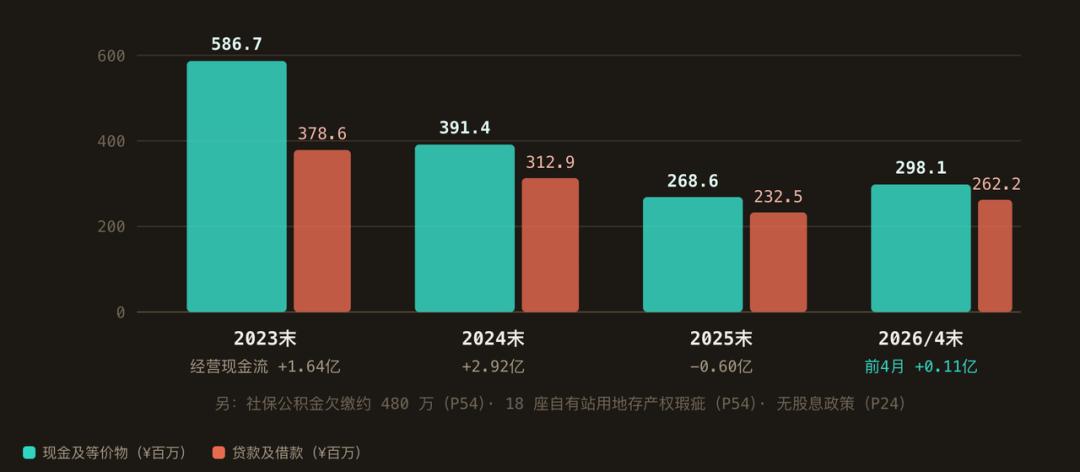
Finally, after January 2022, Aulton did not conduct any new financing for four years. The prospectus shows that its cash and cash equivalents were depleted from 634 million yuan at the beginning of 2023 to 269 million yuan at the end of 2025, with operating cash flow reaching -60.344 million yuan in 2025;
As of the end of April 2026, the company had 298 million yuan in cash on its books, while its loans and other borrowings stood at 262 million yuan, net current liabilities at