Zhipu's stock price plummeted by 40% in two days, and Kimi K3 became the "scapegoat"?
On July 20, the share prices of the two "large model dual giants" on the Hong Kong Stock Exchange, Zhipu (2513.HK) and MINIMAX (0100.HK), remained under pressure, marking the second consecutive trading day of sharp declines.
By market close, Zhipu's share price fell 19.56% to HK$890.50 per share, breaking through the two key integer levels of HK$1,000 and HK$900 in a single day, bringing its total market capitalization down to HK$414.6 billion. MINIMAX's share price dropped 10.60% to HK$193.10 per share, hitting an intraday low of HK$191 per share, a new record low since its listing, and the company's total market capitalization also fell to HK$67.4 billion.
This round of share price declines for Zhipu and MINIMAX started last Friday. On July 17, the two companies saw their share prices plummet by 28.49% and 15.63% respectively in a single trading day. Over these two trading days, Zhipu and MINIMAX have posted cumulative declines of 42.47% and 24.57% respectively.
This slump in Zhipu and MINIMAX's share prices coincided with Moonshot AI, another member of the "Six AI Emerging Players", releasing its latest flagship large model Kimi K3. Launched in the early hours of July 17, this model boasts a total of 2.8 trillion parameters and a 1 million-token context window, primarily designed for scenarios such as long-range programming, knowledge work, and reasoning.
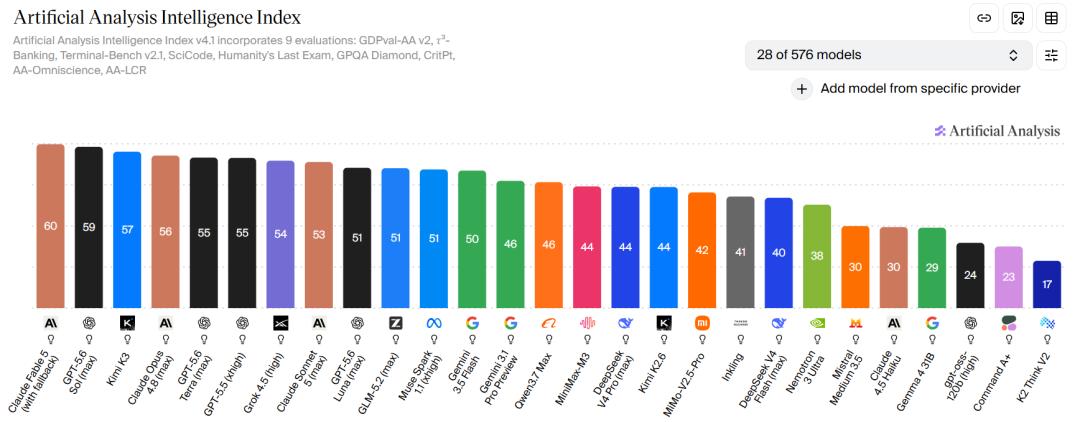
Shortly after its release, Kimi K3 quickly became a hot topic in the global AI community. According to scores from the third-party institution Artificial Analysis, Kimi K3 achieved a composite intelligence index of 57 points, ranking just below Claude Fable 5 and GPT-5.6 Sol, and outperforming a host of other large models including Grok 4.5 and GLM-5.2. In the Code Arena ranking, Kimi K3 even claimed the top spot with a score of 1679.
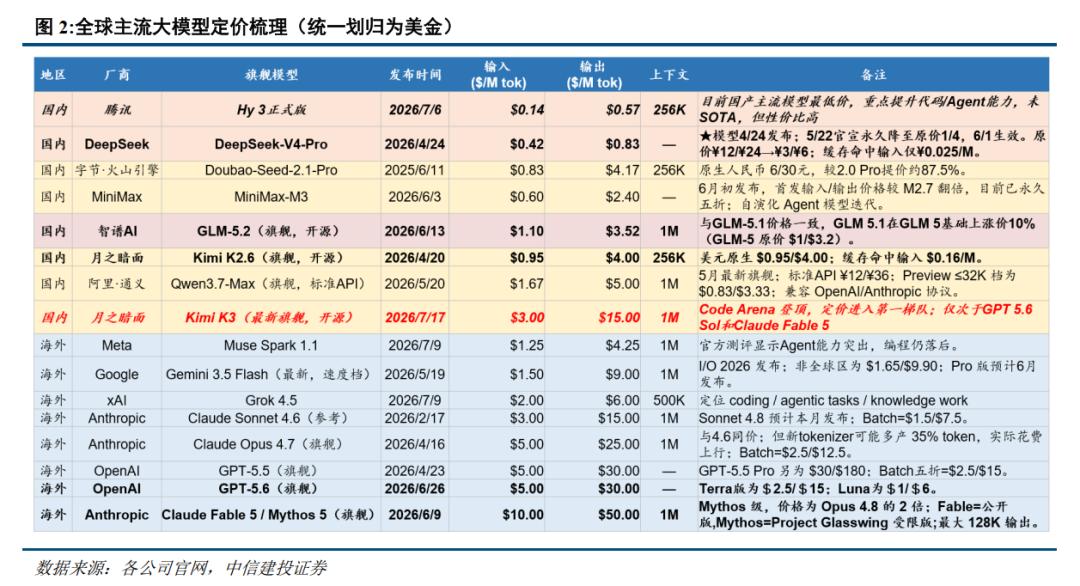
In terms of pricing, Kimi K3 charges $3 per million tokens for input and $15 per million tokens for output. While this price is higher than that of leading domestic large models such as GLM-5.2 and MiniMax M3, it still holds a cost advantage compared to top global large models like Claude Fable 5 and GPT-5.6.
With Kimi K3 delivering outstanding overall performance, many market observers conclude that this round of correction in Zhipu and MINIMAX's share prices is directly caused by the impact of this new model.
So, is Kimi K3 the direct trigger for the sharp drop in its peers' share prices, or is it merely being made a scapegoat for the market downturn?
Kimi as the "Scapegoat"
Just a month ago, Zhipu launched its highly anticipated GLM-5.2 large model, which scored an impressive 51 points in the Artificial Analysis ranking and topped the list among domestic large models. A month later, Moonshot AI's brand-new Kimi K3 large model made a stunning debut, quickly capturing the market's attention with its higher scores.
However, the gap in ranking scores does not mean that GLM-5.2 is comprehensively outperformed by Kimi K3 in overall strength, let alone that Zhipu's existing market share will be significantly eroded by Moonshot AI.
In terms of model positioning, Kimi K3 and GLM-5.2 are relatively similar. Both models support a 1 million-token context window and emphasize capabilities such as coding, complex reasoning, and agent tasks.
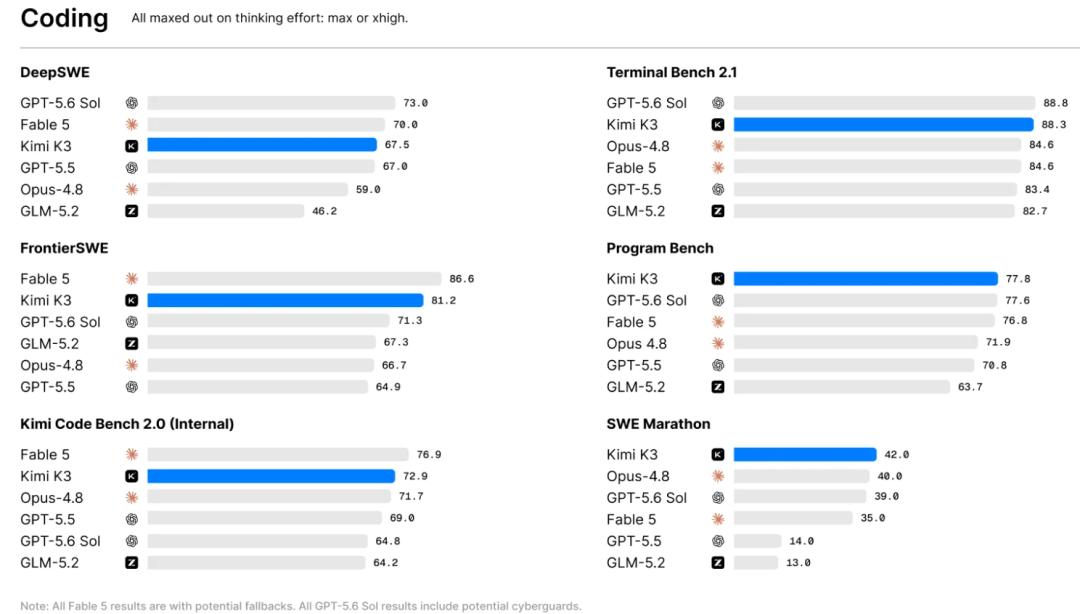
Coding capability is a key strength that both large models highlight, and in this dimension, Kimi K3's ranking is significantly higher than that of GLM-5.2. According to Moonshot AI's official website, Kimi K3 demonstrates exceptional coding performance, leading GLM-5.2 in multiple evaluation benchmarks. On the Program Bench project, which assesses the software engineering capability to fully reconstruct a software system from scratch, Kimi K3 scored 77.8, even surpassing the two global top models Claude Fable 5 and GPT-5.6 Sol.
Nevertheless, behind Kimi K3's formidable capabilities comes higher requirements for localized deployment. As Kimi K3 is an ultra-large model with 2.8 trillion parameters, running it requires massive computing power support.
Kimi's official documentation states that the inference efficiency of large-scale models benefits from a larger high-bandwidth communication domain, so it is recommended to deploy Kimi K3 in a super-node environment with 64 or more accelerator cards. According to evaluations from some tech bloggers, the minimum configuration for GLM-5.2 to achieve 1M context capability is a server equipped with 8 B200 chips.
Kimi K3's token pricing is also higher than that of GLM-5.2: Kimi K3 charges $3 per million tokens for input and $15 per million tokens for output, while GLM-5.2's input and output costs are $1.10 and $3.52 per million tokens respectively.
The differentiated positioning of the two large models in terms of performance and pricing aligns well with the business models of the two companies.
Public information shows that by mid-June this year, Moonshot AI's ARR (Annual Recurring Revenue) had exceeded $300 million, with its revenue mainly coming from developer usage and API (Application Programming Interface) income. Although Kimi K3's token pricing is relatively high, its strong coding performance can deliver significant improvements in development efficiency, allowing it to gain a competitive edge in the market.
In contrast, Zhipu primarily targets the B2G (enterprise and government) market, with most of its revenue coming from localized deployment services. In 2025, Zhipu's total revenue reached 724 million yuan, of which localized deployment revenue accounted for 534 million yuan, approximately 73.7% of the total.
For enterprise and government clients, GLM-5.2 strikes a good balance between performance and localized deployment costs. Coupled with Zhipu's continuous efforts in recent years to advance domestic computing power adaptation and build an enterprise-government ecosystem, the company has been able to maintain its competitiveness in the B2G market.
In summary, Zhipu and Moonshot AI target different markets, and Kimi K3's current performance advantages are unlikely to shake Zhipu's competitiveness in the B2G market. From this perspective, Moonshot AI and Kimi K3 may not be the "culprits" behind Zhipu's share price decline.
Why Zhipu's Share Price Plunged
Zhipu and MINIMAX, both members of the "Six AI Emerging Players", were listed on the Hong Kong Stock Exchange in January this year. However, after going public, their share price trends have been completely different.
MINIMAX hit its market capitalization peak as early as March this year, when its share price reached a maximum of HK$1,330 per share, with a peak market capitalization of HK$410 billion. Since then, the company's share price has been on a continuous downward trajectory, and now it has dropped by more than 80% from its peak, with its total market value shrinking by nearly HK$350 billion.
In comparison, Zhipu's share price peak came later, but the subsequent correction was far more drastic. After its listing, Zhipu's share price kept rising, reaching an intraday high of HK$2,980 per share on June 22, with a peak market capitalization of HK$1.3 trillion. The share price then quickly retreated, losing 70% from its peak in less than a month, wiping out nearly HK$900 billion in total market value.
The sharp decline in Zhipu's share price may stem from a combination of multiple factors.
From an internal perspective, Zhipu's market uniqueness is gradually eroding. As the "world's first publicly traded large model company", Zhipu used to be one of the top choices for investors looking to invest in Chinese large models in the capital market. However, as Moonshot AI reveals its IPO plans, a strong new competitor will enter the large model track. Some capital may choose to reduce their holdings of assets like Zhipu to free up funds and position themselves in advance for Moonshot AI's IPO.
Public information indicates that Moonshot AI has already begun preparations for a Hong Kong listing, having sent listing proposals to investors, with an expected completion of the listing process as early as within six months. Benefiting from the continuous improvement of Kimi's large model capabilities, Moonshot AI's valuation has kept rising, and in its latest financing round, the company's pre-money valuation has reached $31.5 billion.
In addition, Zhipu's share price had risen too sharply in the early stage, and with the overall market correction, the company's share price is facing significant downward pressure.
As a leading publicly traded domestic large model enterprise, Zhipu has posted a substantial cumulative increase in its share price since listing. At the share price peak in June, the company's TTM price-to-sales ratio had exceeded 1,000x. In July this year, the company saw the lifting of its first batch of restricted shares, with the unlocked shares accounting for approximately 5.76% of the total share capital. Although many early shareholders have pledged to hold the company's shares for the long term, there remains considerable selling pressure in the market.
At the same time, the overheating of the global AI computing power industry chain has also raised market concerns. The renowned investor Warren Buffett previously stated in an interview that the current US stock market is increasingly dominated by short-term speculative trading rather than long-term investment.
Since July, the global AI computing power industry chain has undergone a deep correction. Taking the A-share market as an example, the Sci-Tech Innovation 50 Index has fallen by a cumulative 22.16% since July, and related indices for semiconductors, memory, and chips have also dropped by between 25% and 30%. Zhipu's share price has likely been affected by this broader industry-wide correction as well.
This article is from the WeChat Official Account "Damo Finance" (ID: damofinance), written by Damo Finance, and published with authorization from 36Kr.