Parents decide everything, and AI thinks for everything: One in five children is giving up their right to think.
A survey of 8,563 primary and secondary school students across 7 provinces and municipalities conducted by the China Youth & Children Research Center shows that 61.7% have used generative AI, 20.5% admitted they would prefer to rely on AI for thinking, and over 20% only want to chat with AI. When homework, emotional venting, and even romantic interactions shift to AI, children may be ceding more than just their ability to think.
From Smartphones to AI: This "Ceding of Autonomy" Has Escalated
Ten years ago, American psychologist Jean Twenge put forward a judgment in *iGen*: the generation raised on smartphones goes out less, dates less, and makes independent decisions less often, with "18-year-olds behaving like 15-year-olds in previous eras".
At the time, she attributed the cause to screens. Looking back now, that was only an appetizer — smartphones weakened adolescents' autonomy in real-world social interactions, while generative AI directly penetrates their thought processes.
The survey from the China Youth & Children Research Center quantifies this trend into concrete figures. From May to July 2025, the team led by Sun Hongyan collected 8,563 valid questionnaires across 7 provinces and municipalities: Beijing, Guangdong, Jiangsu, Henan, Sichuan, Shaanxi, and Liaoning.
When several sets of data are viewed together, their impact is striking.
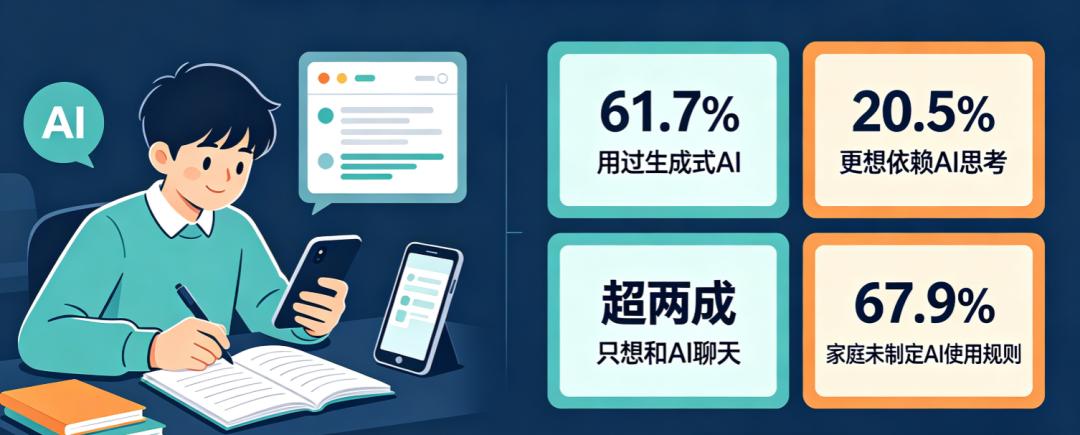
Adoption is already widespread: 61.7% of the surveyed students have used generative AI, with 18.3% using it frequently; assisting with homework is the primary use case, accounting for 71.0% of usage. The usage rate among high school students is 69.5%, higher than the 56.1% rate among junior high school students.
Thinking is being outsourced: 20.5% of students stated they "prefer to rely on AI to think instead of thinking on their own", with the figure reaching 22.8% among rural students, higher than the 17.7% rate among urban students; more than 10% of students fully trust the content provided by AI.
Relationships are also shifting: nearly half of the children choose to turn to AI rather than people around them when they have troubles, and over 20% of students "only want to chat with AI, not with real people".
Family supervision is almost absent: 67.9% of families have not established rules for AI usage, and the proportion of rural parents who "do not supervise at all" is 20.3%, higher than the 15.6% rate among urban parents.
Risks have become visible: 47.4% of respondents are worried about privacy leaks, 34.6% have encountered incorrect information provided by AI, and 21.0% feel anxious due to excessive AI usage.
Mechanism Breakdown: Why AI Is More Dangerous Than Smartphones
Smartphones and AI erode childhood through two distinct paths. Wu Xuan from Zhejiang Gongshang University used sociologist Alfred Schutz's framework to explain this clearly: humans understand the world by centering on the "self" and expanding outward from close to distant. The innermost circle is the "world around us" composed of family, peers, and school, with outer circles sequentially being the world of others, the world of predecessors, and the future world.
In traditional growth, children first navigate the world around them: they practice relational skills through misunderstandings, conflicts, and reconciliations. These experiences are clumsy, slow, and full of friction, yet they form the foundation of cognitive and emotional development.
The problem with AI is that it allows 10-year-old children to easily access the distant world — asking about history, discussing the future, simulating careers, and obtaining emotional advice. Their ability to perceive the distant world is enhanced, while their patience for perceiving the world around them declines. This gives rise to two risk paths.
The first path is relationship substitution. Discussions about homework are replaced by asking AI for answers, seeking help from teachers is replaced by AI queries, and conflicts between friends are covered by AI-generated lines. Every instance of substitution reduces children's opportunities to practice real-world interactions.
The second path is maladaptive relationship learning, which is the real "technical core" of this analysis: AI centers on user needs and is accustomed to giving affirmation, comfort, and instant responses. For adults, this is a product interaction method; for children whose values are not yet fully formed, this may become their template for understanding "relationships".

The consequences of this catering loop are very specific: long-term immersion in highly compliant responses may make it harder for children to accept rejection, more prone to excessively seeking approval, and more likely to amplify negative emotions. A 2026 paper in *The Lancet Child & Adolescent Health* also points to the same conclusion: interactive AI may alter adolescents' relationship learning patterns and mental health trajectories.
What requires the most vigilance is that risks are concentrated in groups that already lack support: children with mental health issues, those in rural areas, those with insufficient family companionship, and those with weak peer support. For them, AI dependence is more of a signal of insufficient real-world support than a simple problem of technology usage.
Regulatory Boundaries Are Being Drawn, But Solutions Extend Beyond Regulation
Looking at the global landscape, legislation targeting "AI companions" is being intensively implemented, driven by a series of real tragedies.
In 2024, 14-year-old Sewell from Florida committed suicide after long-term addiction to Character.AI, which was called "the world's first death case caused by an AI robot"; in August 2025, 16-year-old Adam Rain committed suicide after prolonged interaction with ChatGPT, and his parents sued OpenAI and Sam Altman; internal documents leaked by Meta showed that its chatbots were allowed to engage in "romantic" and even "sexual" conversations with minors.
In October 2025, California signed the nation's first AI companion chatbot bill, SB-243, which took effect on January 1, 2026: mandatory age verification; a reminder every three hours telling minor users "you are talking to AI" and advising them to take a break; a ban on discussing suicide, self-harm, and pornographic topics with minors; a ban on impersonating medical professionals; a maximum fine of $250,000 per illegal deepfake made for profit; users can also directly file civil lawsuits.
In China, five departments including the Cyberspace Administration of China announced the *Interim Measures for the Administration of Artificial Intelligence Anthropomorphic Interactive Services* in April 2026: it is prohibited to provide virtual intimate relationship services such as virtual relatives and virtual partners to minors; providing other anthropomorphic interactive services to minors under the age of 14 must obtain the consent of their guardians; in principle, user interaction data and sensitive personal information shall not be used for model training. The EU's *AI Act* and the UK's Age Appropriate Design Code have also drawn similar red lines within their respective regulatory systems.
Beyond regulation, the practical suggestions provided for families and schools in the original content are worth retaining: parents should replace bans with inquisitive questions — "If you couldn't use AI, how would you express this?" "Is it possible that the AI's answer is wrong?"; schools should implement AI literacy in stages across different school levels: establishing usage boundaries in primary school, teaching information discernment in junior high school, and fostering responsibility awareness in high school, while taking collective campus life as a practice ground for real relationships.
A reasonable projection is that the AI companion industry is in a period of expansion, and minor protection will become the next intensive regulatory area, with product boundaries between "learning assistants" and "emotional companions" being repeatedly clarified. Ultimately, all regulatory provisions point to one thing — return real life to children. In real life, there are people who will misunderstand, argue, and make up, and there is growth that AI can never replace.
This article is from the WeChat official account "AI Contrarian", written by Bai Ke, and published by 36Kr with authorization.