The 70 Billion Dollar American World Cup: A Textbook Tournament Operations Manual
If we had not witnessed the scenes of the FIFA World Cup 2026 in the United States, Canada and Mexico through TV broadcasts and social media, it would be hard for us as Chinese people to imagine that this global sporting event could spark such intense consumer frenzy. It is no wonder that FIFA has shown such a high level of "cooperation" with the host country, the United States.
First and foremost, we must mention the enthusiasm of the fans at the scene. On the day of the final, the stadium was still shrouded in wildfire haze drifting from Canada, and multiple cities in the U.S. ranked as the world's most polluted cities that day. Even so, the New York/New Jersey MetLife Stadium was packed to capacity with 80,000 fans. The stands were graced by tennis stars such as Carlos Alcaraz and Serena Williams, alongside Donald Trump and FIFA President Gianni Infantino watching the match side by side. In the 48 hours leading up to the final, the lowest resale ticket price on the secondary market was $9,753, with the most expensive scalped ticket reaching as high as $69,786. On FIFA's official resale platform, a hospitality package was even listed for nearly $2.3 million.
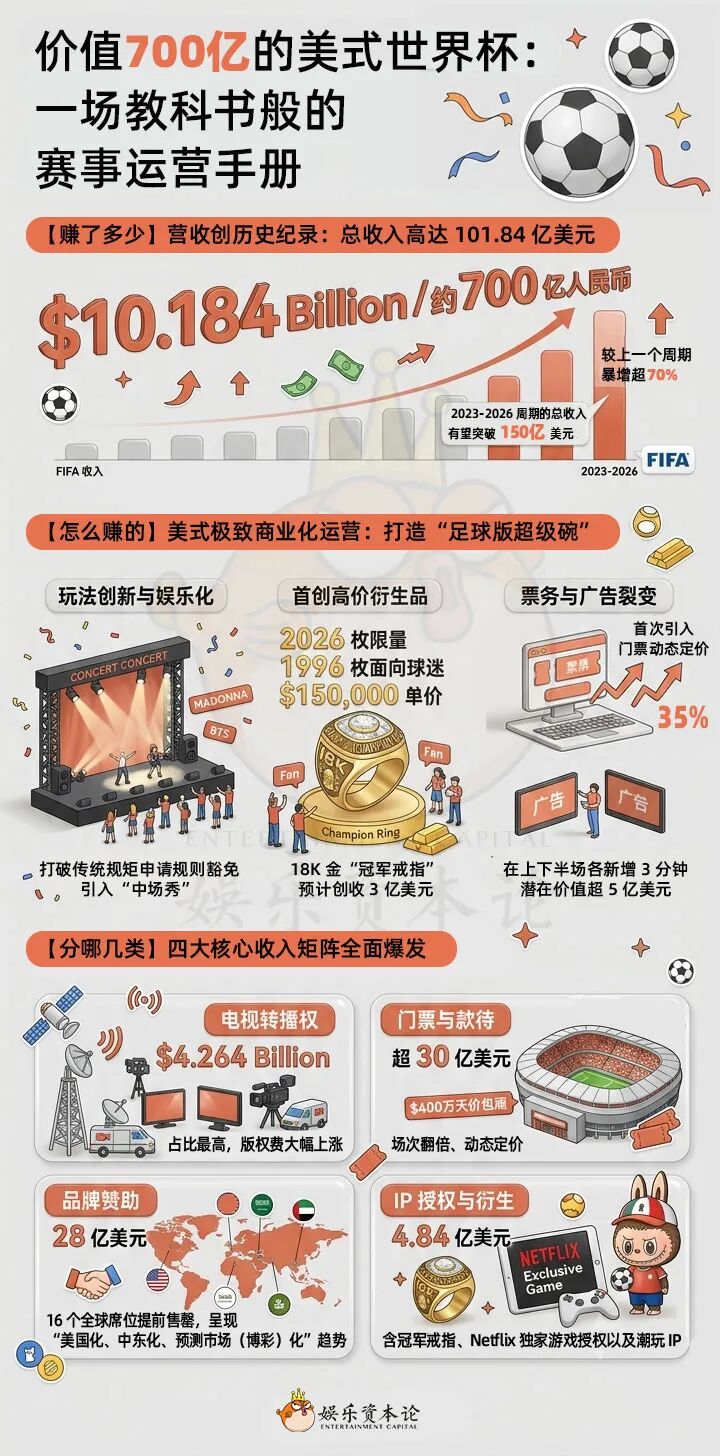
It is not just the matches themselves that draw attention. For the first time in World Cup history, a "halftime show" was held during the mid-game break, featuring Madonna, Shakira, BTS, and Justin Bieber performing on the same stage. The United States, as one of the host nations, was willing to extend the halftime break beyond the official match rules to replicate the "Super Bowl" format by adding this halftime show segment, creating new selling points for tickets and television broadcasts.
This World Cup also borrowed a key concept from another iconic American national sporting event — the NBA — by selling official championship rings. Backed by official authentication and certificates, the championship rings symbolically extend the golden glory of the FIFA World Cup Trophy to anyone willing to pay for the honor. Of course, the price of sharing this glory is steep. When the FIFA championship ring was officially announced on July 16, among the 2026 limited-edition rings, 1996 pieces made available to fans were priced at $150,000 each, theoretically generating roughly $300 million in sales — a revenue-generating method that is unprecedented in history.
Through analysis by Yule Capital, we can see that evaluated across areas including sponsorship policies, ticket sales, television broadcasting, and IP derivatives, the commercial operation capabilities of the 2026 FIFA World Cup in the U.S., Canada, and Mexico have surpassed those of any previous World Cup. FIFA has disclosed that revenue for the 2023-2026 cycle is expected to exceed $15 billion, representing a more than 70% increase compared to the previous cycle. The World Cup alone has generated as much as $10.184 billion in revenue (approximately 70 billion RMB, equivalent to 4.6 times the revenue of the 2022 Beijing Winter Olympics).
The commercialization of the 1984 Los Angeles Olympics saved the Olympic movement; meanwhile, the United States has accumulated successful commercial experience with events like the NBA, MLB, and NFL. This sports-mad great power possesses a "Midas touch" ability to maximize the value of sports event IP. Even in the film industry, which many perceive as being in decline, the U.S. box office has reached $5.2 billion so far this year, on track to easily exceed $10 billion for the full year and hit a new post-pandemic high.
The rise of grassroots "Village Super League" and provincial-level sports leagues across China in recent years, amid the national fitness boom, holds the promise for the future revival of Chinese soccer. At this juncture, how to draw lessons from the World Cup to fully market and develop domestic sports event IP is a proposition worthy of deep consideration.
1
Sponsors: Americanization, Middle Eastern Influence, and the Rise of "Prediction Market" Partnerships
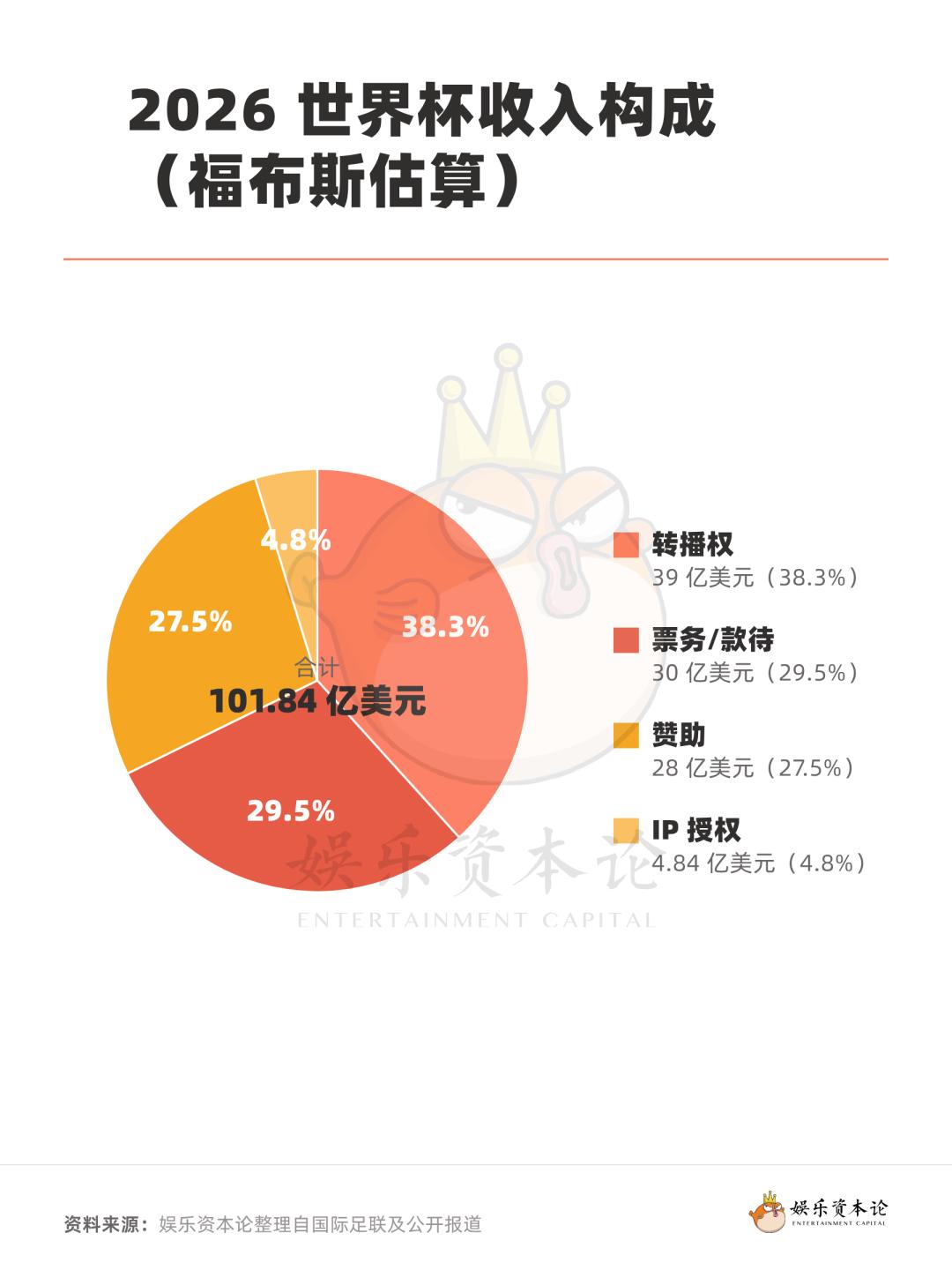
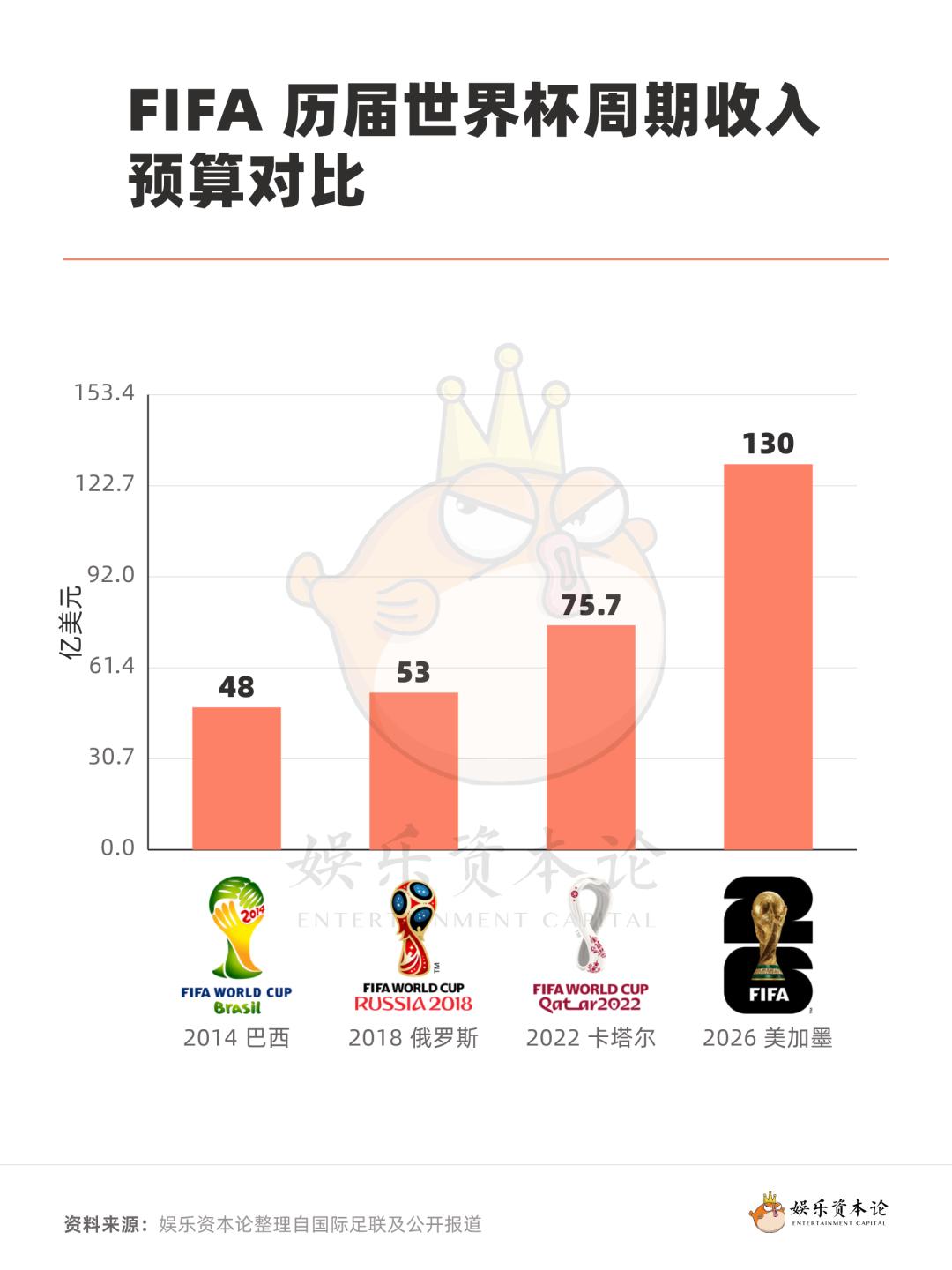
FIFA's revenue budget for the 2023-2026 cycle was revised upward from $11 billion to $13 billion, marking a more than 70% increase over the prior cycle. On the eve of the final, Infantino announced to representatives of 211 member associations that total revenue for the cycle is on track to surpass $15 billion. Within this period, the revenue budget for the 2026 fiscal year (hosting the World Cup) stands at roughly $8.911 billion, while Forbes estimates based on actual performance that this World Cup will generate $10.184 billion in total revenue (including $3.9 billion from broadcast rights, over $3 billion from ticketing and hospitality, $2.8 billion from sponsorships, and $484 million from IP licensing). For comparison, total revenue for the 2022 Qatar World Cup cycle was $7.57 billion.
Next, Yule Capital will guide you to start by examining the revenue generated from sponsorships.
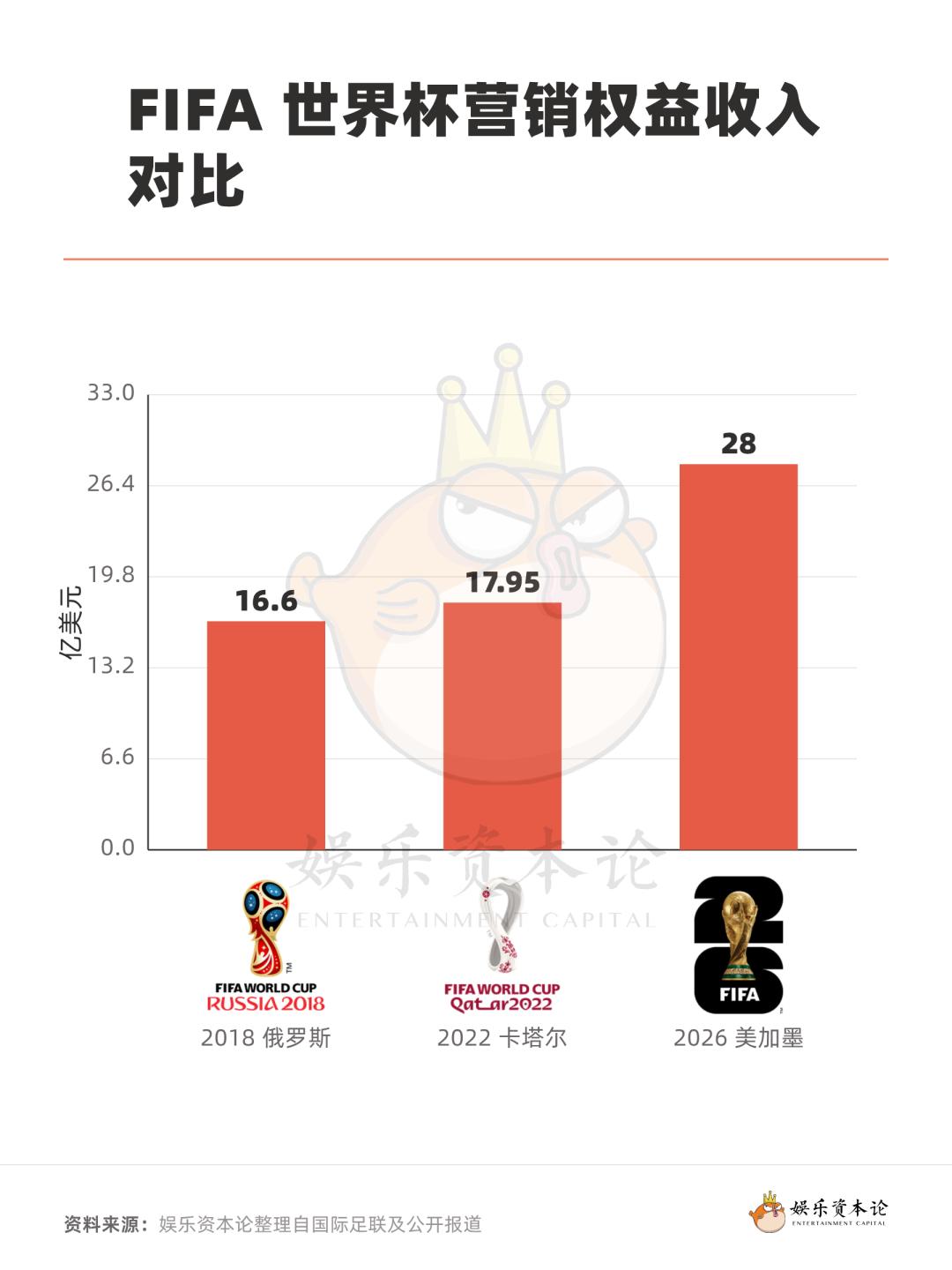
This World Cup featured 16 global sponsorship slots, all of which were fully sold out by late March this year, setting a new record for sponsorship revenue from a single sporting event. Sponsors are granted the right to use the World Cup brand for product promotion and marketing, and this exclusive privilege has driven FIFA's total sponsorship revenue to surge from $1.66 billion at the Russia World Cup to $2.8 billion this year.
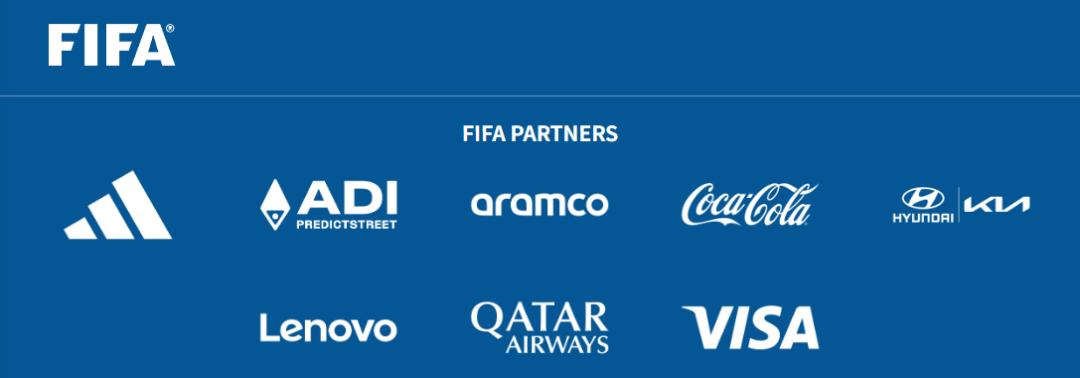
FIFA Partners (the highest tier) include: Visa, Adidas, Qatar Airways, Saudi Aramco, Hyundai/Kia Motors, Coca-Cola, China's Lenovo, and ADI Predictstreet. Each top-tier partner pays an average of approximately $200 million over the 4-year cycle, with Saudi Aramco, Adidas, and Coca-Cola signing contracts valued at as high as $400 million each.
FIFA World Cup Sponsors (the second tier) include Budweiser, Bank of America, Lay's, Hisense, McDonald's, Mengniu, Unilever, Verizon, and American Airlines. Each second-tier sponsor spends roughly $65 million to $95 million over the 4-year period. Three second-tier sponsors, including vivo, exited their sponsorship agreements this cycle.
This World Cup also introduced the "Host City Supporter" program for the first time, allowing each of the 16 host cities to sign up to 10 local sponsors. Regional sponsors include Saudi PIF (Public Investment Fund), Salesforce, Mastercard, Bell Canada, Sony, Airbnb, The Home Depot, DoorDash, and Marriott, among others.
Behind the fully sold sponsorship slots lie two clearly visible capital streams. The first is Americanization, with a wave of local U.S. brands entering the market, directly injecting the commercial momentum of the North American market. The second is Middle Eastern influence: in addition to Saudi Aramco, Saudi PIF has secured a regional sponsorship role and partner status for the 2025 FIFA Club World Cup. Middle Eastern financial support will help Saudi Arabia solidify its bid to host the 2034 Men's World Cup — a bid that previously sparked considerable controversy over procedural adjustments when it was initially submitted.
Among the 8 highest-tier partners, the last one, ADI Predictstreet, is particularly distinctive: it is the first official prediction market partner in World Cup history. It is a blockchain-based platform that allows users to trade on the outcomes of real-world events, matches, and results. The platform is funded by an Abu Dhabi consortium and holds gambling licenses in Gibraltar and 23 U.S. states.
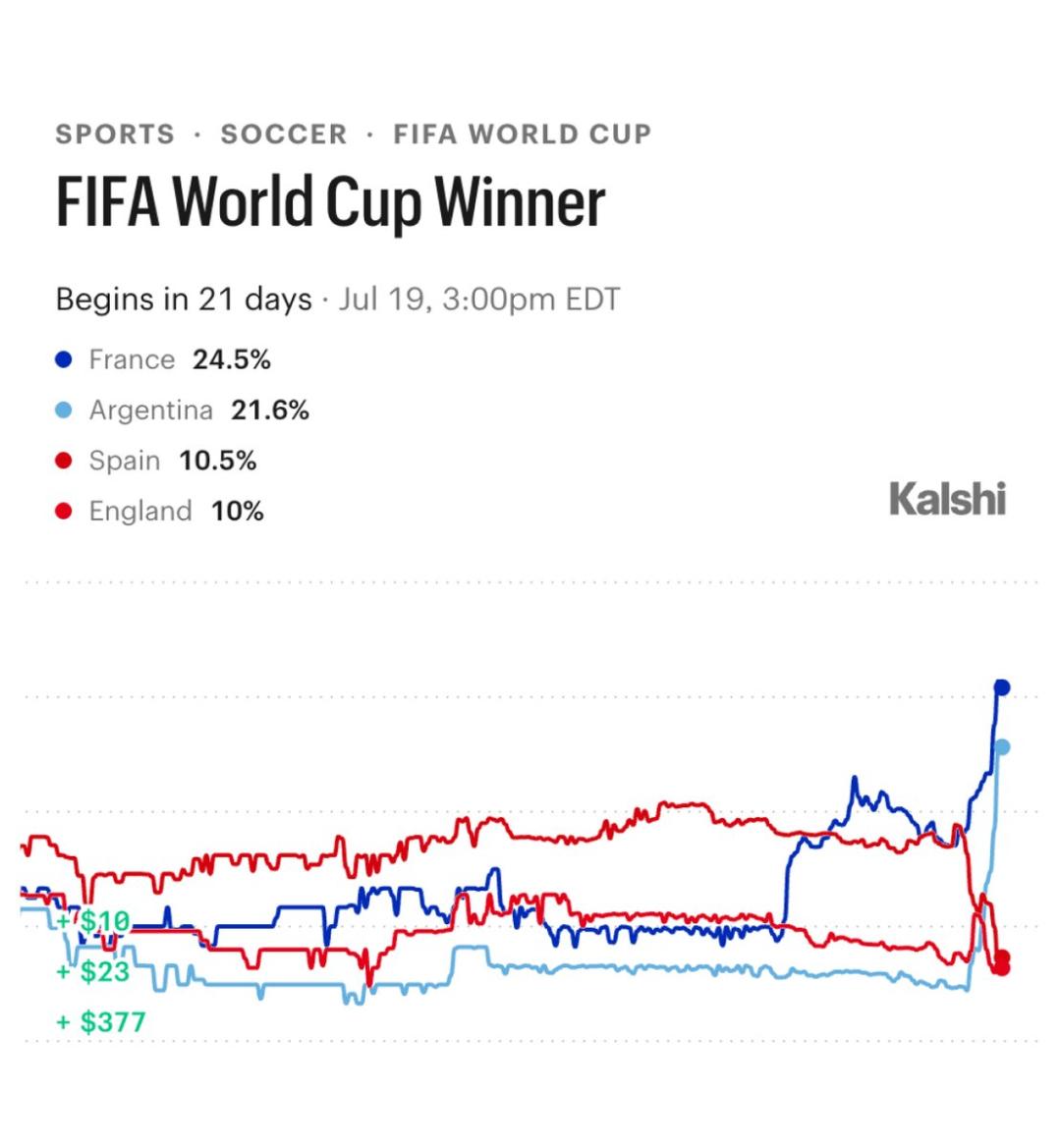
Prediction markets are a "new innovation" that the U.S. has developed only in the past one or two years. Americans' enthusiasm for gambling has spawned an entirely new commercial ecosystem, claiming that probabilities can be wagered on anything, as long as you can find someone willing to take the other side of the bet. The two giants in this industry are Polymarket and Kalshi. Their popularity has reached such a level that insider trading has become rampant across all sectors: even the teleprompter operator for Donald Trump's speeches would take the draft to open positions on prediction markets, betting on which lines the president would and would not say — only to be forced to surrender all their illicit profits when the scheme was exposed.
According to a New York Times report, on the outcome of the final between Argentina and Spain, the two leading prediction market platforms combined saw over $5.69 billion in total wagers. Other popular betting targets included the third-place match, the Golden Boot winner, what commentators might say, and whether this would be Argentine captain Lionel Messi's final World Cup appearance.
In June, the total amount of wagers across all categories on the two platforms exceeded $50 billion for the first time, compared to only about $2 billion in the same period last year. In the week the World Cup kicked off, nearly 270,000 people downloaded the Kalshi app, up from roughly 60,000 downloads just two weeks prior. Analysts argue that "prediction market users" are turning this World Cup into the largest gambling event in history.
You may have noticed that neither Polymarket nor Kalshi are FIFA sponsors. Even within the prediction market industry, the name ADI Predictstreet was largely unknown, because the company was only founded a few days before the sponsorship deal was publicly announced. This multi-year sponsorship agreement valued at roughly $150 million caught many industry insiders by surprise. The platform has not yet obtained widespread operating licenses around the world like the leading prediction market platforms, and Germany is even investigating it for alleged non-compliance and violations of anti-money laundering frameworks. Media investigations have revealed that some of the company's executives were involved in past European political scandals and insider trading cases.
2
Ticketing: Dynamic Pricing, Official Resale, and Sky-High Hospitality Packages
Now let's look at the ticketing business. Even accounting for inflation, average ticket prices have more than tripled compared to four years ago, which is frankly quite outrageous.
The face value of World Cup tickets this year ranges from $60 to $10,990. The cheapest "Supporter Entry" ticket for group stage matches costs $60, which essentially only offers a view of the large stadium screen. All other seating categories are marked with "Cat" numbers, where the smaller the number, the better the view and the more expensive the ticket. Cat 1 tickets for group stage matches cost between $450 and $990, while tickets for the opening match are nearly $3,000.
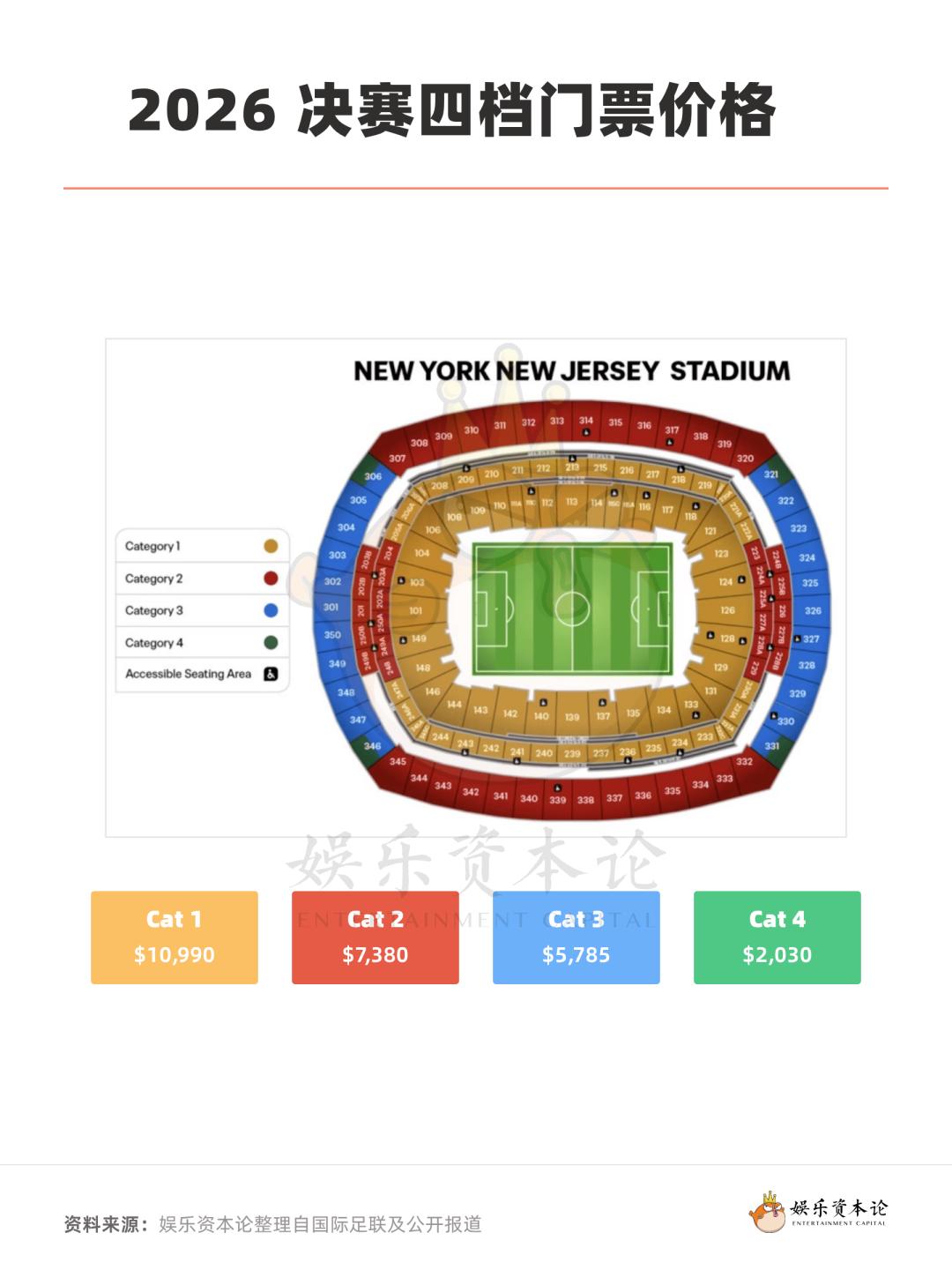
This World Cup introduced the dynamic ticket pricing mechanism for the first time. Between October 2025 and April 2026, FIFA raised prices for at least one ticket tier in 95 out of 104 matches, with an average price increase of 35%. After the April dynamic price adjustment, final match ticket prices reached $2,030 / $5,785 / $7,380 / $10,990. The highest-tier face value for the final is 6.8 times that of the equivalent tier at the 2022 Qatar final ($1,607) and 10 times that of the 2018 Russia final ($1,100). By the end of the April price adjustment, tickets for all matches and all tiers were more than double the prices of the corresponding tiers at the previous World Cup.
Thanks to the expanded number of participating teams and matches, total ticket availability reached roughly 6.7 million, more than doubling the 3.18 million tickets available at the last World Cup and marking the largest ticket pool in history. Even so, during the random lottery sales period from December to January, soccer fans around the world submitted an average of 15 million ticket applications per day, with demand already 30 times greater than supply just two weeks after sales opened. Over 500 million ticket applications were received during this phase — a demand figure that is 3.4 times the total cumulative spectator count of all 964 matches across all 22 World Cups since 1930.
AI Generated by Yule Capital
Even more radical is that FIFA launched its official resale platform for the first time, with no price cap and a 15% commission charged to both buyers and sellers. This essentially legalizes, platformizes, and monetizes the scalper business that was universally condemned in the past — ticketing platforms in China that are still enforcing real-name systems to crack down on scalpers have no choice but to remain silent. On the official resale platform, individual tickets have been listed for as high as nearly $1 million, and hospitality packages for the final were even listed for $2.3 million in the lead-up to the match.
Given this policy, FIFA did not crack down on the unofficial secondary market at all, so platforms like StubHub also thrived. 48 hours before the final, final match tickets on StubHub were being sold for between $9,753 and $69,786.
And that's far from the end of the story. On Chinese social media