ByteDance steps in directly. Is the "playable version of Douyin" really coming?
Since the start of this year, overseas "playable content" platforms have exploded in a concentrated wave, with star products securing successive rounds of financing and climbing industry rankings. From distributing information to delivering immersive experiences, the evolution of content platform formats has clearly begun to emerge.
After the concept of "playable TikTok" was hyped up by overseas capital for half a year, the official platform behind TikTok has finally entered this space in person.
Recently, TikTok launched an internal beta test for its brand-new feature "Interactive Space", simultaneously opening AI interactive content creation tools to creators and releasing access portals for users. This move signals that ByteDance has officially stepped in to disrupt this emerging track.
ByteDance is not the only tech giant making moves in interactive content. Tencent has laid out related offerings both inside and outside the WeChat ecosystem, Xiaohongshu has entered the field through its notes ecosystem, while Alibaba has already gone through a round of trials and subsequent strategic adjustments. Each platform's unique inherent characteristics determine what kind of interactive content ecosystem it can cultivate — a dynamic that deserves more attention than simply tracking which company enters the market first.
Overseas Interactive Content Track Explodes
Domestic Markets Await Major Players' Strategic Moves
"Playable TikTok" is how the capital market defines this new wave of rapidly emerging interactive content platforms. These products lower the barrier to interactive content to the same level as scrolling short videos — users can play immediately upon encountering the content, exit right after finishing, and even share their modified versions with others in just a few taps. The spark that ignited this entire industry trend came from a Chinese overseas product called Loopit.
On February 10 this year, Loopit was officially launched. On its launch day, a user posted a 15-second interactive piece on X that received a comment and repost from Elon Musk, racking up tens of millions of views overnight. This was the first time Loopit entered the global public spotlight.
After going live, its growth rate far exceeded industry expectations. The product quickly topped the Entertainment charts on Google Play in the US and UK, and its parent company Yongyue Intelligence completed three consecutive financing rounds in three months, with total funding reaching nearly 100 million USD. User metrics are equally impressive: by late April, the platform had nearly 2 million registered global users, a next-day retention rate of over 50%, and a user creation rate of 30% — figures that are already at a high level for content platforms.
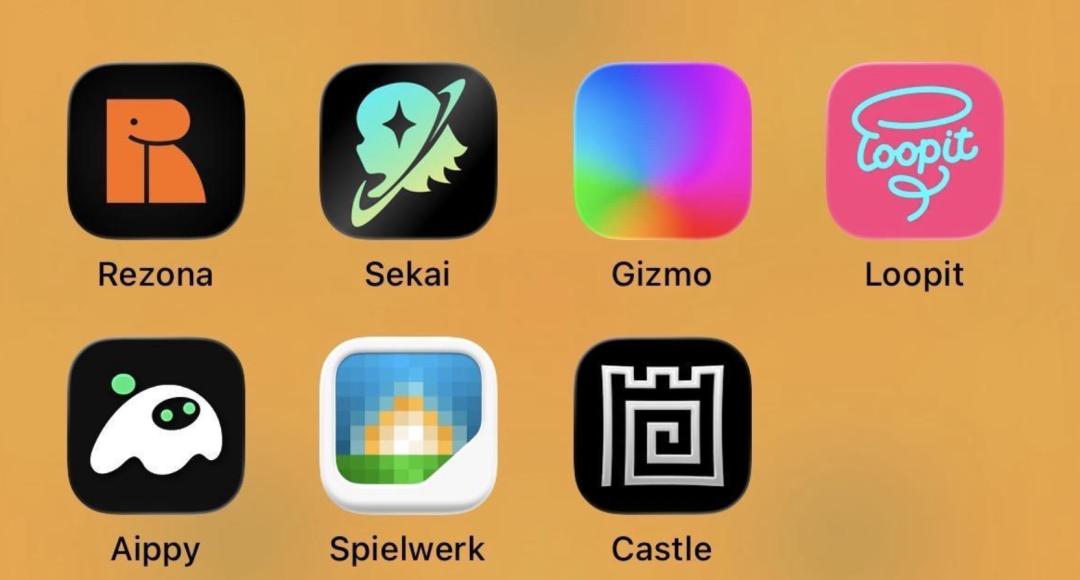
Behind Loopit, multiple products in the same track have all launched this year. Rezona, founded by former TikTok product manager Zhang Jian, can turn viral internet memes into playable mini-games in seconds. It completed four financing rounds within three months of launch, with total downloads exceeding 6 million. Sekai, which focuses on immersive role-playing experiences, secured around 16 million USD in investment from institutions including a16z. Aippy, under the portfolio of Chizi Cheng, has surpassed 3 million global downloads and nearly 2 million monthly active users; it completed an independent financing round in June with a valuation reaching 250 million USD.
All these products confirm one shared truth: content consumption is shifting from one-way viewing to two-way interaction, and capital has begun to collectively place bets on this direction.
Compared to the mini-games found on TikTok, Weibo, and WeChat Moments, interactive content has a far broader scope — it includes interactive storylines, role-playing, simulators, and creative gameplay mechanics. Users can not only play immediately upon seeing content, but also create their own versions using AI, invite friends to collaborate and play together, building fully personalized experiences unique to them. Even more promising, when the creation barrier drops low enough that everyone can participate, it could nurture the next 100-million-user-level content platform.
However, no independent startup has managed to break out in this domestic market yet. Both Loopit and Aippy are backed by Chinese companies, but they all chose to prioritize overseas expansion, with their domestic versions showing significantly lower community activity compared to their international counterparts.
The core reason lies in the extremely high barriers of domestic traffic distribution channels: users' attention and time are already highly concentrated on a small number of super platforms. Independent platforms struggle to acquire users and lack mature distribution systems, leaving them with very limited room for survival. This has made it a widespread industry expectation that major tech giants will enter the space themselves, with the only remaining suspense being who will make the first move, and how.
According to reports from Dujia, TikTok recently began internal beta testing for its new AI feature "Interactive Space", with the "Interactive Space Plaza" launched simultaneously in the app. Centered around lightweight interactive content scenarios and gameplay, it brings together user-created interactive works covering diverse categories such as interactive storylines and casual mini-games.
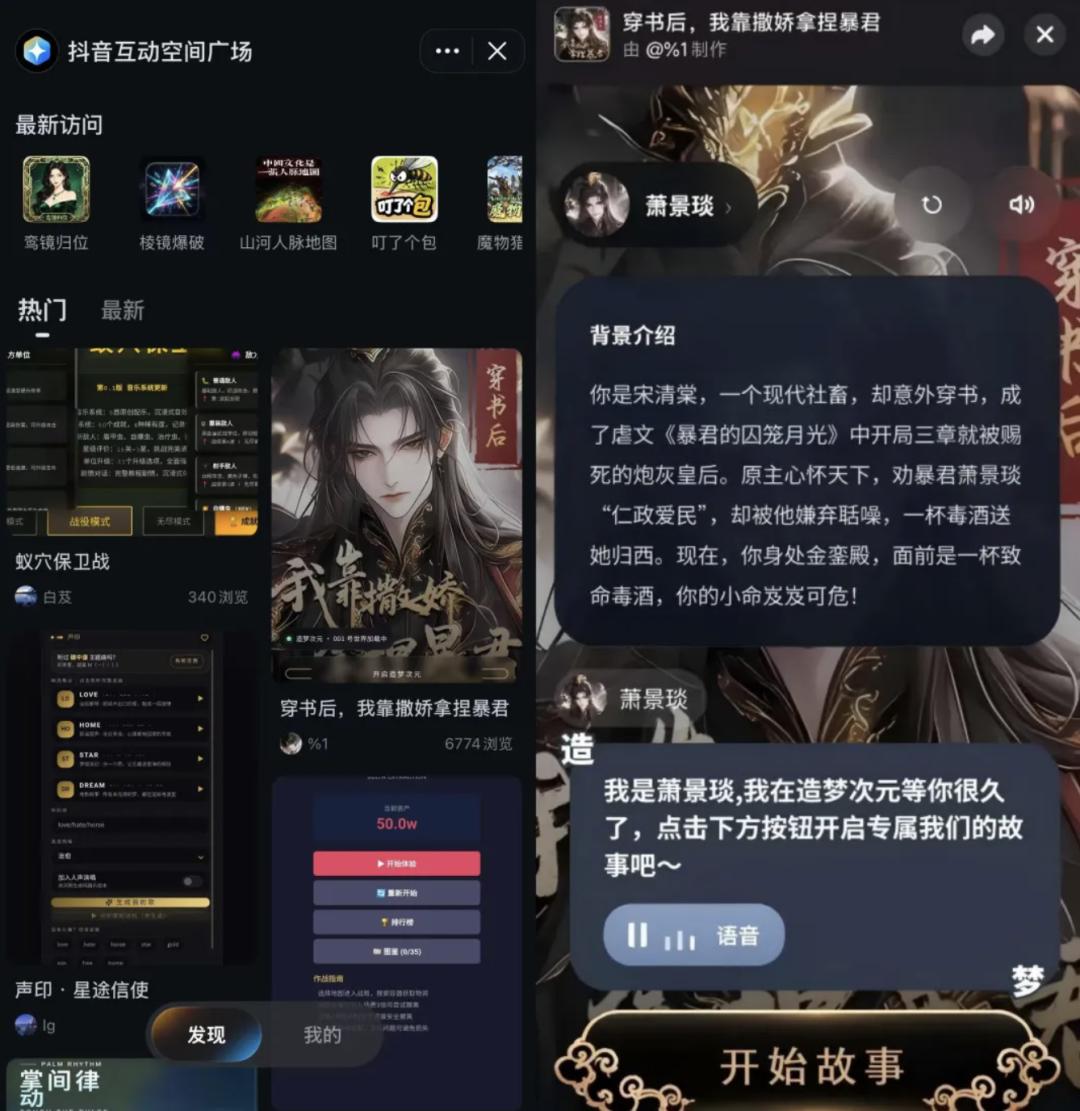
Image Source: Dujia
After entering an interactive work, users can chat with virtual characters, choose different story paths, and experience lightweight instant-play gameplay like simulators and level-clearing challenges. Each work page links directly to the creator's TikTok account, allowing users to follow with one tap. The creation side is also fully integrated: using ByteDance's AI programming tool Trae, creators can generate HTML interactive works through natural language conversations, then package and upload them to the plaza for public display.

Image Source: Dujia
During the internal beta phase, each creator can publish a maximum of 100 works, with a cap of 100 concurrent users per individual work.
Notably, TikTok's "AI Innovator Program" has classified Interactive Space as an independent track, calling for creation submissions from university students across the country — ByteDance's intention to nurture this new content ecosystem clearly goes far beyond simple feature testing.
From Little Firefolk and Build Your World to Interactive Space
How Has ByteDance Advanced Step by Step?
ByteDance chose this timing to enter the interactive content space, driven both by the realistic pressure of competing for existing traffic, and as an active strategic move after its technology and creation ecosystem have matured. It also benefits from the successful trials of earlier products like Little Firefolk and Build Your World.
The most direct external pressure comes from the stagnating growth of its core short-video business. In December 2025, the total number of short-video users across the entire internet reached 1.074 billion, with a usage rate of 95.4%, marking a clear peak for the industry. Platforms urgently need to find the next new content growth curve that can boost user duration and stickiness. Compared to short videos, interactive content inherently offers higher user engagement and longer session times, making it a logically viable direction to break through growth bottlenecks.
At the same time, ByteDance has built a considerable ecosystem of mini-game developers: in 2025, the total number of TikTok mini-game creators increased by 360% year over year, with both the developer count and number of game works nearly doubling. AI technology is further amplifying the productivity of this ecosystem: Volcano Engine's launched AI + game engine solution has shortened the development cycle from weeks to days. After Trae is integrated into the Interactive Space creation workflow, the creation barrier will be lowered even further, not only boosting efficiency for professional teams, but also expanding the pool of potential creators.
The lightweight interactive social experiments that TikTok has accumulated internally not only gave ByteDance user-level confidence for its strategic decision, but also served as the core pre-test ground for Interactive Space, with the two sharing a fully aligned product logic.
The social interactive feature "Little Firefolk", launched in 2024, used the lightweight social mechanism of "keeping the flame alive" as its entry point, turning social check-ins into a virtual pet raising experience. Through lightweight interactions like feeding, outfit customization, and card collection, it quickly gained massive user adoption. By February this year, its daily active users reached 160 million, with over 50% penetration among users under 24 years old.
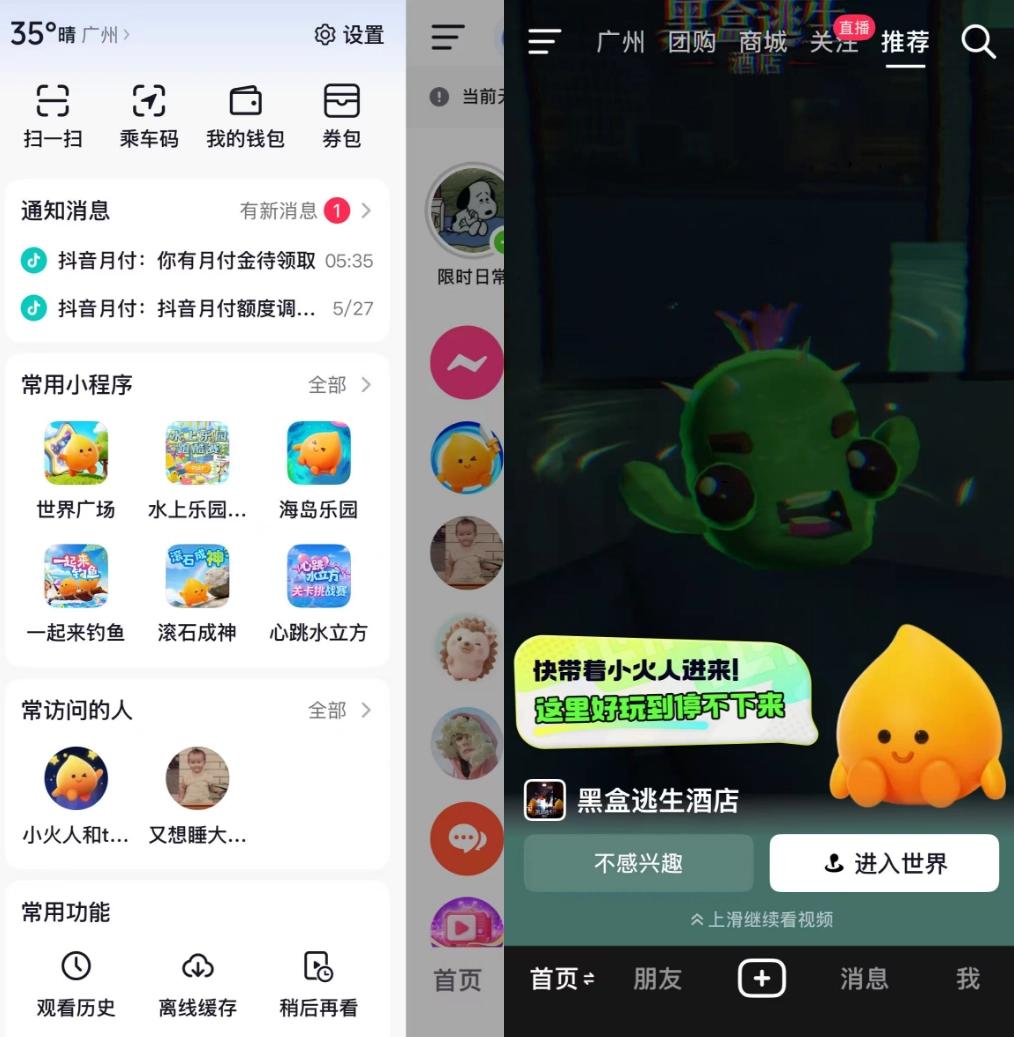
The UGC scene-building feature "Build Your World", developed on this foundation, further validated the feasibility of low-barrier interactive creation: the platform provides visual editors and pre-built gameplay components, allowing ordinary users to build their own custom interactive maps without professional development skills. After launch, its user base quickly surpassed 500 million, accumulating diverse categories of UGC content including raising, racing, and puzzle-solving experiences.
The success of Little Firefolk and Build Your World at least proves that TikTok's user base has a very high acceptance for interactive gameplay, laying the user awareness foundation for the launch of Interactive Space.
The currently beta-testing "Interactive Space" represents ByteDance's next major step forward in its interactive content strategy.
ByteDance chose not to spin off Interactive Space as a standalone app, instead embedding it directly into the main TikTok platform. An independent app would require building from zero, re-acquiring users, and constructing a new distribution system, facing the exact same startup difficulties that Loopit and Aippy encounter. By growing within TikTok, the feature can directly leverage the platform's mature algorithmic distribution system and existing social connections, naturally integrating into the short-video feed and gradually cultivating users' interactive content consumption habits.
More critically, there exists a natural two-way traffic synergy between short videos and interactive content: users can jump directly from watching related short videos to experience the interactive content, and exciting clips from interactive works can also be edited into short videos for secondary distribution. This kind of internal ecosystem synergy is something independent platforms cannot replicate.
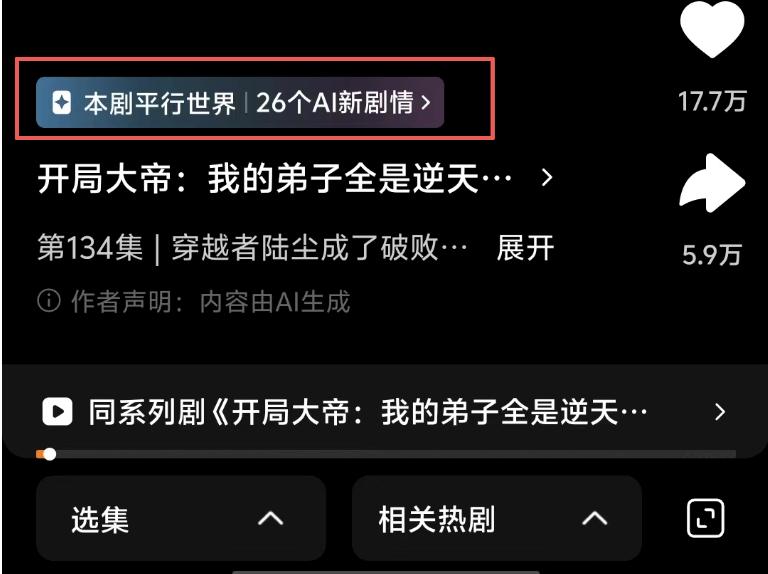
This strategic layout is also extending across ByteDance's broader content matrix. Hongguo Short Drama recently began testing the "Parallel World" feature, opening an AI continuation portal at the end of popular AI animated drama episodes. Users can select characters, specify story directions, and generate AI-created sequel clips. This naturally extends interactive creation from the end of short dramas, addressing the lifecycle limitation of hit dramas that "become outdated once they finish airing", and driving users from passive viewing to participatory creation.
With three product lines — short videos, short dramas, and interactive content — working in tandem, ByteDance is building a full-scenario closed-loop content ecosystem.
From WeChat to Xiaohongshu
Platform Content Is Becoming "Interactive"
ByteDance is far from the only player in the interactive content track, with different companies adopting vastly different strategies based on their unique resource advantages, showcasing diverse approaches to breaking through industry bottlenecks.
"Lingguang" under Ant Group was one of the earliest entrants. Launched at the end of 2025, it positioned itself around "no-code app generation + flash app community", exceeding 1 million downloads in 4 days, with users creating over 30 million flash apps at one point. However, in June this year, its core lead was transferred to another business, key team members were reassigned, and overall investment in the project entered a phase of strategic adjustment and scaling back.
Lingguang's rapid rise followed by gradual decline also reflects the bottleneck facing independent interactive content platforms: affected by the "use and leave" consumption characteristic, they lack high-frequency usage scenarios and strong distribution capabilities. Even with impressive initial growth momentum, it is extremely difficult for them to build a sustainable long-term user retention and ecosystem cycle.
Tencent has actively deployed two parallel strategies both inside and outside the WeChat ecosystem. In June 2026, WeChat launched its native AI assistant "Xiaowei", which supports generating mini-programs with a single sentence, and was granted a top-tier entry portal at the top-left corner of the WeChat homepage. The other initiative is the AI app platform "Tusi", which focuses on native app generation and creative communities, aiming to build a new creator base outside the WeChat ecosystem.
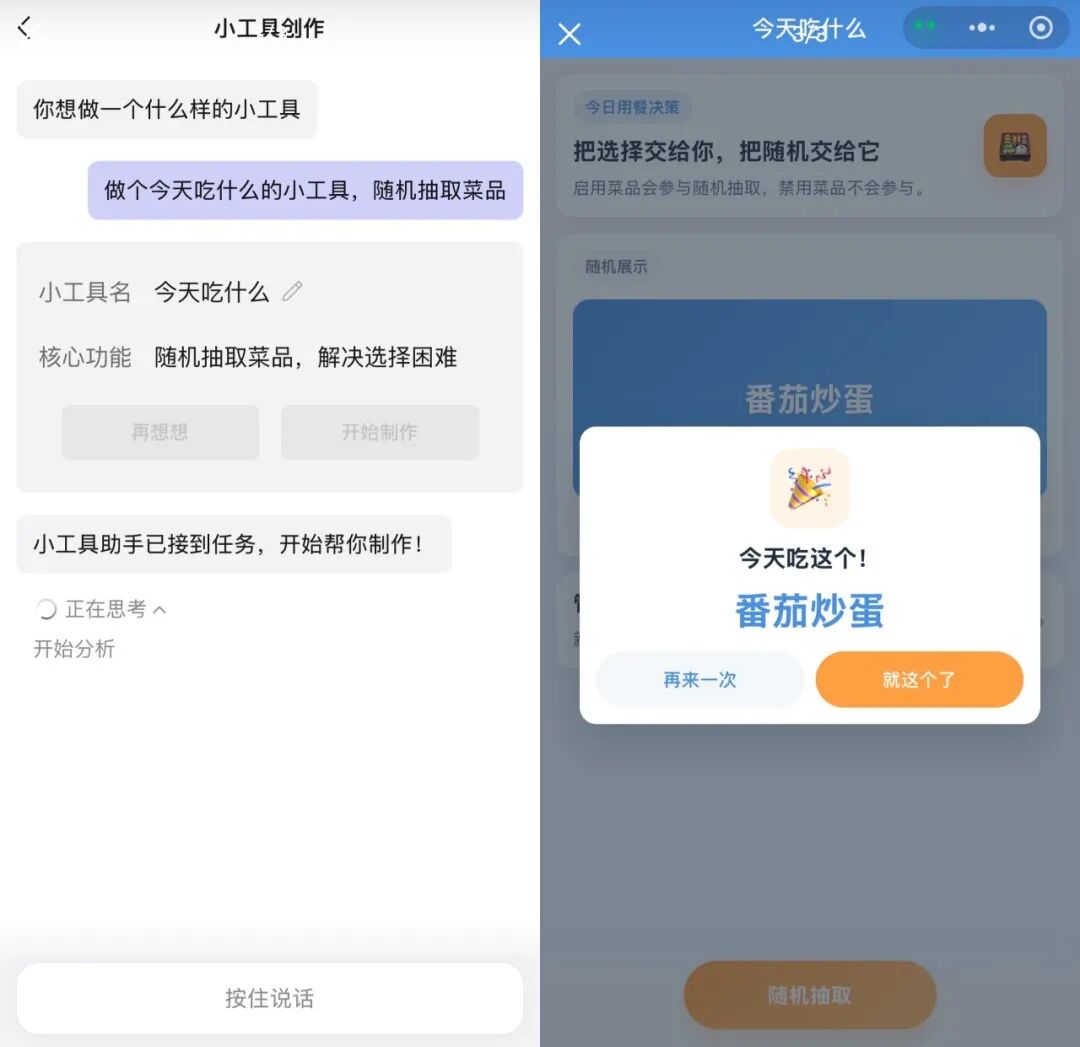
However, Tencent faces equally obvious deep-seated restrictions in the interactive content space. As an independent platform, Tusi encounters the exact same user acquisition challenges that Lingguang faced, and the small tools generated by Xiaowei are currently limited to personal private use — fully decentralized, they cannot be directly distributed through WeChat Moments or WeChat Channels, which to a large extent limits the viral potential of interactive content.
The path that is truly likely to succeed is similar to how mini-games thrived: embedding interactive content into the distribution systems of WeChat Moments and WeChat Channels, leveraging social connections to drive content dissemination.
Xiaohongshu is another platform actively experimenting with interactive content. Recently, the platform launched internal beta testing for its "Xiaohongshu Mini Tools" feature, allowing creators to attach lightweight interactive apps such as calculators, outfit matchers, mini-games, and test tools directly under their notes. After seeing a note, users can click "Try it out" to experience the feature without leaving the app, no download required. Using algorithmic distribution of notes to drive traffic to interactive tools follows a logically smooth path, and perfectly aligns with Xiaohongshu's unique platform characteristics.
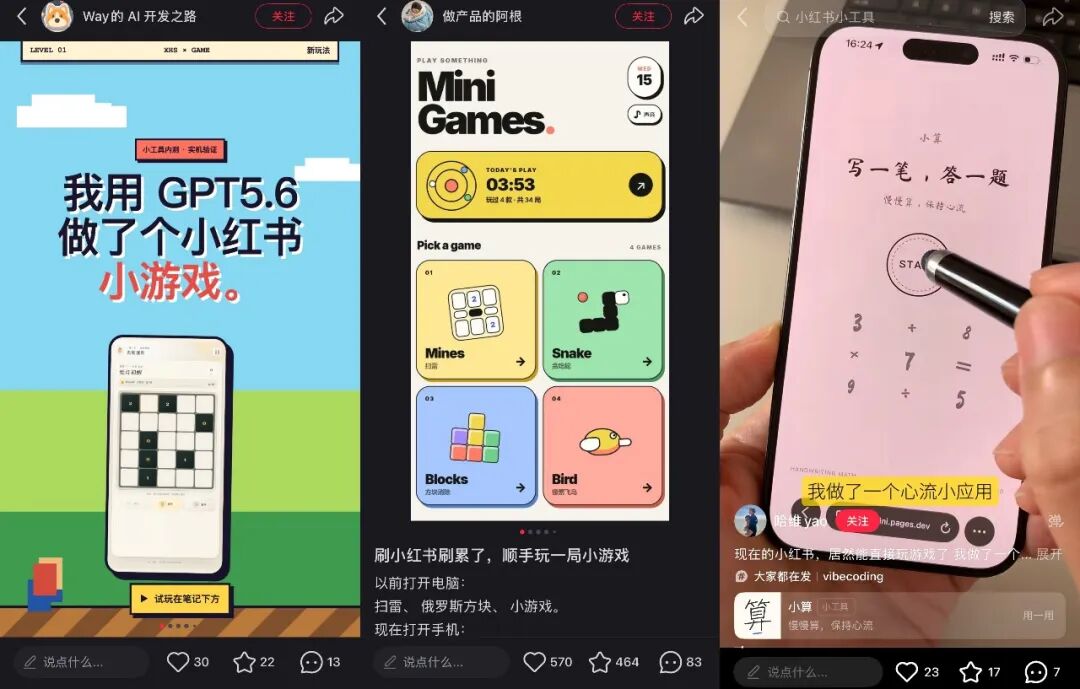
Judging from the content that has already emerged during the beta phase, the ecosystem of Xiaohongshu Mini Tools is richer than expected. Roughly categorized, there are at least three types: first, practical tools, such as itinerary planners, "what to eat on Friday" decision makers, and random lottery generators — small apps that solve specific daily life needs. Second, fun tests and emotional tools, including MBTI personality tests, emotional mute buttons, and digital wooden fish experiences, which perfectly match Xiaohongshu users' well-known habits of taking tests and sharing results with the community. Third, lightweight mini-games, with creative gameplay like CS simulators and time-travel experiences, as well as remakes of classic games like Snake and Minesweeper, all quickly found their target users through Xiaohongshu's recommendation mechanism.
That said, Xiaohongshu's interactive content ultimately relies more on the note recommendation logic to acquire new users, rather than being driven by users' entertainment and social needs, which represents a clear difference from TikTok Interactive Space's distribution logic. It remains to be seen what distinct ecosystems each platform will eventually cultivate.
At this stage, the interactive content strategies of all major platforms show clear differentiated positioning: TikTok, leveraging its algorithmic distribution and entertainment content DNA, follows a centralized content plaza path. WeChat's interactive ecosystem leans more toward a decentralized private tool logic. Xiaohongshu enters the space through its practical