The first REIT for a shopping mall in a county-level city has officially been launched.
Last week, the project company of Xincheng Ruiyang Wuyue Plaza updated its industrial and commercial information, with its 100% shareholder changed from the former Xincheng Wanbo Real Estate Co., Ltd. to Guangdong Baocheng Xinyi Enterprise Management Co., Ltd.
Looking through the ownership structure, the shareholder of Guangdong Baocheng Xinyi is a partnership enterprise. Further tracing back to the partners and their shareholders, it turns out to be two state-owned enterprise investment platforms based in Guangdong and Anhui provinces.
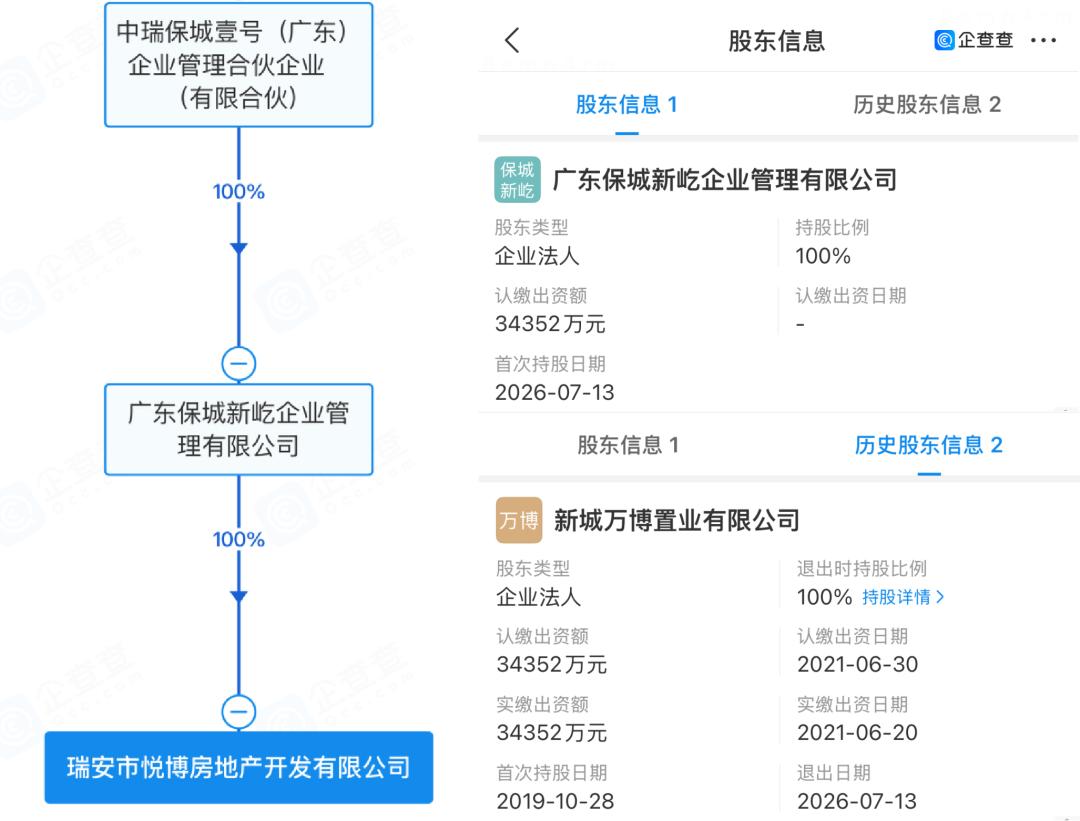
Source: Qichacha
This shows that the asset ownership of the project has been transferred from the original owner, and the new shareholder is not an ordinary acquirer, but most likely a Pre-REITs platform focused on holding and nurturing commercial assets.
This is a low-key but significant signal: The first domestic Pre-REITs for a shopping mall in a county-level city has been officially launched.
In the past, when people talked about REITs, the underlying assets were almost always shopping malls in core locations of first- and second-tier cities. Now, a shopping mall in a county-level market has received real-money investment from the capital market, which is indeed worthy of attention and research.
Asset Side:
Why Ruiyang Wuyue Plaza
Ruiyang is a county-level city under the jurisdiction of Wenzhou, Zhejiang Province, with a permanent resident population of about 1.55 million, ranking 24th among the top 100 counties and cities in China in terms of comprehensive competitiveness in 2025.
According to the latest ranking of per capita disposable income of urban residents in China's county-level regions released by Yicai, Ruiyang ranks 9th with an income level of 89,000 yuan, making it a fairly affluent county-level city.
Xincheng Ruiyang Wuyue Plaza is located in the core area of Anyang District, Ruiyang, only 700 meters away from the Ruiyang Municipal Government. The project opened in 2018, with a total floor area of about 135,000 square meters, making it the largest one-stop shopping mall with the most comprehensive categories in the local area.
In the first half of 2026, its rental income ranked 2nd among more than 200 Wuyue Plazas across the country, and its occupancy rate has long remained 100%. In 2025, the project's annual sales exceeded 1.1 billion yuan, and the annual passenger flow exceeded 17 million person-times, equivalent to an average of 46,500 person-times per day. This figure is quite solid for a county-level city.
The economic development level of Ruiyang is also reflected in the brand tier of the project. Ruiyang Wuyue Plaza currently operates about 210 brands, of which international well-known brands account for 26%. In the past year, more than 130 brands have been renewed, and there are over 60 first stores in the city, including the first local stores of international beauty brands such as Lancôme, Estée Lauder, and Sephora.
In addition, in terms of anchor stores, the Xingyi STARX Cinema has the world's first STARX giant-screen hall, with a total box office of over 14 million yuan last year. Yonghui Supermarket completed the "Pangdonglai Model" renovation in August 2025, with a product replacement rate of 48% and a new product introduction rate of 37, significantly enhancing the stickiness of family customers.
During the 2025 National Day holiday, Ruiyang Wuyue Plaza was featured on the "News Broadcast" of CCTV as a typical case of county-level consumption vitality upgrading, becoming a vivid example of improving commercial quality and expanding consumption potential in the sinking market.
These data and information all indicate that Ruiyang Wuyue Plaza is an excellent asset both within the Xincheng system and in the local market. Compared with the administrative level of its city, the market-leading asset quality and operational stability are the key factors that attract investors.
After all, investors who enter through the Pre-REITs structure are not buying asset allocation, but valuing its ability to continuously generate rental income and the greater returns from future exit.
Judging from the current state of the national REITs market, in addition to Xincheng, several other REITs with county-level projects as underlying assets are also in progress. For example, China Resources' Kunshan Mixc has been included in the expansion list of public offering REITs for consumption infrastructure, while Kunshan China Merchants Garden City is applying for commercial real estate REITs.
As the first county-level shopping mall to enter the Pre-REITs market, Ruiyang Wuyue Plaza may bring more new insights and confidence to the capital market regarding the county-level commercial real estate market.
Original Rights Holder:
Xincheng's Multi-Tier REITs Map
If China Resources is the most active central state-owned enterprise developer in the REITs market, then the top position among private enterprises undoubtedly belongs to Xincheng.
From experimenting with overseas REITs platforms to focusing on the domestic multi-tier REITs market, they have carried out systematic layouts in the field of asset securitization for many years.
According to different target audiences and access thresholds, the current domestic multi-tier REITs market mainly includes public offering REITs (including commercial real estate REITs), inter-institutional REITs, and Pre-REITs.
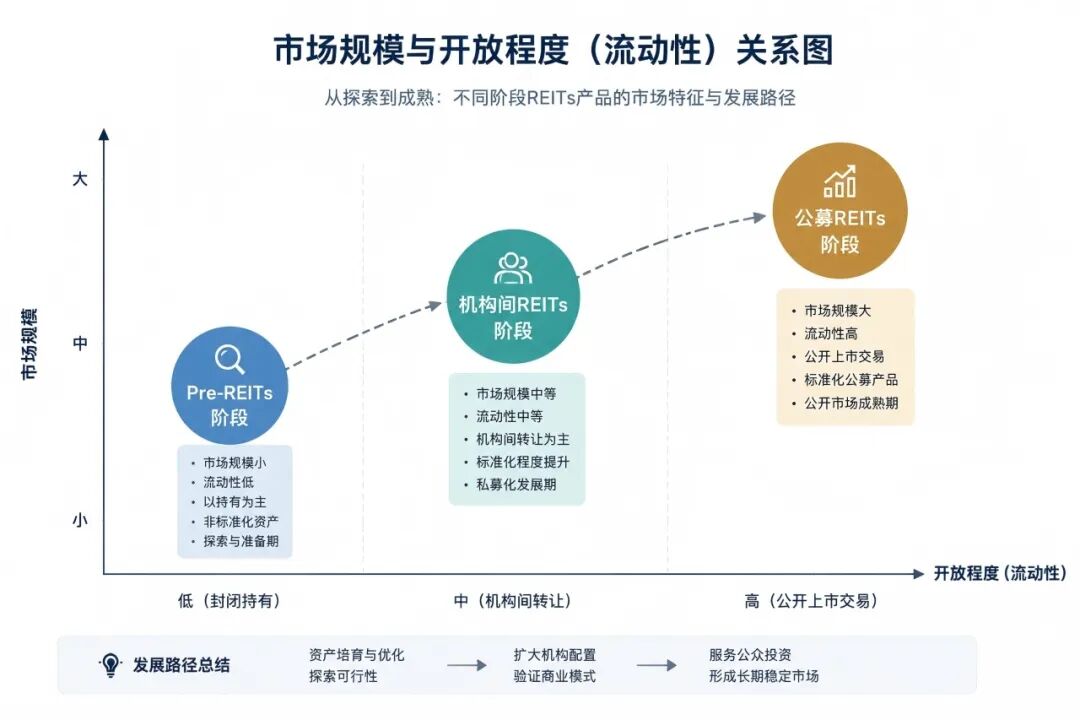
Public offering REITs are publicly listed on stock exchanges and can only be issued after approval by the National Development and Reform Commission and/or the China Securities Regulatory Commission. They have the strictest regulatory requirements, and the assets need to be operationally mature with highly stable cash flow.
Inter-institutional REITs target professional institutional investors such as banks, insurance companies, and funds, with a relatively simple approval process, but the requirements for asset quality are equally high.
Pre-REITs are a more forward step than the previous two.
Assets are first placed into a REITs-like structure for continuous cultivation and operation, while the compliance and financial structure of the assets are sorted out. When conditions are mature, the exit path will be decided based on the market environment and the demands of all parties — either issuing inter-institutional REITs or commercial real estate REITs, or being repurchased by the original rights holder.
Xincheng's layouts in these three tiers are almost advancing simultaneously. In November 2025, the inter-institutional REITs with Shanghai Qingpu Wuyue Plaza as the underlying asset, the "Guojin Asset Management - Wuyue Plaza Holding Real Estate Asset-Backed Special Plan", was officially established on the Shanghai Stock Exchange, with an issuance size of 616 million yuan.
In June 2026, the product completed its first expansion, injecting two assets: Tianjin Jinnan Wuyue Plaza and Jiangsu Rugao Wuyue Plaza. The product scale was increased from 1.286 billion yuan to 2.146 billion yuan. This is the first expansion of a commercial inter-institutional REITs in the entire market, verifying the feasibility of the "initial issuance + expansion" two-wheel drive model.
At the public offering REITs level, GF Xincheng Wuyue Commercial Real Estate REIT has submitted an application to the Shanghai Stock Exchange and been accepted, with a planned fundraising scale of 1.625 billion yuan and an estimated net cash flow distribution rate of 5.59% in 2026. The underlying assets are Changzhou Tianning Wuyue Plaza and Nantong Qidong Wuyue Plaza.
The Tianning project is a Class A store in the Wuyue commercial management system, and the Qidong project is the only large one-stop shopping mall in the local area. Both shopping malls maintained a 100% occupancy rate in 2025, making them competitive among the commercial real estate REITs products that have been applied for currently.
At the 2025 performance conference, Xincheng Holdings stated that the REIT is expected to be launched in the third quarter of this year.
The recent launch of Ruiyang Wuyue Pre-REITs is Xincheng's first practice in the Pre-REITs model.
If the commercial real estate REITs is successfully issued, Xincheng will become the first private real estate enterprise in China to successfully operate at the three tiers of public offering, inter-institutional, and Pre-REITs.
This not only broadens financing channels and enriches cash flow, but more importantly, for Xincheng Wuyue Plazas that are largely distributed in fourth- and fifth-tier cities, the multi-tier REITs market can provide differentiated exit mechanisms to match different assets and investors, thus bringing greater flexibility in asset disposal.
According to the information publicly disclosed by Xincheng Holdings at the 2025 performance conference, the company's goal is to make the underlying asset scale of public offering REITs exceed 20 billion yuan by 2028, and the total scale of the "public offering + private placement" dual platform exceed 30 billion yuan by 2030.
The Professional Investment Bank Behind the Scenes:
CITIC-Prudential Fund
By tracing the equity structure of the new shareholder through Qichacha, we can find that the 100% controlling shareholder behind Guangdong Baocheng Xinyi Enterprise Management Co., Ltd. — the new shareholder of Ruiyang Wuyue Plaza — is Zhongrui Baocheng No.1 (Guangdong) Enterprise Management Partnership. Further tracing up, we can find a well-known name in the real estate finance field: CITIC-Prudential Fund.
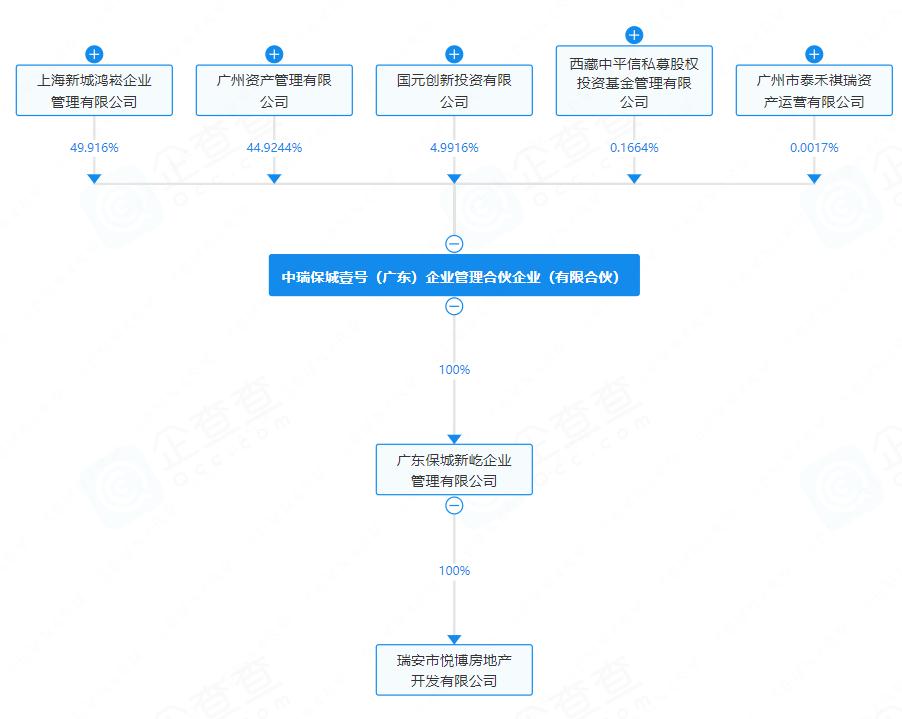
Source: Qichacha
It is understood that in this transaction of Ruiyang Wuyue, as a professional investment bank, CITIC-Prudential Fund has given full play to its integrated resource coordination advantages in asset screening, capital organization, and asset management.
Different from the public offering REITs market, where the original rights holder usually acts as the core initiator and leader, professional investment banks often play a greater role in the Pre-REITs field.
They can lead the entire transaction process including asset locking, due diligence, transaction structure design, equity capital and supporting leverage capital organization, transaction document drafting, and post-investment supervision, to bridge the demands of the original rights holder, equity investors, banks and other parties, and finally realize the transaction landing.
Looking at the domestic Pre-REITs market, transactions led by an investment bank like CITIC-Prudential Fund that dominates the entire process are rare. If we have to find a comparable role in the real estate investment field, CITIC-Prudential's role may be more similar to international institutions such as Blackstone and BlackRock.
This is another highlight of this Pre-REITs transaction besides the particularity of its underlying assets.
In addition, in this transaction, state-owned investment platforms from Guangdong, Anhui and other regions also participated in the investment as professional institutional investors. They rarely appeared in the public offering REITs market in the past.
This joint move is believed to bring inspiration to similar enterprises, and add a new important possibility for potential investors in commercial real estate.
What Can Pre-REITs Do
The word "Pre" in the name of Pre-REITs is very distinctive. We can temporarily understand it as a "preparatory" state, which is exactly the core value of this type of product structure.
For the original rights holder, Pre-REITs realizes investment recovery in advance while retaining the light asset operation right (no need to wait for public offering), and at the same time (possibly) retains the initiative in subsequent asset disposal or further asset securitization operations to a certain extent by holding fund shares.
During the holding and cultivation period, the work of the operator will not change at all because the assets are placed into the Pre-REITs structure. They can continuously improve the occupancy rate, optimize the tenant structure, and enhance the stability of NOI. At the same time, they can promote the compliance sorting of industrial and commercial, tax, land and other issues under the guidance of professional investment banks. If the asset value continues to rise, they can cooperate with the holder to move towards inter-institutional or public offering REITs at the right time.
For capital providers, Pre-REITs provides a logic of "early bird entry". Compared with directly subscribing to inter-institutional REITs or public offering REITs products, the asset pricing at the Pre-REITs stage is more flexible, and the potential excess return space is larger. The more the underlying assets sink, the more obvious this premium usually is.
In terms of income distribution, referring to the structural conventions of similar shopping mall inter-institutional REITs, Pre-REITs will also prioritize distributing income to investors until the agreed annual rate of return is reached, and part of the remaining income after meeting the agreed rate can be used as excess rewards to pay the operation management party. This mechanism not only guarantees the basic income of investors, but also directly links the interests of the operation party with the asset performance.
Another very important point is that after entering the Pre-REITs stage, professional investment banks can usually bring resources beyond capital to the original rights holder, just like the counseling broker of a quasi-listed company, including the expansion of financing channels and structure optimization, improvement of operation standards, and path planning for the next step of asset securitization.
Since institutional investors will supervise the operation of the underlying assets, the NOI performance and operation compliance of the underlying assets are often more efficient and standardized than when they are held by the original rights holder themselves. This external constraint will inevitably become a catalyst for further improving asset quality.
Conclusion
Finally, let's talk about the significance of this incident to the industry.
Many benchmark projects are born with a "silver spoon", such as core city locations, star management teams, and exclusive blue ocean markets, which are naturally the darlings of the capital market. But for most practitioners, there is no such opportunity to "win at the starting line".
However, a shopping mall in a county-level city can also realize transactions through the multi-tier REITs market, which is of greater signal significance for more original rights holders who hold commercial assets in the sinking market.
It shows that after having the public offering REITs as a popular exit channel, the possibility of commercial real estate asset securitization will depend more on asset quality, and will not be "vetoed by one vote" due to the city's tier.
This operation of Ruiyang Wuyue Plaza has further inspired how to find a matching asset securitization path at different maturity stages of the project.
Pre-REITs corresponds to the cultivation period, inter-institutional REITs corresponds to the growth period, and public offering REITs corresponds to the mature