Is the arrival of the "national team" signaling that the A-share market correction is nearing its end?
On the evening of July 19, the A-share market saw concentrated statements from multiple stakeholders.
China Chengtong Holdings Group Co., Ltd. (hereinafter referred to as "China Chengtong") and China New Holdings Co., Ltd. (hereinafter referred to as "China New") simultaneously issued announcements on share increase plans.
China Chengtong stated that it has accumulated nearly 100 billion yuan in purchases recently, and will continue to use its own funds and special re-lending for share repurchases and increases to make large-scale additional purchases of stocks and ETFs (Exchange Traded Funds) of state-owned central enterprises and technology companies. China New disclosed that its subsidiary, China New Investment, has used over 500 billion yuan in special re-lending for share repurchases and increases, and will continue to increase its holdings of central enterprise stocks in the future.
Both China Chengtong and China New are state-owned capital operation companies directly supervised by the State-owned Assets Supervision and Administration Commission of the State Council, constituting two important "national team" forces.
On the same evening, *Caijing* learned from a source close to regulatory authorities that the China Securities Regulatory Commission will hold a symposium with listed companies, securities firms, and fund institutions on July 20 to solicit opinions and suggestions on promoting the stable and healthy development of the capital market.
Meanwhile, multiple quantitative private equity funds have recently moved to make self-purchases intensively. Among them, Lingjun Investment announced that it would use 200 million yuan of its own funds to subscribe for its own products, and Pingfanghe Investment made a 100 million yuan self-purchase. According to statistics, as of July 18, a total of 10 private equity firms have issued self-purchase announcements this year, and the total self-purchase amount since July accounts for more than half of the annual total.
Massive capital has also poured into the ETF market. Wind data shows that as of July 19, the net inflow of the entire market's ETFs in the past two weeks reached 304.26 billion yuan. Equity ETFs contributed the vast majority of this increment, reaching 290.3 billion yuan.
Against the backdrop of drastic market fluctuations, multiple securities firms have issued collective statements. Synthesizing the views of various institutions, the most intense phase of selling pressure in the market has most likely passed, and the market is expected to enter a new stage of volatile recovery.
1
China Chengtong and China New Move to Increase Holdings
On the evening of July 19, China Chengtong announced that recently, China Chengtong and its subsidiaries Chengtong Capital and Chengyang Investment have focused on making large-scale additional purchases of Chinese equity assets from state-owned central enterprises, with a total purchase amount of nearly 100 billion yuan.
China Chengtong stated that it is firmly optimistic about the prospects of China's economy and capital market. Going forward, it will continue to use its own funds and special re-lending for share repurchases and increases to make large-scale additional purchases of stocks and ETFs of state-owned central enterprises and technology companies, making every effort to maintain the stable operation of the capital market.
Based on position data at the end of the first quarter of 2026, China Chengtong maintains a robust investment style, focusing on large-cap blue-chip stocks covering sectors such as resources, infrastructure, and finance, playing the role of the market's "ballast stone". China Chengtong Holdings Group holds positions in Dongxing Securities, China Railway Signal & Communication, Sinopharm Industrial, Sinoma International, CCTC, China Automotive Engineering Research Institute, Xinji Energy, and Yunlu Co., Ltd. Beijing Chengtong Financial Control Investment Co., Ltd. held positions in Hangzhou Iron & Steel Co., Ltd., Tiandi Science & Technology, CNOOC Energy Development, and Star-Map Measurement & Control at the end of the first quarter. Beijing Chengtong Industrial Finance Equity Investment Fund (Limited Partnership) holds positions in Yantian Port.
In terms of fund investment, according to the 2025 annual report disclosure of listed fund holder data, China Chengtong and Beijing Chengtong collectively hold approximately 3.3 billion yuan in funds. In addition, the three private equity products under Chengyang, a subsidiary of Chengtong, have a total stock market value of about 900 million yuan.
China New also announced that it is firmly optimistic about the development prospects of China's capital market and firmly supports scientific and technological innovation and high-quality development of central enterprises. Relevant entities under its subsidiary China New Investment Co., Ltd. have used over 500 billion yuan in special re-lending for share repurchases and increases to maintain market stability.
China New further stated that in the future, it will continue to make full use of the re-lending policy tool, and at the same time use its own funds to continue to increase holdings of central enterprise stocks, resolutely safeguard the strategic value of core assets in the capital market, and resolutely maintain the stable and healthy operation of the capital market.
Wind data shows that China New Investment Co., Ltd. appeared in the top ten tradable shareholders of 29 A-share stocks at the end of the first quarter, with a total position market value of 56 billion yuan.
China New's investment style is in sharp contrast to that of China Chengtong, with a greater focus on scientific and technological innovation and strategic emerging industries. Semiconductors are its largest heavyweight sector, with representative positions including Naura Technology Group, SMIC, and Core Micro-Electronics. In the non-ferrous metals sector, the market value of its position in Zijin Mining Group reaches 8.3 billion yuan, while China Tungsten & Molybdenum High-Tech, Gaona Aero Material, and Grirem Advanced Materials are also important holdings. In the oil and petrochemical sector, the market value of its positions in China National Offshore Oil Corporation and China Shenhua Energy both exceed 5 billion yuan. In the national defense military industry direction, the combined market value of its positions in China First Heavy Industries, AVIC Shenyang Aircraft, and Avicopter exceeds 2.6 billion yuan. In the software services and TMT fields, it has made large-scale layouts in Huada Empyrean Software, Accelink Technologies, and QuantumCTek. In addition, China New also holds positions in stocks such as COSCO Shipping Holdings, Tasly Pharmaceutical Group, and Changan Automobile.
In terms of ETFs and REITs (Real Estate Investment Trusts), China New Investment holds the Southern CSI China New Central SOE Technology Leadership ETF, two Hong Kong Stock Connect Central SOE Dividend ETFs from Invesco Great Wall and Southern, and the ChinaAMC China Resources Consumer REIT. The four products total approximately 1.4 billion yuan.
China New Asset Management Co., Ltd. also holds 11 REITs, mainly covering sectors such as warehousing and logistics, consumption, industrial parks, and energy, with a total market value of about 575 million yuan.
2
Quantitative Private Equity Self-Purchases, Continuous Net Inflows into Broad-Based and Technology ETFs
In addition to China Chengtong and China New moving to increase holdings, quantitative private equity firms have also intensively carried out self-purchases, and the ETF market has seen massive capital inflows.
On July 19, leading quantitative private equity firm Lingjun Investment announced that the company and its core personnel will use 200 million yuan of their own funds to subscribe for its private equity securities fund products within two weeks. On the same day, Pingfanghe Investment announced that it will use 100 million yuan of its own funds to subscribe for its own products within the next week.
According to statistics from Private Equity PaiPaiWang, as of July 18, a total of 10 private equity firms have issued self-purchase announcements this year, with a total self-purchase amount of 222 million yuan. Among them, 4 private equity managers have issued self-purchase announcements since July, with a total self-purchase amount of 112 million yuan, accounting for 50.45% of the annual total. 10-billion-yuan private equity firm Shanghai Xiva even made two self-purchases totaling 42 million yuan in just three days from July 15 to 17.
While the A-share market has continued to adjust, it can be seen from the ETF market that capital is continuously flowing in.
Wind data shows that as of July 19, the net inflow of the entire market's ETFs in the past two weeks reached 304.26 billion yuan. Equity ETFs contributed the vast majority of this increment, reaching 290.3 billion yuan.
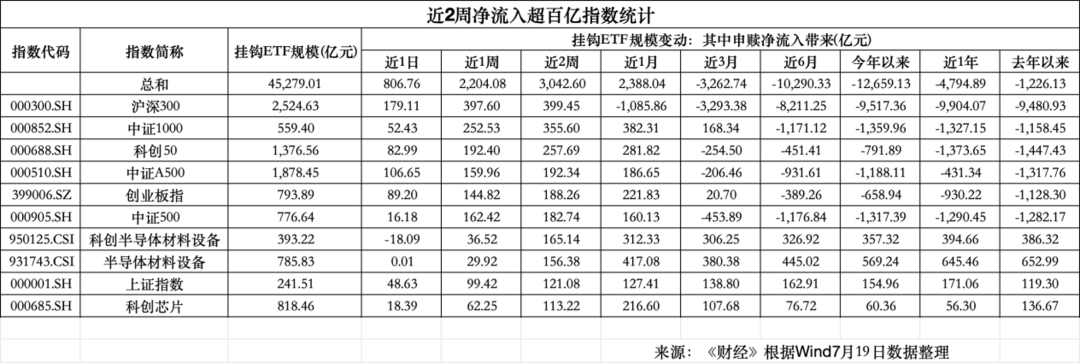
From the perspective of inflow structure, in the past two weeks, capital has been concentrated in two major directions: broad-based ETFs and technology-focused ETFs.
Broad-based ETFs are the absolute main force. In the past two weeks, ETFs tracking the CSI 300 index have seen a total net inflow of 39.945 billion yuan, ETFs tracking the CSI 1000 index have had a net inflow of 35.56 billion yuan, and ETFs tracking the CSI A500 index have recorded a net inflow of 19.234 billion yuan. The three major broad-based indices have collectively attracted nearly 95 billion yuan in capital.
In addition, ETFs tracking technology indices such as Science and Innovation Chip, Semiconductor Materials and Equipment, and Science and Innovation Semiconductor Materials and Equipment have seen a total net inflow of about 61.1 billion yuan in the past two weeks.
3
Securities Firms' Statements: Short-Term Clearing Is Nearing Completion
After the market experienced continuous adjustments, multiple securities firms have intensively released strategy research reports, conveying a converging signal.
A research report from CITIC Securities believes that the index market is in the transition phase from the consolidation of a mid-term rally to the brewing of a new round of market movement, and short-term clearing is nearing completion.
CITIC Securities analysis states that for the North American AI chain, the evolution of industrial logic has a greater impact. The shift from cycle stock valuations to growth stock valuations requires seeing a broader downstream commercial closed loop. For the domestic AI chain, sentiment and capital factors have a greater impact. The restart of the market rally needs to wait for the end of liquidity disturbances, a decline in volatility, and opportunities at the sentiment bottom. For non-AI sectors, the core still depends on overseas demand, with the trade environment being the most critical factor. The market has underestimated the potential demand shock impact of China-EU trade negotiations and the sharp depreciation of emerging market currencies, followed by the Federal Reserve's monetary policy environment. For domestic demand-related varieties, weak domestic demand is the consensus among capital. The foundation for a new round of "9·24"-style incremental policies is already in place. As defensive varieties during the adjustment process, expectation trading for the domestic demand sector has already started in advance.
"Although there are various flaws and problems, many concerns have already been recognized and priced by the market. Non-AI sectors are forming a bottom, and AI sectors are seeing compensatory declines. Under this market structure, the convergence of structural differentiation is a more likely direction, and there is no need to be pessimistic about the index," CITIC Securities stated.
Fu Jingtao, the chief strategy analyst at Shenwan Hongyuan, clearly stated that "selling pressure has been concentratedly released, and a rebound is just around the corner." He analyzed that this round of selling pressure mainly comes from three aspects: absolute return funds reducing positions to guard the break-even line and control drawdowns; small and medium investors redeeming equity products in a concentrated manner near the break-even point; and the decline in risk appetite leading to net selling of margin trading. At the same time, he judged that the negative cycle mechanism of selling pressure from absolute return funds and small and medium investors is limited, and the stability of the short-term micro-market structure may soon recover naturally.
CICC believes that the current market level may have reflected overly pessimistic expectations, and the market will once again usher in a good layout opportunity within the year. It is advisable to wait for the improvement of external narratives and liquidity in the short term, and a rebound may come at any time. "The recent market correction was mainly triggered by external factors, negative factors have been largely released, the market adjustment space has been relatively sufficient, and investors can gradually lay out the mid-term report high-prosperity sectors now."
"Since July, broad-based ETFs have seen huge net subscriptions again, and medium- and long-term funds have strongly supported the market against the cycle, acting as the market's ballast stone," West China Securities believes that the most intense phase of selling pressure has most likely passed, and the market is expected to enter a new stage of "volatility and slow recovery", with the medium and long-term market rally of the technology sector not over.
Industrial Securities judges from the crowding index that this round of adjustment triggered by liquidity and industrial narratives may be nearing completion. The crowding index tracked by Industrial Securities has sent a signal of a short-term sentiment bottom. Based on four major indicators: the magnitude of this round of adjustment, the degree of oversoldness, crowding level, and the intensity of earnings revision, Industrial Securities has selected industries that have seen significant oversoldness and continuous upward earnings revisions in this round, which may have been "mistakenly sold down". These mainly include: TMT (optical modules, optical fiber and cable, storage, panels, IDC), manufacturing (power grids, lithium battery industry chain, photovoltaic auxiliary materials, etc.), and cyclical sectors (rare earths, plastics, chemical fibers, etc.).
This article is from the WeChat public account "Du Shu Yi Zhi" (ID: dushuyizhi007), author: Huang Huiling, editor: Guo Nan, published with authorization from 36Kr.