How are major tech companies responding as AI-generated short dramas hit regulatory red lines?
I used to think the user base for AI-generated short dramas was very niche, until a friend recently told me she was hooked on them and even paid for premium access to her favorite series. That was when I realized AI short dramas have entered a phase of explosive growth.
According to relevant reports, the global AI market size reached 757.58 billion USD in 2025, and is projected to hit 900 billion USD in 2026. In parallel, the monthly penetration rate of AI short dramas among micro-drama audiences reached 36.8% in February 2026, meaning 1 in every 3 users who watch short dramas has viewed an AI-generated one.
In terms of market scale, industry analysts predict the domestic AI short drama market will exceed 110 billion RMB in the first half of 2026, with full-year revenue expected to surpass 350 billion RMB.
However, the booming momentum of AI short dramas has been cooled down by a new regulation. On July 1, the "Management Guidelines (Classification and Tiered Standards for AI Micro-Dramas)" issued by the Network Audio-Visual Department of the National Radio and Television Administration officially came into effect, marking a potential adjustment period for the AI short drama sector.
What are the underlying reasons behind the introduction of these standards? How will internet giants that control massive traffic and computing power respond to this new regulatory framework?

Image source: Internet
01
AI Short Dramas: Overly Accelerated Growth Driven by Technological Advancement
Since the start of this year, AI short dramas have dominated the short drama market with overwhelming momentum. Data shows that in the first quarter of 2026 alone, approximately 128,000 micro-dramas were launched across the entire industry, of which over 95% (around 122,000) were AI-generated. The massive volume of AI short dramas has inevitably brought about numerous irregularities.
First, copyright infringement incidents occur frequently. With AI short dramas being mass-produced, where do the "faces" of the characters come from? Many production teams use unauthorized portrait appropriation for their AI drama creation—celebrities, Hanfu stylists, dancers, and even ordinary people whose portraits can be found online have all become victims.
On April 6, 2026, Deng Wei's studio released a stern statement accusing the male character in the Red Fruit short drama *Tempting the Monarch* of bearing extremely high similarity to his portrait. On the same day, Zhang Jingyi's studio also issued a rights protection statement targeting the hit Red Fruit short drama *Step by Step Falling for You*, which had 32.53 million views.
Apart from unauthorized face appropriation, plagiarism through content rehashing is another severe problem. Some creators revealed that certain production teams make minor modifications to original short stories without permission, then use AI to generate content for monetization, and the infringers are usually held accountable only after they have already profited from the traffic.
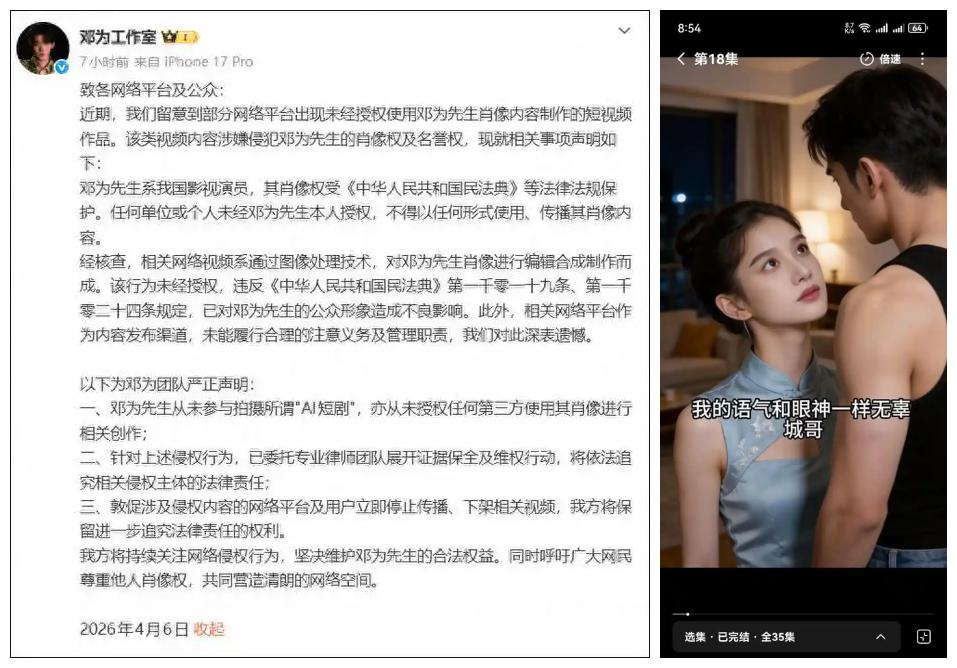
Image source: Internet collage
Second, severe content homogenization leads to the loss of human-like authenticity. Currently, over 70% of the training materials for mainstream AI short drama image and video models come from social media platforms and fashion websites. Users have reported that many AI short dramas feature identical-looking characters, and the mass-produced AI visuals only carry a cold technological feel without any trace of human warmth. This one-size-fits-all experience causes users to quickly consume and abandon the content, resulting in a cliff-like drop in retention rates.
Finally, technical flaws will backfire on AI short dramas. While traditional human-acted short dramas rely on actors' performance skills, AI short dramas are dependent on technical reliability. When a Wuhan-based AI team produced the drama *Huo Qubing*, they generated 1,700 images and went through nearly 2,000 screening processes just to select 90 usable shots, with some close-ups still requiring on-site live filming. However, not every team respects technical rigor. Many current AI-generated short drama videos fail to maintain coherence in complex movements and character expressions, and even facial features can shift inconsistently across different shots.
Amidst this chaotic landscape, China's first dedicated tiered regulatory standard for AI micro-dramas, the "Management Guidelines (Classification and Tiered Standards for AI Micro-Dramas)", has officially been implemented.
Image source: Internet
02
What Exactly Does the New Policy Specify?
So what are the core points of the "Management Guidelines (Classification and Tiered Standards for AI Micro-Dramas)"?
1. Classification based on investment amount and theme
Under the standards, AI micro-dramas are roughly divided into three categories.
Key AI micro-dramas: Productions with an investment of 800,000 RMB or more, or those involving special themes such as politics, military affairs, diplomacy, national security, united front work, ethnicity, religion, judiciary, and public security, will be subject to strict management. They must submit complete filing materials to the National Radio and Television Administration and obtain a "Network Drama and Film Distribution License" before being launched online.
Ordinary AI micro-dramas: Productions with an investment between 300,000 RMB and 800,000 RMB and covering general themes will be filed and reviewed by provincial-level radio and television authorities.
Other AI micro-dramas: General-theme productions with an investment of less than 300,000 RMB will be self-reviewed by the hosting platforms, which must submit regular reports to local regulatory authorities.
2. Clear user right-to-know requirements for AI short dramas
The standards explicitly emphasize users' right to know, just as advertisements must carry clear identifiers—this rule also applies to AI short dramas. If any of the three core links (scriptwriting, image rendering, voice synthesis) uses AI technology at a proportion that meets the specified threshold, a prominent notice must be displayed at the beginning of the drama, and it cannot be shrunk or blurred.
3. Implicit traceability information must be embedded in underlying files
While identifiers are visible to users on the front end, the production source must also be traceable on the back end. All audio and video content generated or partially produced by AI must record information such as the production entity, work ID, and AI participation ratio in the file metadata, enabling full-chain traceability from production to distribution.
4. All participating entities must hold valid radio and television program production and operation qualifications
After the standards take effect, unqualified amateur teams will no longer have room to survive—organizations without proper qualifications are prohibited from independently producing AI micro-dramas.
5. Content red lines follow existing network audio-visual management regulations, with additional strict requirements for key productions
Another key point to note is that key AI micro-dramas must undergo additional special reviews for orientation, historical accuracy, and value alignment on top of regular checks, to prevent sensitive content from spreading through low-cost AI channels.
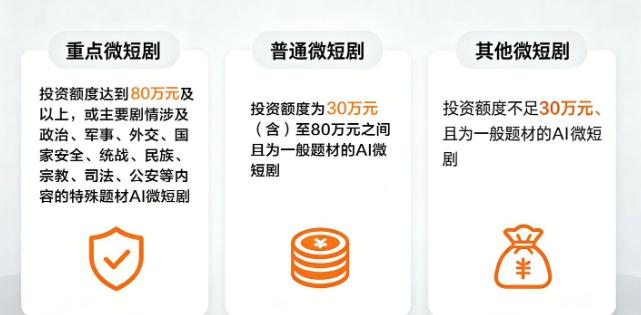
Image source: Internet
03
How Are Internet Giants Responding to the New Regulatory Policy?
Against the core requirements of the "Management Guidelines (Classification and Tiered Standards for AI Micro-Dramas)", how are the major internet platforms adapting their strategies?
Let's first look at Red Fruit, the market-leading platform under ByteDance, which has taken proactive measures. Relevant platform officials stated: "Since April 7 this year, we have implemented stricter review standards for new animated drama works, including strengthening the review of core thematic orientation, and improving the quantitative assessment mechanism for content risk levels."
One major direction is to restore human-like authenticity to content. Amidst the rapid expansion of AI short dramas, the platform is shifting its content structure back to high-quality human-acted productions. It has publicly announced a 500 million RMB special fund to support innovation in human-acted short drama content and in-depth creation of realistic themes, and is promoting transparent revenue sharing through its "Short Drama Creator Center".
The other direction is to enforce technical compliance rigorously. Leveraging its technical advantages, Red Fruit has built an AI content recognition and detection tool that automatically calculates the AI participation ratio during the content ingestion process and completes identifier verification. So far, the platform has finished comprehensive checks on 15,000 works, and has removed 670 non-compliant productions in accordance with regulations.
Rather than waiting for regulatory penalties to hurt their business, the platform has proactively resolved potential issues. After the new standards took effect in July, the mechanisms Red Fruit previously introduced perfectly aligned with the regulatory requirements.
Image source: Internet
Next is Kuaishou. With 700 million active users, the platform has no intention of exiting the AI short drama track, but is also demonstrating full compliance with regulations. Kuaishou's Short Theater has completed special inspections on over 8,000 AI animated dramas, removing more than 900 non-compliant works, primarily AI-generated content that lacked prominent identifiers. The platform has also launched an AI content support fund to seize the new market opportunity through traffic incentives and cash rewards. Meanwhile, it has deployed AI content recognition and detection tools to automatically calculate AI participation ratios during content ingestion. Projects like its "Life Service Animated Drama Season" are exploring new commercial monetization paths within the compliance framework by integrating AI technology with life service scenarios.
Douyin, another platform under ByteDance, uses an incentive system to select high-quality production capacity. It offers guaranteed incentives ranging from 10,000 to 30,000 RMB per minute, or 900,000 to 3.6 million RMB per drama, for high-rated AI human-simulation dramas, effectively reducing production risks for high-quality content creation. Its review process is also strict: a single account can upload a maximum of 30 human-acted dramas and animated dramas per day, and high-quality animated dramas have become a threshold requirement for 2026. In addition, high-rated works go through the filing process for key productions, while ordinary works follow the platform's self-review channel, directly aligning with the new regulation's three-tier classification system.
Other platforms are gaining full control over the entire industrial chain from source to end-users through deep integration with industrial bases. For example, the Taiyuan Micro-Drama Industrial Park has attracted leading enterprises including Ireader, ChineseAll, and Dianzhong Technology to settle in, providing one-stop services covering script incubation, filing review, and copyright trading, supported by specialized "Short Drama Loan" financial products and an "Instant Filing & Instant Review" green channel.
Image source: Internet
04
The Competition Focus of AI Short Dramas Shifts: From Speed to Storytelling Quality
Under the tiered classification management standards, the competitive focus of the AI short drama track has also transformed.
After July, copyright compliance will become the entry threshold for market competition. Previously, infringement had low costs and rights protection was difficult. Under the new regulatory red lines, only production entities that can provide fully traceable documentation covering original scripts, portrait authorization, and AI generation processes will successfully pass platform reviews.
Creating compelling stories and high-quality content remains the core of competition. No matter how advanced AI technology becomes, it will always serve the storyline and the audience. Many may still remember the AI human-simulation short drama *Landscape* produced by Shanxi University of Media and Communications this April, which received widespread attention and acclaim upon release. Its production team emphasized that AI is responsible for technical execution, while the story itself is the core. In other words, the plot logic and emotional resonance that captivate audiences will always take priority over technology.
For internet giants to stand out in the AI short drama market, differentiated positioning and high-quality production are the key assessment indicators. As regulations become increasingly strict and technology continues to iterate, personalized character design and premium IP development may become the competitive advantage for leading production teams. Small workshops that still mass-produce generic-looking characters using free AI models will be eliminated by both the market and regulatory oversight.
In the future, the AI short drama industry is upgrading from a traffic-driven business to a brand-driven business.
Image source: Internet
05
Conclusion
The tiered classification management implemented on July 1 has pressed the pause button on the unregulated development of AI short dramas. The wild era of mass-producing content with only 3,000 RMB in computing costs, launching unfiled productions in 5 days, and operating without any oversight is coming to an end. For the entire industry, the platforms that survive will never be those that are merely best at using AI.
For major internet giants, tiered management is both a constraint and an opportunity. After the market entry threshold is raised and industry standards are clarified, the entities that first establish robust review systems, achieve full copyright traceability, and accumulate high-quality content will seize the commanding heights in the next round of competition.