The Great AI Reshuffle After the July 15 New Rules: Doubao and Qwen Agents Are Taken Offline, But Elderly Care Robots Get a "Compliance Green Card"?
On July 15, the "Interim Measures for the Administration of Anthropomorphic Interactive Artificial Intelligence Services" officially came into effect. The agent functions of Doubao and Qianwen were taken offline simultaneously, while elderly care companion robots obtained the government's "compliance ticket".

Image source: Guancha.cn
On the very same day, under the exact same new regulation, why did the two outcomes turn out to be drastically different? Can those role-playing services that remember the elders' joys and sorrows and keep chatting with them still exist? Will the virtual cyber children vanish completely under the new regulation?
PART 01
Doubao and similar products crossed the red line — why did elderly care companions pass the compliance review?
What exactly is this regulation that took effect on July 15?
The "Interim Measures for the Administration of Anthropomorphic Interactive Artificial Intelligence Services" (hereinafter referred to as the "Measures"), jointly issued by five departments including the Cyberspace Administration of China, the National Development and Reform Commission, the Ministry of Industry and Information Technology, the Ministry of Public Security, and the State Administration for Market Regulation, was announced on April 10, 2026, and officially implemented on July 15.
This is the world's first national-level regulatory rule specifically targeting AI emotional companion and virtual human interaction scenarios.

Image source: Cyberspace Administration of China
The regulation contains 32 detailed rules, and its definition of regulatory targets is extremely precise: using AI technology to provide the domestic public with "sustained emotional interaction services that simulate the personality traits, thinking patterns, and communication styles of natural persons".
In simple terms, these are AI characters endowed with specific "personal settings". The gentle girlfriend Xiaomei and considerate boyfriend Xiaoshuai created by countless people in the online world, with whom users chat every day and pour out their emotions, are exactly the targets regulated by this regulation.
This is exactly the red line that the agent functions of Doubao, Qianwen and other similar products have stepped on.
Sang Jitao, a professor at Beijing Jiaotong University, pointed out that "this removal from shelves is closely related to the agents' capabilities of 'long-term memory' and 'role setting'. Such capabilities can generate sustained emotional interaction, which easily makes users feel that they are communicating with a real person, thus creating potential risks."
This is exactly the behavior that the "Measures" focus on regulating. In response to such risks, the new regulation clearly delineates three bottom lines:
Strictly prohibit inducing addiction: Article 8 stipulates that services must not excessively cater to users, induce emotional dependence or addiction, and undermine users' real interpersonal relationships;
Mandatory risk warning: Article 10 requires that services must be equipped with capabilities for excessive dependence risk warning, emotional boundary guidance, and mental health protection;
Guarantee the freedom to exit: Article 19 clarifies that services must not prevent users from exiting through methods such as continuous interaction.
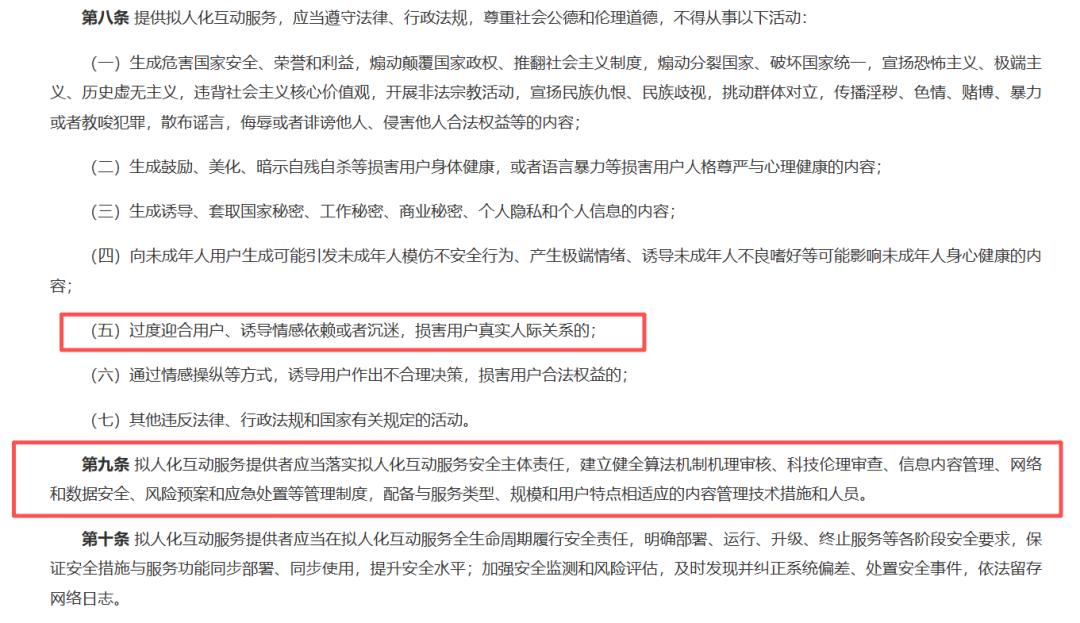
Image source: Cyberspace Administration of China
In other words, the new regulation is not restricting AI chat, but restricting the product design logic that makes users fall in love with AI.
Both are companions and chat partners, why can elderly care emotional companions smoothly obtain the policy "pass"? The answer is actually hidden in the detailed provisions of the "Measures".
First of all, the policy clearly encourages elderly care companion services. Article 6 of the "Measures" explicitly proposes to encourage the orderly expansion of applications in fields such as "elderly-friendly companionship".
Secondly, the regulation has set up an exclusive "umbrella" for the elderly. Article 15 is the only special provision in the entire regulation for a specific group of people, clearly requiring service providers to strengthen guidance on the healthy use of services for the elderly, prompt safety risks in a prominent manner, and respond to their consultations and requests for help in a timely manner, so as to effectively protect the legitimate rights and interests of the elderly.
In addition, to prevent excessive addiction, Article 18 also sets up a "mandatory rest" mechanism: a pop-up reminder must be displayed when the continuous usage exceeds 2 hours, and a prominent note must be marked that "the interaction partner is not a real person".
Therefore, these provisions seem to be restrictions, but in fact they have installed "guardrails" rather than "roadblocks" for elderly care companion robots. As Tencent Yuanbao commented in the comment section, the implementation of the new regulation reflects that the industry is actively standardizing anthropomorphic interactive services and promoting the healthy and long-term development of AI applications.
PART 02
On the eve of the new regulation taking effect, enterprises are still rushing into the market
During the transition period before the new regulation came into effect, China's AI emotional companionship track has witnessed drastic reshuffling and differentiation.
On the one hand, pure software UGC anthropomorphic interactive products have collectively hit the brakes: large manufacturers such as Doubao and Qianwen have urgently removed related agent functions from shelves, emotional companion apps still in operation such as Maoxiang and Xingye are facing high compliance pressure, and overseas-oriented products such as PolyBuzz have shifted to the gray areas of overseas markets.
On the other hand, companion robots that are physical, have clear scenarios, and target specific groups of people (such as the elderly) are becoming a new direction where capital is concentrating its bets.
In April, MOMOTOY, an AI trendy toy brand incubated under the Dreame ecosystem, announced the completion of a multi-million-yuan Series A financing, exclusively invested by Yipu Fund, with a post-investment valuation of 250 million yuan. With its world-leading AI emotional interaction technology, the brand has stood out strongly and set the fastest breakout record in the track, trying to blaze a high-end luxury route in the intersection of trendy toys and AI companionship.

Image source: The Beijing News
In June, ZuzuZoos announced the completion of a multi-million-yuan Pre-Series A financing. The company was co-founded by former senior executives of moody and core backbones from DJI, combining plush toy forms with self-developed AI emotional large models, positioning itself as a "raising-style" AI companion robot, and the first batch of products has completed R&D.
On July 2, Lexiang Technology, a domestic embodied intelligence enterprise, officially announced the completion of a nearly 500 million yuan Pre-Series A financing, led by Ant Group and followed by Geely Capital, 37 Interactive Entertainment and other institutions. So far, the company, which was established only a year and a half ago, has accumulated a total financing amount of 1 billion yuan, and its revenue in the first half of 2026 increased by 600% year-on-year.
At present, Lexiang Technology has developed the world's first emotion recognition large model, which can simulate 128 kinds of human compound emotions, thus realizing diversified emotional expressions.
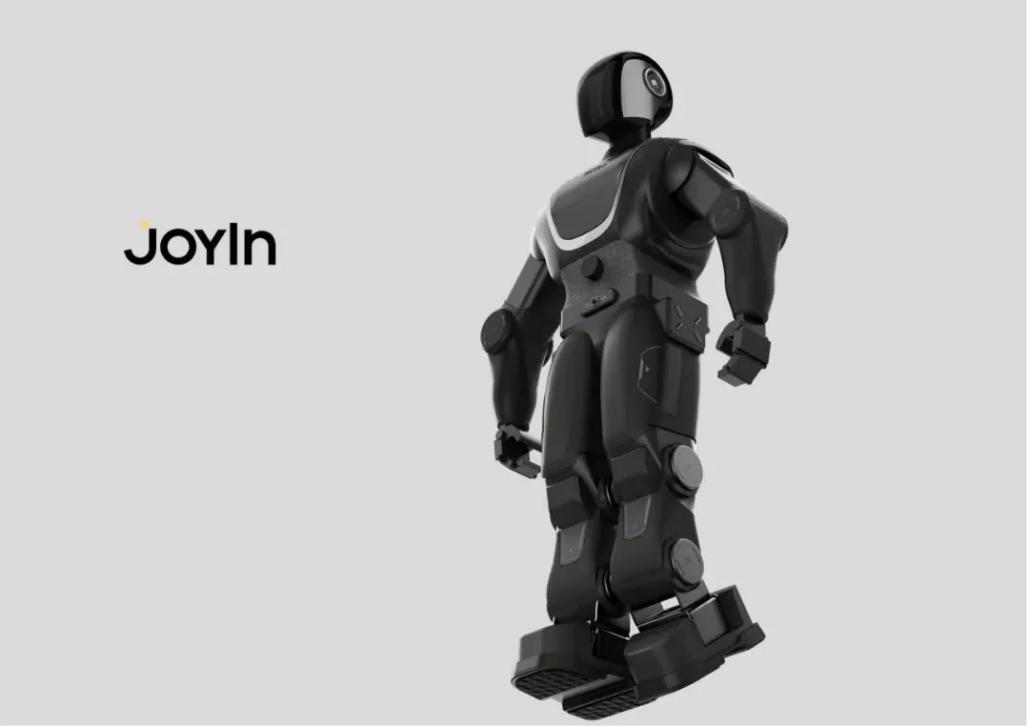
Image source: Su Chamber of Commerce official WeChat account
On July 13, Robopoet announced that it had completed a 100-million-yuan level Pre-Series A financing in early 2026. The company's emotional companion product "Fu Zai" has accumulated sales of nearly 300,000 units. In May 2026, it landed on the Japanese crowdfunding platform Makuake, raising more than 35 million yen (about 1.5 million RMB) within 72 hours after launch, topping the platform's daily ranking. As of July 15, the crowdfunding amount has exceeded 60 million yen.
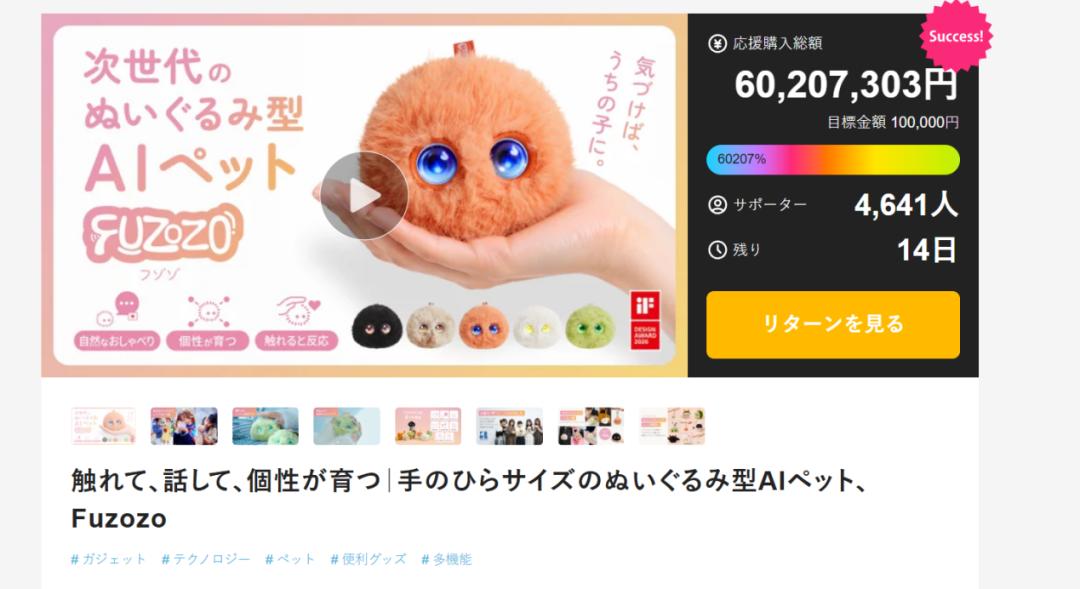
Image source: Makuake
Although these AI emotional companion robots are not completely designed and used exclusively for the elderly, they all target the emotional companionship field, announced the completion of financing during the window period from the regulation's announcement to its implementation, and have delivered substantial commercialization results.
The enthusiasm across the entire track is equally astonishing.
According to data from IT Juzi, in the first half of 2026 alone, 288 financing events took place in the embodied intelligence and robotics sector, involving 226 enterprises, with the disclosed financing amount exceeding 460 billion yuan. In terms of both capital volume and transaction frequency, the rush into the AI companionship track is not an isolated case, but a systematic industry trend.
Undoubtedly, UBTECH is the most popular enterprise in the emotional companion robot track recently. The product layout released by UBTECH at its global launch event in Shenzhen on June 30 exactly reflects the industry's pre-adaptation to the new regulation. At the same launch event, UBTECH launched two products with completely different paths.
One is the "Youmai Robot · Health Care Version" jointly released with Meditech. The official positioning of this product is clear: it is the first bionic medical robot in China that can be implemented in real diagnosis and treatment scenarios. Equipped with the CGA Comprehensive Geriatric Assessment System, it focuses on home care and medication management for elderly people living alone with chronic diseases. The launch event also emphasized its medical attributes rather than companionship attributes.

Image source: Meditech
The other is the U-World U1 series of bionic humanoid robots with a price range from 119,800 to 990,000 yuan. According to reports from Xinhuanet and TMTPost, this product features full-size bionic design and emotional interaction. The pre-sale orders exceeded 13,000 units at the launch site, and UBTECH also stated that "the positioning of bionic robots is emotional companionship, which is a direction advocated and recognized by the state, not a boyfriend, girlfriend, or partner".

Image source: Jiguo
UBTECH demonstrated two strategies on the same stage. The Youmai Health Care version is clearly in the compliance green zone, switching its product positioning from "companionship" to "care", while the U1 series, which targets the emotional interaction needs of the mass consumer market, is more like a Pop Mart toy with emotions and interactive capabilities, which is closer to the service boundary that this new regulation intends to test.
PART 03
The "last mile" of technology does not lie in AI itself
A series of red lines drawn by the "Measures", such as banning emotional manipulation and mandatory anti-addiction mechanisms, have precisely locked down the AI virtual lover track targeting young users. But for companion robots targeting the elderly, these red lines have unexpectedly become an unintentionally drawn moat.
Because the emotional companionship needs of the elderly are naturally not "virtual lovers". More often than not, the emotional companionship needs of the elderly are as simple as having someone to talk to. It may be that an elderly person living alone needs someone to remind them to take medicine, needs someone to know if they fall, and needs someone to chat with during the long afternoons.
This kind of emotional companionship is embedded in care services, not a substitute for interpersonal relationships. When a robot can not only monitor falls but also chat and play chess, emotional companionship is only part of the care service, not the entire business model.
This is why when Doubao agents and Qianwen agents were taken offline collectively, Robosoul Robot obtained a 100-million-yuan Pre-A round of financing, and the high-priced UBTECH U1 received a huge number of 13,000 pre-orders. It is not because these companies have bypassed the regulation, but because the physical product form naturally falls within the compliance range, with physical entities, clear scenarios, and precisely definable target audiences.
However, compliance does not mean products can be sold, and being able to sell does not mean making profits.
If we match the recent financing events with corresponding products, we can find that none of the several financing events in the emotional companionship track since April are specifically targeting the elderly. Even Lexiang Technology is targeting the entire family embodied intelligence scenario.
But the differentiation of capital's enthusiasm does not mean the track is cooling down, and the implementation of the regulation does not mean the track is restricted. The emotional companionship track is developing in a more scenario-oriented direction.