JPMorgan: The "AI deleveraging" in A-shares is a healthy correction, not a bubble burst.
JPMorgan believes that the recent correction in the A-share AI sector is essentially a deleveraging process rather than a deterioration in fundamentals. The proportion of financing transactions in the IT industry has declined, while tech ETFs have attracted capital inflows against the trend, indicating that deleveraging is nearing the end. The asset-liability ratios of leading cloud giants in China and the US are far lower than those during historical bubble periods, and their financial positions remain robust. The iteration of large models and persistent hardware supply constraints will extend to 2028.
JPMorgan argues that the recent correction in the A-share AI-themed sector is essentially a deleveraging process, not a signal of deteriorating fundamentals, and the long-term investment logic of China's AI ecosystem remains intact.
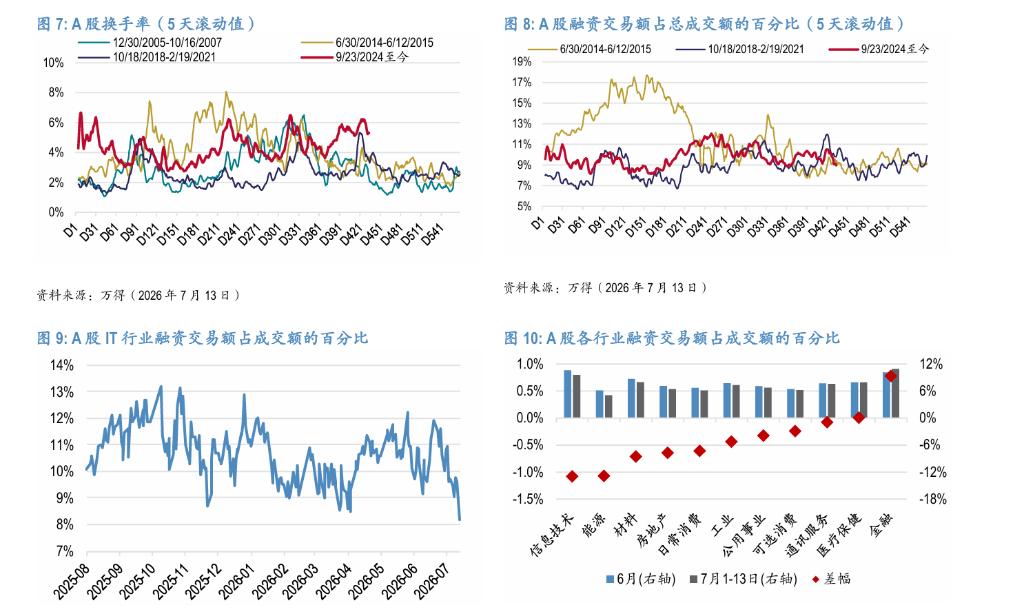
In the latest report released on July 15, Zhang Xiaoning, China Equity Strategist at JPMorgan, explicitly stated that the bank does not endorse the market narrative that "a bubble is about to burst". This judgment is supported by three key pillars: healthy balance sheets, continuous improvement in large language model capabilities, and the short-term difficulty in resolving AI hardware supply bottlenecks. From a liquidity perspective, the proportion of financing transaction volume in the A-share IT sector has dropped from a mid-cycle peak of around 12% to 8%-9%, indicating that the most highly leveraged positions have been largely forced to exit, and the deleveraging process is nearly complete.
For the market outlook, JPMorgan maintains its baseline target levels of 100 for the MSCI China Index and 5200 for the CSI 300 Index by the end of 2026, and advises investors to continue holding high-quality large-cap AI stocks amid short-term volatility, as China's AI ecosystem is expected to regain leading momentum during the August earnings season.
01
Liquidity Signals: Deleveraging Nearing Completion
JPMorgan analyzes the nature of this round of correction through two key liquidity indicators.
First, turnover has slowed but not collapsed. Although the 5-day rolling trading volume of A-shares has declined significantly from its cyclical high of around 6.5%, it still remains above the low points seen at the bottom of previous bull markets. This pattern aligns with a healthy market "de-bubbling" process, rather than a mass exodus of institutional investors. Second, margin trading deleveraging has been largely completed. The proportion of financing transaction volume in the A-share IT sector relative to total market turnover has fallen from a mid-cycle peak of around 12% to 8%-9%, meaning that the most aggressively leveraged positions built up previously have been largely forced to liquidate.
Notably, ETF capital inflows into A-shares have turned positive since early July, with semiconductor and tech hardware ETFs recording the most prominent net inflows — between July 1 and 13, the semiconductor ETF saw an average daily net inflow of 1.2 billion yuan, while the tech hardware ETF posted an average daily net inflow of 350 million yuan. JPMorgan believes this signal further confirms the judgment of a healthy correction, rather than the spread of systemic risk.
02
Balance Sheet Check: Still in a Healthy Range Compared to Historical Bubbles
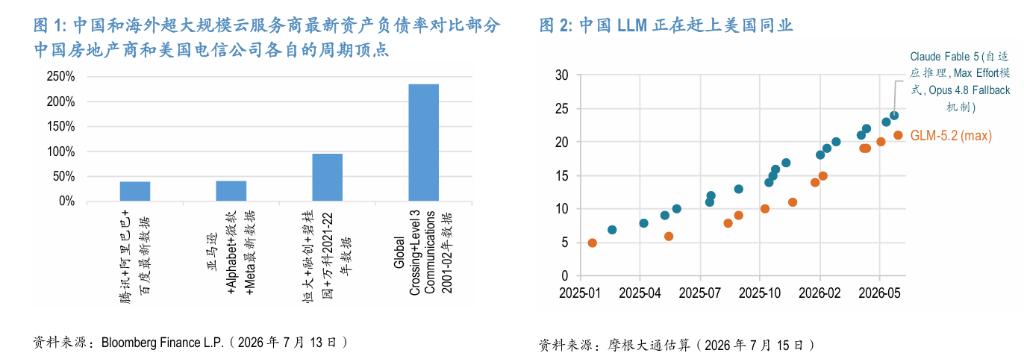
Citing Bloomberg data, JPMorgan points out that the latest asset-liability ratios of China's hyperscale cloud providers (Tencent, Alibaba, Baidu) and their US counterparts (Amazon, Alphabet, Microsoft, Meta) are all around 40%, far lower than the average leverage level of around 100% for Chinese property developers at their peak from 2021 to 2022, and drastically different from the extreme leverage of around 230% for telecom operators such as Global Crossing and Level 3 Communications during the US dot-com bubble from 2001 to 2002.
From a bond rating perspective, all the aforementioned hyperscale cloud providers maintain investment-grade ratings: US cloud giants are rated between 'A+' and 'AAA', while Chinese cloud giants fall between 'BBB+' and 'A+'. JPMorgan argues that although the option-adjusted spreads of some companies have widened slightly due to new bond issuances recently, their overall balance sheets remain robust, with fundamental differences from the financial structures seen before historical bubble bursts.
03
Technological Evolution and Demand Expansion: Upside Option Still Opening
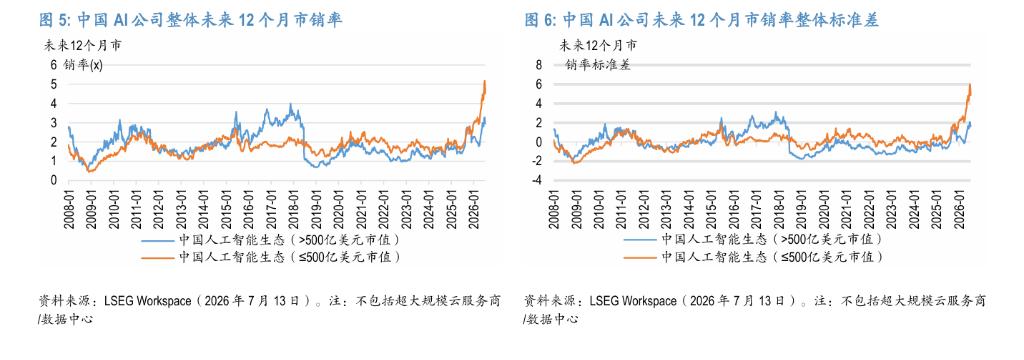
JPMorgan regards the continuous iteration of large language models as the core support for the sustainability of AI capital expenditure. The report notes that leading Chinese models are striving to catch up with the performance of top US models as of mid-2026, and each new generation of higher-performance models will unlock new enterprise and consumer scenarios, driving incremental investment in infrastructure.
On the revenue front, the annual recurring revenue (ARR) of the entire AI sector is accelerating, and order visibility in China's AI supply chain has improved significantly. JPMorgan believes that the current AI investment cycle has not yet been constrained by demand saturation, and the positive feedback loop where technological progress creates new scenarios, which in turn drives ARR growth, is still ongoing, forming an upside option for valuations.
04
Hardware Bottlenecks: Supply Constraints Will Extend at Least to 2028
JPMorgan has mapped out the mass production timeline for global AI hardware in detail, arguing that supply constraints for key components will not ease earlier than the end of 2027 to 2028, meaning the next two quarters will not serve as a window to verify the sustainability of AI capital expenditure.
In terms of global supply, TSMC's Arizona Fab 2 will begin 3nm mass production in the second half of 2027, Micron is advancing HBM memory mass production simultaneously in the US and Singapore, and the CEO of SK Hynix has warned that 2027 will see the worst memory shortage in history. The large-scale release of global HBM supply and the real alleviation of shortages are expected to materialize throughout 2028. JPMorgan believes this constraint actually strengthens the pricing power and urgency of AI infrastructure spending.
05
Strategy Recommendations: Hold High-Quality Large-Cap AI Stocks and Watch for Short-Term Rotation Opportunities
After the correction, the forward price-to-sales multiples and valuation dispersions across China's AI ecosystem have returned to more reasonable levels. JPMorgan advises continuing to hold high-quality large-cap AI stocks amid short-term liquidity volatility. In the near term, JPMorgan expects that with the earnings season catalysts from the securities, insurance, and healthcare sectors, the market in July may continue its rotation from AI to non-AI sectors.
The bank keeps its baseline target levels of 100 for the MSCI China Index and 5200 for the CSI 300 Index by the end of 2026 unchanged. JPMorgan believes China's AI ecosystem will regain market leadership in the August earnings season on the back of Q2 financial results and H2 performance guidance.
This article is sourced from the WeChat Official Account "Hard AI", author: Zhang Yaqi, editor: Hard AI, published with authorization from 36Kr.