The One-Person Company in the Limelight: Pain Points, Temptations, and Realities
From July 10th to 11th, the 2026 "China Entrepreneur" Future Star Annual Conference, hosted by the "China Entrepreneur" magazine, was held in Guangzhou. During the roundtable dialogue session, He Yifan, Deputy Chief Editor of "China Entrepreneur" magazine, held discussions around OPC (One Person Company) with Sun Zhuojian, Founder of Entropy Increase Field, Li Chun, Founder of Jiujian Technology, and Lü Shifeng, Founder of Spark Deep Intelligence.
Key Highlights:
1. A one-person company must define its clear strategy, implement actionable tactics, verify business feasibility, rapidly adjust and optimize after completing each business cycle, and build an AI operation system tailored to itself. Only in this way can it give full play to the advantage of flexible iteration of a single-person team and find a living space in the niche track.
2. In the past, top-tier tools and scarce technologies were like legendary swords, extremely rare across the entire industry; now with the popularization of AI, everyone has access to these powerful tools. However, even with equal access to tools, gaps will still emerge. Some entrepreneurs have natural talents in content creation and technical development, enabling them to maximize the value of AI tools.
3. In the past, poor business performance could be blamed on insufficient employee capabilities, but now the root cause of all problems lies with the founder themselves, and one can only blame themselves for failing to make profits. AI acts as a top-tier employee, eliminating the situation where the team holds back progress, and the threshold for product launch has been greatly reduced.
4. The biggest advantage of OPC (One Person Company) is breaking away from the traditional entrepreneurial narrative of "financing and going public", without the anxiety over valuation and expansion.
5. The definition of OPC should not be limited to a one or two-person small team. Employees in different positions within large enterprises can form independent small OPC units relying on AI, and these units collaborate in series with each other. This is also a brand-new organizational form for enterprises in the current AI-driven environment.
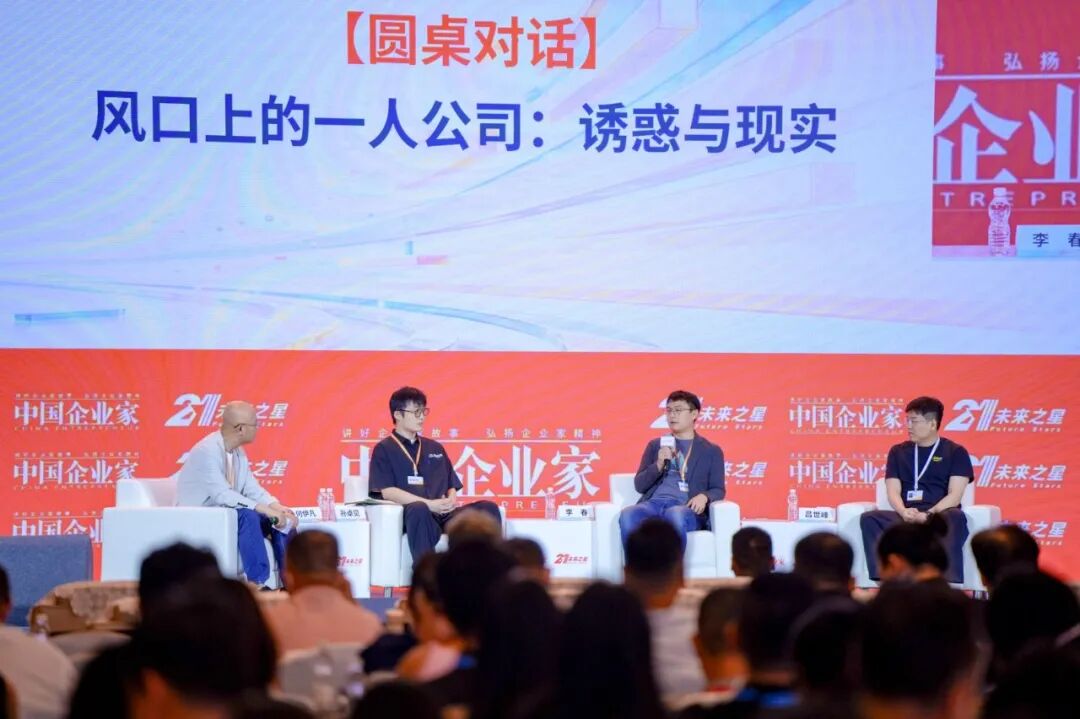
The following is the edited dialogue content (abridged):
01
How to Define "OPC"?
He Yifan: In the inherent impression of many people, entrepreneurs running OPC (One Person Company) are generally relatively young. First, please introduce yourselves briefly, talk about the main business and corporate characteristics of your company, and you can also mention your age by the way.
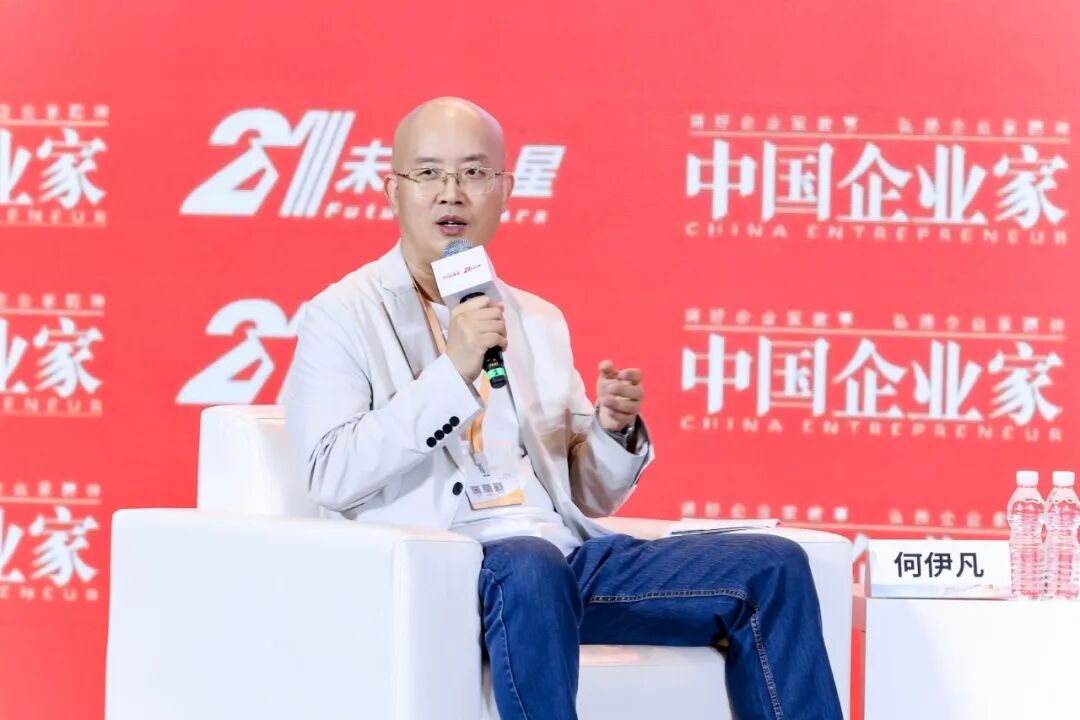
He Yifan, Deputy Chief Editor of "China Entrepreneur" magazine
Sun Zhuojian: Hello everyone, I am Sun Zhuojian, Founder of Entropy Increase Field, 30 years old this year. In fact, I had an exchange with "China Entrepreneur" magazine two years ago, specifically discussing the concept of "one person company". At that time, I strongly opposed and was not optimistic about this concept. In my opinion, although the "one person company" model can work, it is difficult to grow into a high-valuation enterprise. Two years ago, I judged that "one person company" was just a concept hyped up by capital. Now the industry has just shown initial signs of implementation, and the model is barely feasible, but it is not suitable for excessive promotion. Perhaps after a group of pioneers explore and mature the model, OPC can form a stable and mature business model that can be implemented.
At the early stage of starting my business, my team originally had about ten employees. After two years of business transformation and track adjustment, now I am the only person actually operating the company. I have always maintained a vigilant and reserved attitude towards the OPC model, but as reality has developed, my company has unexpectedly become a typical one-person company. Our company's main businesses involve smart hardware, smart spaces, and the Internet of Things, while also undertaking work related to FDE (Frontline Deployment Engineer) within enterprises.
Li Chun: Hello everyone, I am Li Chun. I studied for a dual bachelor's degree in Computer Science and Art at Peking University, then went to the United States for further study in artificial intelligence. After graduation, I worked on AI-related projects at Google Maps for many years. In 2017, I returned to China to start my business. (Jiujian Technology) is my second entrepreneurial project, currently focusing on the AI+ education track. Our self-developed product is called "Kecourse", with the core goal of creating a personalized learning system and customized learning textbooks for every K12 student. Our current cooperative clients include Shenzhen Middle School, Yew Chung International School of Hong Kong, and relevant schools in Longhua District.
In my opinion, OPC is more like the initial stage that every entrepreneur will go through. Any entrepreneur starts out alone, and only after the business model is proven feasible will they expand their team and recruit more people. I personally still agree that more people mean greater strength. For long-term development, it is still necessary to build a team and attract more talents.
Lü Shifeng: Good afternoon everyone, I am Lü Shifeng from Spark Deep Intelligence. Our company was established in 2024, and our initial plan was to develop comic and animation model tool products with GUI capabilities. At the beginning of the project, the team size was small, about ten people; after more than two years of development, the team has now expanded to more than 200 people, which is completely different from our original expectation of focusing on niche tracks and building a small, high-quality independent studio. There is still the possibility for the team size to continue expanding in the future, with the potential to grow to 500 or even 1,000 people. We have long been committed to the research and development of AI tools and models, producing animation content based on related technologies, simultaneously responsible for domestic content distribution, building our own content brand, and promoting global content export business.
In the past, when working on large-scale projects, we assigned a team of ten people to a single project; at the beginning of this year, we adjusted the project structure, with only five to six people assigned to implement a single project. As AI tools and large model capabilities continue to iterate, the manpower required for a single project keeps decreasing while ensuring delivery quality and improving overall efficiency. At this stage, we have verified that a team of two people is the optimal operational unit: the communication cost is extremely low, the decision-making chain is short, and the overall output efficiency is higher. Therefore, our company is also fully implementing the OPC one-person/two-person operation model. We will also communicate with outstanding internal employees to ask if they are willing to start their own independent companies. We will provide small-scale investments to transform the traditional employment relationship into an in-depth cooperative relationship. Of course, we have also encountered many difficulties in the implementation process.
In the long run, relying on the AI technology framework, as long as stable delivery of results can be achieved, more and more OPC one-person companies will emerge in the future market.
He Yifan: You have provided us with a brand new perspective. In fact, when evaluating an OPC one-person company, the number of team members should not be the only criterion, nor even the core evaluation dimension. After several of you briefly shared your respective backgrounds, let's move on to the first formal topic - many people are now raising a question: What is the core difference between the currently widely discussed OPC one-person company and the self-employed individuals who worked alone in the past? I think the biggest dividing line is that an OPC company must be an AI-native enterprise, and it is difficult to be defined as a standard OPC without AI-native attributes. Next, please talk about how AI empowers your own business and share combined with real implementation cases.
Li Chun: I started my first entrepreneurial venture back in 2012. At that time, I was the only person in the whole process, taking care of front-end, back-end, and design work all by myself. Occasionally I would outsource some work to others, but after all, one person's energy is limited. Now with the popularization of AI, it is like I have countless virtual employees and professional consultants. I can call on top-tier large models to plan business routes and sort out team building plans; at the same time, I independently develop multiple exclusive AI agents, some of which are responsible for operating Xiaohongshu accounts and publishing content, some automatically capture customer information, and multiple AI tools assist in code writing. The work of multiple functional positions in traditional enterprises is now all undertaken by AI. With an investment of only about 1,000 yuan in AI tools per month, we can achieve the work effect that used to require hundreds of thousands of yuan in labor costs. Therefore, I firmly believe that OPC must be a product of the AI-native track, which is also the conclusion drawn from my own practical experience.
He Yifan: How much is your company's monthly expenditure related to Tokens approximately?
Li Chun: We keep our overall expenditure relatively economical, with a fixed monthly expenditure of 400 US dollars; if the business peak exceeds the limit, we will additionally call API interfaces, and the excess API part costs up to two to three thousand US dollars, with a total of 1,500 to 2,000 US dollars per month. This amount of money is roughly equivalent to the monthly salary of a junior engineer, but it can support the operation of the entire company's business. This is our current investment situation.
This is only our company's own expenditure. If we include the AI computing power provided to customers for supporting use, the overall cost will be higher.
Sun Zhuojian: I believe that every round of productivity transformation will reshape the organizational form of enterprises. The Internet era has spawned freelancers, digital nomads, and independent developers, whose essence is that the Internet has enhanced the productivity of remote collaboration; the transformation brought by current AI has core differences reflected in three points:
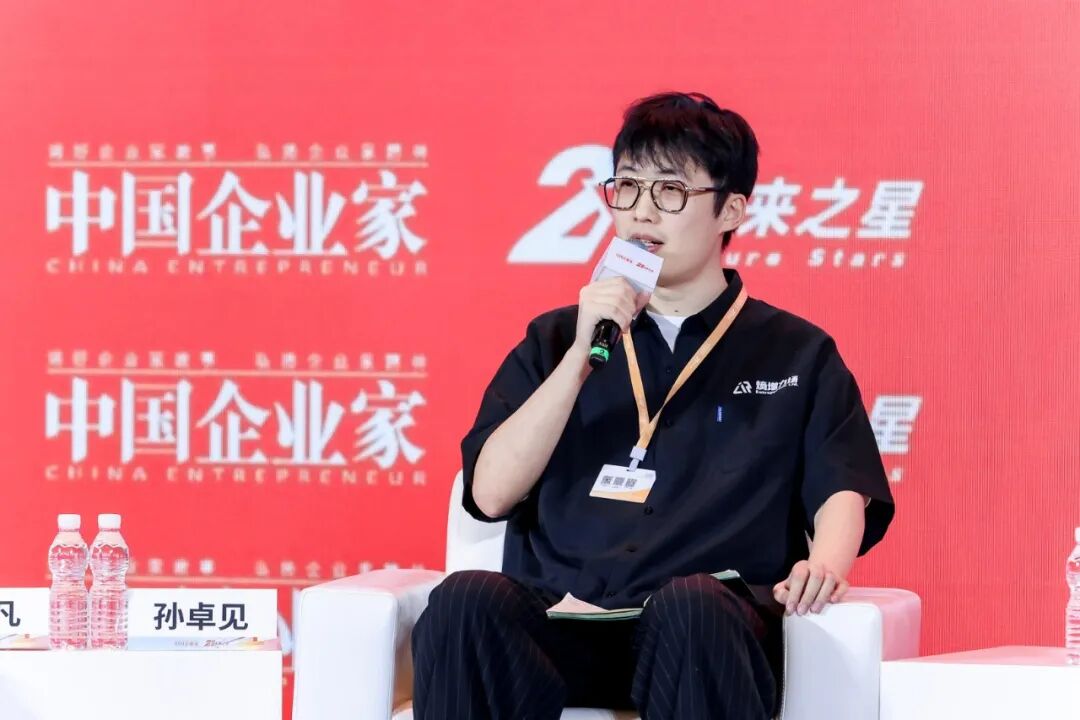
Sun Zhuojian, Founder of Entropy Increase Field
First, AI can undertake a large number of basic tasks, such as writing code, making plans, writing emails and other affairs, all of which can be handled by AI.
Second, when implementing FDE projects in many enterprises, I summarized a consensus view: in the future, all enterprises will build their own exclusive AI middle layer. Now traditional enterprises generally have the pain points of slow information flow and low execution efficiency: there are too many daily meetings, the R&D team does not know the overall strategy of the company and can only passively receive tasks assigned by the R&D director; marketing personnel do not understand technical logic, and the promotional materials they produce lack professionalism; HR does not know the real work content of each position, and the recruitment process requires repeated meetings and multiple rounds of interviews, leading to a lengthy process. After enterprises build a data and AI middle layer, they can break down information barriers across all departments and solve such inefficient collaboration problems.
Third, the AI-native operation system (Harness) has given me great inspiration. This system covers the AI work cycle logic, supporting tools, implementation paths, result evaluation standards, and the iterative optimization mechanism after evaluation, which is exactly the core operation paradigm that OPC one-person companies need to follow. A one-person company must define its clear strategy, implement actionable tactics, verify business feasibility, rapidly adjust and optimize after completing each business cycle, and build an AI operation system tailored to itself. Only in this way can it give full play to the advantage of flexible iteration of a single-person team and find a living space in the niche track.
He Yifan: Essentially, you are discussing the collaborative work model between human creators and AI agents. Shifeng, your company has a larger business volume, so your monthly Token consumption should be much higher.
Lü Shifeng: That's right, our monthly Token consumption is about 1 million, and the computing power investment in a single month during business peaks even reaches several million. AI has greatly changed the internal project collaboration model of enterprises, and the vast majority of basic repetitive tasks have been replaced by AI. In the content production process, humans only need to control the aesthetics and make the final decisions. The high decision-making efficiency of a two-person small team is also rooted in the fact that AI undertakes the underlying basic work.
The core reason why OPC one-person companies are born in batches in the AI era is that AI makes up for the shortcomings of human basic capabilities, which is equivalent to equipping entrepreneurs with a capability amplifier. The core threshold for high-quality OPC, whether it is making products or creating content, is a stable and controllable delivery capability. As long as the delivery system is mature and standardized, the OPC business model will continue to improve.
We often joke internally that in the past, top-tier tools and scarce technologies were like legendary swords, extremely rare across the entire industry; now with the popularization of AI, everyone has access to these powerful tools. However, even with equal access to tools, gaps will still emerge. Some entrepreneurs have natural talents in content creation and technical development, enabling them to maximize the value of AI tools.
A few years ago, we predicted that 30% to 40% of enterprise employees would be programmers; but after the popularization of AI code tools, enterprises do not need large-scale technical teams at all. In the past, to implement a project, a product manager needed to output requirements, organize cross-department alignment meetings, conduct multiple rounds of reviews before development and testing, and the entire process took an extremely long time; now product managers can directly use AI to complete code writing, and the entire project can be implemented in two or three days to quickly obtain market feedback.
In my opinion, the definition of OPC should not be limited to a one or two-person small team. Employees in different positions within large enterprises can form independent small OPC units relying on AI, and these units collaborate in series with each other. This is also a brand-new organizational form for enterprises in the current AI-driven environment, which is an industry change verified by our practical operations.
02
The Commercialization Dilemma of One-Person Companies
He Yifan: In the past, the competition was about scarce tools, but now everyone can get the same tools. The gap lies in the user's operational skills; at the same time, large enterprises can be split into multiple independent OPC units for flexible division and collaborative integration. This business logic is very in-depth.
Several of you just talked about how AI empowers your own business. Next, let's talk about the next practical problem: AI has lowered the threshold for product production, and OPC one-person companies can easily produce high-quality products, but it is difficult to open up a complete commercial closed loop. It is easy to make a product, but difficult to sell it, and there are a large number of practical obstacles in between. How do you view this awkward status quo in the industry?
Sun Zhuojian: I have a very typical case around me. In 2024, a friend told me that he had an excellent entrepreneurial idea, but the only thing he lacked was technical implementation, and later he started to practice it himself. When I met him some time ago, he sighed that before the AI era, poor business performance could be blamed on insufficient employee capabilities, but now the root cause of all problems lies with the founder themselves, and one can only blame themselves for failing to make profits. AI acts as a top-tier employee, eliminating the situation where the team holds back progress, and the threshold for product launch has been greatly reduced.
But I think small teams of one or two people are not suitable for the financing expansion path. There is no need to hold the entrepreneurial goal of building a large track, pursuing high valuation, or subverting the industry. This is not the development direction of OPC. The core advantage of OPC is lightweight, flexible and agile, focusing on solving real, segmented niche pain points. Many independent developers around me have built personal official websites and improved their work portfolios, with products of high completion, but they have never been able to achieve sales conversion; there are also many entrepreneurs who only rely on simple workflows to build WeChat groups, relying on private domain transfer to complete transactions, without complex technical support, but their business can operate stably instead.
Therefore,