The counterattack of Baijiu starts with Moutai's price hike
Feitian Moutai has raised its price again.
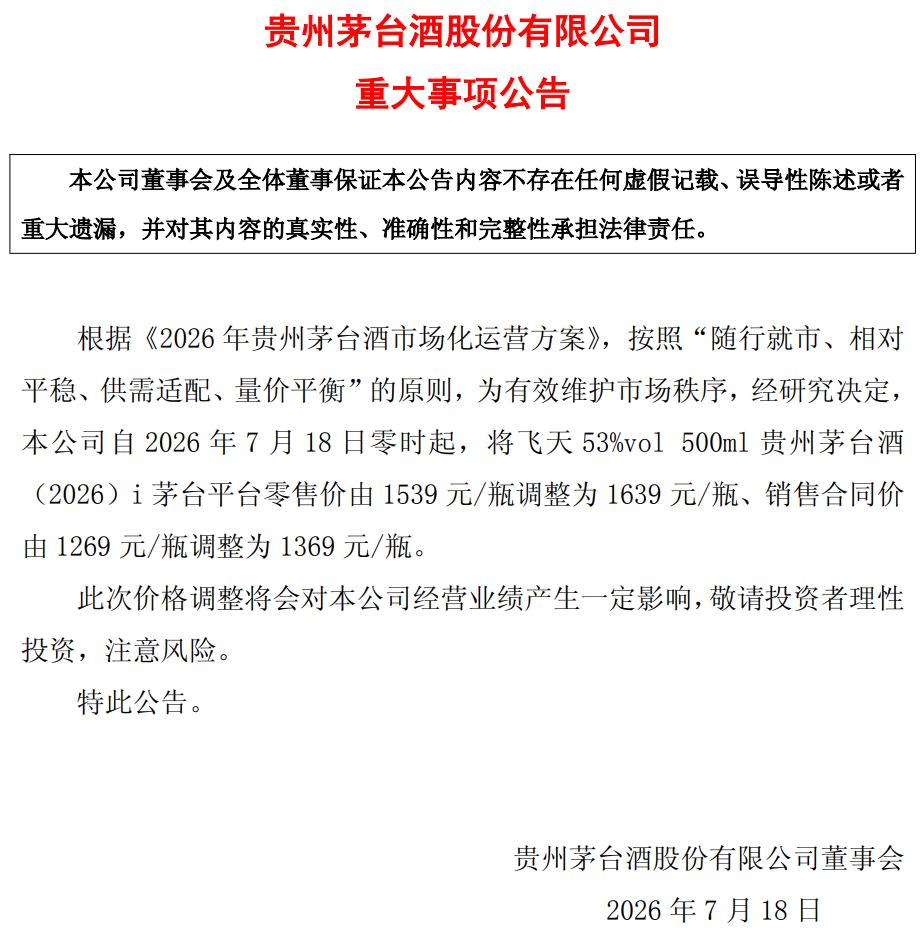
At the end of March this year, Kweichow Moutai (600519.SH) announced that the ex-factory price of 53%vol Feitian Moutai was increased from 1,169 yuan to 1,269 yuan, and the retail price was raised from 1,499 yuan to 1,539 yuan.
At that time, we made a judgment that this was not an isolated price increase, but the start of a new round of price hike cycle for Moutai.
Sure enough, three months later, Moutai raised its price again. Starting from July 18, the ex-factory price of 53%vol Feitian Moutai was increased to 1,369 yuan, and the retail price was raised to 1,639 yuan, with a 100-yuan increase for both.
After the news was announced, the wholesale price of Feitian Moutai surged. From July 18 to July 19, the price of full-case Feitian Moutai rose from 1,650 yuan to 1,720 yuan, and the price of bulk Feitian Moutai increased from 1,630 yuan to 1,680 yuan.
Over the 20-plus years of the Moutai myth, more than half of the time has been accompanied by price increases of Feitian Moutai.
Kweichow Moutai went public in 2001, coinciding with the liberalization of pricing power for baijiu. From that year to 2018, the price of Feitian Moutai was raised 10 times in 18 years, and the ex-factory price directly increased from 185 yuan to 969 yuan.
Restricting production through origin constraints on one hand, and creating arbitrage space via price increases on the other, together form the financial attributes of Moutai.
Therefore, in the years when Moutai did not raise prices, Feitian Moutai, which was in short supply, operated for a long time with a market price higher than the suggested retail price. At its peak in 2023, the bulk wholesale price of 53%vol Feitian Moutai with an ex-factory price of 969 yuan and a guided price of 1,499 yuan remained stable at around 2,700 yuan for a long time, with the terminal price exceeding 3,000 yuan, and even higher in peak seasons.
This kind of price chaos does not conform to normal market logic, nor does it serve the core interests of Kweichow Moutai. Although Moutai has made a lot of money, those in the distribution chain and those speculating on Moutai have earned even more; this will also disrupt the normal market order.
In the years when Moutai's output was stable and no price hikes were implemented, Kweichow Moutai once used two measures to drive its own performance growth: series baijiu products and direct sales.
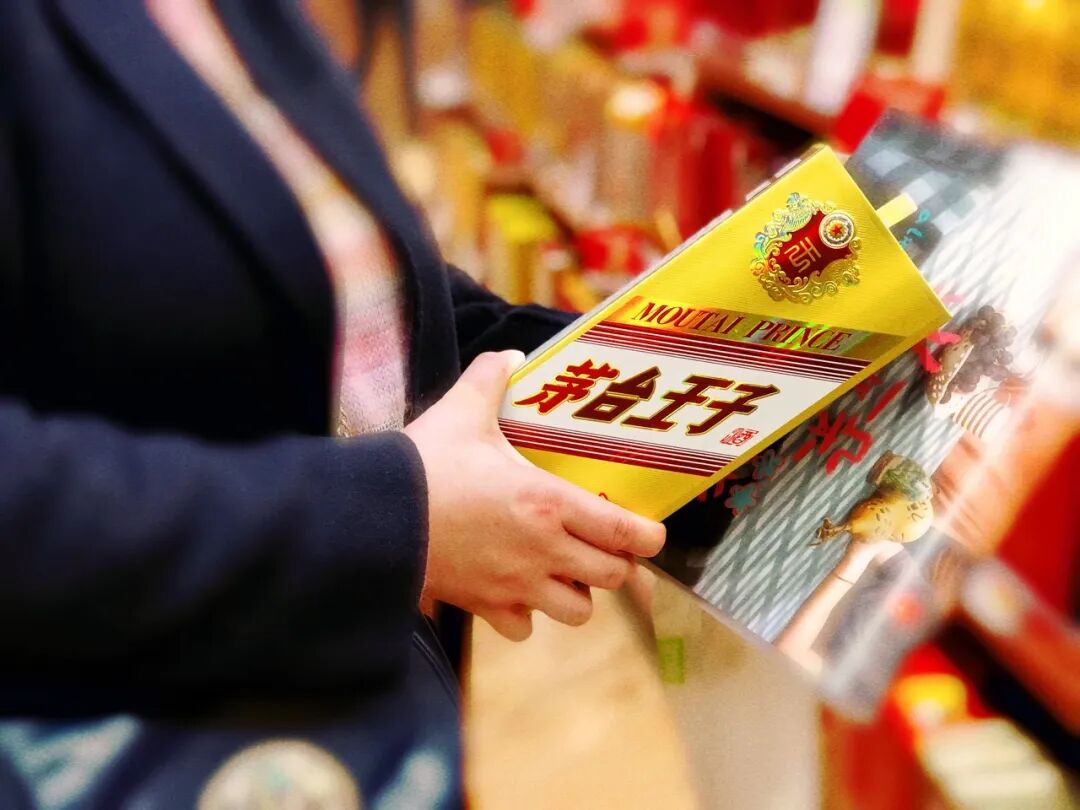
Moutai's series baijiu products include Moutai 1935, Prince Moutai, Yingbin Moutai, Lai Mao, Han Jiang, Ren Jiu, Guizhou Daqu, etc. The promotion went smoothly in previous years. After the revenue first exceeded 1 billion yuan in 2015, the scale doubled year after year; in recent years, the growth has stalled, with last year's revenue reaching 22.275 billion yuan, a year-on-year decrease of 9.76%, and the gross profit margin dropped by 3.76 percentage points. The core issue lies in Moutai 1935.
In 2022, Kweichow Moutai launched Moutai 1935 with a suggested retail price of 1,188 yuan per bottle, filling the gap in the thousand-yuan price range below Feitian Moutai, attempting to create another blockbuster product in the high-end soy sauce-flavored baijiu market.
In the year of its launch, Moutai 1935's sales exceeded 5 billion yuan, reaching 11 billion yuan the following year. However, due to the decline in Feitian Moutai's price, Moutai 1935 could not sustain its high-end positioning. In recent years, its price has dropped to 600-700 yuan, and its scale has stagnated at the 10-billion-yuan level.
For many years in the past, Moutai's sales followed two paths. One was to sell baijiu to distributors at the ex-factory price, and the distribution channels sold it to consumers at a price far higher than the ex-factory price; the other was through direct sales channels, where the company directly sold Moutai baijiu to end consumers at the retail price - which was 1,499 yuan in previous years and has now reached 1,699 yuan. Last year, Kweichow Moutai's direct sales channel revenue reached 84.543 billion yuan, accounting for more than half of the total.
The core driver of Moutai's direct sales, iMoutai, was launched in May 2022. Its user base exceeded 30 million within half a year, and now it has reached nearly 100 million people. In Q1 2026, Kweichow Moutai's operating revenue reached 53.909 billion yuan, of which iMoutai alone contributed 21.553 billion yuan.
However, promoting direct sales has undermined the livelihood of distribution channels. If the promotion proceeds too quickly as in previous years, it will inevitably trigger backlash from distribution channels and cause greater market fluctuations.
Therefore, Kweichow Moutai, which cannot find other alternatives for the time being, has no choice but to re-enter the price hike cycle. At the end of 2023, it made a single adjustment, raising the ex-factory price by 200 yuan while keeping the retail price unchanged; it was not until 2026 that it launched successive bold measures.
Moreover, this will not be the end, but the beginning of a new price hike cycle. Moutai's goal is also clear: to anchor the retail price to the wholesale price, striving to achieve "market-aligned pricing, relative stability, supply-demand adaptation, and balance between volume and price".
A 200-yuan increase in both the ex-factory price and retail price of Feitian Moutai will have a very clear driving effect on Moutai's performance. Based on the widely estimated 100 million bottles in the market, it can add 20 billion yuan in net profit to Kweichow Moutai every year, effectively alleviating its growth pressure.
In 2025 before the price hike, Kweichow Moutai delivered impressive performance but stalled in growth, with operating revenue of 168.838 billion yuan and net profit attributable to shareholders of 82.320 billion yuan, down 1.21% and 4.53% year-on-year respectively.
A simultaneous decline in both revenue and net profit is a situation that Kweichow Moutai has never experienced since it began disclosing performance in 1998. Even during the baijiu industry adjustment period from 2013 to 2015, Moutai still maintained growth. It can be seen that this round of counter-cyclical adjustment in the baijiu industry in recent years is far more severe than that of 10 years ago.
The upward movement of Feitian Moutai's price can create more space for flagship series products such as Moutai 1935, and the low-growth status of series baijiu products can also be alleviated.
At the same time, Moutai's price hike can untie the entire baijiu industry, promote the overall market price to return to a normal state, which is also of great significance to the market and the industry.
This round of baijiu industry adjustment is driven by medium and long-term factors such as consumption pressure and consumer iteration, while the short-term trigger is a vicious cycle formed by price inversion caused by inventory crisis.
Even at the end of the adjustment period, the sales prices of baijiu in the first half of 2026 saw more declines than increases, and a large number of famous baijiu brands were still trapped in the quagmire of price inversion.
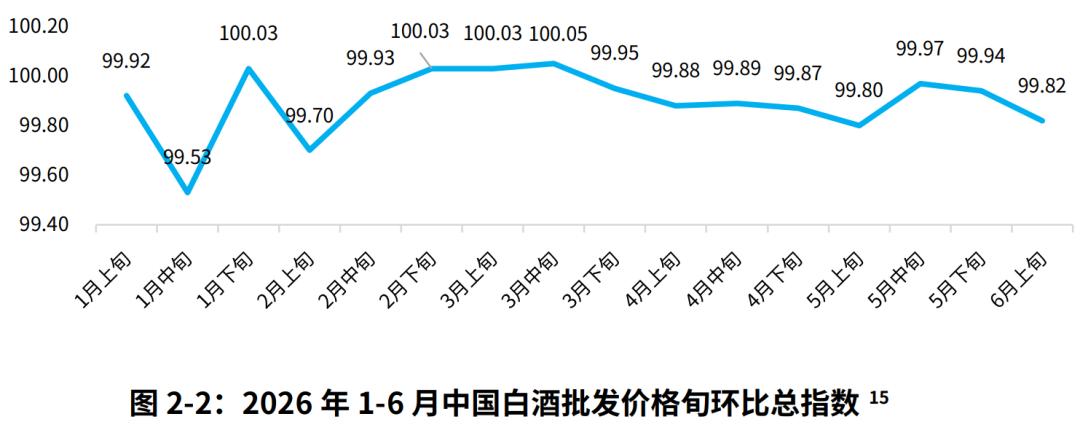
If the market can accept Feitian Moutai priced at 2,000 yuan, it can naturally accommodate Wuliangye and Guojiao 1573 priced at 1,000 yuan. All major famous baijiu brands can heave a sigh of relief in the face of current price pressure, and gradually promote the baijiu market to form a counterattack trend.
In fact, since Moutai entered the price hike cycle, many famous baijiu brands have launched price increase measures, including the Li Du series under Zhenjiu & Lidu, and the high-end series Neican of Jiuguijiu, etc.
After three years of adjustment, 2025 became the darkest hour for the baijiu industry. Judging from the data in the first half of 2026, the industry has gradually entered an inflection point. Moutai's continuous price hikes may well be the starting gun at this critical moment. However, most people at the inflection point cannot perceive this change.
If you don't believe it, you can look at the situation in 2016. At that time, the baijiu industry emerged from the 2013-2015 adjustment period and achieved overall growth through a round of comprehensive high-end transformation.
The market always exaggerates the erosion of unfavorable factors such as younger consumers and declining baijiu consumption, while ignoring its base of nearly 600 billion yuan and the possible 10-20 year transition period.
After any cycle shift, the market will never return in the same way. After the new cycle, how will the baijiu industry re-establish its foothold and where will it eventually go? That will be another story.
This article is from the WeChat official account "Zebra Consumption" (ID: banmaxiaofei), written by Yang Wei, published with authorization from 36Kr.