Apple sues OpenAI: I treated you like a brother, but you stole my trade secrets
Two years ago, Apple brought ChatGPT onto the iPhone.
Two years later, Apple dragged OpenAI into the defendant's dock.
On July 10, Apple filed a lawsuit against OpenAI in a California court in the United States:
OpenAI's hardware division io Products, along with two former Apple employees, are accused of stealing and using Apple's trade secrets.
A week later, the scope of the dispute continued to expand.
According to reports, Apple has sent legal letters to approximately 40 former Apple employees currently working at OpenAI, demanding that they preserve emails, chat records, documents, and notes, and meet with Apple's lawyers.
This does not mean all 40 individuals have become defendants, but it indicates that Apple intends to expand its investigation scope from the two employees to OpenAI's entire hardware team.
As of now, the case is still in its very early stages. Public court records do not yet show that the court has issued a substantive ruling on Apple's allegations, and OpenAI has not yet submitted a full response in public filings. All details in Apple's complaint are unilateral allegations that remain subject to discovery and trial verification.
But this lawsuit has already told a story more important than "who stole whose documents":
After large model companies enter the hardware sector, their most scarce assets are no longer just algorithms and chips, but the "industrial memory" hidden in the minds of people, factories, and suppliers.
In the AI era, what pitfalls should you avoid? Click the Pencil News - Opportunity Intelligence System below, spend 5 minutes a day, and stay updated on the latest profitable opportunities worldwide.

01
An unreturned laptop that landed a partner in the defendant's dock
Apple and OpenAI have not always been adversaries.
In June 2024, the two companies jointly announced a partnership. ChatGPT was integrated into Siri, writing tools, and Apple's visual intelligence features. When Siri cannot answer a question, it can, with the user's consent, hand the question over to ChatGPT.
At the time, this was a mutually beneficial deal.
Apple needed OpenAI to fill its large model capability gap. OpenAI, in turn, needed Apple's massive device ecosystem to bring ChatGPT to hundreds of millions of phones, tablets, and computers.
The shift happened after OpenAI decided to develop its own hardware.
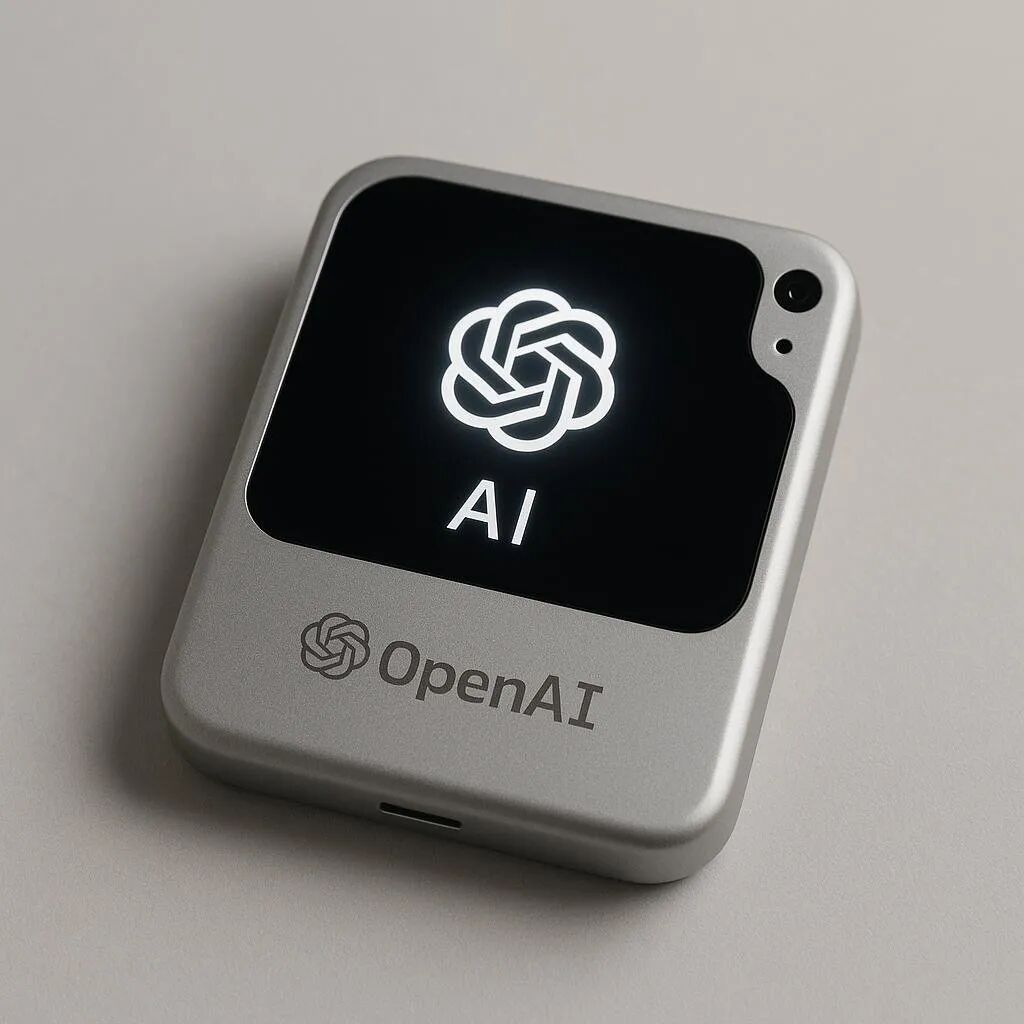
The AI hardware device co-designed by OpenAI and Jony Ive Source: stuff.tv
In 2025, OpenAI acquired io Products, a company co-founded by former Apple Chief Design Officer Jony Ive, in a deal valued at nearly $6.5 billion. The io team was subsequently merged into OpenAI to develop new consumer AI devices. OpenAI has not disclosed the product form, only stating that it aims to create a human-computer interaction method different from traditional phones and computers.
It was from this point on that OpenAI was no longer just a model supplier in Apple's eyes.
It was becoming a potential hardware competitor.
Apple specifically named two individuals in its complaint.
The first is Tang Yew Tan, who worked at Apple for 24 years, previously served as Vice President of Product Design for iPhone and Apple Watch, and worked on products including the iPhone, Apple Watch, and iPod. After leaving Apple, he joined Jony Ive's team and now serves as OpenAI's Chief Hardware Officer.
The second is Chang Liu, who worked at Apple for eight years as a Senior Systems Electrical Engineer, participating in several highly confidential hardware projects before leaving for OpenAI in January 2026.
Apple's complaint reads like a Silicon Valley spy thriller.
Apple alleges that Liu failed to return a company laptop upon his departure and did not complete the standard exit interview. After joining OpenAI, he discovered a previously unknown authentication vulnerability that still allowed him to access Apple's shared network folders.
Apple further claims that instead of reporting the vulnerability, he wrote "LOL" and "hilarious" in the device notes, then proceeded to download dozens of confidential hardware files over several weeks, including unreleased product materials, engineering demonstration files, technical specifications, and project data.
The complaint also alleges that Liu instructed a colleague still working at Apple on how to copy files without alerting the security team; told the colleague which unreleased Apple projects to review before attending an OpenAI interview; and suggested switching to private communication tools like LINE for exchanges.
This colleague later also joined OpenAI.
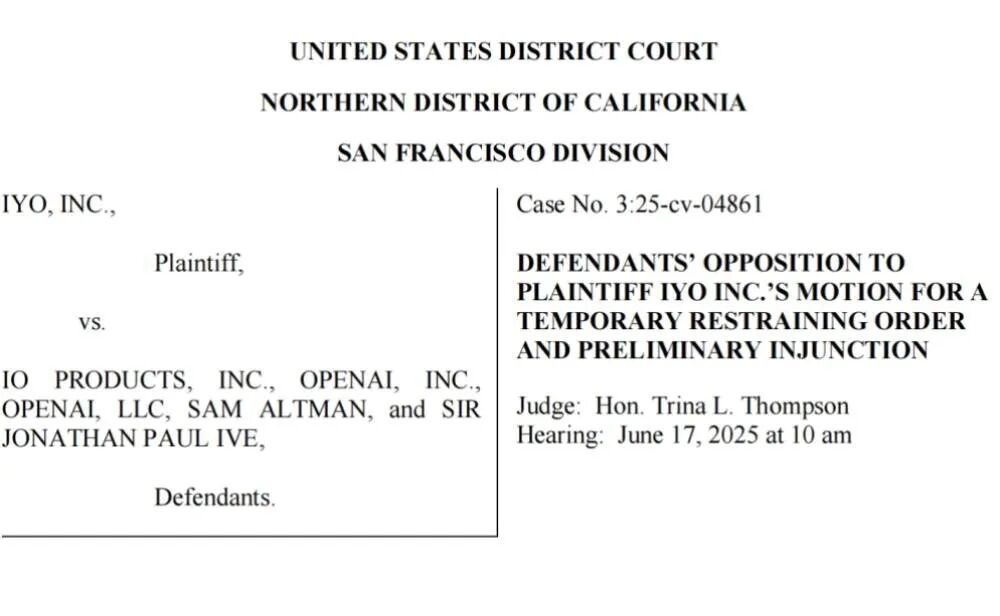
Court documents from the U.S. District Court for the Northern District of California
Apple's allegations against Tang Yew Tan are even more systematic.
Apple states that before leaving, he sent supplier information and industry analysis to his personal email; when interviewing Apple employees, he used internal Apple project codenames to ask about unreleased products; and he requested candidates to bring Apple's "physical parts", CAD design materials, and prototypes to OpenAI for "demonstration and communication".
One candidate was reportedly even surprised to say that they did not know these items could be taken out of the office.
OpenAI denies intentionally obtaining a competitor's trade secrets. A company spokesperson stated that OpenAI "has no interest in other companies' trade secrets" and is still reviewing the complaint.
02
The fundamental reason behind Apple's lawsuit
The most notable aspect of this lawsuit is not the unreturned laptop.
It is Apple's definition of "trade secrets".
What Apple is protecting is not just a single product drawing, or the appearance of an unreleased device.
It also includes material formulas, metal processing methods, component tolerances, mass production processes, supplier division of labor, device access permissions, battery and power design, and exactly which factory and which production line completes a specific manufacturing process.
Apple even alleges that OpenAI approached a long-term Apple partner and asked them to use Apple's multi-step metal surface treatment process developed over many years. The supplier reportedly mistakenly believed OpenAI had obtained Apple's permission.
OpenAI is also accused of contacting another Apple supplier involved in batteries, power, and manufacturing design, using terminology familiar only to Apple insiders to ask questions about specific components and manufacturing processes.
This reveals the most easily underestimated challenge that AI companies face when developing hardware.
Software products can start with ten people and dozens of servers.
Hardware cannot be mass-produced just by drawing a pretty sketch.
Whether a device can be made thin enough depends on how components are stacked; whether it can operate for long periods depends on heat dissipation and power consumption; the textured feel of the outer casing may be the result of dozens of surface treatment processes; and improving yield by one percentage point may require years of coordination between engineers and suppliers.
These capabilities are rarely fully documented in a single file.
They are scattered in the experience of engineers, stored in suppliers' equipment, and hidden in the countless pitfalls the company has navigated over decades.
This is what "industrial memory" means.
OpenAI may have trained a world-leading large model within a few years, but it can hardly replicate Apple's 40+ years of hardware ecosystem in the same timeframe. Acquiring a design firm and recruiting a group of Apple engineers can quickly bring in talent, but it will not automatically grant access to a mature manufacturing network.
Therefore, Apple's lawsuit essentially raises a sharp question:
When an employee leaves Apple, what belongs to their personal professional skills, and what still belongs to Apple?
They can of course take their own judgment, experience, and aesthetic sense with them.
But can they use a supplier's process that only Apple knows about? Can they tell their new employer why a certain component must use a specific tolerance? Can they rely on their memory to bypass the years of trial and error that Apple went through?
Talent can flow freely.
Corporate confidential information cannot flow along with them without restriction.
Yet it is extremely difficult to draw a completely clear line between the two.
California law has long opposed non-compete agreements, which is an important reason for the vibrant talent mobility and entrepreneurial activity in Silicon Valley. Professor Mark Lemley of Stanford Law School points out that OpenAI hiring a large number of former Apple employees is not illegal in itself; Apple must prove that specific secrets were improperly obtained or used.
Apple states in its complaint that more than 400 former Apple employees currently work for OpenAI. This number is impactful, but it alone does not prove that OpenAI stole trade secrets.
That is precisely why the legal letters Apple sent to around 40 former employees are particularly significant.
What Apple needs is not just proof that someone downloaded files. It also needs to verify whether this information has entered OpenAI's design, procurement, recruitment, and supplier systems.
03
Careful consideration is now needed for both resignations and talent poaching
Apple is framing itself as the victim.
But the 41-page complaint also inadvertently exposes loopholes within Apple.
Why did an employee get to keep a company laptop after leaving?
Why wasn't their authentication access immediately revoked?
Why did an unknown vulnerability allow a former employee to continue accessing shared folders?
Why did a departure security document marked "Need to Know" end up in a competitor's hands, and even be used to help new employees anticipate Apple's inspection processes?
From this perspective, Apple suing OpenAI is also a public acknowledgment that it had serious problems with its departure management, device retrieval, and access control systems. The complaint states that Apple later fixed the relevant authentication vulnerability, but this cannot change the fact that the most rigorous confidentiality system can ultimately fail because of a single unretrieved laptop.
This serves as a reminder for the AI industry, which is currently aggressively poaching talent.
In the past, the recruitment logic of large model companies was simple: find the best people, offer higher salaries, and get them to start working as soon as possible.
After entering the hardware sector, this logic is no longer sufficient.
Future AI hardware companies will need to establish mechanisms similar to "compliance quarantine zones". Interviews should not inquire about internal codenames, supplier lists, and unreleased products from the candidate's former employer. After new employees join, they should not immediately participate in projects that highly overlap with their previous company's work. When acquiring hardware teams, companies must also audit the sources of their laptops, cloud storage, personal emails, and supplier materials.
Otherwise, a team acquired by a company for billions of dollars may simultaneously bring billions of dollars in legal risks.
Apple is asking the court to prohibit the defendants from continuing to possess, use, or disclose its trade secrets, demand the return of relevant materials, order the payment of damages, and request a jury trial. What Apple truly aims to secure is likely far more than just compensation.
It hopes to obtain legal access to OpenAI's internal operations.
Through discovery, Apple may request access to emails, recruitment records, design documents, supplier communications, and product development timelines. In other words, this lawsuit itself could become a window for Apple to observe OpenAI's secret hardware plans. Apple sending letters to 40 former employees is precisely widening this window.
This also explains why the case is particularly troublesome for OpenAI.
If the court ultimately rules that the problem only lies with individual employees, OpenAI can isolate liability, delete materials, and even replace the relevant personnel.
But if Apple proves that the information in question has already been integrated into product design, supply chains, or manufacturing processes, OpenAI will face far more than just fines.
It may have to re-verify the source of its designs, replace partners, redo part of its engineering work, and even delay the launch of its hardware products.
Two years ago, OpenAI entered Apple's ecosystem because it had models that Apple lacked.
Now, as OpenAI seeks to break out of Apple's ecosystem and build its own end devices, it discovers that Apple's strongest moat has never been just the iPhone.
That moat is built on thousands of engineers, hundreds of suppliers, countless production parameters, and decades of experience that never made it into product launch events.
Large models have led startups to believe that intelligence can be replicated quickly.
But the hardware world is reminding them:
Some knowledge can be downloaded, but some capabilities can only be grown over time.
This article is from the WeChat official account "Pencil News" (ID: pencilnews), written by Huang Xiaogui, edited by Zhu Shanshan, and republished by 36Kr with authorization.