Summer of SK Hynix: A Country's High-Stakes AI Gamble
Thanks to memory chips, young South Koreans are starting to feel confident enough to expand their personal balance sheets of life.
In this global AI boom, if Nvidia is the undisputed top winner, then the second place undoubtedly goes to SK Hynix, the South Korean memory chip giant.
Hynix recorded quarterly revenue of 52.58 trillion won in Q1, with an operating profit of 37.61 trillion won. Its profit margin soared to 72%, surpassing Nvidia's 65% and TSMC's 58%, setting an all-time high in the global semiconductor industry. This once-bankrupt outcast, shunned even by Samsung and Micron, now ranks 15th in global market capitalization and has become the most dazzling star in South Korea.
Generous dividends have turned Hynix employees into the most sought-after new rich class in South Korea. The skyrocketing of Hynix's stock price has led to a national wealth creation effect in the South Korean stock market, and the meme of South Korea's "best era" went viral on Chinese internet platforms. Even South Korea's fertility rate has seemingly rebounded from the bottom of the global rankings to an optimistic 15% as a result.
With all these glories, Hynix officially went public in the United States last Friday (July 10, 2026), listing on the Nasdaq through American Depositary Receipts (ADRs). The financing scale reached approximately 26.5 billion US dollars, breaking Alibaba's 2014 record of 25 billion US dollars and making it the largest IPO by a foreign company in US history. The stock price rose by about 12.8% on the first day, corresponding to a market value of around 1.22 trillion US dollars.
SK Hynix CEO Kwak Noh-Jung said at the bell-ringing ceremony: "Today is a truly historic day for SK Hynix. High Bandwidth Memory (HBM) is at the core of the AI revolution."
However, while Hynix's US-listed stock hit this historic high, the South Korean domestic stock market kicked off a sharp plunge. The KOSPI index entered a technical bear market, triggering multiple circuit breakers, and millions of trading accounts were forced to liquidate. Retail investors who went all-in on leverage instantly fell from paradise into the hell of bankruptcy and debt.
South Korea's "national destiny AI stock" is now undergoing a severe financial storm test.
01
The Best Summer for South Koreans
In 2026, many South Koreans feel as if they are living in a golden age.
The epicenter of this boom is SK Hynix. Hynix's full-year profit in 2025 reached a staggering 47.2 trillion won, doubling year-on-year and surpassing its big brother Samsung. On February 5, SK Hynix distributed year-end bonuses equivalent to 2964% of base salary, averaging about 674,000 RMB per person. Some investment banks even estimated that Hynix's per capita bonus could reach 700 million won (approximately 3.2 million RMB) this year.
In April, a post titled "I'm a Production Worker at Hynix, Life is Too Sweet" on South Korea's anonymous workplace community Blind sparked widespread heated discussions.
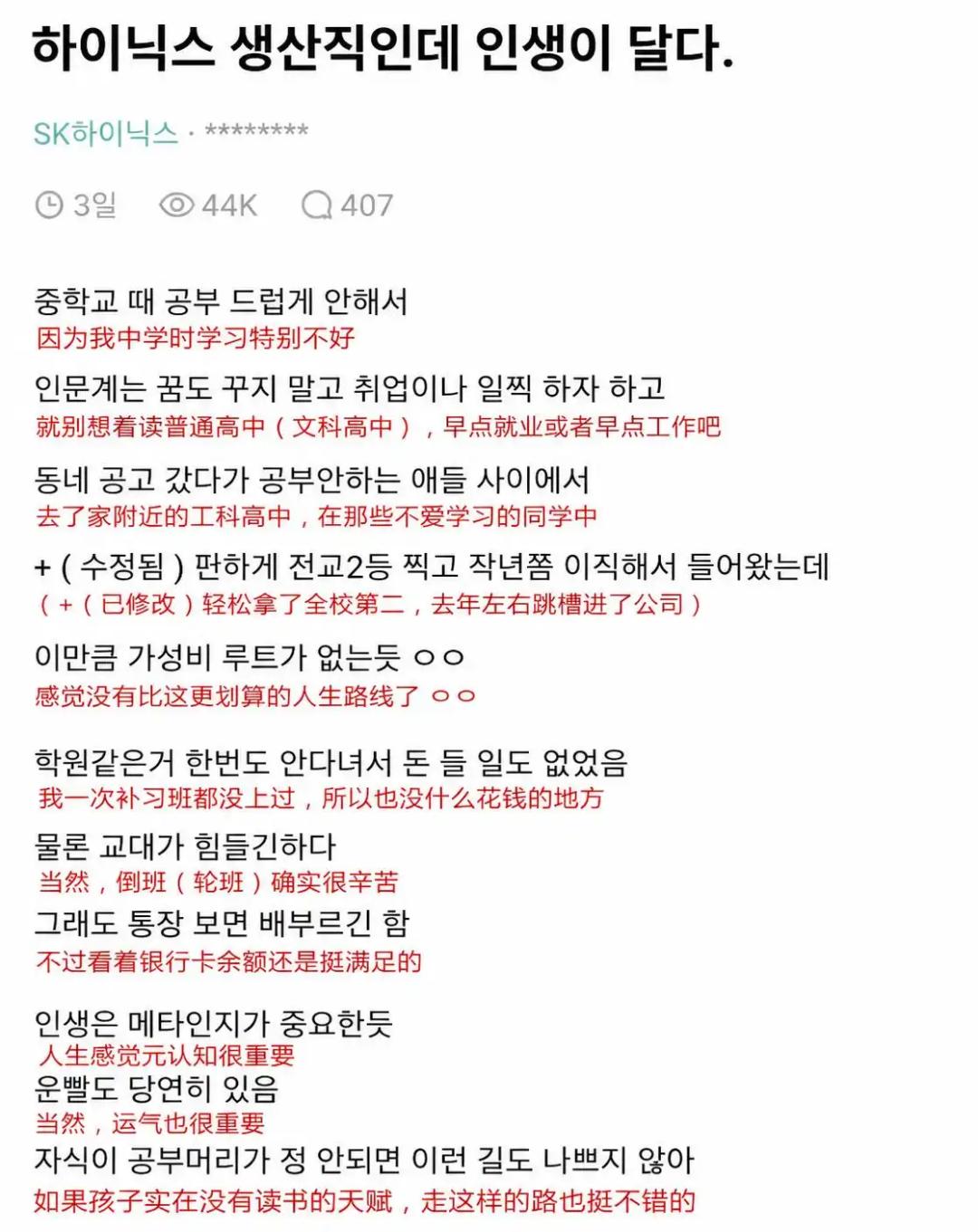
Samsung employees, whose bonuses are less than one-third of those for equivalent positions at SK Hynix, staged an 18-day massive strike, demanding improved performance rewards. Hundreds of Samsung employees jumped ship to join Hynix.
Hynix employees suddenly became the most sought-after group across all consumer industries.
Housing prices around Hynix's commuter routes have skyrocketed, surging by 100 million to 200 million won, with transaction volumes also exploding. In the first quarter, 2,470 apartments were sold in Giheu District, Yongin, a year-on-year increase of 118.7%.
In Gyeonggi Province, where South Korea's chip company headquarters are concentrated, luxury goods sales at the Shinsegae Department Store Seongnam branch surged 53.6% year-on-year, luxury jewelry sales soared 146.3%, and luxury watch sales rose 85.3%. Major high-end department stores even opened exclusive shopping channels for Samsung and SK Hynix employees.
An even more surreal piece of news is that work jackets printed with the SK Hynix company logo have become the best outfit for blind dates.
This AI feast has even spread to the entire citizen class.
South Korea's KOSPI index soared all the way from 2294 points in April 2025 to 9115 points in June 2026, nearly quadrupling in 14 months.
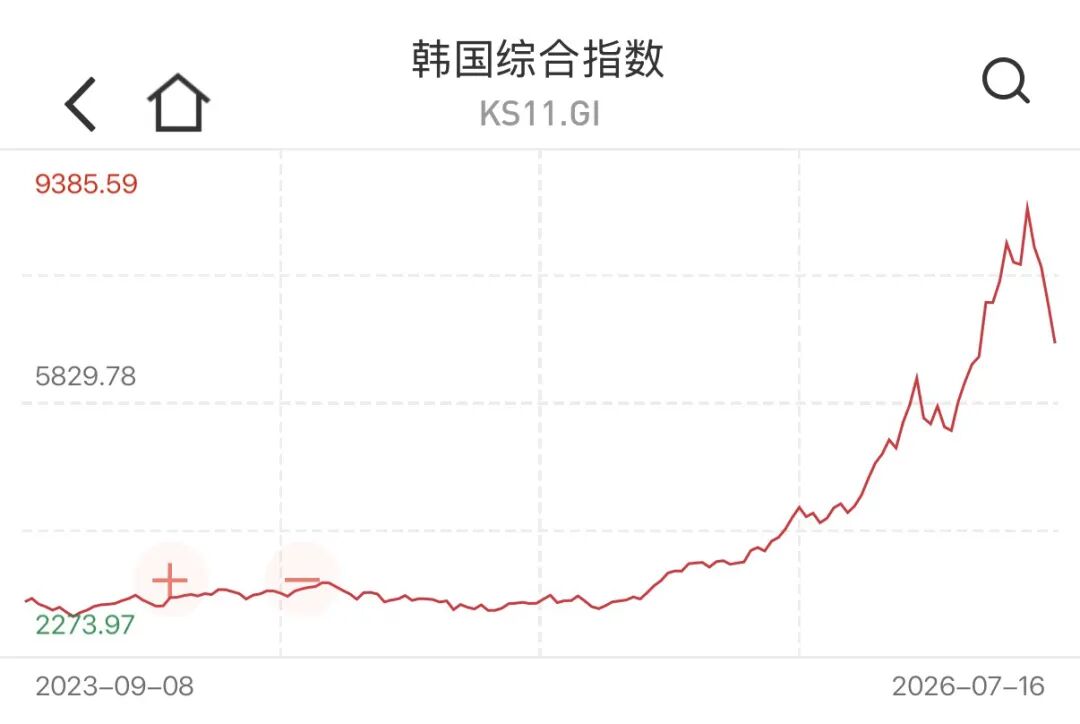
With a total national population of about 51 million, the number of stock trading accounts has exceeded 100 million, meaning two accounts per capita. In the first five months of 2026, more than 10 million new stock accounts were opened. Roughly one in every three adults is a stock investor.
The paper appreciation of South Korean households' domestic stocks and fund assets has exceeded 1000 trillion won — equivalent to 40% of the annual GDP, with per capita paper wealth increasing by nearly 20 million won.
This is a speed of wealth creation never before seen in South Korea's capital market. Many young South Koreans, trapped in the rat race of education and career, have breathed a huge sigh of relief: stock trading has opened another window for them to change their fate.
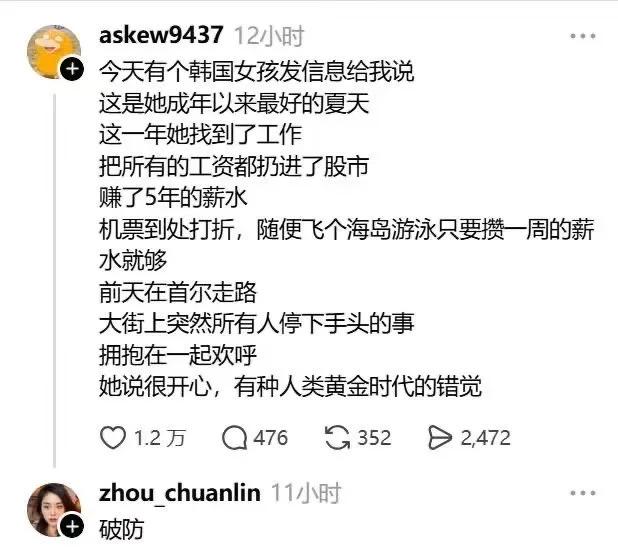
The widely circulated "golden age" meme on Chinese internet platforms
This round of stock market surge is an AI bull market, and even more so a policy bull market completely boosted by the government.
Kim Yong-beom, Director of the Policy Office of South Korea's Presidential Secretariat, proposed that South Korea should return the excess profits created by its domestic AI industry to the public. The intention is to imitate Norway's sovereign fund based on oil revenues, so that South Koreans can enjoy national "dividends" just like Norwegians do.
On May 27, 2026, when the South Korean stock market was already red-hot, South Korean regulators even went out of their way to launch 16 leveraged ETF products with twice the leverage, targeting Samsung Electronics and SK Hynix. Their goal was to allow ordinary people to "ride the lever" and "catch the ride of the memory super-cycle".
This is part of President Lee Jae-myung's series of measures to eliminate the "Korea discount". Previous measures included cutting the stamp duty from 0.3% to 0.1%, establishing a 100-trillion-won market stabilization fund, and pushing for South Korean stocks to be included in the MSCI index. The president even personally live-streamed his stock trading, explicitly stating that "the South Korean stock market is still undervalued".
Retail capital flooded in frantically. In less than two months, the total size of these leveraged products surged from 3 billion US dollars to 9.1 billion US dollars, making them the world's largest single-stock leveraged products, with retail investors holding as high as 92% of the shares.
By late June, Samsung and Hynix alone accounted for 54% of the KOSPI index's weight. The trading volume of Samsung, SK Hynix and their leveraged ETFs once accounted for 84% of South Korea's entire 4.3-trillion-US-dollar stock market in June.
The entire South Korean stock market and the wealth of South Korean residents are all tied to the Hynix + Samsung chariot.
People seemed to have forgotten the risk of a price drop. According to a report from China International Capital Corporation, the total size of the double-long leveraged products targeting Samsung and Hynix (domestic and Hong Kong markets combined) reached 46.9 billion US dollars, and the size of long positions was 206 times that of short positions — everyone was betting on the same side.
Meanwhile, since May, foreign investors have made a net outflow of 127 trillion won. Foreign investors are fleeing, institutional investors are fleeing, pension funds are fleeing — only the retail "ants" went against the trend and made a net purchase of 62 trillion won. Retail investors have become the only buyers, and the pricing power of the South Korean stock market has shifted from foreign and institutional investors to retail investors.
The bubble is getting bigger and bigger, just waiting for a slight shift in market sentiment to trigger an explosion.
02
Why Did Hynix Have to List in the US?
The plunge started almost simultaneously with Hynix's US listing.
On July 8, two days before the listing, the KOSPI index had fallen more than 20% from its June high, crossing the red line of a technical bear market. On July 13, the first trading day after the listing, the market plunged nearly 9%, triggering the seventh circuit breaker of the year. Hynix's stock price plummeted by more than 15%.
A total of 1.2 million leveraged trading accounts across the market hit the margin call line, and about 320,000 to 360,000 accounts were fully forced liquidated, with their principal completely wiped out. Leveraged ETFs magnified market fluctuations exponentially.
Ahn Cheol-soo, a member of the National Power Party and former presidential candidate, lashed out on social media: "The KOSPI has been reduced to a casino." Lee Chan-jin, head of the Financial Supervisory Service, publicly expressed regret: "I deeply regret that I didn't stop the introduction of leveraged ETFs at all costs back then."
Moreover, Samsung and Hynix's leveraged ETFs have severely distorted price signals. For example, on June 8, Hynix's leveraged ETF skyrocketed by 50% in a single day, but its underlying stock fell by 8%, resulting in an ETF premium as high as 86%.
A single company has grown so large that it has muddied the waters of its own market. The South Korean domestic market can barely accommodate Hynix anymore. Listing in the US, gaining access to a larger pool of capital, is like opening a pressure relief valve.
Another reason why SK Hynix had to go to the US is its valuation.
In the first quarter of 2026, SK Hynix recorded quarterly revenue of 52.58 trillion won, a year-on-year increase of 198%; its operating profit reached 37.61 trillion won, with an operating profit margin soaring to 72%. This is the characteristic of the memory industry: you can earn in one year what you lost over several previous years. Especially the explosive demand for HBM brought by AI allows Hynix to make profits in one year equal to the total profits of past decades.
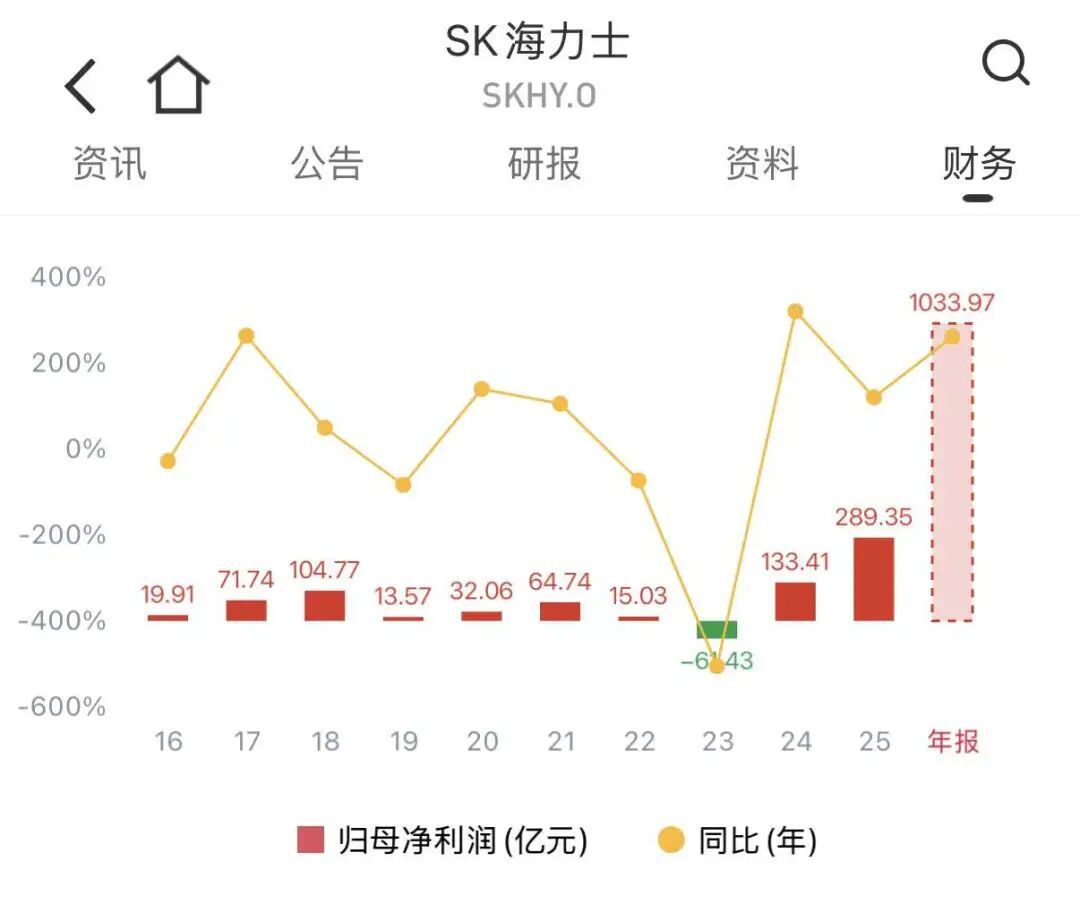
However, in the capital market, Hynix, which has a stronger dominant position in both the DRAM and HBM sectors, has long maintained a single-digit PE ratio, lower than Micron's 7 times, and far below TSMC's 20 times. A company whose profit margin can surpass TSMC only has a valuation multiple one-third of TSMC's.
The reason is simple: the market classifies it as a "memory cyclical stock". Under the shadows of Moore's Law, depreciation, and the supply-demand cycle, no matter how sharply it rises, it could collapse at any time.
Hynix only issued new shares accounting for about 2.5% of its total share capital this time, and the main purpose is not to raise money. The prospectus clearly states: diversify the investor base, obtain a "valuation that better reflects the company's value", and integrate into the "epicenter of AI innovation".
Hynix wants Wall Street to believe one thing: memory chips are no longer a cyclical business alternating between boom and bust, but a part of AI infrastructure, and should be valued as a growth stock.
The mission of value revaluation is not just the task of Hynix alone; it has become the common interest of the entire South Korean economy.
03
Hynix Steps to the Center of the Table
The memory chip industry has largely moved beyond pure market competition.
In the hit South Korean drama *Reborn Rich* at the end of 2022, the male protagonist is reborn as the youngest son of a chaebol family running the Sunyang Group. Sunyang's memory business once suffered heavy losses, and the founder hesitated whether to abandon it. In the end, the founder of Sunyang decided to raise funds against the trend, acquire overseas memory factories, and eventually monopolize the industry.
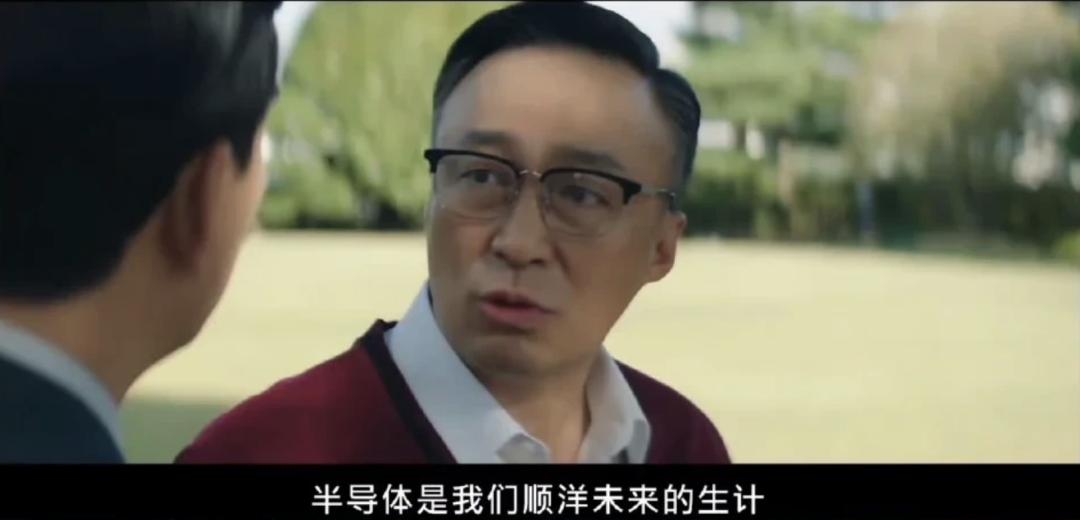
The real-life prototype of the Sunyang Group is exactly Samsung.
In the early 1980s, South Korea's per capita GDP was just over 1,500 US dollars, and its semiconductor industry was almost non-existent. At that time, Japan's share of the global semiconductor market was close to half. The United States and Japan were fighting the DRAM war, and US companies were forced to withdraw from the memory market in batches due to fierce competition from Japanese firms.
With the support of the South Korean government, Samsung and Hynix gradually narrowed the technology gap, endured years of losses, and expanded production against the trend. Japanese memory manufacturers were eventually driven into bankruptcy by South Korean companies.
South Korea has since occupied most of the memory market. The "government + market" model has kicked purely market-oriented companies out of the competition table.
In the past, demand for memory chips mainly came from PCs and mobile phones, and the expansion-overcapacity-production reduction cycle every two or three years was almost an iron law. But this time, the main driver of demand has changed — AI servers.
In 2026, servers accounted for over 50% of total DRAM demand for the first time, up from only one-third two years ago. HBM (High Bandwidth Memory) has grown from scratch to quickly become the most scarce AI component. HBM is the "highway" for GPU operation, and each GPU needs to be paired with 6 to 8 HBM chips.
South Korea has thus stood at the center of AI profits. According to estimates by US asset management firm Altimeter, the global net AI profit will reach 637 billion US dollars in 2026. The United States takes 49%, South Korea takes 35%, and the two countries share 84% of the total.
