Tencent Cloud Launches ADP 4.0 Overseas Edition, Bringing Enterprise-Grade Agents to the Global Market | Frontline
Tencent Cloud's enterprise-grade agent platform has officially gone global.
On July 18, at the 2026 World Artificial Intelligence Conference, Tencent Cloud officially launched the overseas version of its agent development platform ADP 4.0, simultaneously upgrading three core modules: the intelligent workspace, Claw Mode, and Skill Plaza, with comprehensive international adaptation across four key capabilities: reach, interaction, ecosystem, and connectivity.
ADP stands for Agent Development Platform, positioned as an enterprise-level AgentOps platform that covers the full lifecycle of agent construction, distribution, and governance.
In simple terms, it addresses the full lifecycle challenges of enterprise agents, from setup and operation to management.
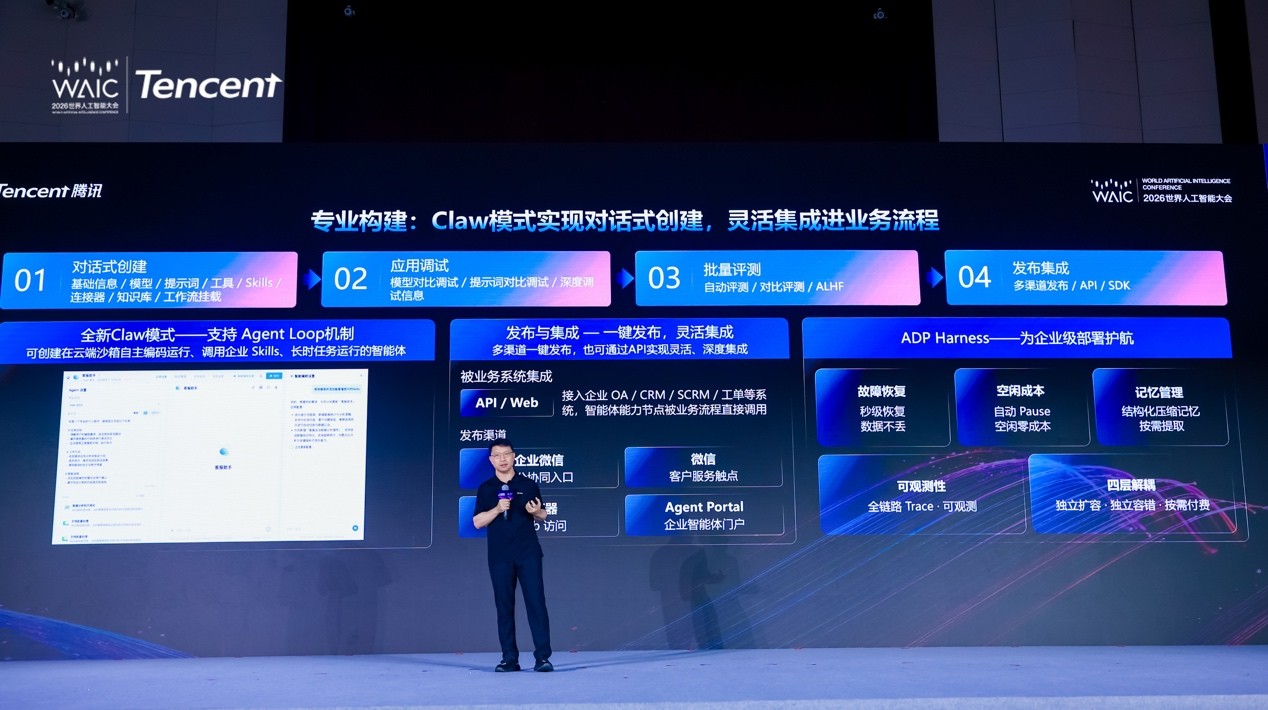
Overseas version of the Agent Development Platform ADP 4.0
The core upgrades of this enterprise-level overseas agent version focus on four areas: First, in terms of channels, Claw applications support mainstream overseas social platforms such as LINE and Telegram, enabling cross-regional reach to global users with a single release;
In terms of interactive experience, the intelligent workspace supports custom time zones and multi-region scheduling, with model outputs that automatically respond in the user's input language;
For the open ecosystem, the model plaza has integrated multiple leading international large models, and platform Skills have completed international adaptation; furthermore, the platform is deeply integrated with mainstream overseas SaaS applications such as Google Workspace, Confluence, and Jira.
A key capability upgrade in ADP 4.0 is the bidirectional interoperability between Agents and Workflows. Wu Yunsheng explained the logic behind this design in an interview: In real-world enterprise usage, some tasks are ambiguous and open-ended, making them suitable for Agent processing, which consumes more Tokens; however, certain deterministic processes can be handled via Workflows without repeated Token consumption. The combination of the two not only meets business requirements but also reduces costs.
This logic already has benchmark domestic cases. For example, Zhaogang.com built its enterprise middle-platform digital employee based on the ADP 4.0 Claw Mode, integrating with WeCom to cover scenarios including orders, logistics, finance, warehouses, and invoices. The Agent handles open-ended problem understanding, while the Workflow executes rigorous business processes, with the two collaborating seamlessly within a single application.
In overseas markets, ADP 4.0 has already achieved implementation results. Currently, a large medical group uses ADP to build an AI medical assistant covering full processes such as intelligent triage, outpatient appointment booking, and emergency risk identification. It is expected to independently handle over 80% of routine consultations and appointments, improving overall appointment efficiency by more than 50% and reducing the average patient waiting time by 30%. After another leading overseas carrier reconstructed its unified customer service platform based on ADP, overall operation and maintenance costs are projected to decrease by 30%-40%, the new business launch cycle is shortened from several weeks to several days, and application development efficiency is expected to increase by over 70%.
Wu Yunsheng stated in the interview that the number of ADP customers has at least doubled compared to last year. He attributed this growth to two factors: First, the Agent Loop capability has become stronger this year, enabling support for tasks that were previously difficult to implement; second, customers have gained widespread exposure to agent technologies in their daily lives and work, significantly reducing adoption barriers.
While ADP currently remains focused on the domestic market, its overseas expansion prioritizes regions such as Southeast Asia, with comprehensive consideration of local population size, infrastructure conditions, political environment, and bilateral relations with China. In Indonesia, Tencent Cloud has already completed multiple privatization projects, deploying agents within enterprise internal environments.
Notably, Wu Yunsheng also proposed the "Ten Industries, Hundred Scenarios Ecosystem Initiative" during the launch event, inviting ecosystem partners to enter high-frequency scenarios such as customer service, business analysis, and transaction automation, leveraging the ADP infrastructure and partners' industry know-how to bring intelligent agents to all sectors. At the same time, Tencent Cloud has also upgraded Tencent Leting's Agentic Knowledge Base as the knowledge infrastructure, forming a synergy with ADP's capability infrastructure.
In 2026, the Agent boom driven by OpenClaw has led many enterprises to rapidly integrate Agents into their production workflows. When asked about the relationship between WorkBuddy and ADP, Wu Yunsheng drew an analogy: WorkBuddy is like a personal intelligent assistant for individual employees, and enterprise managers may not be aware of what tools their staff are using; ADP, by contrast, is a cloud-integrated solution where developed agents can be published for team use, with full visibility of usage for the enterprise. The two are complementary, targeting different scenarios.
As we enter 2026, the enterprise-grade agent track is rapidly gaining momentum. Wu Yunsheng believes that what enterprises care most about is trust and control — "I need to know exactly who did what, and everything that happens afterwards must be auditable and secure." This is the core difference between ADP and consumer-grade agent products: it offers stronger governance capabilities, supports permission configuration, full-link observability and auditing, and can be directly integrated into enterprises' existing CRM or OA systems.
From a broader perspective, the launch of the overseas version of ADP 4.0 represents a key step for Tencent Cloud to export its domestically refined enterprise-grade agent capabilities to the global market. The cost-performance advantage of Chinese AI models has been recognized by overseas small and medium-sized enterprises, and the global expansion of enterprise-grade agent platforms signifies that competition has risen from the Token layer to the application layer.