A decade of serving the world is emerging as Pudu's strongest underlying advantage to advance towards embodied intelligence.
On July 17, the annual World Artificial Intelligence Conference opened in Shanghai. It is not only the weather that is scorching, but also the tangible and intangible industry competition in the exhibition halls.
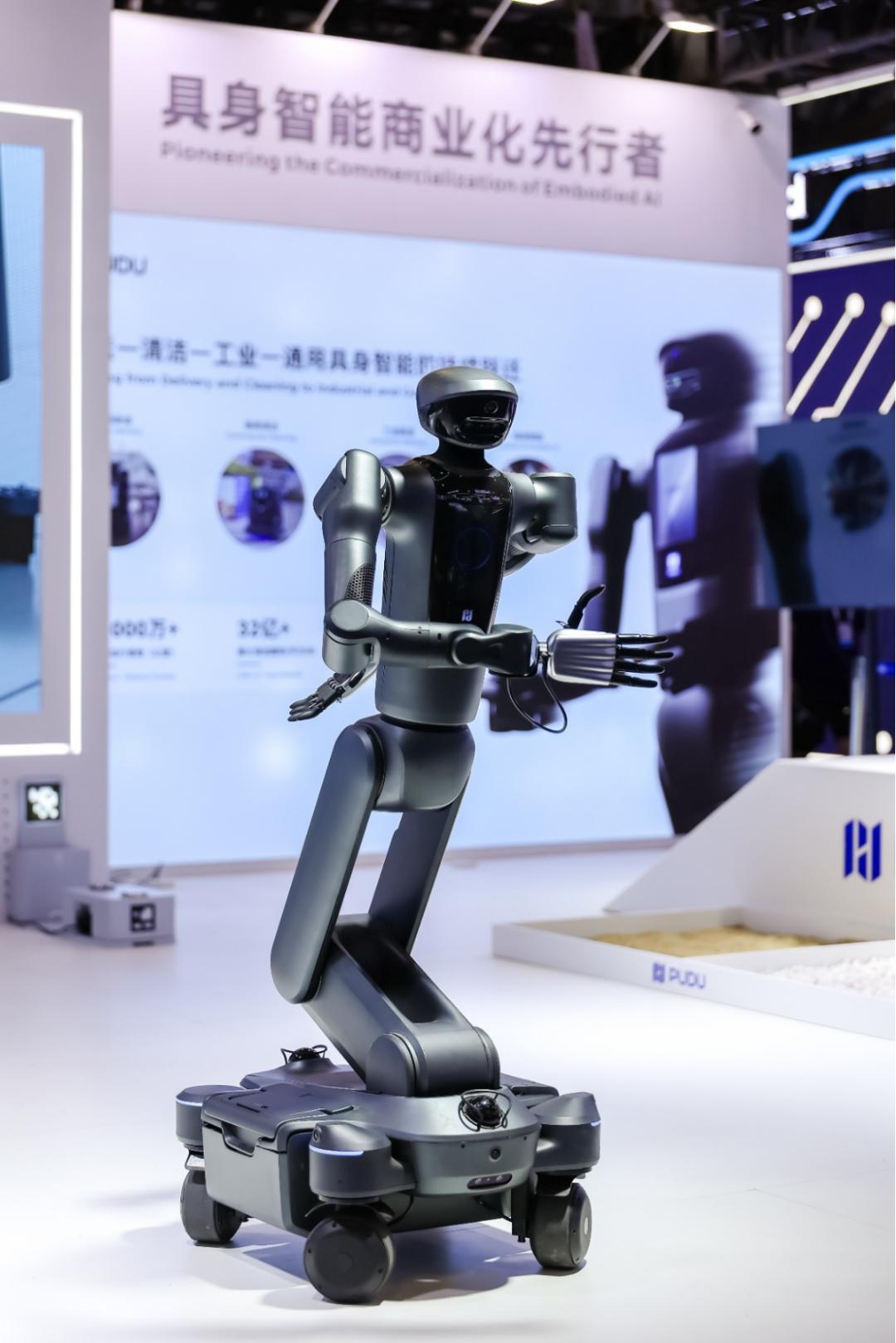
Among all exhibition zones, the embodied intelligence area saw particularly fierce competition. It is reported that 208 embodied intelligent terminals and over 300 real robots will make their debut there. Amid a multitude of robots in various shapes, a robot with dark gray matte material stands steadily in front of the crowd. It is composed of large square geometric blocks, yet designed with soft and smooth arcs at every joint transition and connection point. Its four-legged wheeled chassis allows it to move in a smooth and stable gliding posture even in complex booth aisles.
This marks the first offline appearance of Pudu D7, the humanoid-like intelligent robot developed by Pudu Robotics focusing on industrial, retail and other scenarios.
Over the past two years, the embodied intelligence industry has experienced vigorous development. The feedback from the capital market is straightforward: data from IT Juzi's event database shows that the total financing amount of China's embodied intelligence track in the first half of 2026 reached 935 billion yuan, 5 times higher than that in the first half of 2025.
Massive capital, talents and public attention are pouring into the track, while debates over industry bubbles have never ceased. Amid the hustle and bustle, some industry insiders regard 2026 as the first year of large-scale mass production of humanoid robots, as well as a critical node for commercial implementation and scenario verification. After two years of technology demonstration, what the market truly needs and is waiting for is the embodied intelligence technology that can be applied in real scenarios to solve practical problems.
No matter whether enterprises are prepared or not, the turning point has arrived. The winner will be the one that can put robots into factories, supermarkets and hospitals for practical operations at the fastest speed. Behind this competition, what is tested is no longer only the laboratory R&D capability, but also capabilities covering strategy, technology, product, commercialization, supply chain, organization and many other aspects.
As a global leader in the commercial robot sector, Pudu Robotics started its business with food delivery services a decade ago. Its services cover multiple industries including retail, hotel, manufacturing, warehousing and logistics, catering, property and real estate cleaning, healthcare, entertainment and sports, education, public transport and public services. Its total shipment volume has reached 130,000 units, with a valuation of 10 billion yuan. In this competition for embodied intelligence implementation, Pudu Robotics is responding head-on with a systematic approach of independent R&D of software and hardware, as well as efficient closed loop of data and business.
01
Multi-form and full-category product layout, dominance in the real scenario world
"Different from C-end products where you can hardly turn the tide if you lose the first battle, B-end business is a multi-round game that requires endurance rather than explosive power, allowing companies to use time to gain space through multi-category layout." Zhang Tao, founder and CEO of Pudu Robotics, said when he delivered a speech at the BEYOND Expo in Macau this May.
Pudu Robotics has implemented this strategy firmly and successfully: its product lines have expanded from service delivery robots to commercial cleaning robots, industrial delivery robots, and then to general embodied intelligent robots, with four widely-spanned product lines supporting each other.
On the earliest service delivery product line, in addition to continuing to maintain its leading position in the global market, its cumulative revenue from January to April 2026 increased by more than 100% year-on-year. Its products will also integrate AI large model and multi-modal interaction technology to realize environmental data return and intelligent decision-making. Take Bella Pro, the star product for high-end indoor delivery, as an example, it has developed functions combining retail scenarios with AI, which can realize intelligent inspection and restocking, crowd feature recognition, AI dirt detection and call linkage.
Facing a trillion-level market, the shipment volume of Pudu Robotics' commercial cleaning robots ranks firmly at the top of the industry. Its core Magic Cleaning AI Agent system can not only accurately identify special materials such as offset printing and carpets, but also realize customized recognition of special obstacles such as cotton and plastic bags. Derived functions of the system such as "garbage/stain detection heat map", "extreme speed cleaning" and "intelligent supplementary cleaning" have greatly reduced the daily deployment and operation costs for users.
In terms of industrial delivery, the sales revenue of Pudu Robotics' industrial delivery products achieved a 100% year-on-year growth in the first quarter of 2026. Among them, the main intelligent handling AMR T300 series saw its shipment volume exceed 4,000 units in the first year of launch, ranking first in the industry in terms of growth rate. The light-weight intelligent handling robot T150 also exceeded 1,000 units in the 4th month after its launch. The products have entered more than ten sub-sectors such as automobile manufacturing, electronics and semiconductors, consumer electronics, PCB manufacturing and warehousing logistics. In May this year, Pudu Robotics also officially announced its entry into the unmanned forklift market.
Zhang Tao has a clear understanding of the industry. He judges that the global industry as a whole is in a "transition period of commercial popularization of special-purpose robots and scenario verification of general embodied intelligence in laboratories". As a company that has achieved profitability and secured its leading position in the special-purpose robot track, Pudu Robotics has the confidence and strategy to take the lead in moving towards general embodied intelligence.
Pudu Robotics' embodied intelligence product matrix is divided into three lines: the first is the quadruped robot line, which has the capabilities of stunts, all-terrain obstacle crossing, autonomous inspection and following, and can be competent for tasks such as power inspection, surveying and mapping, guide and disinfection. The second is the humanoid-like robot line, which is equipped with self-developed joint modules and three-finger dexterous hands, focusing on complex dual-arm collaborative flexible operations in industrial production and commercial services. The third is the humanoid robot line, which focuses on in-depth upgrading of the two core capabilities of "ontology structure" and "bionic cerebellum", accelerating its entry into the deep water area of human production and life.
At present, Pudu Robotics' products have been widely used in 16 scenarios including retail, hotel, manufacturing, warehousing and logistics, catering, property and real estate cleaning, healthcare, entertainment and sports, education, public transport and public services. Its shipment scale and revenue continue to grow, with a cumulative shipment of more than 130,000 units, and its business covers 85 countries and regions around the world.
According to the *2025 Global Independent Market Research Report on Embodied Intelligence and Commercial Service Robots* updated by international consulting firm Frost & Sullivan on July 15, Pudu Robotics ranks first in the industry in terms of revenue, shipment volume and overseas business of global commercial service robots, with proportions of 25%, 23% and 44% respectively. In the sub-sector of commercial cleaning, Pudu Robotics' market share reached 29% in terms of revenue, ranking first. On the whole, Pudu Robotics is one of the few enterprises in the industry that has realized full-category mass production, global penetration and a clear profitability path.
A long-cycle multi-round competition tests how to use the depth of product lines to gain long-term trust from customers in the long and cruel market reshuffle. Each category expansion relies on the technology stack, scenario understanding and channel resources accumulated in the game, so as to extend the reuse capability to a wider range of robot forms and realize the leap from single-point breakthrough to platform-based layout.
Pudu Robotics' four product lines have formed a solid defense line covering all categories, which not only resists the fluctuation risk of a single market, but also builds a globally self-sustainable commercial closed loop.
02
One-brain-multi-form concept and the world's largest real data accumulation
Behind the global deployment of the full product line is a set of hard-core technical control capabilities. "Technology and business are like two legs, you can't go far without either one," Zhang Tao said.
In the embodied intelligence era that puts the highest test on technology and scenario understanding, Pudu Robotics has its own top-level planning and core formula:
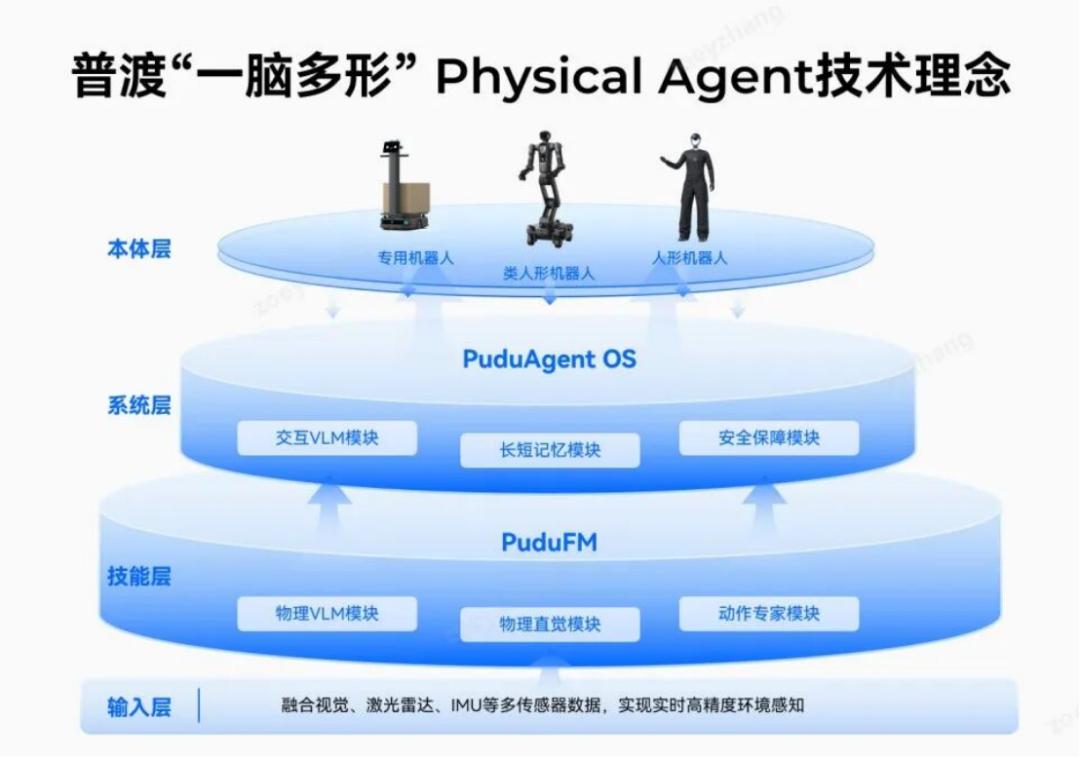
Physical Agent = Ontology + System + Skills
The embodied intelligence industry is evolving from "single execution tool" to "general physical intelligent agent". The "one-brain-multi-form" architecture is just like the ecological closed loop of "mobile phone + operating system + application App" in the mobile Internet era. Pudu Robotics hopes to reconstruct this grand blueprint in the embodied intelligence industry: the unified intelligent brain can adapt to multiple configurations such as special-purpose, humanoid-like and humanoid, greatly reducing the R&D threshold and improving the adaptation efficiency.
For a long time, the real implementation of embodied intelligence is facing three major bottlenecks: the first is the architecture fragmentation of "uncoordinated hands and feet", where navigation is responsible for movement and operation is responsible for manipulation, and the lack of a unified center leads to frequent disconnection of complex tasks. The second is the lack of physical intuition: robots can see objects but do not understand common sense such as gravity and friction, so they are like blind men touching elephants in fine operations. The third is that robots of different configurations train their own dedicated models, and the model capabilities cannot be transferred across forms. The deeper crisis is that the massive real data generated in each scenario is fragmented and cannot form a joint force.
To solve these problems, Pudu Robotics has developed the embodied intelligence base large model PuduFM, which builds three core technical dimensions: in-depth perception and reasoning of 3D space, future-oriented physical state prediction, and a learning mechanism that continuously evolves in real interaction. Based on the understanding of the physical world, it supports the unified operation of heterogeneous machines, realizing the leap from "execution" to "cognition". In layman's terms, PuduFM hopes to help robots understand the physical world.
On the other hand, if robots want to achieve large-scale implementation, a unified physical intelligent agent system must be provided, so that developers can flexibly build existing capabilities like combining standard modules to quickly build applications, instead of reinventing the wheel every time. Therefore, Pudu Robotics has built PuduAgent, a general embodied intelligent agent platform for the physical world. If PuduFM is responsible for letting robots understand "how to work", then PuduAgent is more like the "task brain" of robots. It can further understand user task goals, independently disassemble complex processes, dynamically call different capability modules such as navigation, operation and perception, and cooperate with multiple robots to complete long-distance complex tasks across regions and processes.
On top of this unified underlying model, robots of different forms are like different avatars sharing the same "intelligent brain": greeting robots understand proper smiles and subtle gestures, delivery robots independently plan the optimal path to complete accurate delivery, and cleaning robots perceive the ground material and environment in real time to dynamically adjust strategies.
This means that the technical precipitation accumulated by Pudu Robotics in the delivery scenario can be efficiently transferred to new fields such as cleaning and industry. With only a small amount of targeted training, it can realize rapid development of new products and consistent experience, fundamentally reshaping the R&D paradigm and implementation efficiency of service robots.
The one-brain-multi-form architecture builds an exquisite skeleton, and data is the blood that makes the skeleton grow muscles. The scale and quality of data determine the upper limit of the capability of the embodied intelligence model, and the efficiency of data acquisition will affect the iteration speed of the model.
However, for the industry, a well-known pain point is the lack of data in real scenarios. Simulation data has limitations, and the cost of real machine data is too high. Tesla can obtain massive road test data by virtue of hundreds of thousands of running cars, but in the field of embodied intelligence, no enterprise can deploy hundreds of thousands of robots in the real world out of thin air.
And this just constitutes Pudu Robotics' irreplicable advantage. As an embodied intelligence company with extremely large robot navigation data assets around the world, Pudu Robotics relies on 130,000 commercial robots deployed globally to generate a cumulative total of 50 million hours of real machine data every year, including 36.5 million hours of real, effective and diverse navigation data.
At the fine-grained "operation data" level, the teleoperation data commonly used in the industry is expensive and inefficient. Handheld collection is prone to distortion of human movements due to configuration differences. To solve this problem, Pudu Robotics proposes a non-inductive collection solution.
Pudu Robotics cooperates with global channel partners and customers to deploy non-inductive collection devices. Operators do not need to change their daily work habits, and can complete data collection in daily operations, with a single person producing up to 1580 hours of data per year. Through ecological cooperation to quickly aggregate 1000 partners, a flood of 15.8 million hours of operation data can be formed every year.
This mode of "scenario is collection, work is data" not only reduces the data collection cost by an order of magnitude, but also ensures the physical authenticity and natural movement of the data. Relying on a large amount of non-inductive collection data, PuduFM can quickly learn a large number of prior knowledge and operation concepts. On this basis, by using correction data and fault data for reinforcement learning fine-tuning, it can support large-scale online distributed strategy update and continuous evolution of robots.
The one-brain-multi-form technical architecture, combined with the real-world data flywheel constructed by the deployment of more than 130,000 real machines around the world, means that Pudu Robotics' understanding of real scenarios and data accumulated in different industries can be transferred to "general embodied robots", realizing cross-product line technology reuse of special-purpose, humanoid-like and humanoid robots.
03
The new humanoid leap opened by PUDU D7
In the implementation spectrum of embodied intelligence, if the delivery scenario tests the autonomous movement and path planning capabilities of robots in 3D space, then more complex real operation scenarios further test robots' understanding and operation capabilities of the physical world — not only to "reach the destination", but also to "grasp accurately, place stably and perform well". This means that robots need to complete the leap from "leg capability" to "hand-brain coordination capability".
At present, embodied intelligent robots are accelerating their entry into real operation scenarios such as industrial manufacturing, warehousing and logistics, and retail supermarkets, but the industry is still facing different explorations on technical routes.
Traditional industrial robotic arm manufacturers try to improve flexible operation capabilities by introducing large models, but they are limited by fixed working space and lack autonomous movement and environment perception capabilities. Humanoid robot startups hope to cover more scenarios with a general form, but the stability, maintenance cost and supply chain maturity of the biped structure in long-term and high-frequency operations still need further verification.
PUDU D7, which made its debut at this year's WAIC, provides another idea for the implementation of embodied intelligence.
As a new generation of humanoid-like intelligent operation partner created by Pudu Robotics for real operation scenarios, PUDU D7 adopts the technical route of "omnidirectional mobile chassis + flexible dual arms", combining the fine operation capability of dual arms with the stability and high efficiency of the mobile platform, achieving higher operation reliability and scenario adaptability while taking into account dexterous operation.
At present, D7 can support a maximum load of 14kg and an operation height of 2 meters, and can complete complex tasks such as material handling, shelf picking and placing, and in-site transfer. It can not only meet the high-frequency operation requirements in industrial manufacturing scenarios, but also gradually expand to more real commercial environments that require mobile operation capabilities such as warehousing, logistics and retail supermarkets.
For high-precision tasks such as dispensing and precision assembly, D7 is equipped with high-precision tactile sensors, which can perceive contact force and pressure feedback in real time, realizing millimeter-level force control adjustment capability. The system can dynamically adjust the force application mode according to different materials and working conditions, maintain stable output in scenarios such as fine grasping, gentle pressing and precise force application, and avoid workpiece damage caused by improper force application. At the same time, the equipment has stable thrust output capability, which can independently complete operation tasks such as cart placement and cargo transfer, further improving the operation efficiency of warehousing, logistics and production sites.
More importantly, D7 is not only a product, but also an important practice of Pudu Robotics' "one-brain-multi-form" technical system in real operation scenarios. In the process of performing tasks such as handling, grasping, picking and placing, the robot continuously collects multi-dimensional data such as environment perception, action execution and human-robot interaction, forming a data closed