Defeated Fable 5! Kimi K3 claims the top spot, Professor Yang Zhilin is brimming with pride.
Reported by Zhidx on July 17, Kimi has officially released Kimi K3 today, the world's first open-source model with the strongest capability so far at the 3 trillion parameter level. This model boasts a parameter count of 2.8 trillion, natively supports visual understanding, and is equipped with a 1 million token context window.

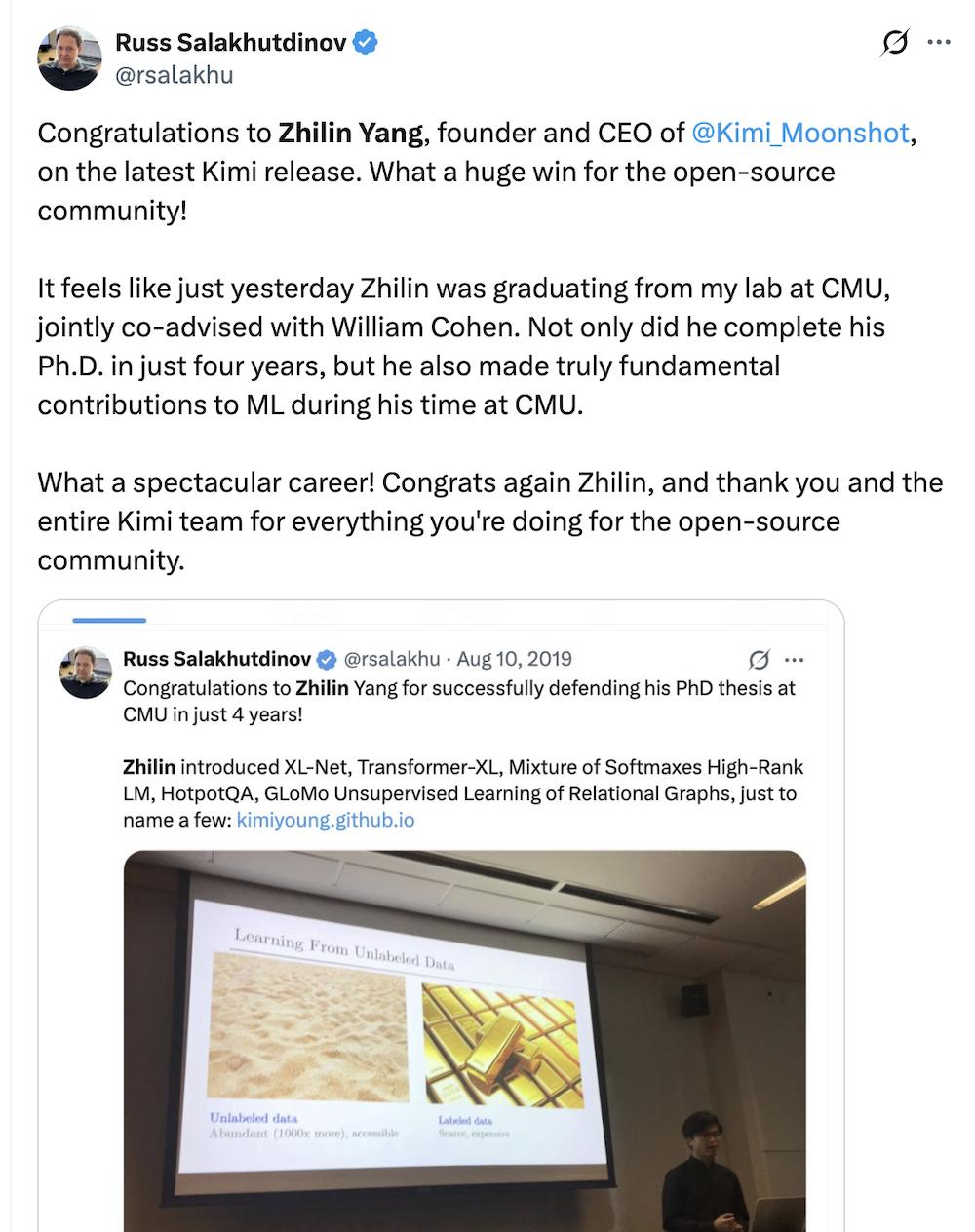
Upon its launch, Kimi K3 immediately became the top trending large model, with many users calling its release "China's Fable 5 Moment". Even Yang Zhilin, the founder and CEO of Kimi, whose doctoral advisor is Russ Salakhutdinov, a giant in machine learning at CMU, posted to praise the new Kimi version for bringing major breakthroughs to the open-source community.
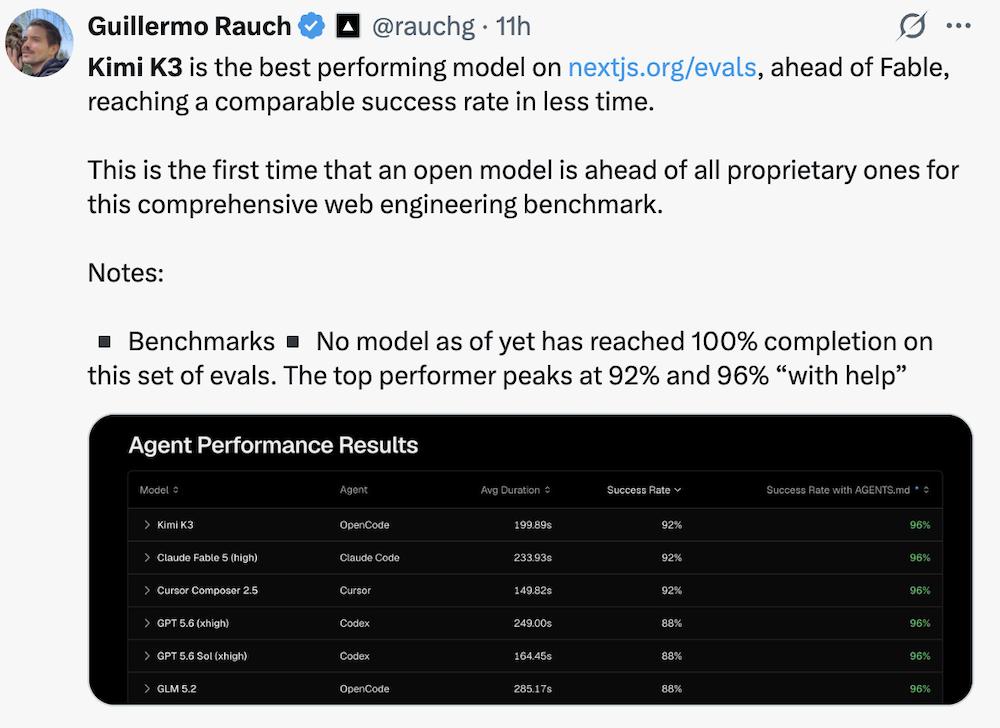
Guillermo Rauch, the founder of cloud platform Vercel and creator of Next.js, announced the results of a professional web engineering AI evaluation, where Kimi K3 ranked first in overall performance. He posted that for the first time, an open-source model has surpassed all overseas closed-source models on this authoritative list; its task success rate for coding reaches 92%, and its development efficiency outperforms Claude Fable 5 in the same tier.
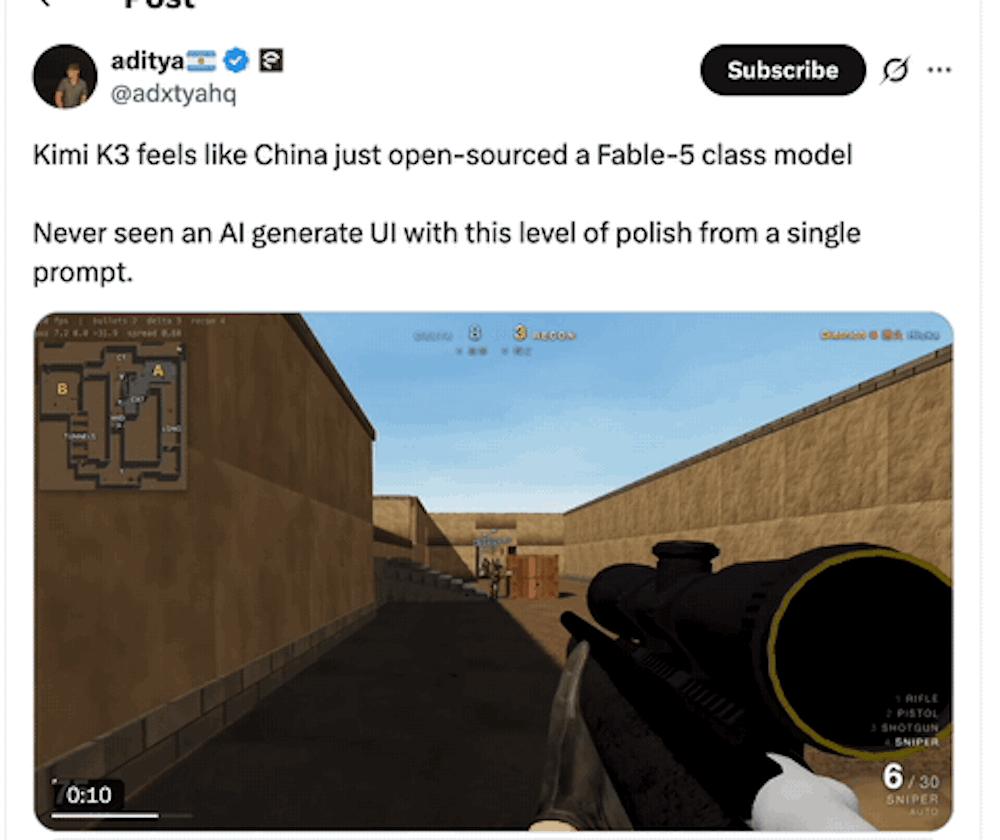
After practical testing, tech reviewer aditya stated that Kimi K3 is equivalent to China open-sourcing a model of the Claude Fable 5 class. He used Kimi K3 to generate a shooting game, noting that he had never seen an AI produce such a surprising interface with only a single prompt.
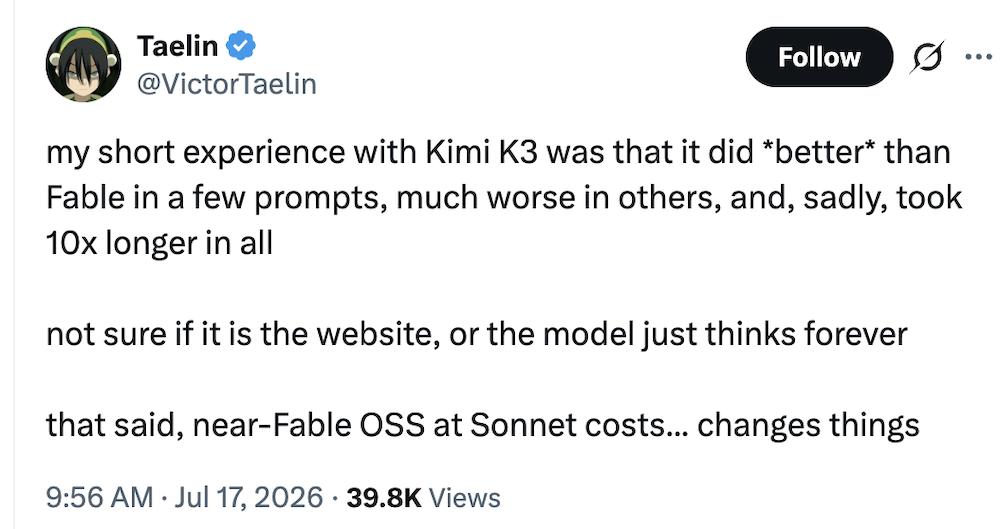
Taelin, a top AI reviewer, also tested Kimi K3. He found that Kimi K3 outperforms Claude Fable 5 on some problems but performs poorly on others, taking 10 times longer than Claude Fable 5. However, he noted that being able to access an open-source model close to Claude Fable 5 at the price of Claude Sonnet 5 truly changed his perspective.
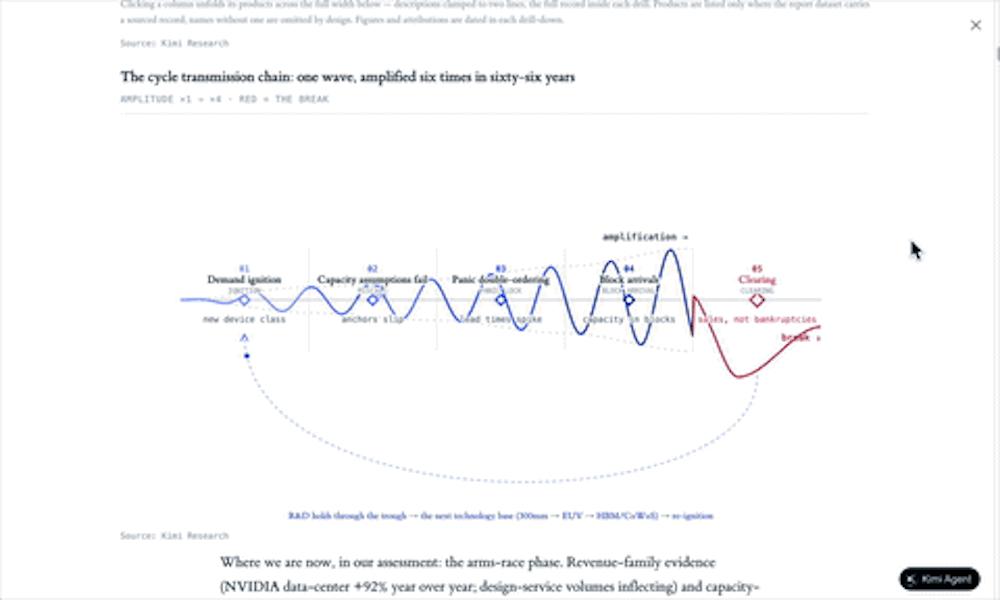
According to technical blogs, Kimi K3 has seen a significant improvement in its long-range Agent execution capability, allowing it to integrate programming, visual understanding, tool invocation, and knowledge work into a complete workflow. Taking the official demo of a 42-year ASIC industry research website as an example, Kimi K3 completed over 120 iterations, performed more than 2,800 web searches and crawls, over 1,100 rounds of terminal data extraction, processed 87 quarterly reports and 99 original PDFs, and finally generated a research report with customized charts, animated diagrams, and interactive visual narratives.
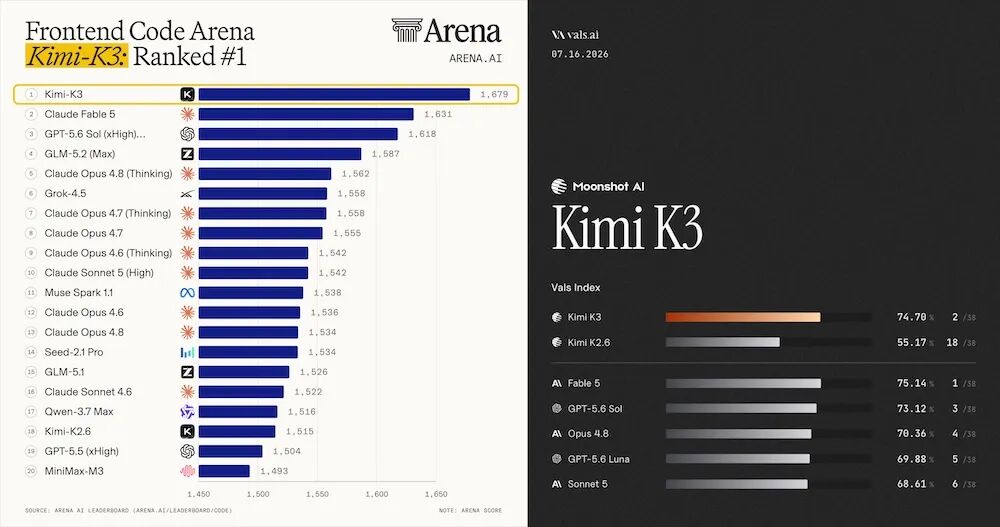
In terms of benchmark tests, Kimi K3 surpassed Claude Fable 5 in the front-end code test of the large model evaluation arena Arena.AI; in independent third-party evaluations from Vals AI, Kimi K3 scored 74.7 in overall tests, ranking 2nd, surpassing GPT-5.6 and only behind Claude Fable 5.
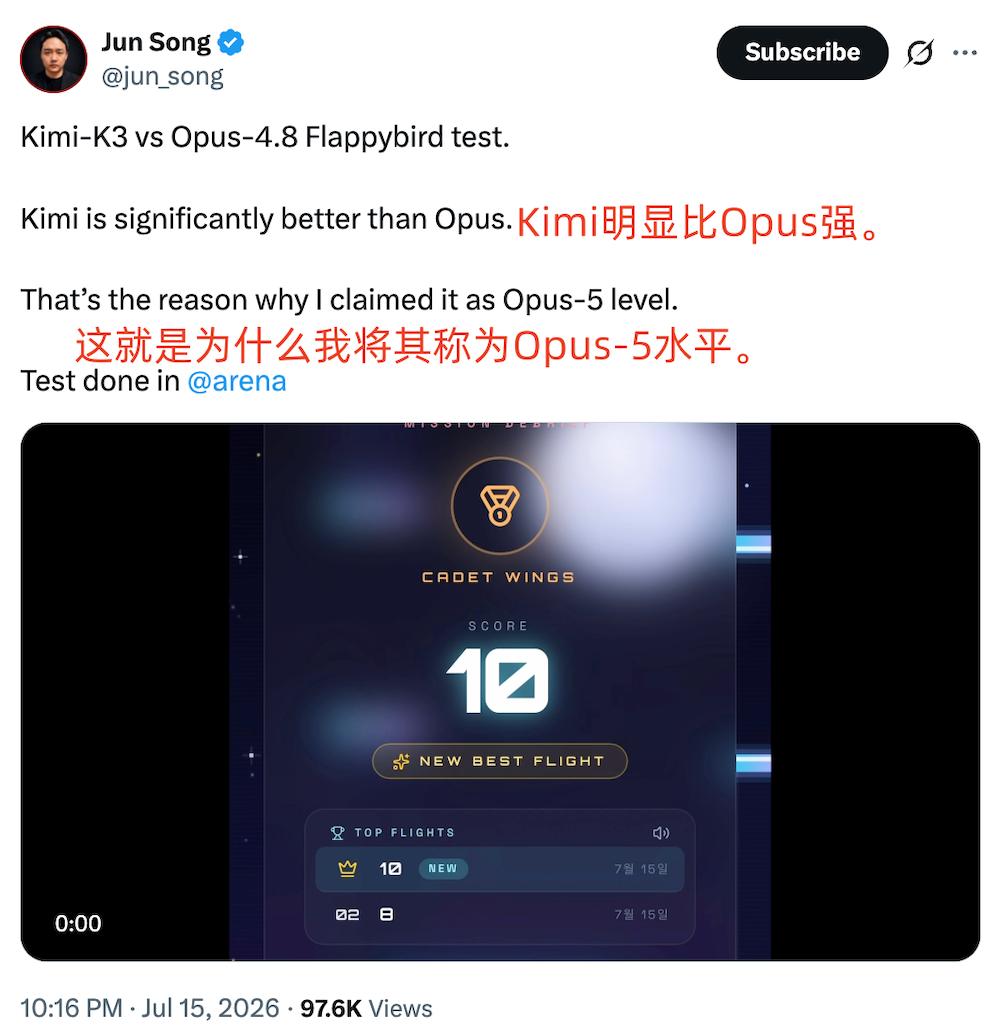
Before its launch overseas, Kimi K3 was noticed by many users under the codename Kivine. Jun Song, founder of the open-source ecosystem foundation Super Gemma, commented that based on the generated results, "Kimi is clearly stronger than Opus" and believes Kimi K3 has reached the level of Opus 5.
In terms of architecture and infrastructure, Kimi K3 leverages architectural upgrades such as KDA and AttnRes, along with a higher-sparsity MoE design, to improve long-sequence information processing and model scaling efficiency, delivering an approximately 2.5x overall scaling efficiency improvement compared to Kimi K2.
For pricing, Kimi retains its tiered billing model, but prices have risen significantly compared to Kimi K2.6. Specifically, Kimi K3's input price per million tokens (cache miss) is 20 yuan, an increase of approximately 207.69% from Kimi K2.6's 6.5 yuan; the input price for cache hits is 2 yuan, also up from the previous 1.1 yuan; the output price has been raised from 27 yuan to 100 yuan, a roughly 270.37% increase. In terms of window capacity, Kimi K3 supports a 1,048,576-token context window.
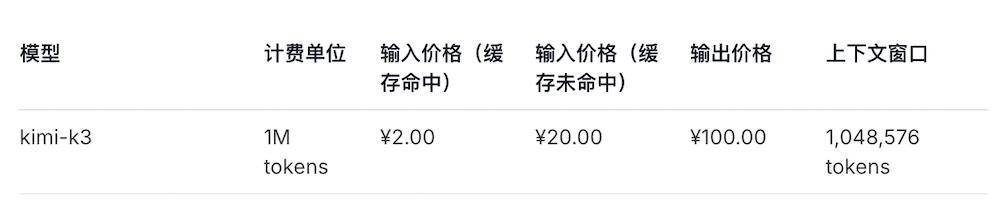
Compared with top-tier closed-source models, Kimi K3 still maintains relatively low pricing. Taking Claude Fable 5 as an example, its API input and output prices are 10 USD (about 67.78 yuan) and 50 USD (about 338.88 yuan) per million tokens respectively, which are significantly higher than Kimi K3.
Kimi K3 is now available on kimi.com, the latest version of the Kimi app, Kimi API, and Kimi Code programming assistant. All users can experience it within the free quota, and paid access is required after the quota is exhausted. Kimi announced that the full model weights of Kimi K3 will be released before July 27. Zhidx also conducted a practical test of multimodal creativity under Kimi K3 Max mode. Due to the widespread attention Kimi K3 has received and the growing number of users, Zhidx was notified that the service was temporarily unavailable during its second practical test.
01.
Practical Test Benchmark Against Claude Fable 5
Kimi K3 Demonstrates Multimodal Creative Understanding
Zhidx tested the multimodal and code generation capabilities of the model under Kimi K3 Max mode, assigning Kimi K3 the task of creating a 3D side-scrolling fighting game.
Prompt: Create a single-file HTML 3D side-scrolling fighting game. The scene is a ruined city invaded by Decepticons, with humanoid Cybertronian robot enemies, including weapon recoil effects, adopting a low-poly style with cartoon aesthetics. At the start of the game, the player is positioned on a street surrounded by building ruins; the game should include destructible detail objects such as cars, trees, stones/debris, and vending machines. Players can choose from 5 Autobot-aligned characters to play, fighting 5 variants of Decepticon enemies that continuously spawn, in an infinite-time sandbox mode.
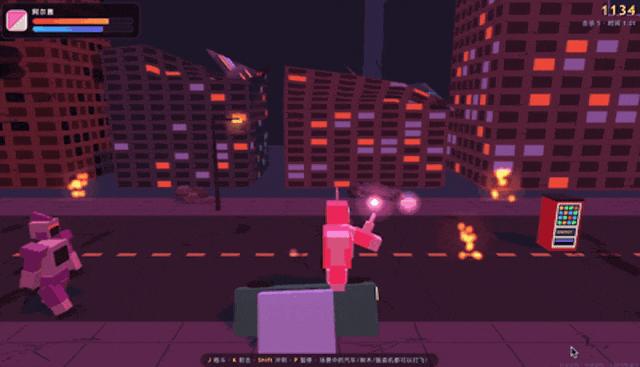
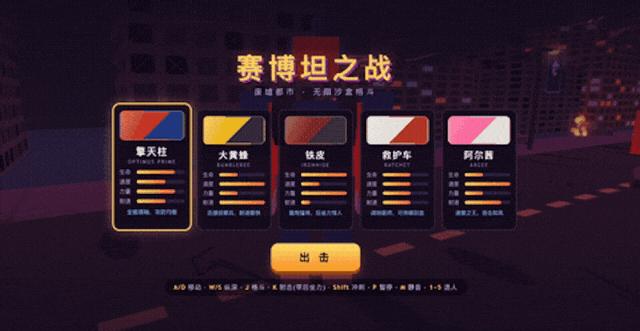
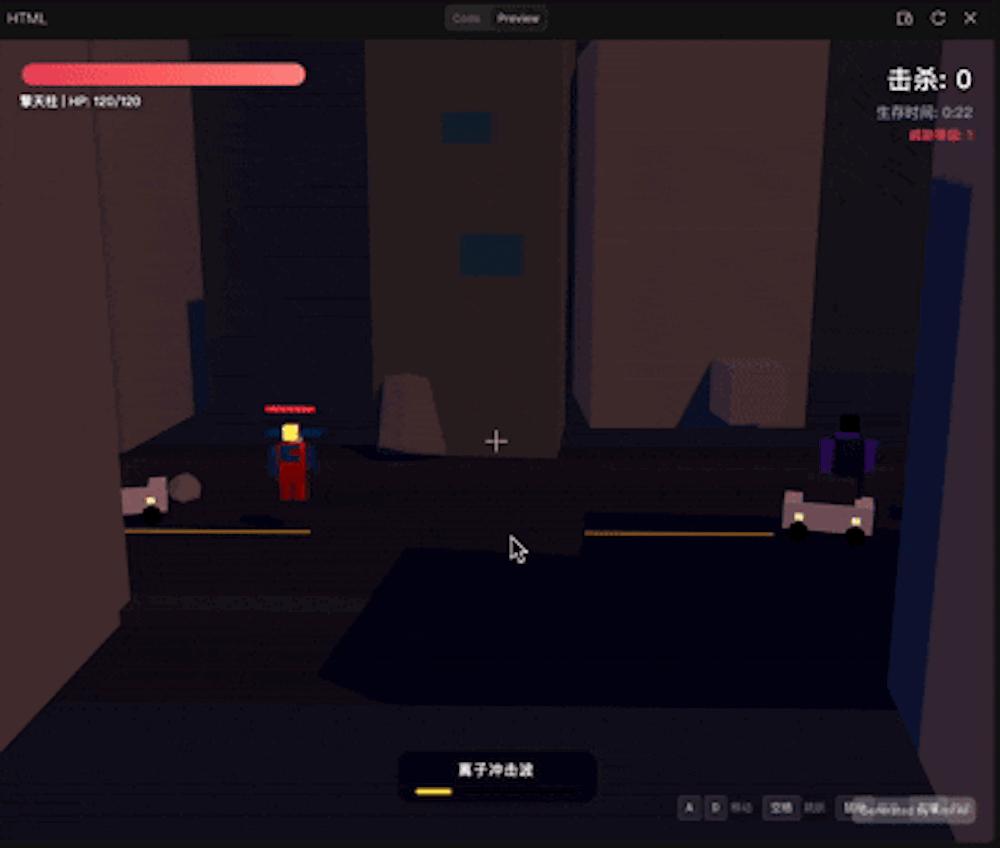
According to the practical test results, Kimi K3 completed the game creation in a single attempt without errors. In terms of game logic and element restoration, Kimi K3 shows strong improvements over the previous Kimi K2.6 (shown in the image below), mainly reflected in the fact that its understanding of the prompt does not incorrectly force players to move up and down as Kimi K2.6 did; secondly, in terms of screen detail, the generated characters are more aligned with the prompt requirements, and environments such as ruins are properly presented. Additionally, without extra prompting, the game provides players with two attack modes: shooting and melee combat.
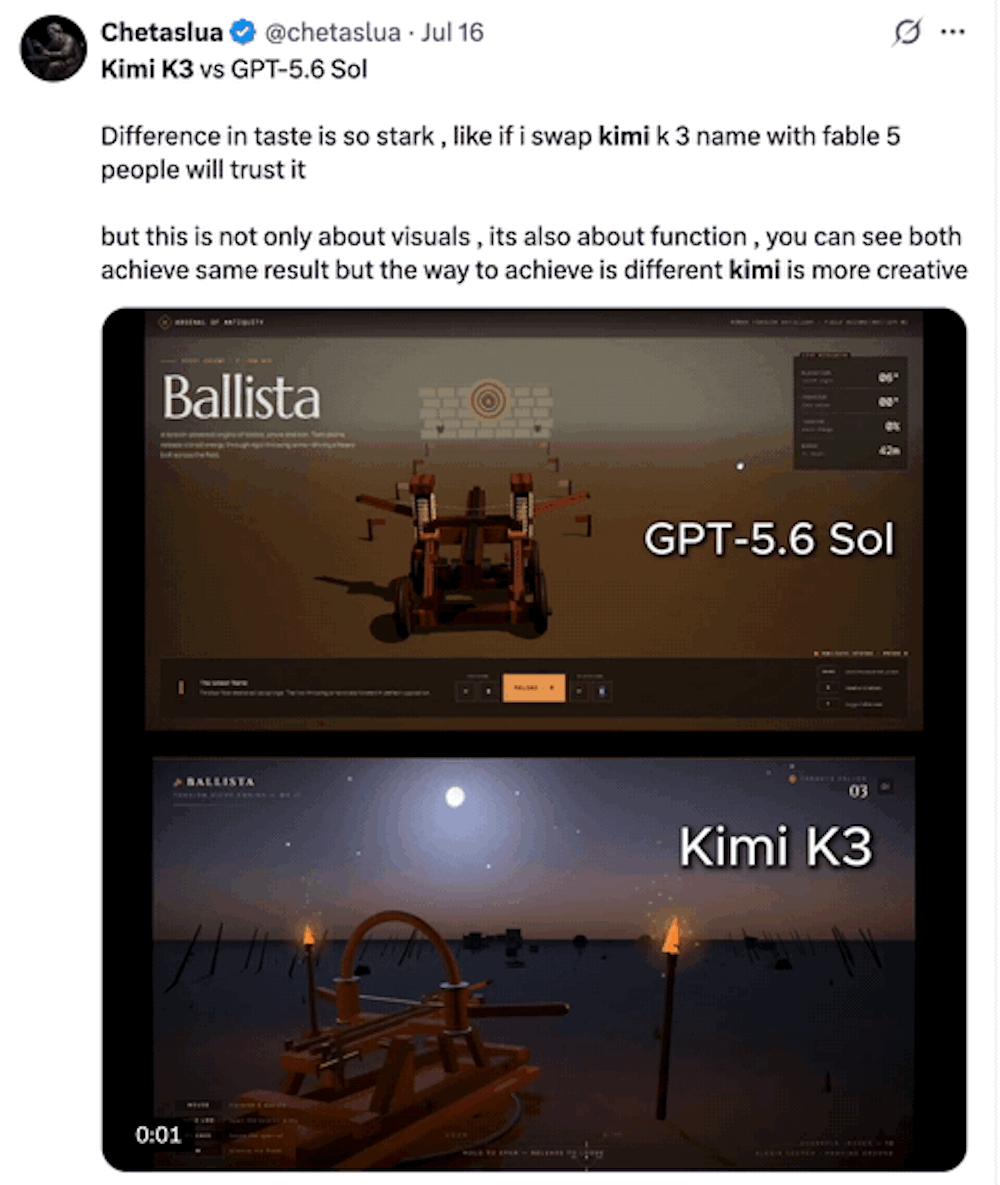
Chetaslua, a journalist covering the AI industry, compared Kimi K3 and GPT-5.6 Sol in 3D content generation. He stated that the differences between the two models are not only reflected in the output effects, but also in the way tasks are completed. Even with relatively similar final outputs, the implementation paths adopted by the two models have clear differences, and he believes that Kimi K3 performs more prominently in creative generation.
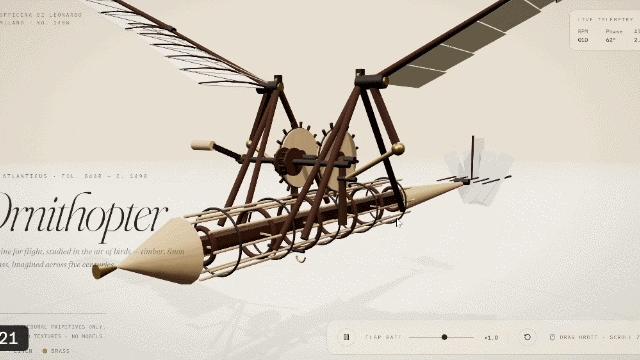
Overseas users previously used Kimi K3 to generate a "Officina di Leonardo" simulator themed around Leonardo da Vinci's designed Ornithopter.
Kimi K3 not only reproduced the visual style of the Renaissance workshop, but also understood the historical background and engineering details of da Vinci's ornithopter, integrating knowledge of materials, structures, and aerodynamics into the generated results, demonstrating that the model has cross-domain knowledge integration capability.
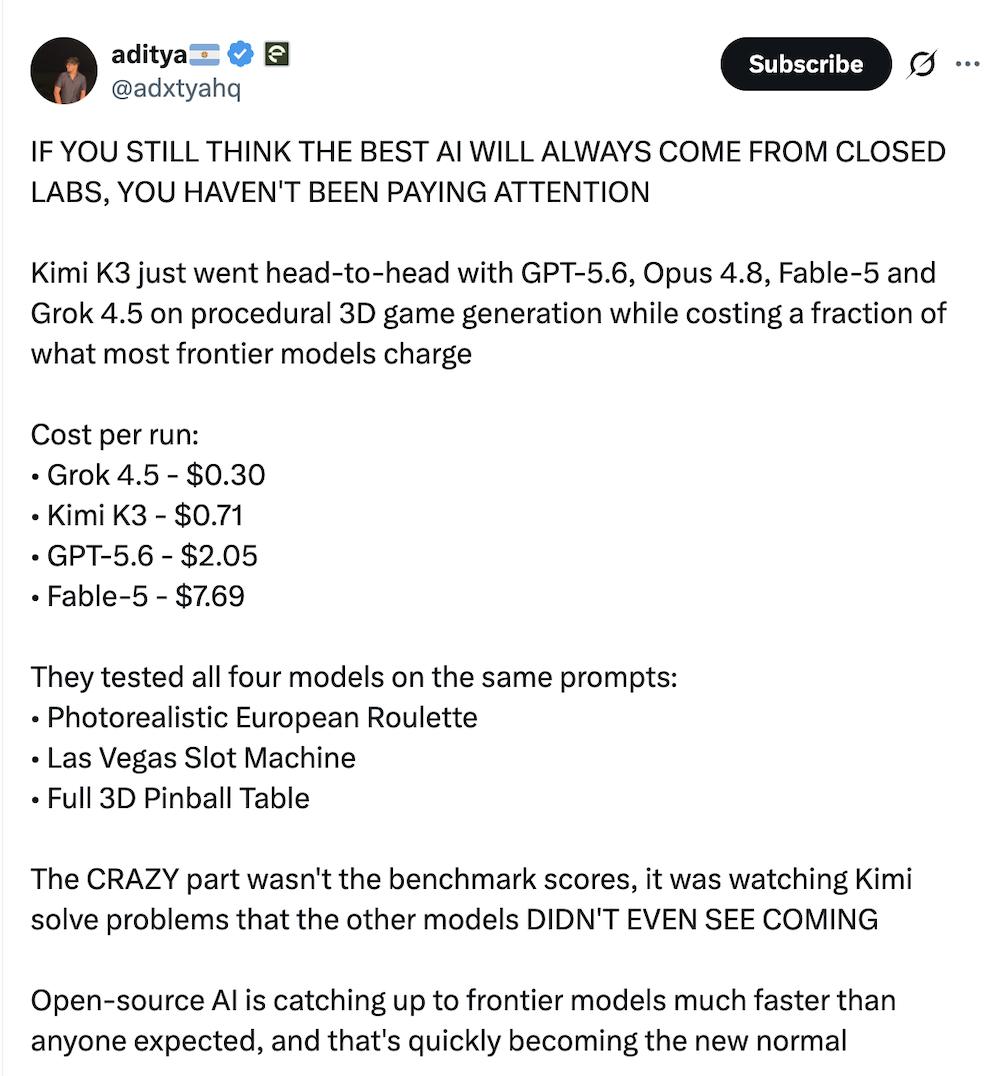
Tech reviewer aditya pitted Kimi K3 against GPT-5.6-Sol, Claude Fable 5, and Grok 4.5 in a 3D game generation task, finding their performance comparable, but Kimi K3's single invocation cost is only 0.71 USD (about 4.81 yuan), far lower than GPT and Claude; more notably, it can identify hidden issues that other models fail to detect. He believes that the speed at which open-source large models are catching up with top-tier closed-source products far exceeds industry expectations.
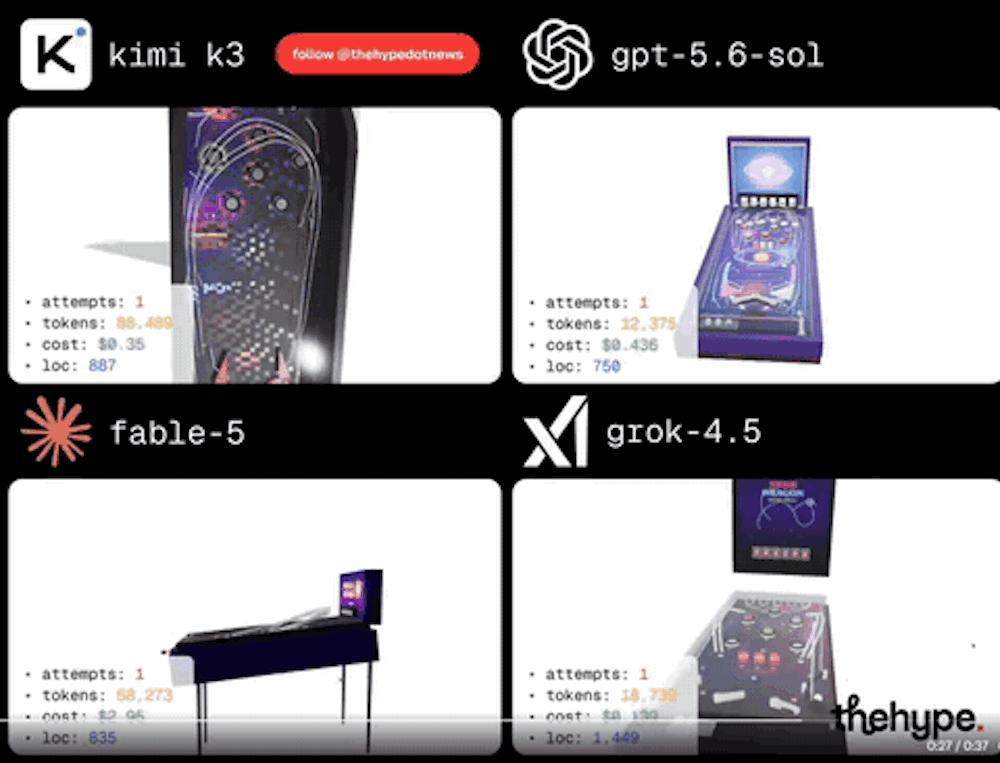
Developer LASCHUK also conducted a practical comparison between Kimi K3 and Claude Fable 5, using the same prompt to replicate Apple's official website without extra assistance. Both models completed the page development, but Kimi K3's single invocation cost is only 0.44 USD (about 2.98 yuan), which is half of Claude Fable 5's 0.94 USD (about 6.37 yuan); priced per million tokens, Claude Fable 5 is far more expensive than most models on the market, while Kimi K3's pricing is only one-third of that, leading LASCHUK to question the premium value of high-priced closed-source models.
