From Stepverse to GalaxyCore: The Capital Migration Path Behind WAIC Exhibitors
On July 17, 2026, the World Artificial Intelligence Conference (WAIC) opened in Shanghai. More than 1,100 exhibitors, a 100,000-square-meter exhibition area, and over 300,000 professional visitors — these represent the "visible showcase" of the event.
What truly deserves in-depth analysis, however, lies beneath the surface: the financing performance of these exhibiting enterprises over the past 18 months has become a capital barometer for the trajectory of China's AI industry.
Through the IT Juzi data platform, we systematically sorted out the investment and financing dynamics of the core exhibiting enterprises at this WAIC from 2025 to July 2026.
Three major tracks — large models, embodied intelligence, and AI chips — are entering an unprecedented period of capital concentration —
For the key exhibiting enterprises counted in this article alone, the total financing amount over the past 18 months has exceeded the 100-billion-RMB mark.
Large Models: IPO Window Opens, Capital Flows to Leading Players
Large models are the most capital-absorbing track at this WAIC, as well as the field where the logic of capital has changed most drastically.
Zhipu and MiniMax have successively completed IPOs on the Hong Kong Stock Exchange, setting an exit benchmark for the large model industry. Zhipu completed placement refinancing on July 9, raising HKD 31.41 billion; MiniMax (Xiyu Technology) followed suit the next day, raising approximately HKD 16 billion through placement shares and convertible bonds.
Unlisted enterprises are also attracting massive capital.
StepFun completed a $2.5 billion Pre-IPO round of financing in May 2026, with joint investments from ZTE, Huaqin Technology, Tencent Investment, OmniVision Group, and Longcheer Technology;
Shengshu Technology just completed a $500 million B+ round of financing in July;
Faceunity completed an E+ round of financing of several hundred million RMB in the same month;
MetaX completed a RMB 700 million Series B financing in May.
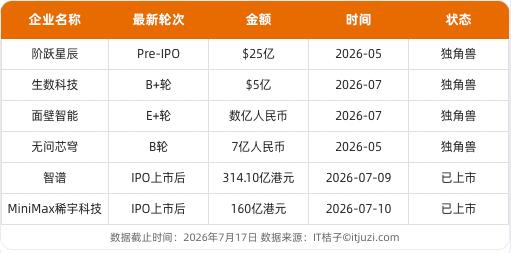
StepFun is the most representative case in this wave of large model financing.
This Tsinghua-affiliated large model company, founded in Xuhui, Shanghai in April 2023, has a market-estimated valuation of $12 billion.
Its financing speed is remarkable:
In November 2023, it completed a Series A financing of tens of millions of dollars, with investors including 5Y Capital, Qiming Venture Partners, and HSG; in December 2024, the Series B financing amount rose to several hundred million dollars, with Shanghai State-owned Investment joining; in January 2026, the B+ round jumped to RMB 5 billion, with Shanghai State-owned Investment, 5Y Capital, Qiming Venture Partners, Tencent Investment and others continuing to increase their stakes; just four months later, the Pre-IPO round reached $2.5 billion, with joint investments from ZTE, Huaqin Technology, Tencent Investment, OmniVision Group, and Longcheer Technology; in the same month, Lotus Holdings led a follow-on investment of RMB 300 million.
What is worth noting is the change in the structure of investors.
Early rounds were dominated by pure financial investors such as 5Y Capital, Qiming Venture Partners, and HSG; starting from the B+ round, Tencent placed bets for three consecutive rounds; by the Pre-IPO round, hardware ecosystem partners such as ZTE and Huaqin Technology entered the market — this marks that industrial capital is no longer satisfied with financial returns, but is trying to secure end-side large model deployment capabilities through investments.
From the overall industry perspective, the financing logic of the large model track is undergoing three transformations:
First, the IPO channel has opened, and the listings of Zhipu and MiniMax have provided exit expectations for subsequent enterprises;
Second, industrial capital has entered the market, and physical giants such as ZTE, CATL, and SAIC Motor have shifted from financial investment to strategic layout;
Third, the financing rhythm has shifted from "small, rapid steps" to "large-scale concentration", with the average single financing amount in the first half of 2026 about 3 times higher than that in 2025.
Capital is shifting from "evaluating PPTs" to "focusing on implementation", and leading players with commercialization capabilities are obtaining excess premiums.
Embodied Intelligence: Extreme "Compressed Financing"
If 2024 was the first year of the embodied intelligence concept, 2025 to 2026 has been a period of capital explosion.
Leading humanoid robot enterprises such as Unitree Robotics, Galbot, Fourier Intelligence, Fourier Intelligence, and Agibot have collectively raised more than RMB 30 billion over the past 18 months, and many of them have entered the Pre-IPO stage.
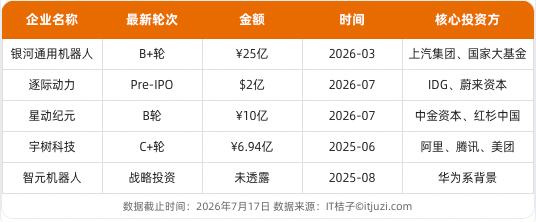
The financing rhythm of Galbot is the most extreme case in this embodied intelligence capital boom.
This enterprise, founded in Haidian, Beijing in May 2023 and focusing on general-purpose humanoid robots, completed 5 rounds of financing in less than two years from the Angel round in June 2024 to the B+ round in March 2026, with a total amount exceeding RMB 7 billion.
Specifically:
RMB 700 million in the Angel round in June 2024, with investments from IDG Capital and Qiming Venture Partners; RMB 500 million in the strategic investment round 5 months later, with Meituan joining; RMB 1.1 billion in the Series B round in June 2025, with CATL and GGV Capital entering; $300 million in the B+ round in December of the same year, with China Mobile and CICC Capital following; RMB 2.5 billion in another B+ round in March 2026, with joint investments from SAIC Motor, the National Artificial Intelligence Industry Investment Fund, and the National Integrated Circuit Industry Investment Fund.
The evolution trajectory of Galbot's investors clearly presents the capital upgrading path of the embodied intelligence track:
It was initially led by top VCs such as IDG and Qiming, followed by the involvement of industrial capital such as Meituan and CATL, and finally the entry of "national team" players such as the National Integrated Circuit Fund and the National AI Fund.
This triple endorsement structure of "national team + industrial leaders + top VCs" indicates that embodied intelligence has been regarded as a national strategic emerging industry.
Fourier Intelligence has an even tighter rhythm —
It completed a $200 million Pre-IPO round of financing in July 2026, only 5 months after the previous Series B round.
This kind of "compressed financing" only appears during a super boom period, which means that capital has a high degree of consensus on the prospects of the track, and also implies that competition for talent and technology among enterprises is intensifying.
AI Chips: Domestic Substitution Enters Deep Waters
The Zhangjiang Science Hall, as the "Chip-Computing Integration Pavilion" of this WAIC, has gathered more than 60 AI chip enterprises including Huawei, Mthreads, Enflame Technology, Moore Threads, and Iluvatar CoreX.
The financing logic of this track is completely different from that of large models and embodied intelligence — it has a longer R&D cycle, higher capital threshold, and stronger policy dependence.
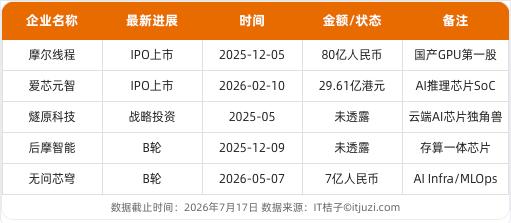
Moore Threads is the most iconic case in the AI chip track.
This enterprise, founded in Haidian, Beijing in June 2020 by Zhang Jianzhong, former Global Vice President of NVIDIA, completed its IPO on December 5, 2025, raising RMB 8 billion and becoming the "first domestic GPU stock". Its shareholder lineup includes top institutions such as ByteDance, Tencent, HSG, and 5Y Capital, spanning the entire process from early stages to listing.
The listing of Moore Threads has multiple significances for the AI chip track:
It verified the feasibility of domestic GPU enterprises accessing the capital market, and also provided a valuation reference for subsequent enterprises. In February 2026, Axera Intelligence followed suit and completed its IPO on the Hong Kong Stock Exchange, raising HKD 2.961 billion, further confirming that the listing channel for AI chip enterprises is expanding.
However, compared with the large model and embodied intelligence tracks, financing in the AI chip field presents different characteristics:
The latest financing amounts of some enterprises (Enflame Technology, MobiVision) have not been disclosed, reflecting the higher information barriers and longer commercialization cycles in this track;
State-owned capital and operators account for a relatively high proportion among investors, while the participation of market-oriented VCs is relatively low.
This is directly related to the industrial characteristics of AI chip R&D, which features long cycles, large investments, and slow returns.
Panorama of Capital Flows: Where Has the Money Gone?
By comparing the three major tracks side by side, we can more clearly see the distribution logic of capital.
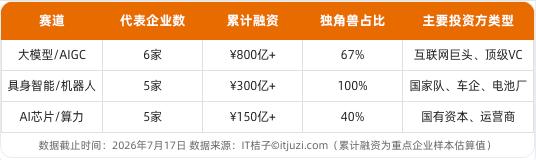
From the above comparison, we can extract five noteworthy trends:
First, the winner-takes-all effect is significant.
StepFun raised $2.5 billion in a single Pre-IPO round, and Shengshu Technology raised $500 million in the B+ round, with capital highly concentrated in the Top 5 players.
The total financing in the large model track exceeds RMB 80 billion, but the vast majority flows to a small number of leading enterprises.
This trend means that the "Matthew Effect" in the large model field is accelerating — leading enterprises leverage their capital advantages to expand barriers in computing power and talent, while the survival window for mid-tier and lower-tier enterprises may be narrowing.
Second, embodied intelligence has become a new growth pole.
Galbot completed 5 rounds of financing in 9 months, and Fourier Intelligence raised $200 million in Pre-IPO financing within 5 months — this kind of "compressed financing" only appears during super boom periods.
All 5 representative enterprises are unicorns, with total financing exceeding RMB 30 billion.
What is more noteworthy is the structure of investors: industrial chain giants such as SAIC Motor, CATL, and NIO have directly entered the market, indicating that embodied intelligence is regarded as the next automotive-level industry.
Third, industrial capital has replaced pure financial investors.
ZTE invested in StepFun, SAIC Motor injected capital into Galbot, CATL bet on embodied intelligence, and Alibaba, Tencent, and Meituan jointly invested in Unitree Robotics —
These cases show that industrial capital is penetrating into different links of the AI industry chain through investments. Unlike pure financial investments, industrial capital places more emphasis on technological synergy and supply chain positioning, and its entry often means deeper business integration.
Fourth, the national team has moved from behind the scenes to the forefront.
The National Integrated Circuit Industry Investment Fund and the National Artificial Intelligence Industry Investment Fund frequently appear, co-investing with market-oriented capital in projects such as Galbot.
This indicates that AI has been incorporated into the national strategic blueprint, and government-guided capital is forming a synergy with market capital.
Fifth, exit channels are diversified.
In addition to IPOs, methods such as merger and acquisition integration and strategic investment are increasing.
Zhipu, MiniMax, Moore Threads, and Axera Intelligence have successively listed, providing valuation references and exit expectations for subsequent enterprises; some enterprises have chosen to introduce industrial partners to pursue deep synergy instead of simply pursuing listing.
Capital Is Not a Panacea
WAIC 2026 is not only a technological feast, but also a centralized review of industrial strength.
The financing data tells us:
China's AI industry is undergoing a critical transition from proof of concept to large-scale implementation.
Large models need to find a sustainable commercial closed loop, embodied intelligence needs to cross the gap from the laboratory to the factory, and AI chips need to achieve independent controllability amid external restrictions.
The influx of hundreds of billions of capital shows that the market has cast a vote of confidence in the prospects of China's AI industry.
However, the prosperity driven by capital is also accompanied by risks:
High concentration of financing in leading enterprises may inhibit ecosystem diversity; deep involvement of industrial capital may affect the independent decision-making space of enterprises; under the rhythm of "compressed financing", the risk of valuation bubbles cannot be ignored.
When you walk through the booths at WAIC 2026, you might as well think about one more question —
What are the investors of this company thinking?
The answer is often more informative than the technical parameters on the display boards.
This article is from the WeChat official account "IT Juzi" (ID: itjuzi521), written by Judy, and published by 36Kr with authorization.