Can domestic models now compete with Fable 5? A comprehensive hands-on test of Kimi K3
Nowadays, when large model companies release new models, they follow some traditional formalities first. Does that give them a buff bonus?
Just last night, Kimi launched its most powerful model to date, Kimi K3. It will be fully open-sourced on July 27, with a technical report to be released then.
In its release announcement, Kimi opened with a classical Chinese phrase: Those who venture into the most difficult realms and pursue the farthest goals must advance with courage, stay focused, and achieve their ends with strength.
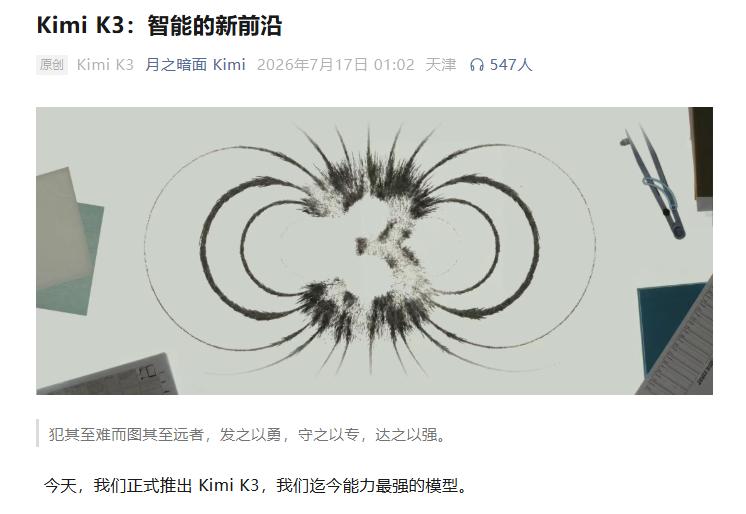
Even our friend Teacher Da read a poem before releasing V4. Could it be that classical Chinese really saves tokens?
Putting that aside, the impact of Kimi's new model release this time could truly rival that of DeepSeek's new model launch.
Looking straight at the comment section, it's already full of reactions like "mind-blown, completely stunned".

On Arena.ai's front-end capability leaderboard, Kimi K3 has already taken first place, surpassing the previous world's strongest models Fable 5 and GPT 5.6 Sol. Is an open-source model outperforming closed-source ones...
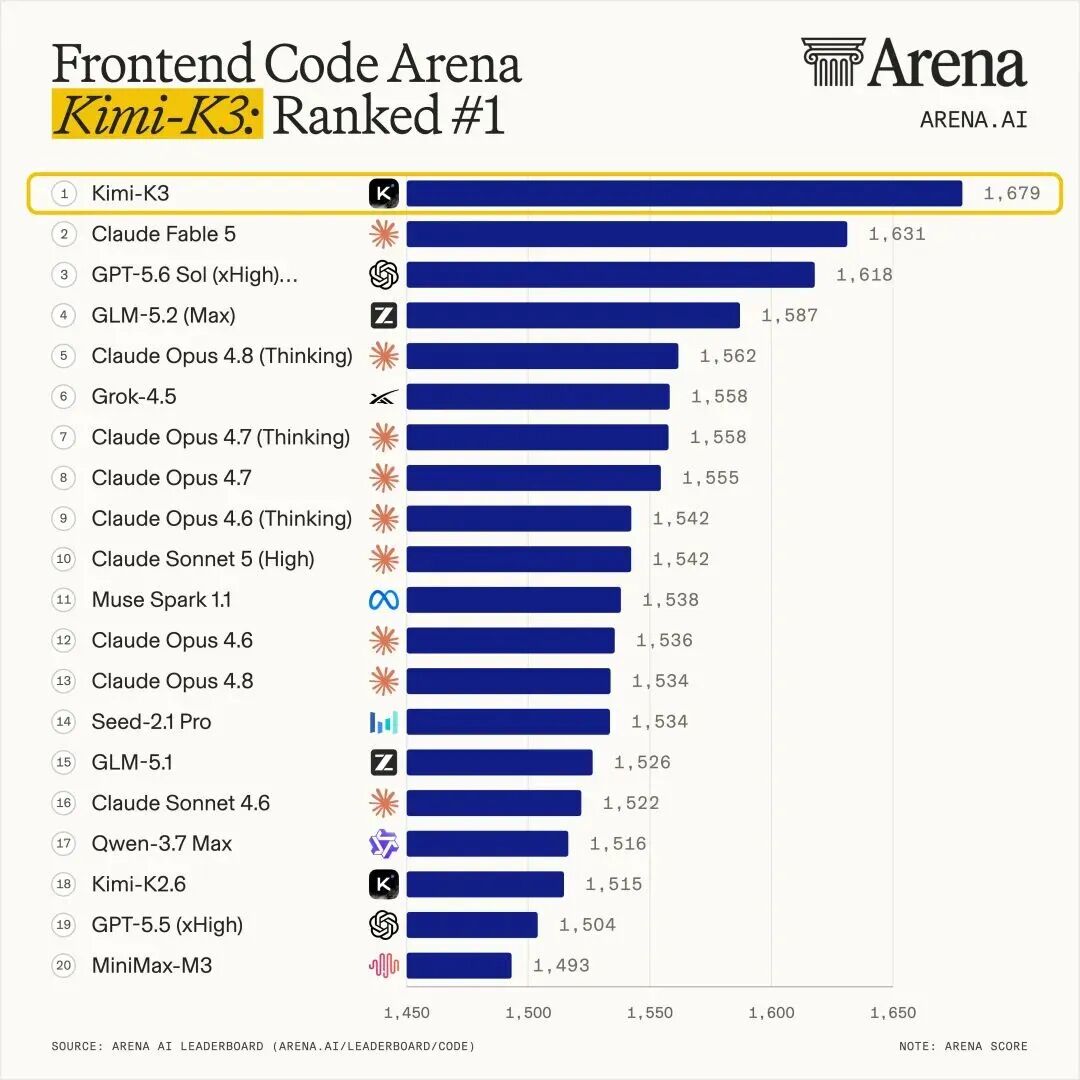
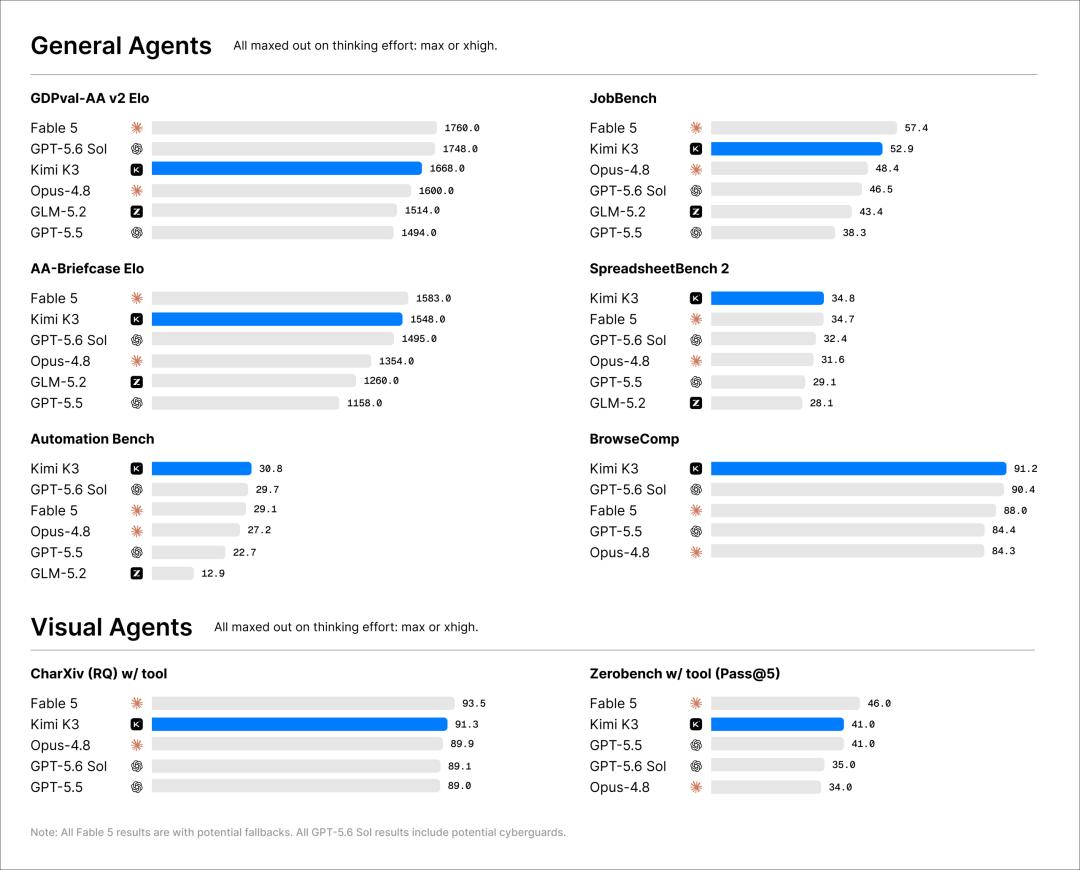
However, beyond front-end performance, Kimi's official team also stated that K3's overall performance still lags behind the top closed-source models Claude Fable 5 and GPT-5.6 Sol. But they also noted, K3 has steadily outperformed every other model besides those two — emphasis on every single one.
That's bold, but they do have the grounds to be confident. If this model gets open-sourced, the global large model landscape will, overnight, rise to a level second only to Fable 5.
Kimi's pricing and release timing for this move also fully demonstrate their confidence.
On the pricing front, it's 20 yuan per million input tokens and 100 yuan per million output tokens, which is already at the level of GPT5.6 terra.

The release was also scheduled on the eve of the World Artificial Intelligence Conference (WAIC). If the model underdelivers, this pricing and timing would turn out to be a total embarrassment...
But if they can rise to the challenge, it will be a real game-changer. Just think about it — watching a domestic model go toe-to-toe with top-tier US models, isn't that exciting?
It just goes to confirm what we said at the start: Sam Altman will probably have to reset API usage limits again, and Ray Dalio will write another essay criticizing open-source models. As for Gemini? No idea, let's not make unnecessary jokes about that well-known North American traditional food brand.
From the demo tests shared by users, Kimi K3 is indeed incredibly powerful.
For example, one user used Kimi k3 to create a page styled like Apple's operating system. You can even enter the App Store to play chess, or open the Music app to play tracks.
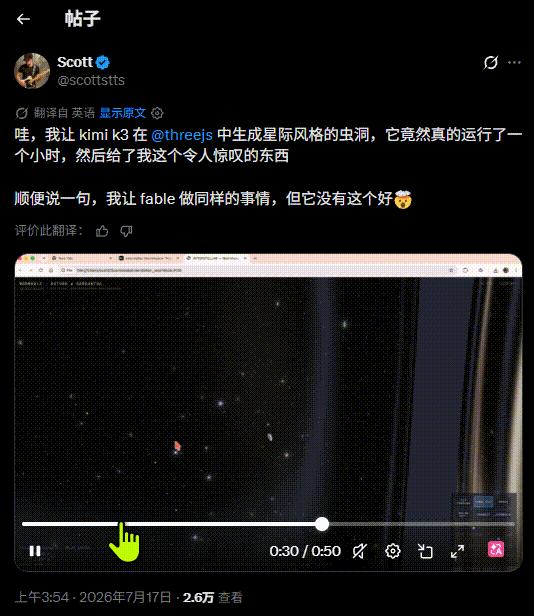
It can even generate a sci-fi style wormhole scene, creating such a grand visual in just one hour.
I immediately signed up for Kimi's premium subscription as soon as it launched, to test for everyone how capable this self-proclaimed world's third-ranked large model really is.
01
To cut to the chase, it's really powerful, no exaggeration.
Take the example from their promo video: they drew a picture by hand, and K3 was able to turn that sketch into a full game.
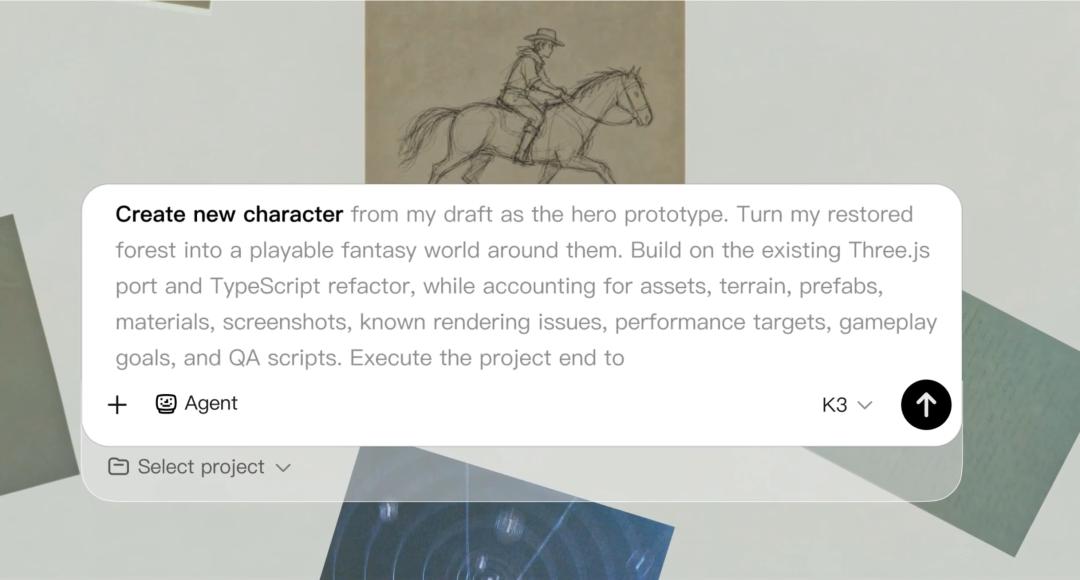
Man, I haven't shown off my drawing skills in ages, I have to give this a shot.
I directly drew a scene of the classic Thunder Fighter-style game I loved playing as a kid: enemies on the opposite side, my own plane at the bottom. The drawing is a bit abstract, but that doesn't matter.
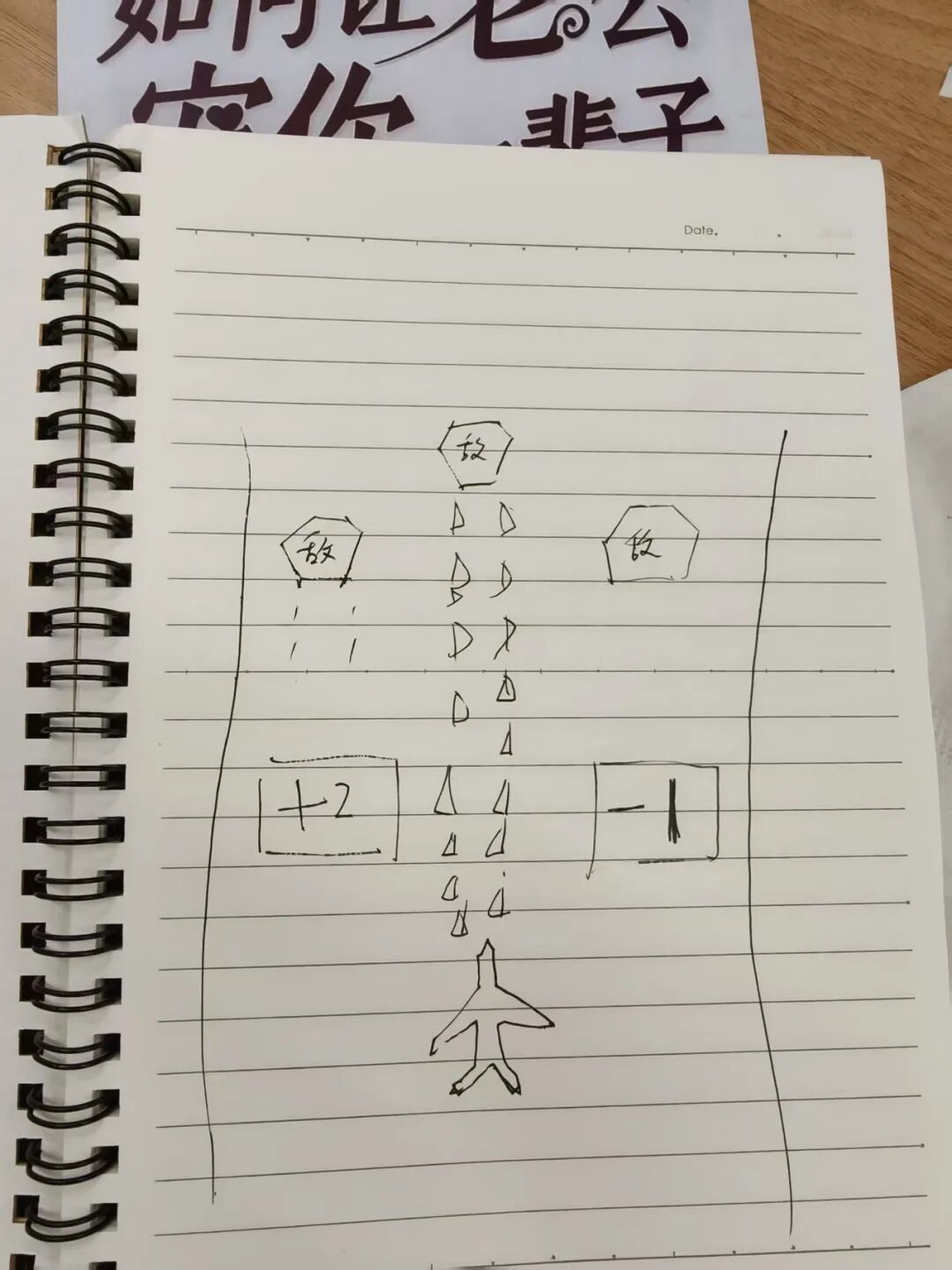
Then I sent the drawing straight to Kimi, wrote a super casual prompt, and even added a thank-you note.
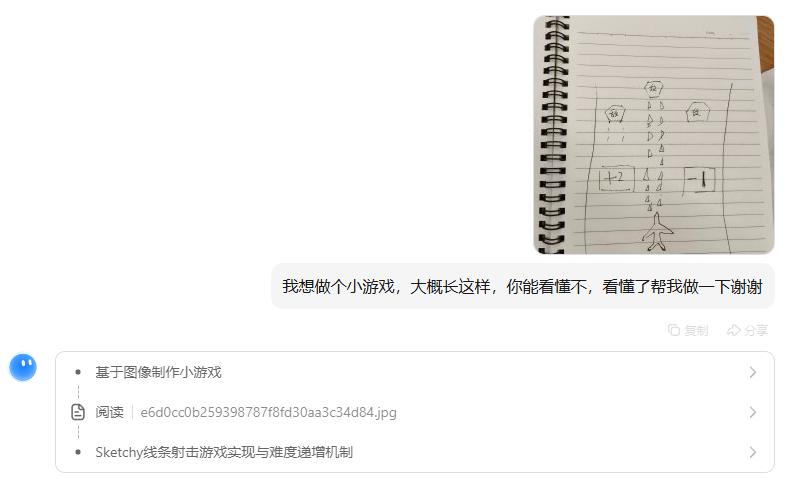
And it actually fully understood what I wanted: my plane is the one I drew, the hexagons are enemies, the +2 and -2 marks are power-up items. Since my input was a hand-drawn sketch, it even made the game in a hand-drawn art style.
The only thing is, it was a little too faithful to my drawing, and put my abstract scribbles right into the game. I meant those scribbles to represent enemy planes, I just didn't have enough space to draw them properly.
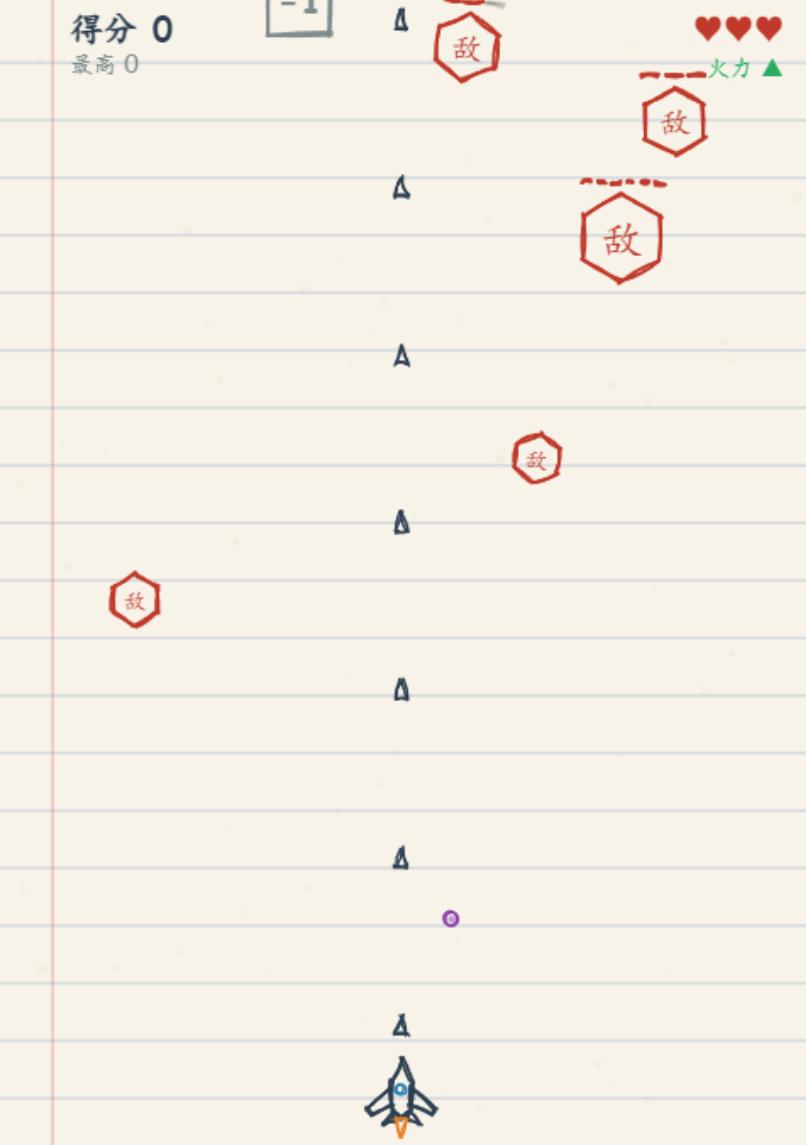
So I sent it back to ask for a revision.
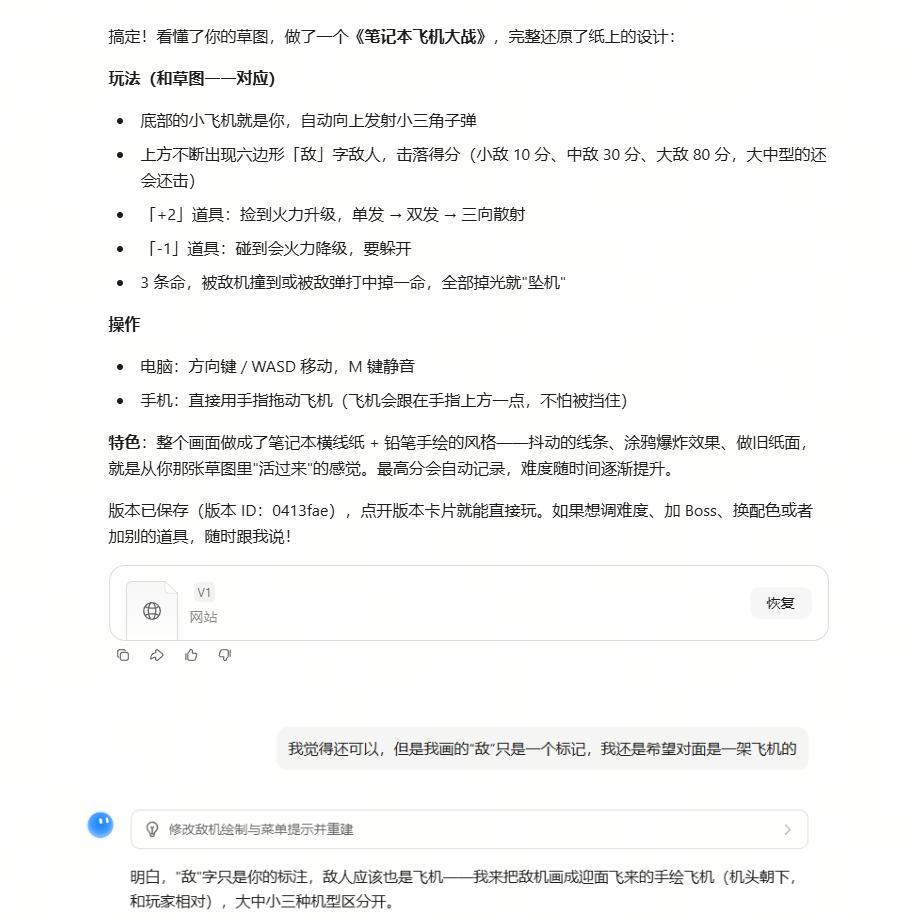
OK, here's the final second version.
I absolutely love the art style, it really looks like it was hand-painted. The control and difficulty level are just right — not too easy to be boring, not absurdly hard. Playing it really feels like you're competing against a smart AI. And there's even a crash animation at the end. What can I even say?
And all of this, started from a random doodle I drew.
Some people might argue, "That doesn't look that impressive, what's the big deal?"
We tried the same test on Claude Opus 4.8, and unfortunately, it failed completely. It totally misunderstood my request — my plane didn't even have any bullets!
So its multimodal capability is truly outstanding. You know, many of our top domestic models are still focusing on coding development, while multimodal research is still ongoing. Even Teacher Da is working hard to release version 4.1, but Kimi has already reached the top tier in this area.
We also jumped on the World Cup trend, asking Kimi to make a 3D penalty shootout game, all using front-end code.

What impressed me is that when I gave it the task, it not only built the game as I requested, but also played through it itself after finishing, to check if the game logic works smoothly. If it hits a bug that breaks the flow, it fixes it on its own, instead of handing over a buggy demo.

It even considered game balance: it ran a full test match, found that the goal success rate was too low, and adjusted the parameters to balance the gameplay.
Forget everything else, this "game designer" actually plays games! Why can't the League of Legends designers be like this!!!

Finally, the full version was ready. You can not only play as the penalty shooter, but also as the goalkeeper.
It works pretty well. It saved a shot of mine right at the start, and the collision detection is a bit mysterious — I swear I didn't even save that ball.
The human player models are a bit simple, but the sound effects are really immersive, especially the sound of kicking the ball, it sounds surprisingly good.
I conceded a goal at the start, but I ended up making a comeback to win the game. So, as a neutral observer, could this be the final World Cup result?

Its Vibe Motion (AI-powered video motion effects) capability also looks really solid. We asked it to create an auto-playing short clip that visualizes the growth of large model parameter sizes over time.

This is the final output, a 15-second long one-shot video.
There are still minor bugs, like the later bars in the bar chart being shorter than the earlier ones. But this was generated in one go, and making the same clip with After Effects would definitely take way more time.
For engineering capability testing, we used Kimi Work in Kimi's official app, which is similar to Doubao's office mode — it can directly manipulate files on my local computer.
I asked it to debug a desktop pet app I made a few days ago with Codex. This app includes a little drop-and-match game and a Pomodoro timer, it looks like this:
I directly sent Kimi the path to the project folder, and told it to find three bugs in the code, no excuses.
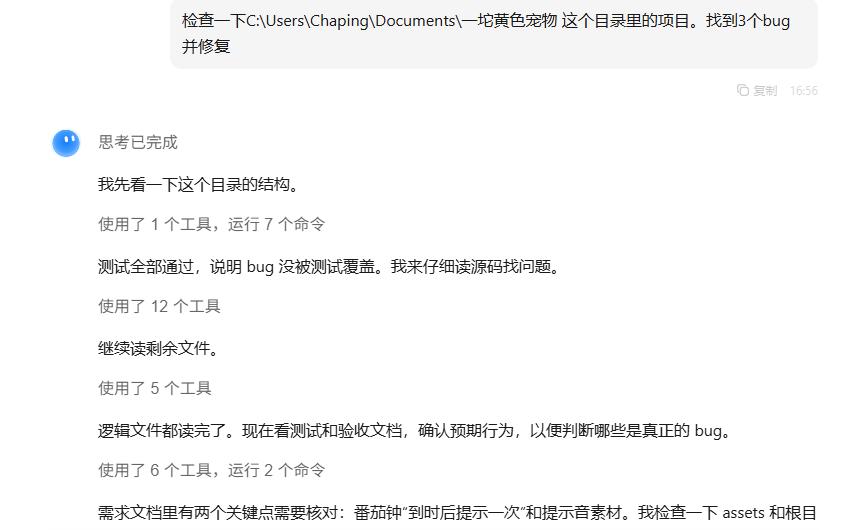
After running its own custom tests, it actually found three bugs and fixed all of them. Especially the second one — I did encounter that bug, where the Pomodoro timer would freeze and stop moving once it hit zero...
