Top 50 AI/Embodied AI Companies Most Favored by Investors in 2026 Unveiled
Artificial intelligence is entering a new industrial cycle.
Over the past year, the capabilities of large models have continued to evolve, with technical directions such as generative AI, multimodal interaction, and agents advancing rapidly; meanwhile, embodied intelligence has gradually moved from the early stage of technical exploration to the deep zone of industrial verification, and robots have begun to become a critical carrier connecting artificial intelligence with the real world.
The market has already delivered its response first. According to estimates from 36Kr Research, the market size of China's embodied intelligence industry has grown from 2.133 trillion yuan in 2018 to 9.15 trillion yuan in 2025, and is expected to exceed the 10-trillion-yuan threshold in 2026. Data from ITJuzi shows that the total financing amount of the embodied intelligence sector in the first half of 2026 reached 935 billion yuan, nearly 5 times higher than that in the first half of 2025, with 322 investment and financing events, marking a 137% year-on-year increase.
However, the other side of the coin is equally glaring. The Institute for Intelligent Computing of Beijing openly stated in the *2026 Top 10 AI Technology Trends* that embodied intelligence startups face severe homogenization of business models, generally adopting the combination of "general open-source large model + motion control" to conduct optimization in a single scenario. The National Development and Reform Commission also recently issued a public reminder that the embodied intelligence industry must focus on preventing risks such as a flood of highly repetitive products hitting the market.
On one side, there is a trillion-yuan market with tens of billions of hot money pouring in; on the other side, there are industry warnings of severe homogenization and accelerated elimination.
In 2026, artificial intelligence is undergoing a critical phase transition. How to convert technology into tangible applications, commercial value, and industrial influence has become the core priority for enterprises in their next stage of development.
For many years, 36Kr has continuously focused on the evolution of the artificial intelligence industry. From the rise of large models, to the exploration of intelligent agents, and further to embodied intelligence entering the industrial horizon, we have been consistently documenting the interactive dynamics between technology, capital, and industry through in-depth reports, industry research, and industrial events.
In April this year, 36Kr launched the call for the "2026 Most Investor-Recognized Artificial Intelligence / Embodied Intelligence Enterprises". By the beginning of July, we received applications from hundreds of enterprises, covering multiple tracks including large models, embodied intelligence, AI infrastructure, and vertical industry applications. After reviewing application materials and going through multiple rounds of evaluation, 50 enterprises were finally selected.
Although these enterprises are distributed across different tracks, we can observe common ongoing changes in the AI industry from their technical paths, industrial layouts, and business explorations, which also point out the key directions for future competition.

The Unseen "Know-How" Is Widening the Performance Gap
The rapid development of the artificial intelligence industry over the past few years has roughly gone through two phases.
The first phase was driven by model capabilities. Breakthroughs in large models enabled machines to possess interactive capabilities close to general intelligence for the first time, pushing the entire industry to re-recognize the boundaries of AI.
The second phase is now being driven by industrial applications. As model capabilities gradually become public infrastructure, the gap between enterprises has shifted from "whether they have AI capabilities" to "how they use AI to create value".
Judging from the shortlisted enterprises in this selection, a clear trend is that artificial intelligence entrepreneurship is evolving from "technology-driven innovation" to "dual-driven model of technology + industry". More and more enterprises choose to deeply cultivate specific vertical industries, rather than providing generalized capabilities.
The reason behind this is that where AI truly generates commercial value is often not the scenarios with the most prominent technical demonstrations, but those long-standing, highly complex problems that are difficult to solve through traditional methods. The processes, experience, and data accumulated over many years within an industry may precisely be the optimal entry point for AI to create value.
Therefore, the future gap between AI enterprises may not only stem from model capabilities, but more importantly, from the depth of their understanding of industry know-how, as well as their ability to convert general-purpose technologies into industry-specific solutions.
The artificial intelligence industry is moving from the phase of "searching for AI application scenarios" to the phase of "re-optimizing industrial processes with AI".

Moving from the Digital World to the Physical World: Embodied Intelligence Enters the Industrial Verification Phase
Over the past year, embodied intelligence has become the focus of attention for both the industry and capital.
However, different from the early robotics industry, the core of this wave of embodied intelligence is not simply manufacturing a robot, but exploring how to enable machines to perceive the environment, complete tasks, and achieve continuous evolution.
Behind this trend lies comprehensive breakthroughs in perception, decision-making, control, and hardware systems.
Robots need to possess visual perception capabilities, understand complex environments, complete task planning, and achieve precise execution through motion control at the same time.
Among the 50 shortlisted enterprises in this selection, more than 20 belong to the embodied intelligence and robotics track. From a holistic observation, several new changes are emerging at present.
First, enterprises are paying more attention to data accumulation in the real world.
In the internet era, data mainly comes from online behaviors; in the embodied intelligence era, data is mostly generated from interactions in the real physical environment. How robots acquire data, learn from it, and form feedback loops will directly determine their future capabilities.
Second, the importance of industrial chain collaboration keeps rising.
Embodied intelligence is not a breakthrough of a single technology, but the combined result of model algorithms, robot bodies, core components, supply chains, and application scenarios.
The enterprises that succeed in the future may not be those with the highest single technical indicator, but those that can effectively integrate multiple links and rapidly complete product iterations.
Third, commercialization is becoming a watershed for the entire industry.
After robots are deployed in real scenarios, beyond technical challenges, they also need to face practical issues such as cost, stability, delivery cycles, and user demands.
From 36Kr's perspective, the next phase of embodied intelligence will no longer be just a capital story, but will enter a stage that truly tests industrial capabilities.

Investors Have Adopted a New Evaluation Framework
Over the past few years, artificial intelligence has become the main battlefield of global technology investment, attracting a large number of startups to enter the market.
However, as the industry gradually matures, the investment logic is also changing. In the early stage, capital was willing to pay for technical possibilities, but today, the market is looking for enterprises that have already proven their ability to generate revenue and build competitive moats.
Based on 36Kr's observations, the AI enterprises that are currently favored by investors generally exhibit three characteristics.
First, their technical routes are worthy of long-term investment. The artificial intelligence industry is changing extremely fast. Enterprises not only need to maintain R&D investment, but also possess the ability to judge technical directions. Among the shortlisted enterprises, those that have independent judgments on technical routes and do not follow trends blindly are more favored by long-term capital.
Second, they have achieved a fully operational commercial closed loop. Enterprises that can identify clear customer demands, deliver product value, and continuously expand their application scope will have stronger long-term competitiveness.
Third, the comprehensive capabilities of the team are becoming increasingly important. Artificial intelligence entrepreneurship is no longer a one-man show for algorithm engineers. Product capabilities, industrial resources, delivery capabilities, and business understanding collectively form the fundamentals of an AI company.
This also means that the AI industry is transitioning from a phase of rapid expansion to a phase of rational and in-depth cultivation.
In the next few years, the industry will not lack new technical breakthroughs, but the enterprises that can truly achieve large-scale applications and create sustainable value will be the core focus of the market.

Closing Remarks
"People always overestimate the changes a technology will bring in the next two years, but underestimate its impact in the next ten years."
This saying still applies to today's artificial intelligence industry.
Over the past few years, the development speed of AI has continuously exceeded expectations, and the entire industry has undergone profound changes.
However, in the process of technological evolution, what is truly worth paying attention to are those enterprises that can continuously invest in R&D, deeply engage in industrial scenarios, and gradually build a complete commercial closed loop.
This is also the core significance of 36Kr launching the selection of the "2026 Top 50 Most Investor-Recognized Artificial Intelligence / Embodied Intelligence Enterprises".
Through this selection, we aim to document the key participants in the process where the AI industry moves from technical exploration to industrial implementation, and also observe those enterprises that are building long-term competitive advantages.
The era of proof of concept is coming to an end, and the era of value verification is arriving.
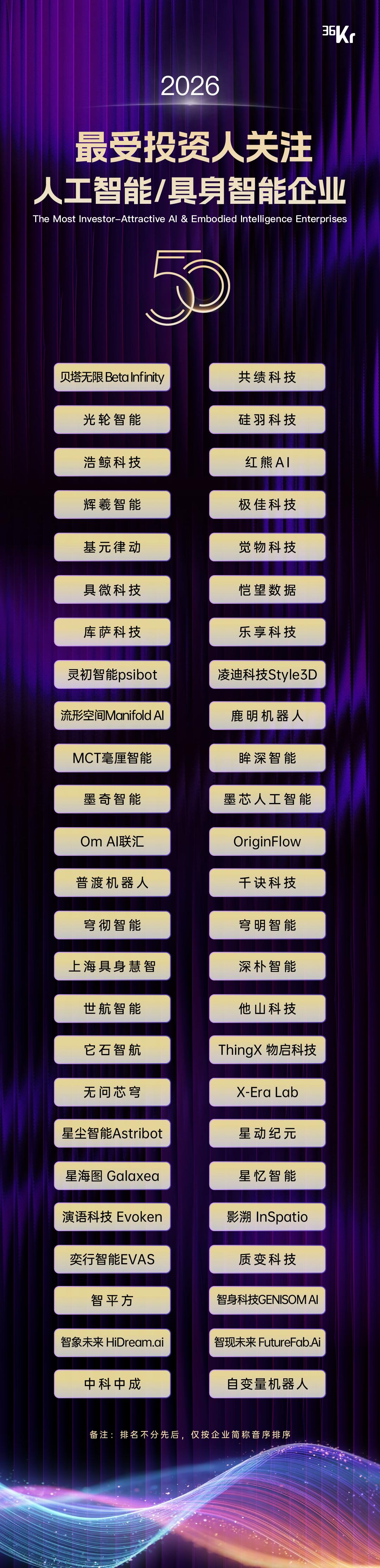
The following is the complete list of the "2026 Top 50 Most Investor-Recognized Artificial Intelligence / Embodied Intelligence Enterprises"
This article is from the WeChat official account "36Kr", and 36Kr publishes it with authorization.