Advertisers have underestimated Xiaohongshu
Recently, a sticker-sharing feature dubbed "Little Green Book" has been pushing WeChat Official Accounts toward a "Xiaohongshu-style" image-text content ecosystem with an almost zero-threshold content format.
Short-form image-text content on Official Accounts? Two years ago, that idea itself would have seemed like a paradox.
For over a decade, this platform has remained the stronghold of in-depth long-form articles. Readers are accustomed to spending 3 to 5 minutes reading thousands of words, while brands are used to placing feed ads within this "serious reading" scenario.
Long-form image-text content defined Official Accounts, and Official Accounts defined long-form image-text content in turn.
But as this unshakable rule begins to loosen, can advertisers' placement logic still remain unchanged?
01 A grossly underestimated traffic entry point
In February 2026, WeChat officially renamed "Image-Text" to "Stickers", set up an independent creation entry in the backend, and placed sticker accounts side by side with video accounts on the work display page.
From adding the "Sticker Account" category entry to the "Search" function, placing it alongside core products such as Video Accounts and Mini Programs, to significantly increasing the proportion of sticker content recommendations in the "Top Stories" feed, and finally launching a dedicated tab on the Official Account homepage, stickers have been elevated to a strategic-level content format by WeChat.
Official data shows that among the first batch of sticker creators who activated the ad monetization feature, the average view count of sticker content is 3-5 times higher than that of traditional Official Account image-text posts, and user dwell time has increased by 40%.
What deserves more attention is the deep penetration of this entry point. Open WeChat, and sticker content has spread to almost every corner: scrolling down the collapsed service account message page shows nothing but stickers; stickers are interspersed in Official Account article recommendations; in the "Top Stories" feed, users are highly likely to encounter a sticker post every 2-3 swipes; even the "Me" page is guiding users to "Post a Sticker".
WeChat has begun to unleash the traffic of its 1.432 billion monthly active users in this single direction. However, most advertisers still perceive this change as nothing more than a "photo-posting feature".
02 Why spending 1 million on impressions is less effective than spending 100,000 on content
Traditional brand marketing placement logic in the WeChat ecosystem has long relied on two paths: feed ads on long-form Official Account posts, and Moments ads. The common trait of these two paths is strong reach but weak content.
Advertisers are used to the exposure logic of "pay once, get once": buying ad slots on Official Accounts and purchasing impressions in Moments. As for whether the content itself can spread organically, get algorithmically recommended, or generate long-tail effects sustainably, these factors, while not entirely unimportant, are not their primary consideration.
But the logic of stickers is completely different.
Stickers adopt a "publish" mode instead of the "mass send" mode, which does not consume the limited mass-send quota. However, the system will not actively push stickers to followers, and their traffic mainly comes from platform algorithm recommendations. This means the number of sticker impressions has relatively low correlation with follower count. Even with very few or zero followers, creators can still get considerable recommended traffic as long as their content quality is recognized by the platform.
For advertisers, this is precisely the biggest cognitive barrier.
The logic of traditional advertising is "traffic buying", which means paying for impressions. The logic of stickers is "content wins recommendations", earning algorithm favor through high-quality content. The former is certain, controllable, and calculable; the latter is uncertain, requires content capabilities, and demands time accumulation.
Most advertisers are unwilling to pay for "uncertainty". They would rather spend 1 million on guaranteed impressions than invest 100,000 to test a content system that could bring excess returns.
This is exactly the biggest underestimation advertisers have about Little Green Book: they are still applying old placement logic to understand a brand-new content ecosystem.
03 The value of stickers lies not in "volume", but in the "conversion path"
If you only regard stickers as a "content format with cheaper traffic", it really is not worth making a big fuss about.
But the real value of stickers is that they fill the long-missing middle layer of the WeChat ecosystem.
WeChat's past content ecosystem was dumbbell-shaped: one end was long-form articles of 3,000 to 5,000 words, the other end was 15-second short videos. There was no lightweight, visual content format suitable for fragmented consumption in between.
Stickers are exactly this missing middle layer. A few images paired with a few hundred words, readable in seconds, fit for fragmented time, perfect for visual expression, friendly to algorithm recommendations, and fill the gap between long-form image-text content and short videos.
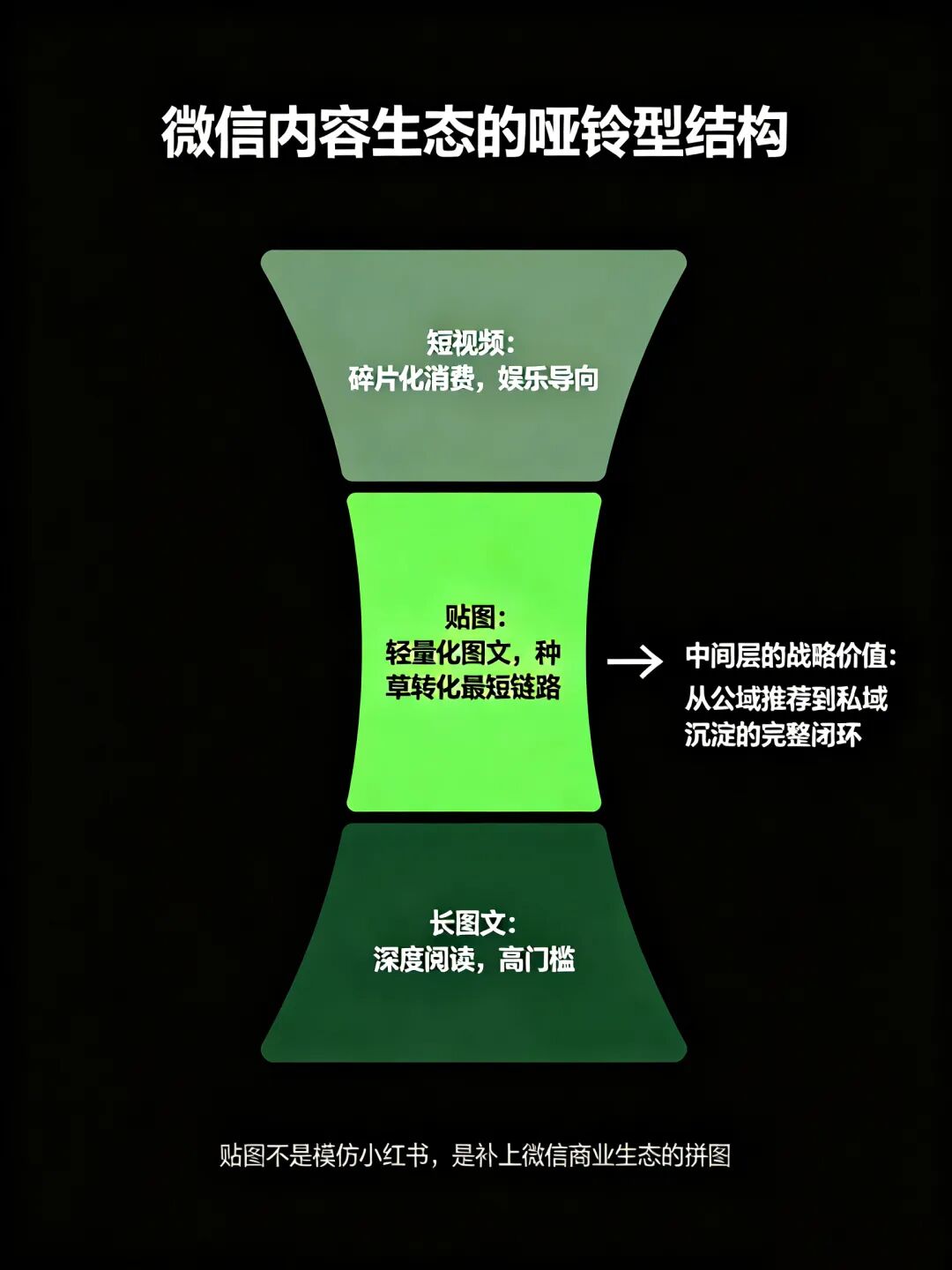
For brands, the strategic value of this middle layer is: it is the shortest path from "interest cultivation" to "conversion".
In sticker posts, brands can directly attach product links, allowing users to click the image to make a purchase instantly; they can guide users to follow service accounts, join communities, or add corporate WeChat accounts; they can insert links to past articles and the Video Account homepage; they can realize a complete closed loop from public domain recommendation to private domain retention.
A Xiaohongshu note may spark users' interest, but to complete the purchase, users may need to exit the app, open an e-commerce platform, search for the product, compare prices, and place an order. Every step brings a risk of user churn.
With stickers, from content exposure to product purchase, the entire process is completed within the WeChat ecosystem. Between discovering a product and making a purchase, there are no redirects, no exits.
This is the most compelling advantage of stickers for advertisers: it is not that traffic is cheap, but that the conversion path is extremely short.
04 Why the perfect time to enter the market is now
The dividend period of any platform has a window. The window for stickers is opening, but it will not stay open forever.
First, traffic tilting is underway, but it has not been fully released yet. WeChat is using full-link resource slots to divert traffic to stickers, and this level of strategic support will not last long. Once the sticker ecosystem matures and content supply is sufficient, the platform's recommendation weight will tend to be balanced, and the traffic dividend for early entrants will disappear.
Second, user habits are being formed, but not yet solidified. The recommendation frequency of sticker content in "Top Stories" is increasing, and users' habit of "scrolling" image-text content on WeChat is being cultivated. Whoever captures users' mindshare at this stage will continue to benefit after these habits are fully established.
Third, commercial infrastructure is being improved, but it is not yet saturated. Conversion functions such as WeChat Mini Shop, product link attachment, and live stream appointment are being completed, and the ad monetization feature has been fully opened. At present, the supply of sticker content is not saturated, and competition is far from white-hot.
But the dividend period will not last forever. When more and more brands realize the value of stickers and flood into this track, traffic costs will inevitably rise, and content competition will inevitably intensify.
05 Little Green Book tests not your budget, but your content comprehension
Little Green Book does not test the size of advertisers' budgets, but their way of understanding "content".
In traditional advertising thinking, content is a carrier, and channels are the delivery paths. Brands create content and distribute it through channels. Content and channels are separated.
But in the logic of stickers, content itself is the channel. A high-quality sticker post does not need to pay for impressions, as the algorithm will push it to interested users; it does not need to pay to build trust, as authentic content will naturally gain user recognition; it does not need to pay for conversions, as the built-in product link allows transactions to happen immediately after content consumption.
An amateur creator with very few followers can get traffic tilting as long as their content is authentic and valuable, and this logic of traffic equality also applies to brands. Brands no longer need to accumulate hundreds of thousands of followers to get effective exposure as in the past; a single high-quality sticker post can bring far more organic traffic than expected.
This is exactly the opportunity that brands relying on "big account placement + hard-sell ad impressions" are most likely to miss. They are still using the "traffic buying" mindset for marketing, while stickers reward "content capability", testing brands' insight into users, aesthetic sense of content, and understanding of algorithms.
06 After a decade of advocating "integrated brand and performance marketing", WeChat Stickers may be the closest answer
Many people interpret the emergence of stickers as WeChat's imitation of Xiaohongshu, a defensive product patch.
This is the biggest misreading of WeChat's strategic intent.
Over the past decade, Official Accounts have always been a content position centered on long-form image-text content. The problem with long-form articles is not poor content quality, but the high consumption threshold: reading an article of 3,000 to 5,000 words requires significant time cost.
As users' time becomes increasingly fragmented, the reachable audience of long-form content keeps shrinking.
The essence of stickers is that WeChat has found a content format that can support a commercial closed loop between long-form image-text content and short videos.
This opening brings back light content consumers who were previously blocked by long-form articles, attracts creators who were unwilling to invest energy in Official Accounts, and completes the missing interest cultivation link in WeChat's commercial ecosystem.
WeChat has no shortage of transaction scenarios, user duration, or social connections. What it lacks is a medium that allows content to flow lightly. Therefore, stickers are not an imitation of Xiaohongshu, but a crucial puzzle piece of WeChat's commercial ecosystem.
Xiaohongshu has verified the feasibility of "image-text interest cultivation + community trust". What WeChat will do is to replicate this success within its own ecosystem, leveraging its strengths in social distribution and private domain retention.
Moreover, this may be the closest brands have ever gotten to "integrated brand and performance marketing" in the past ten years.
Advertisers, it is time to re-recognize Little Green Book.
This article is from WeChat Official Account "Jiafang Finance" (ID: jiafangcaijing2019), written by Deep Thinker, and authorized for release by 36Kr.