Qianwen Lands on Apple: Has Alibaba's "Mercury Retrograde" Finally Come to an End?
The capital market's sense of smell often catches changes earlier. Over the past week, Alibaba's stock has surged with expanded trading volume twice: on July 8, after the performance outlook was leaked, its Hong Kong-listed shares rose by more than 12% in a single day; on July 15, the other shoe dropped — after two years of compliance marathons and behind-the-scenes technical battles, the Cyberspace Administration of China included Apple's "Apple Intelligence" in the filing list of generative AI services. This means that the China-market version of Apple Intelligence has obtained the access ticket to the Chinese market.
Alibaba confirmed on the same day that Qwen will be integrated into Apple Intelligence as an AI capability, bringing intelligent experiences to users of iOS, iPadOS, macOS and visionOS in China. Users can directly experience Qwen's capabilities such as text and image understanding, and content generation on Apple devices without switching between apps.
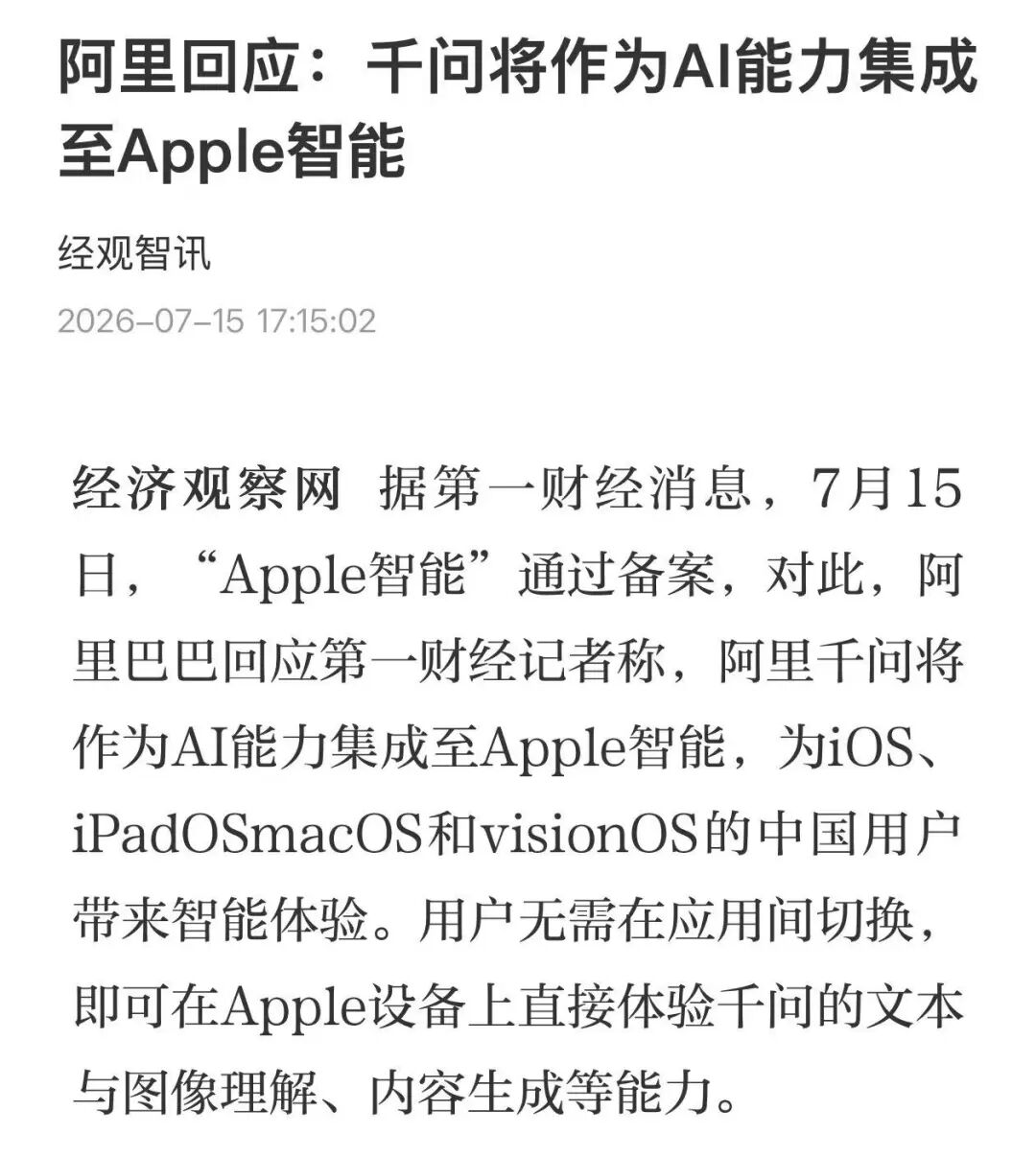
The long-suppressed market sentiment was ignited. On the day the news was released, Alibaba's US-listed shares once rose by more than 6% in pre-market trading; the next day, its Hong Kong-listed shares once followed to rise by more than 5% in early trading, then fluctuated at a high level, with some short-term funds taking profits. Two pulse surges plus one round of profit-taking indicate that the money driven by sentiment has been earned, and the real divergence in the market is shifting from "whether the story is true" to "whether the performance can support it".
For a long time, the global capital market has been accustomed to measuring Alibaba's value with a single and cruel indicator: e-commerce GMV. When the consumer cycle fluctuates and industry competition intensifies, this valuation system has become a heavy yoke.
But this time, the market logic has changed.
Qwen's integration into Apple is more like a "seal of approval" issued by the world's most demanding tech giant — proving to the market that Alibaba has substantially transformed into a technology company capable of providing core infrastructure for the world's top smart hardware.
From the acceleration of cloud business performance to the continuous rise of stock price, a question that has lingered in investors' minds for nearly a year has begun to have a clear direction: Has Alibaba's "downturn" ended?
Not a multiple-choice question, but the only solution
In the entire tech consumer electronics industry, Apple's requirements for privacy protection, on-device operation adaptation and supplier stability are recognized as the most stringent level.
Before this cooperation was reached, Apple went through a long period of evaluation and trial and error. Since 2024, Apple has been looking for local AI partners in the Chinese market, and has conducted intensive closed-door evaluations of many leading model manufacturers. To stably meet the system-level inference standards under the extremely lightweight deployment conditions on mobile terminals, while withstanding the layers of scrutiny on privacy architecture, engineering response and long-term service capabilities, the threshold is far higher than the outside world imagines.
What Apple needs is an AI hub that can run stably for a long time in system-level scenarios. Under the extremely strict screening conditions, Alibaba Qwen finally stood out.
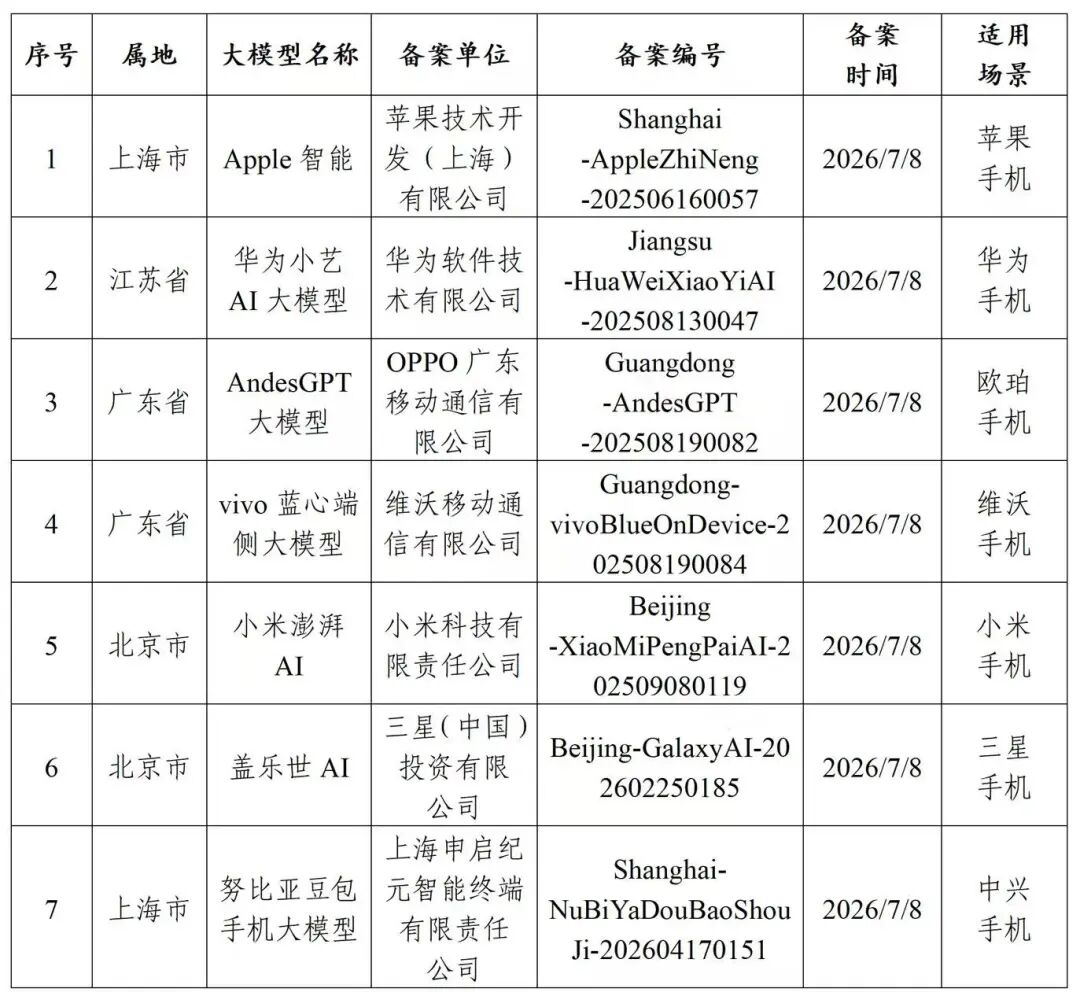
To cross this technical and commercial threshold, three almost irreplaceable conditions need to be met at the same time:
First, the model capabilities must withstand international testing. Alibaba Qwen large model has always had an excellent reputation in overseas developer communities and is one of the most recognized Chinese model series.
Second, it needs to have top-level computing power carrying capacity to handle 100-million-level concurrent connections. With the practical experience accumulated in the Double 11 promotion over the years and the global scheduling of Alibaba Cloud, Alibaba can provide long-term and stable comprehensive computing power guarantees.
Finally, there is the natural complementarity of business forms with the Apple ecosystem. Apple's "device + service" ecosystem has extremely strict technical standards, requiring the system-level AI experience to be pure. This perfectly aligns with Alibaba's strategic goal of exporting technical infrastructure. As for the specific commercial arrangements, neither party has disclosed them — but for Alibaba, the value of this business is never about short-term revenue.
In all of China, only Alibaba can meet these three harsh conditions at the same time.
Cloud and AI are contributing profits
For a long time, the AI business for most tech companies has mostly remained in the stage of "storytelling" in the capital market and huge unfillable investment. But Alibaba's fundamentals have begun to turn before the broader market.
This shift is directly reflected in the financial report data.
In the previous financial report, the year-on-year growth rate of Alibaba Cloud's external commercial revenue has increased to 40%; the latest performance outlook shows that Alibaba Cloud's revenue growth rate in this quarter may further accelerate to around 45%, far exceeding market expectations. On the profit side, thanks to the huge scale effect and refined operation, the EBITA margin (adjusted earnings before interest and tax margin) of the cloud business has steadily increased from the previous 9.1% to the low double digits. At the same time, the traditional Taobao and Tmall basic market remains stable. Taobao Flash Purchase has not lost its share while reducing subsidies, and the loss reduction speed is faster than expected.
More importantly, AI is no longer just an expenditure item — it has truly become the growth engine of Alibaba Cloud. The revenue from Alibaba's AI-related products has achieved triple-digit year-on-year growth for 11 consecutive quarters, and its proportion in the cloud's external revenue has exceeded the 30% mark for the first time.
The cloud and AI "second curve" that has been highly anticipated is truly transforming from a grand narrative to tangible profits on the financial statements.
To accelerate this process, Alibaba has shown strong strategic awareness in organizational structure and commercial pricing. In March 2026, the Alibaba Token Hub (ATH) business group, led by group CEO Wu Yongming, was officially established, integrating the Tongyi Laboratory, MaaS business line, Qwen Division, Wukong Division and AI Innovation Division into a unified command system. This move is aimed at one goal: in the next five years, the annual commercial revenue of cloud and AI, including MaaS (Model as a Service), will exceed 100 billion US dollars.
At the commercial front, Alibaba Cloud Bailian Platform (MaaS) has launched a highly competitive pricing strategy. For enterprise customers, the platform provides a step-by-step package deduction plan covering more than 150 models such as Qwen3.6-Plus and Qwen3.7-Max; for large development teams, it has launched the "Token Plan Shared Usage Package Mechanism", supporting multi-tenant isolation and cross-seat shared deduction. This refined cost accounting tool effectively eases enterprises' concerns about the loss of control of AI invocation costs, and directly catalyzes the scale explosion of commercial revenue.
Three hidden cards to end the downturn
The AI large model track changes extremely fast. The benchmarking champion of yesterday may be surpassed by a new star in the open source community three months later. But after the glitz fades, the end game of large model competition essentially still depends on the underlying resource investment, computing power infrastructure and engineering efficiency.
This is precisely the long-distance running game that Alibaba is best at. Whether Alibaba's "downturn" is over should not only depend on the short-term sentiment release of the capital market. Three core clues that reshape the long-term logic are more critical:
First, the confidence brought by computing power infrastructure.
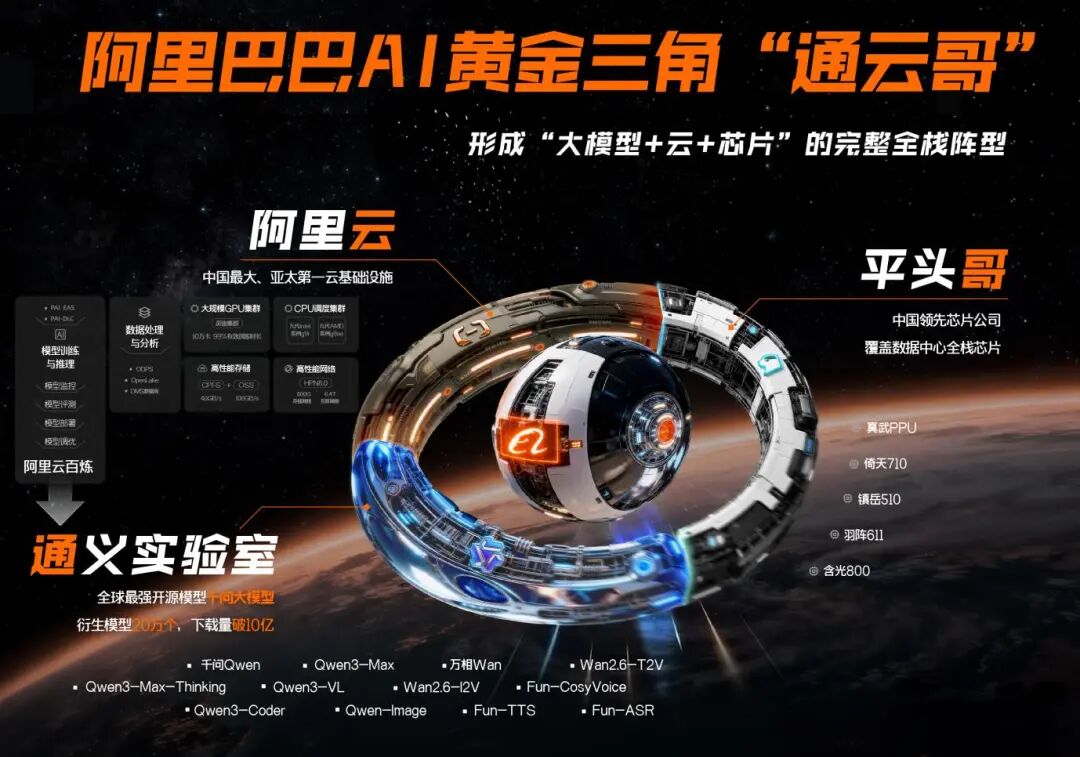
From a macro cycle perspective, the computing power shortage brought by the AI wave is by no means a short-term fluctuation. Computing power is not only a cost center, but also a strategic lifeline that matters survival. Facing the uncertainty of the global high-end GPU supply chain, Alibaba not only has the largest cloud infrastructure network in China, but also has built a moat in the underlying chips early on.
The high-end AI chip (PPU) Zhenwu series independently developed by T-Head adopts the GPGPU (General-Purpose Parallel Computing Architecture) path, realizing the full-stack self-developed parallel architecture and inter-chip interconnection technology. It has been widely deployed on the Alibaba Cloud public cloud platform and serves a large number of external commercial customers.
Second, the certainty of staying at the center of the game.
It is not difficult to take the lead in the short term, but it is difficult to always stay at the forefront. With more than ten years of strategic investment and the extreme open source of Qwen's full-size models from 0.5B to 235B, Alibaba has established an unshakable ecological discourse power.
Qwen may not top every single test, but its profound technical heritage ensures that it can always stand at the most core table of the industry. This anti-cyclical certainty is precisely the asset that the capital market particularly values after the AI craze.
Third, the "super dual flywheel" under the water.
This is the most easily underestimated clue of Alibaba at present. Alibaba also has a trump card in the B-end — DingTalk. DingTalk is integrated into the underlying capabilities with 800 million users and tens of millions of enterprise organizations. When the B-end commercial transformation of DingTalk's tens of millions of enterprise user assets starts at the same time, Qwen has essentially controlled the world's highest-quality two-way data entry. The tight engagement of these two flywheels may bring a new round of momentum to Alibaba.
Of course, Apple has provided a window period for pioneers, and Qwen needs to maintain this position with continuous iteration speed. But putting the computing power base, model certainty and dual-terminal entrance together, what Alibaba is ushering in this round is not just a valuation repair, but a reconstruction of the growth logic.
The downturn cycle has begun to shift. The only remaining question is: how much of a splash these cards can make.
This article is from the WeChat Official Account "Economic Observer", author: Zhang Qi, published with authorization from 36Kr.